Executive Overview
For nearly two decades, the Canadian electronic music duo Zeds Dead—comprising Zachary Rapp-Rovan (Hooks) and Dylan Mamid (DC)—has operated as both a forward-thinking bass music powerhouse and an obsessive cultural preservation society. Named after a memorable line from Quentin Tarantino’s breakout 1994 masterpiece, Pulp Fiction, the project has continuously bridged the gap between underground sound system culture and cinematic legacy.
As they wrap up their monumental Journey of a Lifetime tour—a massive trek that filled legendary spaces like Factory Town in Miami, Forest Hills Stadium in New York, and culminated in two sold-out nights at Grand Park in Los Angeles—Zeds Dead are preparing to step away from the relentless touring cycle. This hiatus is not merely a break from the road; it represents a calculated retreat back into the studio to pursue unbridled, uncommercialized creativity.
Speaking backstage just moments before their final Los Angeles performance, Rapp-Rovan and Mamid opened up about their enduring relationship with audio-visual sampling, the philosophy of curating cultural history on modern sound systems, and why generative artificial intelligence poses an existential threat to the human dialogue embedded within music. Their critique of modern tech cuts deep: while traditional sampling is an act of historical reverence and artistic collaboration with the past, AI generation, in their view, strips the soul away from the craft, threatening to replace human connection with sterile, algorithmically averaged facsimiles.
Detailed Chronology: Two Decades of Sonic Evolution
The lineage of Zeds Dead is deeply intertwined with the shifting paradigms of digital music distribution, blog-era hype, and the evolution of North American bass music.
The Formative Years and the Birth of "Bassmentality" (2006–2009)
Long before headlining major international festivals, Rapp-Rovan and Mamid were immersed in the foundational ecosystems of hip-hop production and sample-delving. Their early work relied heavily on the time-honored hip-hop tradition of crate-digging—unearthing forgotten cinematic cues, rare vocal takes, and obscure breaks to inject a gritty, organic atmosphere into their electronic compositions.
In 2009, operating out of their native Toronto, the duo launched Bassmentality, a weekly party series that laid the groundwork for the modern North American dubstep and bass scene. This grassroots initiative was built on a curatorial ethos that mirrored a hip-hop DJ set: genre boundaries were fluid, blending heavy basslines with classic soul, hip-hop, and indie rock aesthetics.
The Breakthrough and Crossover Wave (2010–2018)
Zeds Dead quickly transitioned from local torchbearers to international heavyweights. Their 2007 bootleg remix of Blue Foundation’s Eyes on Fire became a viral juggernaut, bridging the gap between indie electronica and heavy festival bass. Throughout the 2010s, they cemented their reputation with a string of boundary-pushing EPs, cinematic originals, and high-profile remixes.
A hallmark of their production style has always been an unabashed celebration of their source material. Whether pulling vocal snippets from vintage blues records or constructing heavy beats around classic cinematic dialogue, they never obscured their influences; they amplified them.
The Audiovisual Era and the Journey of a Lifetime (2020–2026)
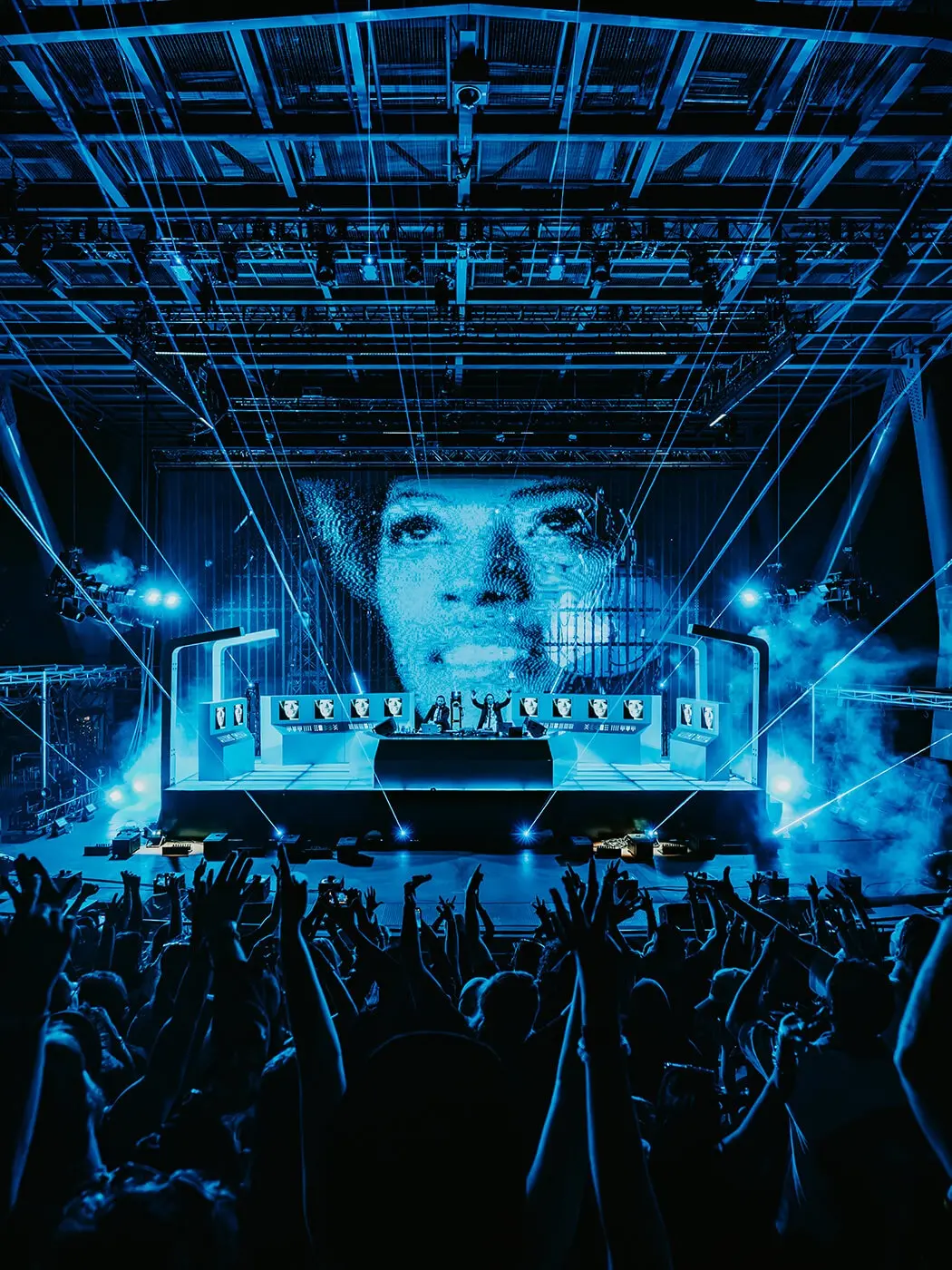
Over the past five years, Zeds Dead methodically built an immersive visual apparatus to accompany their live performances. Recognizing that modern electronic music often lacks a tangible connection to performance history, they paired their heavy-hitting bass tracks with synchronized archival footage and classic music videos.
This culminated in their ambitious Journey of a Lifetime project, supported by a pair of thematic album conceptualizations—Return to the Spectrum of Intergalactic Happiness (2025) and Return to the Return (2026). These projects utilized diverse samples ranging from Duke Ellington and Norma Jean Wright to dialogue from cinematic staples like Scarface and Blue Velvet.
The tour brought this audiovisual thesis to its absolute pinnacle, packing massive outdoor spaces and historic amphitheaters before arriving at its emotional terminus in Los Angeles.
Supporting Context & Metrics: The Mechanics of Archival Sampling
To truly understand Zeds Dead, one must look at how they approach the recording studio. Unlike producers who scrub samples clean or bury them beneath layers of digital processing to avoid clearance issues, Rapp-Rovan and Mamid treat samples as structural pillars of emotional resonance.

The "Magic of the Room"
"When you sample a record, you sample the magic of that room," Rapp-Rovan explains. "There are things that you can bring out in someone playing the piano that are only in that one recording."
This philosophy elevates sampling from mere borrowing to a form of archeological curation. When the duo crafted their fan-favorite track Sweet Memories, they built a driving, epic electronic beat around a visual and vocal sample of Ann Peebles singing her 1973 soul classic, I Can’t Stand the Rain. By projecting live archival footage of Peebles during their live sets, they avoided treating the sample as a disposable loop; instead, they framed it as a collaborative performance across decades.
Similarly, tracks like Bad Guy drew inspiration not from a calculated desire to educate listeners on Brian De Palma’s Scarface, but from an intuitive need to capture a specific atmospheric tension. "The song felt like it needed some coked-up Miami energy," Mamid notes.
Tour Scale and Production Metrics
The Journey of a Lifetime tour represents a massive logistical and creative undertaking:
- Ticket Sales: Hundreds of thousands of tickets sold globally across prominent outdoor venues and historical spaces.
- Key Stops: Factory Town (Miami), Forest Hills Stadium (New York), and a two-night sold-out grand finale at Grand Park (Los Angeles).
- Visual Integration: Five years of iterative development went into syncing real-time archival footage, historical television broadcasts, and classic film cuts with live bass music production.
Official Statements: The Interview Transcript
Minutes before taking the stage for their final Los Angeles show, Zachary Rapp-Rovan and Dylan Mamid sat down to discuss the culmination of their tour, the philosophy of curation, and their stark warnings regarding generative artificial intelligence.
How does it feel for the Journey of a Lifetime tour to be coming to a close?
Zachary Rapp-Rovan: It’s been an amazing tour. The venues have been insane. Every night we walk out on stage, and we can’t believe how many people are there.
Dylan Mamid: We’ve been building this visual component to our show for the last five years. Being able to do these venues, we took the opportunity to see this vision to its pinnacle.
Your show involves unabashed audiovisual sampling. You’re not hiding the source material; you’re highlighting and celebrating it. What are your thoughts on that kind of sampling in the AI age?
Zachary Rapp-Rovan: Where I’m at now, the interest is more in the history. AI has no history. It’s an average of things that sound similar. I can’t speak for where my interest might go, but I know for sure people will sample stuff that’s from AI.
Dylan Mamid: I’m sure they already are.
Zachary Rapp-Rovan: There are some moral and ethical dilemmas there. Much like with sampling, people were very against it, but it was an art. I’m sure there is art in AI. But where I’m standing right now, I’m seeing it as something that could be catastrophic to the thing that I love, which is searching for some kind of connection with something bigger than myself. The idea that it can be done on a computer in a few seconds by someone who’s never put any effort into making music… something about it seems very "Not why I got into music."

Dylan Mamid: I haven’t engaged with it very much either. I’ve tried out the tools just to see what they were like, and it tends to be sort of weird. It creeps me out when I see what it comes back with.
Zachary Rapp-Rovan: I’m totally into some of the AI tools like stem separation and voice changing. But the idea that, out of the box, you can be making stuff on the same level as someone who’s been doing it for a long time, it does seem more bad than good at the moment.
Generative AI, to a certain degree, is the same as sampling. You’re drawing from models developed based on music that existed before, then using a tool to rework that material into something else.
Dylan Mamid: It’s like hyper-sampling.
Zachary Rapp-Rovan: There’s something legit in a way because it is human work. The basis of it all is something that really happened.
Dylan Mamid: You’re in dialogue with humanity. You’re not in dialogue with some unknown being.
Zachary Rapp-Rovan: In the same way that the thing might be giving seven fingers—I know it’s not like that anymore—on a microscopic level in sound, there might be some weird artifacts there that are totally…
Dylan Mamid: Demonic.
Zachary Rapp-Rovan: You might be injecting some evil into your songs.
The difference, it seems, is the intention. You guys are approaching samples to explore history.
Dylan Mamid: It’s in support of human culture. Not denigrating it.
How do you feel about your technique exposing new movies, TV shows, and games to your audience?

Zachary Rapp-Rovan: The context you hear movie samples in a song, you might have no idea where it came from or no interest, and it does what it’s supposed to do. It gives a feeling or makes you think about the words that person is saying. Then there’s the extra element of when you see it that might give it more context and appreciation. But it’s not always about looking for where the sample came from, although that is interesting. Sometimes it’s the end product that you’re trying to achieve.
In our show, we’ve done a lot of things where you see what the sample is. Certain times, when you see the singer, it adds this dimension that gives a certain emotional weight. But the video has to be right. Our videos are very precise. It’s a look we’re going for. Almost like making a movie. Plenty of samples don’t have good videos. It doesn’t give that emotion.
Why now to take a hiatus away from the project?
Zachary Rapp-Rovan: It’s always a push and pull with being on the road and making music. The show takes up a lot of creative headspace. It’s amazing, and we love that. But we also love being in the studio and making stuff that might not be dance music or influenced by the show. But we end up having to split the time so much between thinking about what we’re going to play. We always wondered what it would be like if we focused on unbridled creativity.
Dylan Mamid: We’ve been touring pretty steadily for quite a while. It’s just giving space to be creative in a different way.
Zachary Rapp-Rovan: Doing all the shows and making all the music makes it difficult to think about anything else. We need time where we aren’t doing anything for a while before we come out of that with a great idea.
Future Outlook: The Road Ahead and Unbridled Creativity
As Zeds Dead transitions away from the demanding rhythm of continuous touring, the electronic music landscape faces a transitional moment. For nearly twenty years, Rapp-Rovan and Mamid have served as cultural anchors, proving that heavy bass music and deep historical reverence are not mutually exclusive.
Their vehement rejection of uncritical generative AI underscores a broader artistic anxiety: the fear that synthetic generation will replace the messy, emotional, and historically grounded dialogue between living artists and their predecessors. By defining their sample-based approach as a conversation with human culture rather than an automated statistical average, they have staked out a principled defense of authentic musicianship.
When Zeds Dead finally re-emerges from their studio hiatus, the electronic music world will be watching closely. Unburdened by the logistical pressures of audiovisual festival spectaculars and stadium tours, the duo is poised to explore new sonic territories—reminding us all that true creative breakthroughs often require stepping away from the stage to rediscover the magic hidden in the room.