Executive Overview
In an era where African popular music is recalibrating global pop charts, Lagos-born singer-songwriter Solana—born Busola Ogunlana—has emerged as one of the most distinctive and subversive voices originating from West Africa. Bridging traditional Yoruba heritage with an eclectic sonic palette spanning synth-pop, rock production, 1980s dancefloor energy, and Afrobeats, Solana has spearheaded a movement christened as "YoruPop."
Her breakthrough single, "Okunkun," exploded across social media channels and streaming platforms without a conventional label rollout, earning immediate co-signs from international figures including SZA, Little Simz, Diplo, and Tyla. However, Solana’s path to critical acclaim was not a seamless rise. The track that catapulted her into the global music consciousness was delayed for years due to creative resistance within industry circles, pushing the artist into a period of profound isolation before she reclaimed her creative autonomy.
Now signed to Since ’93, Solana is preparing to release her landmark EP, Girl From The West, on November 13. This comprehensive analysis traces her trajectory from her early mentorship under Mr Eazi’s emPawa Africa initiative to her current standing as a cultural pioneer redefining the boundaries of contemporary African music.
                     SOLANA: ARTISTIC TRAJECTORY

   2020                  2021                2023               2026
 [emPawa Africa] ───> [Early Singles] ───> [Creative Stasis] ───> [Breakthrough & EP]
   Mentorship &        "Far Away" ft.      "Okunkun" written;   "Okunkun" goes viral;
   Launchpad           Joeboy; "Badder"    industry resistance  "Dide" & "O Rí Mi";
                                           & isolation          'Girl From The West'
Detailed Chronology
2020: The emPawa Catalyst and Early Collaborations
Solana’s professional artistic journey gained structural momentum in 2020 when she was selected to join emPawa Africa, the talent incubator founded by Nigerian music executive and artist Mr Eazi. Designed to provide independent African creators with financial backing, mentorship, and distribution infrastructure, emPawa served as a crucial launchpad.
During this foundational period, Solana released her debut single, "Far Away," featuring emPawa alumnus Joeboy. The track stood out for its warm Afrobeats textures, syncopated rhythms, and melodic hooks. The initiative offered Solana a rare operational sanctuary, allowing her to develop her craft without the immediate commercial pressures typical of early-stage label contracts.
2021–2022: Sound Exploration and Iterative Releases
Following her initial exposure, Solana pursued an extended period of sonic experimentation. In 2021, she released "Badder," a track that highlighted her vocal dexterity and growing confidence, followed by the single "On My Way," featuring Nigerian hitmaker Victony.
These early projects established her ability to navigate standard Afrobeats frameworks while subtly integrating non-traditional arrangements. However, behind the scenes, Solana was searching for a broader musical vocabulary—one that extended far beyond the commercial templates prevailing in West African radio at the time.
Early Discography & Key Collaborators:
├── 2020: "Far Away" (feat. Joeboy)
├── 2021: "Badder" (Solo Single)
├── 2021: "On My Way" (feat. Victony)
└── 2023–2026: "Okunkun", "Dide", "O Rí Mi" (Prod. by Killertunes)
2023: Creative Friction and Psychological Isolation
In 2023, Solana composed "Okunkun," a high-energy composition blending Yoruba drum patterns, Afrobeats percussive cores, driving synth-pop basslines, and rock-infused production. Despite its artistic innovation, the track met with strong resistance from industry executives and advisors who viewed its genre-clashing nature as a commercial risk.
The institutional skepticism triggered a severe creative crisis and personal withdrawal. Solana retreated from her social circles and spent months indoors, seeking refuge in solitary pursuits such as gaming, crocheting, jewelry making, and visual arts.
"I put myself in a cage," Solana reflected on this period of withdrawal. "I withdrew from my friends, from everybody. I was always gaming, just staying indoors, keeping to myself."
The turning point occurred when Solana resolved to dismantle the external expectations constraining her output. Questioning her own self-imposed limitations, she made a deliberate decision to release her music on her own terms, embracing the risk of commercial rejection in exchange for absolute artistic freedom.
2026: Organic Virality and the Path to Girl From The West
In early June, Solana posted a teaser snippet of "Okunkun" directly to social media, completely bypassing traditional PR rollouts. The clip achieved immediate viral velocity. Listeners and industry peers reacted to the track’s driving 1980s dancefloor energy and uncompromising Yoruba vocal delivery.
High-profile endorsements quickly followed from global artists such as Little Simz, SZA, Diplo, and Tyla. The viral momentum transformed "Okunkun" from an unreleased, contested demo into a global breakthrough.
Building on this surge, Solana released subsequent singles "Dide"—a punchy, rhythmic anthem—and "O Rí Mi," a darkly romantic, atmospheric track accompanied by a visually striking music video. Together, these singles set the stage for her debut project under major label distribution: the Girl From The West EP, scheduled for release on November 13 via Since ’93.
Supporting Context & Metrics
Deconstructing ‘YoruPop’: Tonal Linguistics as Percussive Architecture
The core of Solana’s identity lies in her pioneer status within "YoruPop"—a sub-genre that fuses the linguistic, tonal, and rhythmic structures of the Yoruba language with global pop and electronic arrangements.

                          YORUPOP ARCHITECTURE

   Linguistic Foundation          Traditional Echoes           Modern Fusion
 ┌──────────────────────┐      ┌────────────────────┐     ┌───────────────────┐
 │ Yoruba Tonal Syntax  │  +   │ Fuji Drums & Jùjú  │  +  │ 80s Synth-Pop &   │
 │ Words act as pitch   │      │ (King Sunny Adé,   │     │ Rock Production   │
 │ and rhythm embellish.│      │ Ebenezer Obey)     │     │ (Killertunes)     │
 └──────────────────────┘      └────────────────────┘     └───────────────────┘
Yoruba is a tonal language where pitch variation alters word meaning. In Solana’s compositions, this linguistic trait allows her vocal phrasing to function dualistically: as narrative lyrics and as an additional layer of rhythm.
- Linguistic Depth: As Solana notes, a single word in Yoruba carries multiple meanings depending on inflection and emotional context, giving her lyrics narrative flexibility.
- Cultural Lineage: Her music incorporates sonic elements from traditional Nigerian Fuji and Jùjú icons—such as King Sunny Adé, Ebenezer Obey, and Lagbaja—blended with Western pop and hip-hop influences like Rihanna and Nicki Minaj.
- Genre Boundary Fluidity: While embracing the YoruPop label as a recognition of her roots, Solana resists rigid genre definitions, viewing the designation as merely one vector of a multi-faceted creative identity.
The Sonic Alchemy of the Killertunes Partnership
A pivotal factor in Solana’s evolving sound is her partnership with acclaimed Nigerian producer Killertunes. Known for his versatility across Afrobeats, pop, and dance genres, Killertunes provides the structural framework for Solana’s vocal experiments.
+-----------------------------------------------------------------------+
|                   SONIC ELEMENTS OF SOLANA'S SOUND                    |
+-----------------------------------+-----------------------------------+
| Rhythm & Drums                    | Electronic & Rock Fusion          |
+-----------------------------------+-----------------------------------+
| • Traditional Yoruba drum kits    | • Retro 1980s synth basslines     |
| • Syncopated Afrobeats percussion | • Distorted rock guitar accents   |
| • Tonal vocal phrasing            | • Avant-garde pop arrangements    |
+-----------------------------------+-----------------------------------+
Their collaborative process relies on heavy experimentation, combining vintage analog synthesizer patches with traditional African percussion. This producer-artist dynamic has allowed Solana to bridge the gap between traditional West African rhythm and modern electronic music.
Visual Identity and Aesthetic Strategy
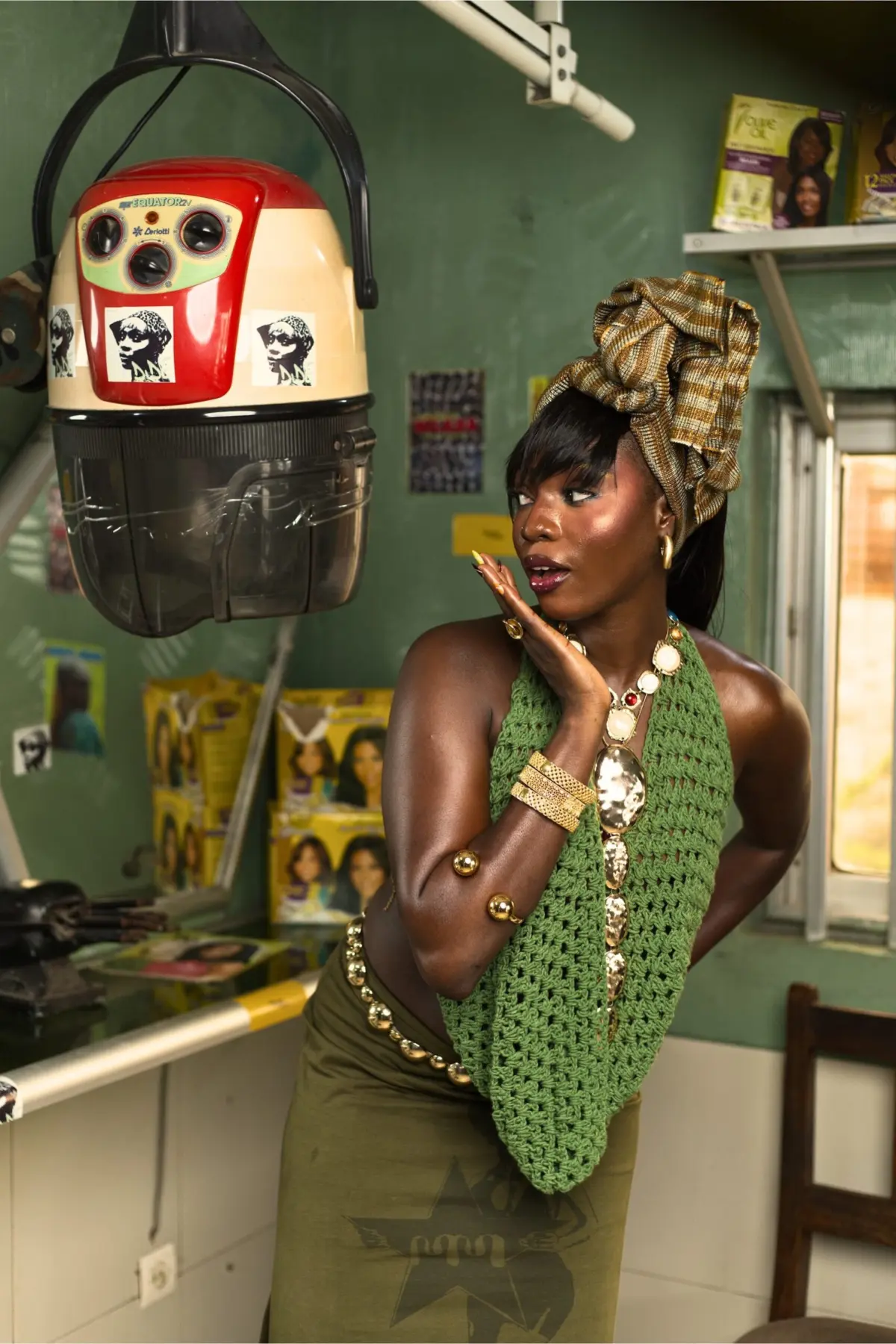
Solana’s visual identity is as deliberate as her music. Her aesthetic pairs vibrant subcultural fashions with traditional West African elements:
- Hairstyling as Art: Her signature hairstyle combines soft yellow roots fading into vibrant orange strands, framed by a block fringe, silky locs styled into a mullet, and intricate orange braids beneath.
- Etymology of the Moniker: Her stage name "Solana" is a blend of her birth names, Busola and Ogunlana, while unexpectedly coinciding with the Spanish word for "sunshine" or "sunny place"—a motif reflected in the bright, neon-yellow artwork of her releases.
- Lagos On-Location Visuals: Rejecting glossy, studio-bound aesthetics, Solana shoots her visualizers and music videos on location across Lagos State—utilizing local markets, street corners, and coastal beaches to ground her music in its origin culture.
Official Statements
Solana’s commentary highlights her artistic shift from institutional compliance to self-determination, while emphasizing her intent to showcase Yoruba culture on global stages.
On Overcoming Industry Resistance and Reclaiming Autonomy
Reflecting on the psychological toll of withholding "Okunkun" due to label and industry hesitation, Solana detailed her shift in perspective:
"I put myself in a cage. I withdrew from my friends, from everybody. I was always gaming, just staying indoors, keeping to myself… Suddenly I was like, ‘Bro, you can do whatever you want. Where’s your free will? Did you sell it?’ I realised that life is beautiful and I’ve got value.
"I finally thought, ‘This is me. Take me as you want to. If you don’t like it, it’s all right.’ I had already made up my mind. [Music is about] expressing yourself, and telling people who have been caged in for so long that there’s a whole world out there. Just look forward. If you fall, get up again."
On the Intricacies of the Yoruba Language
Explaining why she writes predominantly in her native language despite targeting a global audience, Solana highlighted the unique musicality of Yoruba:
"If you’re talking, it can sound like you’re singing… But for people that don’t understand [Yoruba], I’m not even going to lie, I feel you might be slightly cheated. As a songwriter, I’m very intentional about what I’m saying. In Yoruba, a particular word can have different meanings depending on the emotion you are putting to it. It’s a really deep language. You’ll still enjoy the music either way ’cause the sound is beautiful, but if you understand what I’m saying, I think it will give you a whole different experience."
On Cultural Pride and Creative Freedom
Addressing her heritage and her overarching artistic vision, she stated:
"I’m a Yoruba girl. I would really love people to come into my world. African culture is beautiful, and we’re so, so cool… YoruPop is just another part of me. It draws out just one part of my world, ’cause I’m made up of a whole lot.
"I don’t like talking. I’d rather write or sing. I feel like music is the way that I express my emotions… For me, music is a safe space. I can just forget every other damn thing and be in that world. I can be whoever I want to be. I want my music to do that for anybody listening, ’cause that’s what music has done for me."
Future Outlook
The upcoming release of Girl From The West on November 13 via Since ’93 marks a pivotal transition for Solana. Moving from an independent viral sensation to a signed act backed by major distribution, her evolution reflects broader shifts in the global music ecosystem.
                             FUTURE TRAJECTORY

   November 13            Global Positioning             Sub-Genre Legacy
 ┌──────────────┐      ┌──────────────────────┐      ┌──────────────────────┐
 │ EP Release:  │ ───> │ Expanding YoruPop to │ ───> │ Establishing new     │
 │ 'Girl From   │      │ Western markets via  │      │ templates for African│
 │ The West'    │      │ Since '93 imprint.   │      │ alternative artists. │
└──────────────┘ └──────────────────────┘ └──────────────────────┘- Expansion of African Sub-Genres: Solana’s success demonstrates that international audiences are increasingly receptive to specialized African sub-genres beyond standard Afrobeats. YoruPop provides a model for how regional African languages and aesthetics can be integrated with global electronic and pop genres.
- Commercial & Critical Expectations: With high-profile endorsements already established, Girl From The West will test whether Solana’s genre-blending style can achieve sustained commercial success while preserving its alternative identity.
- Template for Artist Autonomy: Solana’s refusal to modify her sound to fit industry trends serves as a case study for young African artists navigating the friction between commercial expectations and authentic expression.
As Girl From The West nears its release, Solana stands at the forefront of a new wave of West African innovators—proving that true crossover success lies not in adapting to global formulas, but in presenting unvarnished local identity to the world.