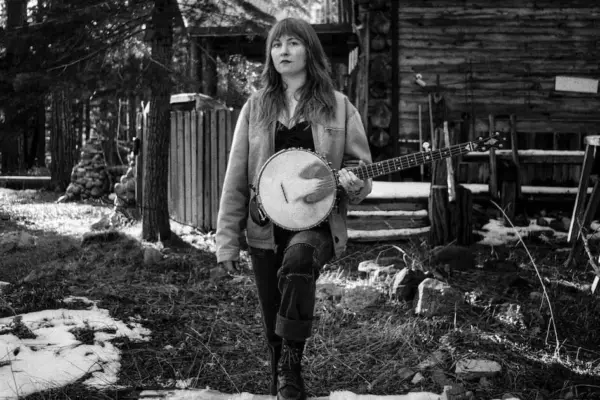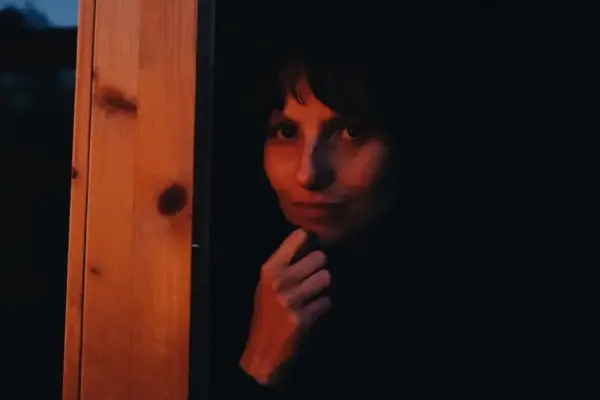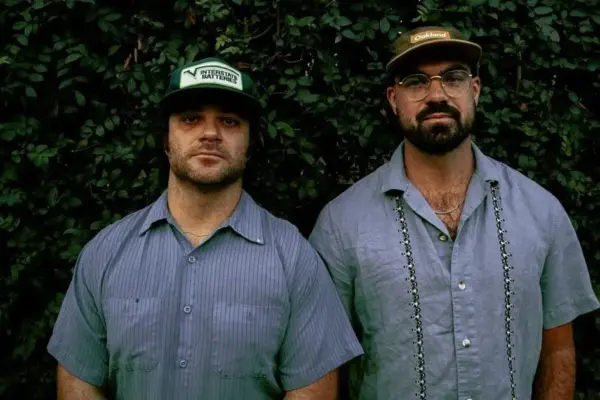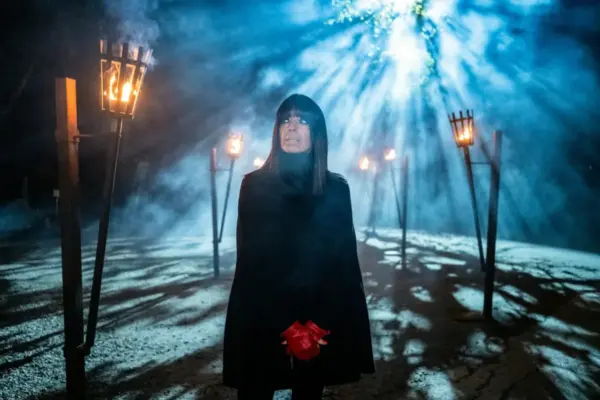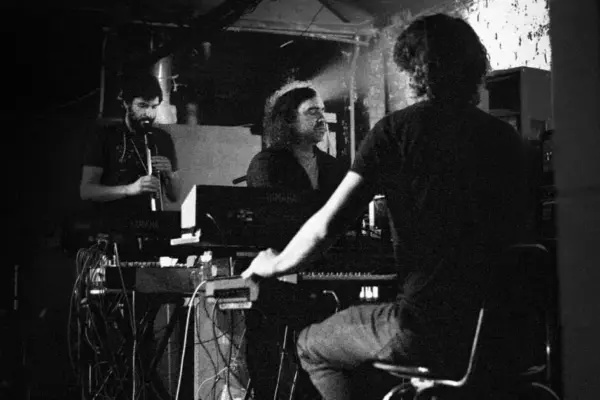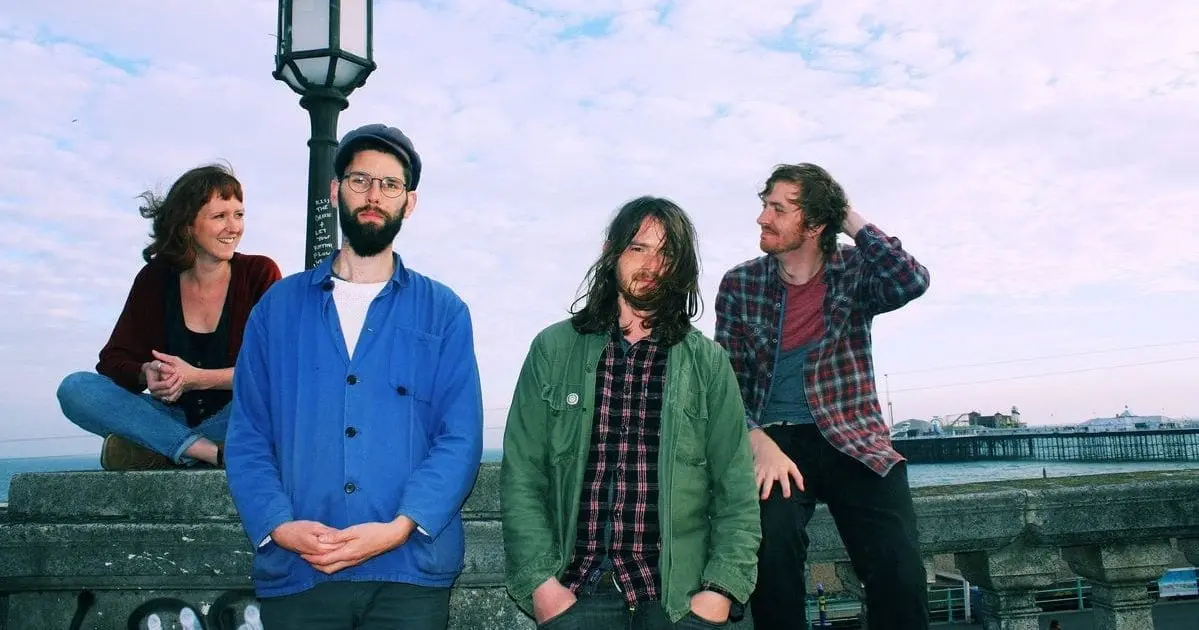
Four albums into a critically lauded and fiercely independent career, the Brighton-based quartet Bird in the Belly continues to defy easy categorization. Comprising Ben “Jinwoo” Webb, Laura Ward, Tom Pryor, and Adam Ronchetti, the band returns with their latest full-length release, Only Dogs as Friends. Released via GF*M Records on October 30, 2026, the record cements the group’s reputation as modern visionaries within the British folk tradition. While undeniably rooted in the structural heavy-hitters of 1970s folk-rock legends like Fairport Convention and Trees, Bird in the Belly refracts these classic influences through a distinctly modern, slightly subversive lens.
Rather than relying on sterile historical preservation, Only Dogs as Friends operates on the premise that music’s grasp on history is fluid, porous, and continuously negotiated between past and present. The Brighton ensemble constructs an alternative folk history, dredging up the forgotten, marginalized, and disenfranchised figures whose lives were ground down by the machinery of their eras. From 14th-century Florentine teenagers executed under draconian sodomy laws to 18th-century "molly house" madams and all-female London crime syndicates, the band’s subject matter is as visceral as it is socially vital.
The album walks a tightrope between grim historical documentation and empathetic storytelling. While some tracks indulge in the ghoulish, strange, and filthy details of genuine villains, others act as piercing laments for the persecuted. By blending traditional arrangements with innovative instrumentation—pairing driving guitars and rhythmic bodhrans with melancholic chamber-folk strings and flutes—Bird in the Belly has delivered a masterclass in contemporary political folk music. In doing so, they have produced an album that feels less like a dusty museum exhibit and more like an urgent dispatch from the margins of history, carrying profound resonance for the socio-political climate of the 21st century.
Detailed Chronology and Track Analysis
The journey through Only Dogs as Friends is a meticulously sequenced tour of society’s underbelly, moving seamlessly from tales of sudden, violent demises to systemic injustices and moments of hard-won empowerment.
From Shoreham to 14th-Century Florence: The Arc of Injustice
The album opens with its brisk, rousing, and darkly comic title track, Only Dogs as Friends. The song recounts the true, grim tale of a Shoreham criminal who was killed during a botched burglary. In a gruesome display typical of early jurisprudence, his nameless corpse was left on public display until his loyal dog finally stepped forward to identify him. Instrumentalists Tom Pryor and Ronchetti provide a stirring, percussive backbone with violin and bodhran, while vocalists Webb and Ward channel the legendary chemistry of classic folk partnerships like Tim Hart and Maddy Prior.
Moving from the macabre to the tragic, Lambs shifts the focus to 14th-century Florence. It tells the story of Giovanni de Giovanni, a teenager executed under increasingly punitive laws targeting sodomy and so-called immoral behavior. Nearly seven hundred years later, against a global backdrop where homosexuality remains criminalized in numerous nation-states, Lambs functions simultaneously as a historical artifact and a poignant protest song. Webb’s vocal delivery—possessing a soft, cracked intensity—is buoyed by a lush, melancholic chamber-folk arrangement that evokes a palpable sense of dreamy, tragic resignation.
The theme of marginalization persists in Go Along Bobby, a loose, highly sympathetic adaptation of the traditional tune widely known as Katie Cruel. Here, the subject is a woman forced into sex work simply to provide for her dying husband. Far from reducing her to a moralistic trope, the band frames her as an unwitting pawn in a larger, crueler system. Webb and Ward combine their voices for a dramatic, emotionally charged performance that stands as one of the album’s dramatic peaks.
This is contrasted by the comparatively sedate Old Holborn, which adopts the perspective of Margaret Clap. Better known as "Mother Clap," she operated an 18th-century "molly house" in London—a clandestine safe haven providing the city’s outlawed gay communities a rare space to congregate, socialize, and find community away from the gallows.
Ghoulish Villains, Literary Echoes, and True Crime
While the aforementioned tracks deal heavily with victims of state and social cruelty, a significant portion of Only Dogs as Friends revels in the genuine villainy of historical figures.
The dark, heavily percussive Hen’s Egg tackles the horrific Victorian practice of "baby farming" through the lens of its most notorious practitioner, mass murderer Amelia Dyer. Eschewing sensationalism, Webb’s lyrics are rich, allusive, and deeply textured, weaving in haunting passages from Charles Kingsley’s classic 1863 novel The Water Babies. Webb utilizes a magpie-like compositional approach that reappears on I Once Built a Boy. That track interpolates Alfred Lord Tennyson’s poem Rizpah to narrate the harrowing true story of a grieving mother who covertly removes her hanged son’s body from the gallows, piece by piece, to reconstruct him at home and afford him a proper Christian burial. Driven by Ward’s clear, plaintive vocal delivery, the song manages to draw out profound human sympathy from a remarkably grim premise.
Ward steps forward to take the lead on 40 Elephants, a brief, deceptively sweet-sounding track detailing the exploits of the real-life all-female London crime syndicate that dominated the capital’s underworld for nearly a century. Meanwhile, When Your Soul Goes Free pairs a driving, modern guitar line with the steady, heartbeat-like thump of a bodhran.
Among the album’s most staggering achievements is Fairweather MacGregor. Here, Tom Pryor adapts a broadside ballad titled The Land of Poyais to recount the devastating true story of hundreds of Scottish pioneers who were duped by a fraudulent confidence trickster into sailing across the Atlantic to settle a lush, prosperous utopian colony that simply did not exist. The song achieves an added layer of poignant irony given that the original ballad was penned by MacGregor himself as part of an aggressive marketing campaign for his fictitious paradise, further elevated by Ward’s mournful, haunting flute work.
The Macabre, the Mythic, and the Empowering Finale
As the record races toward its conclusion, it embraces both folklore and dark humor. Black Annis delivers the album’s most chilling moment. Based on the legendary, hag-like bogeywoman said to haunt the murky lanes of Leicestershire to prey on children and livestock, the track begins as a gentle, melodic arrangement by Pryor before slowly unspooling into something deeply uncanny. Ward’s singing floats above the mix—clear yet frustratingly elusive—possessing a mesmerizing, siren-like quality.
Americana also receives a characteristically dark revisioning in Big Rock Candy Mountain. Stripping away the lighthearted sheen of the version popularized in the Coen brothers’ film O Brother, Where Art Thou?, Bird in the Belly plunges the traditional hobo song back into the bleak economic desperation from which it originally emerged.
The album closes on an unexpected note of triumph with Law of Kissing. A gleeful, energetic retelling of a historical legal dispute, the track celebrates a court ruling in favor of a woman who legally defended herself by biting off the nose of a man who assaulted her. Webb’s lyricism embraces the cheeky, humorous details of the courtroom battle without ever losing sight of its broader moral implications. It provides Only Dogs as Friends with an empowering, resilient conclusion.
Supporting Context & Metrics
Personnel & Creative Lineup
- Ben “Jinwoo” Webb: Lead vocals, lyricist, acoustic arrangements.
- Laura Ward: Lead and harmony vocals, flutes, primary interpretive co-pilot.
- Tom Pryor: String arrangements, violin, broadside adaptations, composition.
- Adam Ronchetti: Percussion, bodhran, rhythmic structuring.
Release Specifications
- Album Only Dogs as Friends
- Release Date: October 30, 2026
- Label: GF*M Records
- Catalog Position: 4th studio album in the band’s discography
Thematic Matrix of Only Dogs as Friends
| Track Title | Historical/Literary Inspiration | Core Theme / Narrative Focus |
|---|---|---|
| Only Dogs as Friends | 19th-Century Shoreham Criminal | Public execution, criminal justice, canine loyalty |
| Lambs | 14th-Century Florence (Giovanni de Giovanni) | Anti-sodomy laws, historical persecution, protest |
| Go Along Bobby | Traditional (Katie Cruel) Adaptation | Economic survival, sex work, female vulnerability |
| Old Holborn | Margaret "Mother Clap" (18th Century) | Queer spaces, underground community, 18th-century London |
| Hen’s Egg | Amelia Dyer / The Water Babies | Victorian baby farming, institutional neglect |
| I Once Built a Boy | Tennyson’s Rizpah | Maternal grief, bodily autonomy, taboo mourning |
| 40 Elephants | The Forty Elephants Crime Syndicate | Female organized crime in Victorian/Edwardian London |
| Fairweather MacGregor | The Land of Poyais Broadside | Colonial fraud, financial exploitation, mass deception |
| Black Annis | Leicestershire Folklore | Mythic monsters, childhood fear, uncanny atmosphere |
| Big Rock Candy Mountain | American Folk Standard | Economic destitution, hobo folklore, dark satire |
| Law of Kissing | Historical Legal Precedent | Self-defense, bodily autonomy, legal empowerment |
Official Statements and Critical Reception
Industry insiders and cultural commentators have already begun weighing in on what many are calling Bird in the Belly’s most cohesive and ambitious artistic statement to date. Speaking on the conceptual underpinnings of the record, primary lyricist Ben Webb noted the intentional blurring of chronological lines:
"History isn’t a straight line written by victors; it’s a patchwork quilt made of discarded rags, broken promises, and silenced voices. When we write about a 14th-century Florentine teenager or an 18th-century brothel keeper, we aren’t looking backward out of mere nostalgia. We are holding up a mirror to the present. The machinery that crushed these people centuries ago—be it penal law, economic coercion, or institutional hypocrisy—is still humming right along today."
Co-vocalist and instrumentalist Laura Ward emphasized the collaborative, sonic lengths the quartet went to in order to ensure the album’s arrangements matched the gravity of its subject matter:
"We didn’t want these stories to feel like homework. They had to breathe, to ache, and occasionally to bite back. Working with Tom [Pryor] and Adam [Ronchetti] on tracks like ‘Black Annis’ and ‘Fairweather MacGregor’ meant finding a sonic space where traditional British folk instruments could sound genuinely dangerous and unpredictable. Folk music has always belonged to the common denominator—the tricksters, the outcasts, and the survivors. That’s where we wanted this record to live."
Early critical notices have echoed these sentiments, highlighting the band’s rare ability to marry academic historical inquiry with visceral, foot-stomping musicianship. Reviewers have universally praised the record’s dynamic sequencing, noting that Only Dogs as Friends manages the delicate feat of lecturing on social justice while remaining fiercely entertaining, melodically rich, and texturally breathtaking.
Future Outlook
As Bird in the Belly prepares to take Only Dogs as Friends on an extensive live touring circuit across the United Kingdom and continental Europe throughout late 2026 and 2027, the band’s trajectory points toward an increasingly influential role in contemporary European roots music.
By refusing to dilute their artistic vision or pander to the sanitizing impulses of mainstream commercial folk, the Brighton quartet has carved out an untouchable niche. Their methodological synthesis of archival research, literary pastiche (drawing from Kingsley, Tennyson, and historic broadsides), and unflinching socio-political commentary establishes a gold standard for modern folk production.
For the contemporary music landscape, Only Dogs as Friends serves as a timely reminder that folk music is, at its core, a living, breathing weapon of the disenfranchised. As long as history continues to marginalize the vulnerable, artists like Bird in the Belly will remain essential—excavating the past not to romanticize it, but to arm the present.