Executive Overview
In the rapidly evolving landscape of music production technology, artificial intelligence has frequently been viewed through a lens of existential anxiety. Concerns over copyright infringement, third-party model training, and the replacement of human creativity with automated "one-click" generation have dominated industry discourse. However, a distinct sub-sector of audio technology is carving out a more collaborative paradigm—one focused on assistive, non-generative tools designed to augment human agency rather than usurp it.
Enter Tamber, a creative suite powered by what its developers term "sonic intelligence." First launched to critical intrigue in May, Tamber has returned with Tamber v2.0, a sweeping, comprehensive expansion of its foundational ecosystem. Dropping hot on the heels of its initial release, version 2.0 introduces native Windows support—bridging a critical gap for PC-based producers—alongside a modular redesign of its core feature set.
Rather than churning out finished songs, AI-generated stems, or recycled sample packs, Tamber positions itself as an intuitive co-pilot. It translates abstract human thoughts, physical gestures, and linguistic prompts into parameters that control traditional virtual instruments and effects. By operating directly alongside existing digital audio workstations (DAWs) and integrating deeply into standard studio workflows, Tamber v2.0 signals a maturing philosophy in music tech: AI as an invisible, highly responsive facilitator of human expression, built strictly on ethical, transparent foundations.
Detailed Chronology: From Debut to the v2.0 Revolution
The trajectory of Tamber has been remarkably swift. When the platform initially debuted in May, it arrived with a bold mandate: to bridge the cognitive gap between abstract musical ideas and technical DAW execution. Built from the ground up to avoid the ethical pitfalls plaguing contemporary generative AI models, Tamber was marketed as an assistive suite—a tool that helps musicians operate their own software and hardware arsenals more fluidly.
Despite the positive reception of the original release, user feedback immediately highlighted areas for optimization. Producers working on PC platforms demanded native Windows compatibility, while session musicians and beatmakers called for tighter integration between Tamber’s distinct software modules. Rather than letting the platform sit stagnant, the development team—spearheaded by founder Zoe Wrenn—embarked on an aggressive development cycle that culminated in the rapid rollout of version 2.0.
The milestone v2.0 update represents more than just a routine bug fix or minor feature addition; it is a structural reimagining of the platform. By breaking down the barriers between Tamber’s individual utilities, the update transforms the suite from a collection of promising experimental tools into a cohesive, streamlined production environment.
The Five Core Pillars of Tamber 2.0
At the heart of Tamber v2.0 is a refined architecture. Its five core tools—Gestures, Tamby, Librarian, City Packs, and Sonic Atlas—now operate as dedicated applications within a single, connected suite. Users can open the exact tool they need on demand, navigating fluidly between them via a unified account system. Here is a granular breakdown of how each tool has evolved in the new update:
1. Gestures: From Experimental Utility to Versatile Instrument
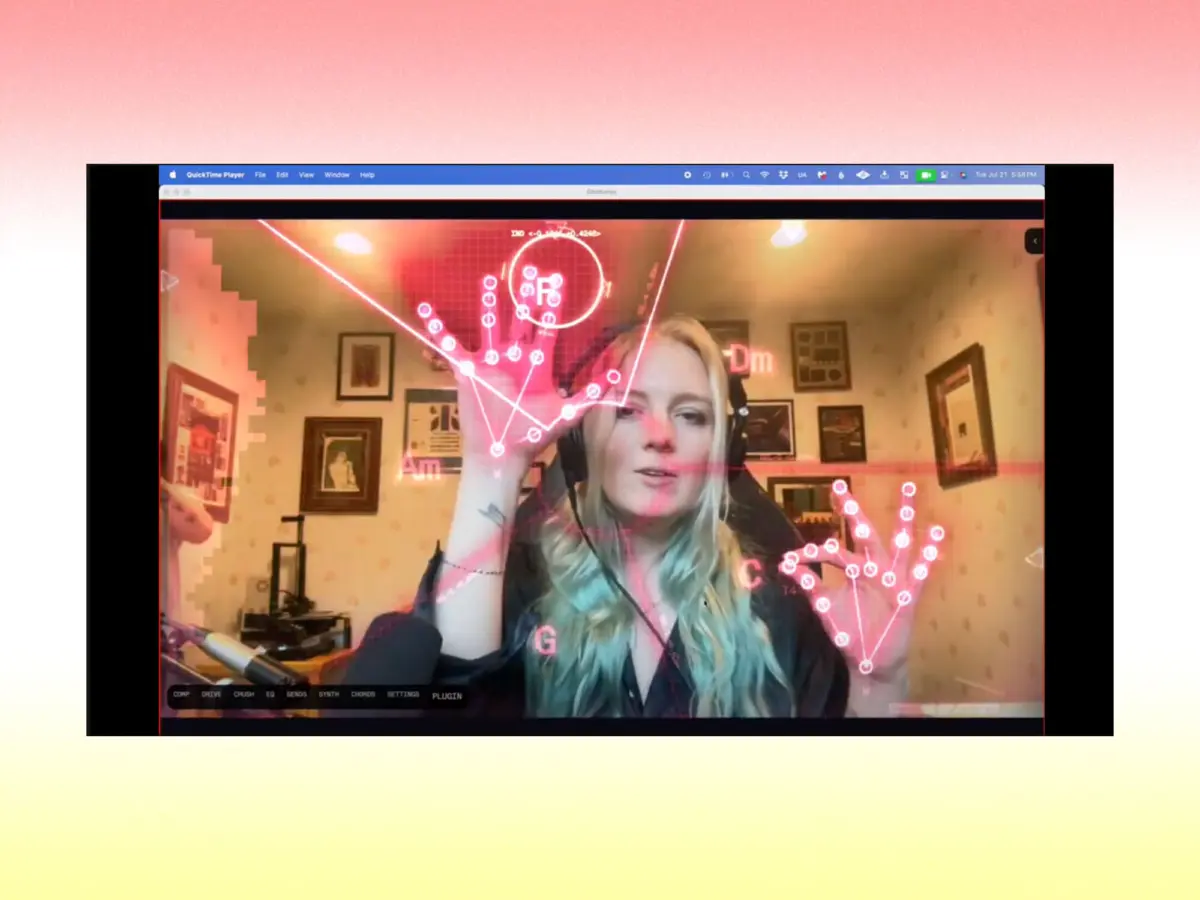
Arguably the most visually striking component of the Tamber ecosystem, Gestures allows creators to control vocal effects, MIDI parameters, and virtual instruments using natural hand movements captured via a standard webcam.
In version 2.0, Gestures makes a massive evolutionary leap. No longer confined to acting merely as a control-data translator, Gestures now functions as both a standalone virtual instrument and a fully fledged VST3/AU plugin. Equipped with new, built-in synth and vocoder engines, users can now play Gestures entirely on its own without even opening a DAW, or drop it directly into a complex session track. Furthermore, architectural optimization has dramatically reduced latency, making hand-tracked performance smooth enough for live stage applications and real-time studio tracking.
2. Tamby: The Unobtrusive In-Session Co-Producer
Interacting with software assistants mid-flow can often disrupt the creative zone. Tamby, Tamber’s conversational in-session co-producer, has been meticulously redesigned to address this friction point.
In v2.0, Tamby appears as an unobtrusive, lightweight overlay that can be summoned instantly whenever inspiration or technical troubleshooting calls for it—without obscuring critical DAW real estate. Additionally, a newly introduced chat history feature preserves previous prompts and actions, allowing producers to retrace their steps, audit past creative decisions, and maintain a seamless narrative through long mixing and arrangement sessions.
3. Librarian: Streamlining Sample and Preset Management
Navigating sprawling hard drives and disorganized sample libraries is one of the most tedious chores in modern music production. Tamber’s Librarian has been rebuilt from the ground up for version 2.0.
A new Mini-Librarian search bar now floats directly over the user’s DAW, enabling lightning-fast queries without breaking focus. This is complemented by newly introduced Favourites and Crates tools, which bring intuitive cataloging, tagging, and organization to producers struggling with digital clutter.
4. City Packs and Sonic Atlas: Expanding Global Audio Discovery
Music production is fundamentally an act of cultural synthesis. Tamber’s Sonic Atlas—a visual discovery application that allows users to explore popular music styles, regional traditions, and sonic textures from different countries, cities, and eras—has been upgraded with a dedicated favourite tool, allowing producers to curate historical and geographical inspirations effortlessly.
Simultaneously, the platform is expanding its City Packs initiative. Comprising meticulously curated collections of original field recordings captured across the globe, Tamber has committed to a continuous release schedule, promising a brand-new City Pack drop every single month to fuel organic, non-synthetic sound design.

Supporting Context & Metrics: The Philosophy of Ethical AI
To truly understand the significance of Tamber v2.0, one must examine the broader socio-technical ecosystem in which it operates. For the past three years, the commercial music industry has been locked in fierce debates regarding the ethics of artificial intelligence. Major record labels, publishing houses, and independent artists have mounted legal and moral challenges against AI companies accused of scraping copyrighted master tracks, compositions, and stems to train black-box generative models.
Tamber has aggressively positioned itself in direct opposition to this extractive model. According to official press releases and technical documentation provided to industry outlets, Tamber does not generate finished songs, complete stems, or AI-synthesized samples. Crucially, the underlying technology has never been trained on third-party audio.
Instead of replacing the human creator, Tamber operates strictly as an assistive bridge. It empowers musicians to better command their own existing toolkits—hardware synthesizers, software plugins, digital audio workstations, and local sample libraries. This non-generative, assistive approach falls under the banner of "sonic intelligence," a philosophy that leverages computational pattern recognition and human-computer interaction design to remove technical barriers, rather than doing the creative heavy lifting for the user.
By ensuring that users maintain absolute ownership over every audio wave generated in their sessions, Tamber sidesteps the copyright minefield entirely. Producers retain 100% control over their intellectual property, utilizing Tamber strictly as an ergonomic accelerant for their personal workflows.
Official Statements and Industry Insights
The release of version 2.0 has been accompanied by candid reflections from the platform’s leadership regarding the development philosophy and the value of direct community engagement.
Zoe Wrenn, founder and visionary behind Tamber, emphasized that the monumental updates packed into version 2.0 were driven almost entirely by direct dialogue with the platform’s early adopter community:
"Almost all of this came from users telling us what they needed," Wrenn stated in an official release. "Gestures is a real instrument now—it has its own synth and vocoder engines, so you can play it on its own with no DAW at all, or load it as a plugin right into your session."
Wrenn also highlighted the profound structural overhaul applied to the software’s interface and utility apps, noting the qualitative leap in the user experience:
"We rebuilt Librarian from the ground up, and Tamby is something you can pull up mid-take without losing your place. I’ve been in my own sessions with it for weeks and it doesn’t feel like an update. It feels like a new product."
The decision to roll out native Windows support alongside these massive functional upgrades also addresses a critical demographic gap. While music technology startups frequently launch Mac-first due to CoreAudio standardization and unified hardware architectures, ignoring the vast global majority of PC-based producers severely caps a platform’s reach. By achieving robust, native Windows optimization in v2.0, Tamber has transformed from a niche macOS experiment into a cross-platform studio contender.
Future Outlook: Where Does Sonic Intelligence Go From Here?
As Tamber v2.0 establishes its footprint across both macOS and Windows systems, the broader implications for the future of music production software are profound. The industry is currently bifurcating into two distinct camps: on one side are the mega-corporations pushing fully generative AI black boxes that promise to write, mix, and master entire tracks from a single text prompt; on the other side are boutique innovators like Tamber, who are doubling down on human-centric, ergonomic enhancement.
The enthusiastic adoption of Tamber’s assistive tools suggests that working musicians—from bedroom DIYers to professional film scorers—are fundamentally skeptical of tools that disintermediate them from the joy of making music. Producers want efficiency, organization, and creative catalysts, but they do not want to surrender the steering wheel to an algorithm.
Looking forward, the roadmap for Tamber appears anchored in continuous, community-driven expansion. With the promise of monthly City Packs ensuring a steady influx of organic, real-world acoustic textures, and the technical flexibility afforded by the newly minted VST3/AU Gestures plugin, the platform is well-positioned to infiltrate diverse production environments—from electronic music studios and film scoring stages to experimental live performance setups.
Ultimately, Tamber v2.0 proves that artificial intelligence in music does not have to be an existential threat. When designed with ethical boundaries, a commitment to local data sovereignty, and a deep respect for human creativity, sonic intelligence can act as a powerful catalyst—expanding what is possible in the studio while keeping the artist firmly at the center of the creative universe.
For further information, technical specifications, and download options for Tamber v2.0, visit the official Tamber website.