Executive Overview
Nearly a millennium after its creation on English soil, the legendary Bayeux Tapestry has returned home. In what cultural historians are already calling a landmark exhibition, the 70-meter masterpiece is currently on display at the British Museum, drawing unprecedented crowds and sparking fresh academic and public fascination. Crafted at the twilight of the 11th century, this staggering feat of medieval embroidery is more than just a historical artifact; it is a chameleon-like cultural icon that has continuously evolved, been co-opted, and reimagined across nearly a thousand years of European history.
While its modern blockbuster run at the British Museum—scheduled to remain on view through July 2027—brings the physical artifact back into the British consciousness, the tapestry’s life extends far beyond its thread and linen origins. From Victorian-era replicas and wartime propaganda to cinematic pop-culture staples and modern political weaponization (including its invocation during the Brexit debate), the Bayeux Tapestry occupies a unique space where art, politics, and collective memory intersect. This comprehensive report examines the deep history of the tapestry, its mysterious origins, its profound impact on modern creative expression, and what its triumphant return tells us about how the past persistently invades the present.
Detailed Chronology: From the 11th Century to the British Museum
To understand the weight of the tapestry’s current exhibition, one must trace a timeline marked by as much ambiguity as historical documentation.
The Late 11th Century: Creation in Anglo-Saxon England
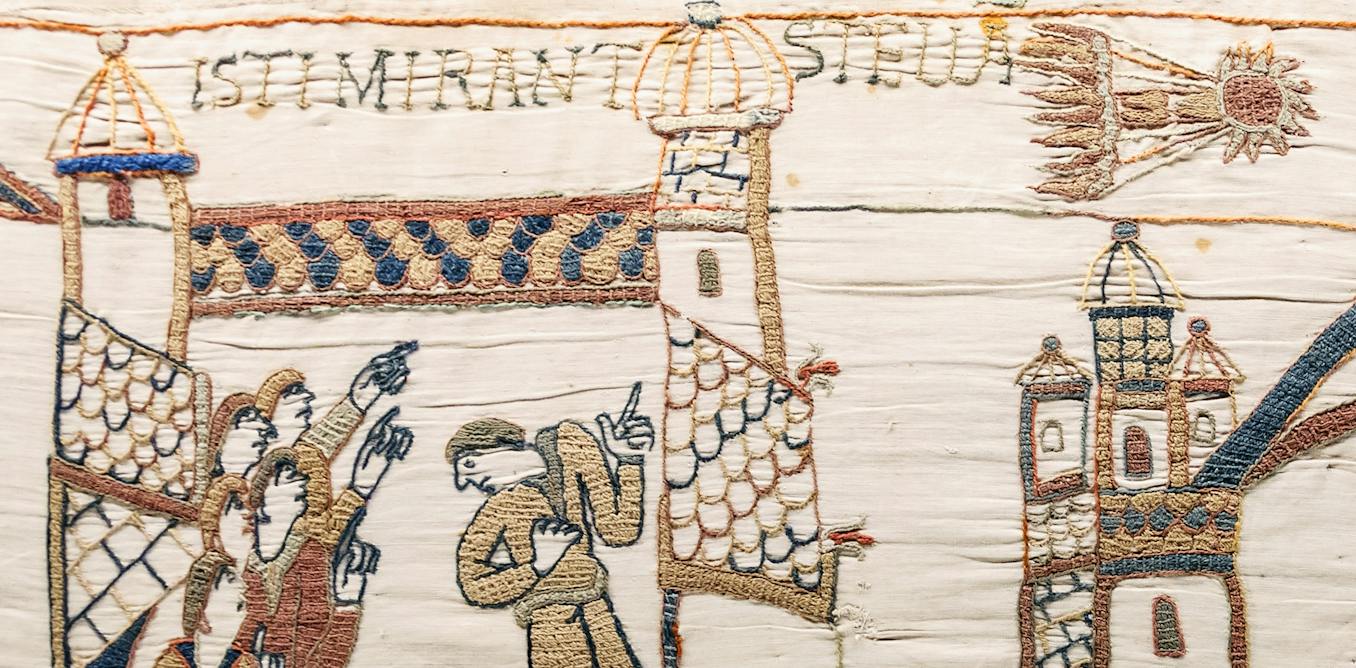
Fashioned at the end of the 11th century—scholars largely agree it was designed by the visionary monks of St Augustine’s in Canterbury and executed by master embroideresses—the tapestry chronicled the events leading up to the Norman Conquest of England in 1066, culminating in the fateful Battle of Hastings. Commissioned potentially by Bishop Odo of Bayeux as a gift for his half-brother, William the Conqueror, the work may have originally graced the walls of a grand monastery refectory, a bishop’s palace, or a seat of immense political authority.
The Early Centuries and the Historical Void
Despite its monumental scale, the tapestry vanishes from the historical record for centuries. There is ample evidence that early medieval England produced vast, now-lost embroidery masterworks—such as the tapestry donated to Ely Abbey by Æfflflæd, the formidable widow of Byrhtnoth, the ealdorman of Essex who fell at the Battle of Maldon in 991, as recorded in the 12th-century chronicle Liber Eliensis.
However, no contemporary sibling to the Bayeux masterpiece survived. The Bayeux Tapestry itself finally re-emerges into the historical documentary record in an inventory of Bayeux Cathedral drafted in 1476—roughly 400 years after the last needle was pulled through the linen. How it traveled from England to the cathedral in Normandy remains one of history’s most enduring mysteries.
The Victorian Revival (Mid-1880s)
The modern afterlife of the tapestry truly ignites in the Victorian era. In the mid-1880s, Elizabeth Wardle—a pioneering scholar, artisan, and founder of the Leek Embroidery Society in Staffordshire—embarked on a monumental project. Alongside a collective of approximately 35 skilled needlewomen, Wardle traveled to Bayeux, studied facsimiles at the Victoria & Albert Museum, and meticulously crafted a full-scale replica of the tapestry. Exhibited in June 1886, Wardle’s replica began its own global journey, touring the United States before being acquired in 1895 by a former mayor of Reading. Today, it remains proudly displayed at the Reading Museum, serving as Britain’s own localized window into the epic.
Wartime Re-imaginings (1944)
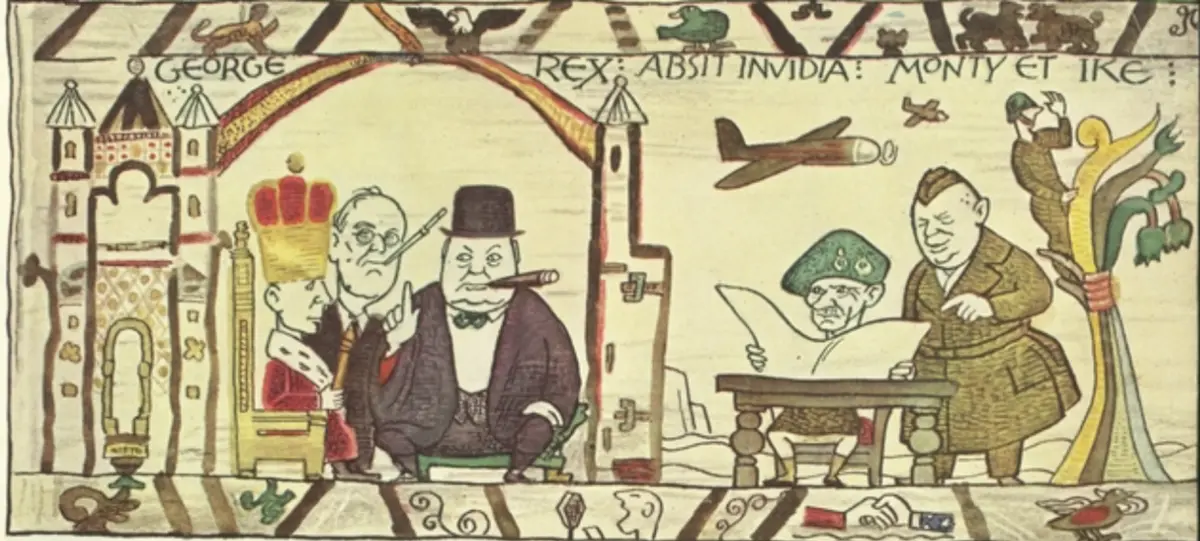
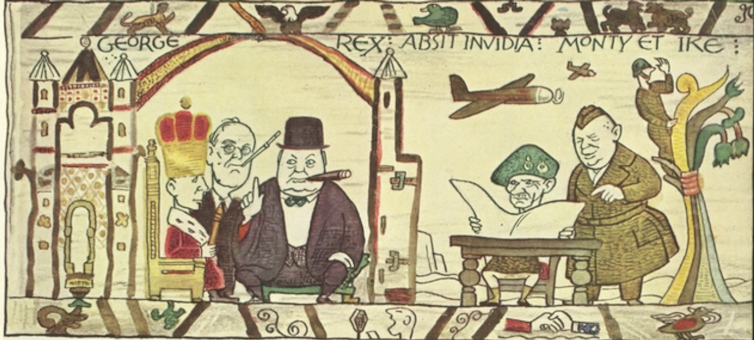
As Europe tore itself apart during the Second World War, artists found poignant political resonance in the medieval narrative of invasion and conquest. In July 1944, American artist and designer Rea Irvin reimagined the tapestry for the cover of The New Yorker magazine to commemorate the D-Day landings. Irvin substituted Edward the Confessor and Harold with King George VI, Winston Churchill, and Franklin D. Roosevelt. Instead of longships and cavalry, troops traversed the channel by aircraft and tank, while a stark swastika fluttered from a castle tower. Irvin’s work weaponized the tapestry’s intrinsic interest in morality and statecraft to reflect the horrors of Nazism and the heroism of the Allied forces.
The Late 20th Century to Present: Pop Culture and Political Symbolism
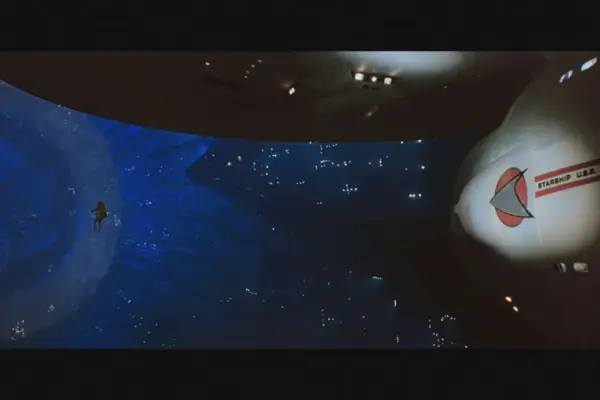
From the second half of the 20th century onward, the tapestry’s distinct visual style achieved global ubiquity. It influenced the opening credits of major motion pictures, ranging from Disney’s Bedknobs and Broomsticks (1971) to Robin Hood: Prince of Thieves (1991) and Shrek the Third (2007).
In the political arena, its imagery became a shorthand for national destiny and sovereignty. Most notably, Reform UK leader Nigel Farage frequently wore a tie decorated with scenes from the Bayeux Tapestry in the years leading up to the 2014–2016 Brexit referendum, explicitly framing it as a reminder of "the last time we were invaded and taken over." Capitalizing on the same cultural nerve, The Sun newspaper commemorated the UK’s formal departure from the European Union by releasing its own custom-made "Bye-EU tapestry."
Today, the 70-meter masterpiece sits within the galleries of the British Museum, where it is slated to remain on public exhibition until July 2027.
Supporting Context & Metrics
To fully appreciate the cultural and material footprint of the Bayeux Tapestry, consider the following structural metrics and contextual data points:
- Physical Dimensions: Approximately 70 meters (230 feet) in length and 50 centimeters (20 inches) in height.
- Composition: Embroidered with woolen yarns on a linen background using two primary stitches (outline stitch and couching).
- Narrative Scope: Features dozens of individual scenes depicting the build-up to the Norman Conquest, Harold Godwinson’s fateful journey to Normandy, the coronation of Harold, the crossing of the English Channel, and the Battle of Hastings on October 14, 1066.
- The Margin Details: Beyond the main historical narrative, the upper and lower borders (or margins) are packed with rich, esoteric, and occasionally bawdy iconography, including hunting scenes, fables, agricultural labor, and a famously contentious modern scholarly debate surrounding the frequency and placement of phallic imagery.
- Exhibition Milestone: The current British Museum exhibition marks the first time in nearly a thousand years that the original 11th-century artifact has returned to its country of origin on this scale.
Official Statements and Academic Insights
The unprecedented loan and exhibition of the tapestry have prompted widespread commentary from cultural stewards, historians, and artists.
Curators at the British Museum have emphasized the diplomatic and cultural significance of the loan, framing it as an exercise in high-level European soft power and shared heritage. Speaking on the implications of the exhibition, heritage analysts note that bringing the artifact to London allows a modern public to engage directly with the foundational mythos of the British state.
Historians studying the physical object continue to push past sanitized Victorian interpretations of the work. Recent academic panels—such as those addressing the fine details of the embroidery—have highlighted how the tapestry’s chaotic margins challenge the tidy narrative presented in the central register.
Furthermore, contemporary artists have been invited to deconstruct the artifact’s overwhelming cultural weight. Notable among these responses is artist Fiona Banner’s 2010 installation, 1066. Described by Banner as a "still film," the installation translates the visual imagery of the tapestry into a dense textual account plastered across gallery walls. By stripping away the familiar embroidered figures, Banner forces viewers to read the conquest anew, disrupting the cozy nostalgia often associated with medieval history and forcing a confrontation with the raw text of invasion.
Future Outlook: The Tapestry in the 21st Century and Beyond
As the Bayeux Tapestry’s blockbuster exhibition continues its run at the British Museum through July 2027, long-term questions regarding its preservation, digitization, and political utility remain at the forefront of museum administration.
The delicate nature of the 900-year-old linen and wool means that international loans of this magnitude are exceptionally rare and fiercely scrutinized by conservationists. Environmental controls, light exposure, and structural support systems will dictate whether future generations will ever witness the original artifact outside of Normandy again.
Yet, the physical fragility of the medieval object contrasts sharply with the boundless digital and cultural life of its progeny. As new generations of digital artists, political actors, and satirists utilize the distinctive Bayeux style to comment on contemporary crises—from global pandemics to geopolitical realignments—the tapestry proves that it is not merely a static relic of 1066.
Ultimately, the enduring legacy of the Bayeux Tapestry demonstrates a profound historical truth: the past never stays neatly confined to the past. Through continuous acts of recreation, political appropriation, and artistic subversion, the stitches woven by anonymous medieval hands in Canterbury continue to stitch together the modern political and cultural imagination of Europe.