Executive Overview
Ask any citizen on the cobbled streets of Copenhagen what makes their nation uniquely Danish, and the conversation will invariably drift toward frisind—a dense, deeply culturally loaded term that encompasses open-mindedness, radical tolerance, and the unfettered freedom to live life on one’s own terms. Today, this progressive ethos is viewed as an intrinsic cornerstone of Danish national identity, proudly codified in cultural inventories like the government-sponsored Danmarkskanon (Danish Canon).
Yet, historical excavation reveals a startling counter-narrative: Denmark’s world-renowned reputation for social liberalism was not forged in a cultural vacuum, nor is it entirely an indigenous creation. New academic research suggests that this celebrated open-mindedness was, to a profound degree, a transnational project.
From the 1960s through the 1980s, a restless, post-Nazi West Germany served as an eager and impressionable audience. Frustrated by the stifling, authoritarian, and hyper-conservative structures of their own society, young West Germans cast a hopeful gaze northward. Through cross-border tourism, the burgeoning commercial trade of newly legalized pornography, the exchange of avant-garde political and artistic ideas, and the cross-pollination of progressive activist networks, Denmark became a living laboratory for counterculture.
In short, one of Denmark’s most cherished national values was, in its formative decades, largely defined in relation to "somewhere else"—functioning as a mirror for a fractured German society desperately seeking emancipation from its own authoritarian ghosts.
Detailed Chronology: The Evolution of a Transnational Liberalism
To understand how a small Scandinavian kingdom became an international beacon of unbridled personal freedom, one must trace a historical timeline stretching from the early post-war era through the threshold of the 1990s.
1. The Post-War Crucible and the West German Urge for Renewal (Late 1940s–1950s)
In the immediate aftermath of the Second World War, West Germany found itself tethered to the heavy, agonizing legacy of National Socialism. The social fabric of the Federal Republic was dominated by older generations who had lived through or actively supported the Third Reich.
Universities, courtrooms, and political institutions retained deeply hierarchical, paternalistic, and conservative structures. For the generation coming of age in the late 1950s and 1960s—the West German New Left—this societal framework felt suffocating, moralistic, and intellectually bankrupt. They began looking across international borders for models of alternative democratic governance, personal autonomy, and social experimentation.
2. The Legislative Seismic Shifts in Denmark (1969)
While West German youth were dreaming of alternatives, Denmark was quietly dismantling its own traditional legal frameworks. In 1969, the Danish parliament made international headlines by becoming the first sovereign state in the world to completely legalize written pornography.
Although the domestic debate within Denmark was fiercely contested—with many traditionalists warning of moral decay—the international ripple effects were immediate. For a West Germany governed by Chancellor Willy Brandt, which was itself contemplating sweeping legal and social reforms, Denmark transformed overnight from a sleepy northern neighbor into a daring vanguard of modernity.
3. The Cross-Border Exchange: Sex, Counterculture, and Commerce (1970s)
By the early 1970s, the border between West Germany and Denmark had become a dynamic conduit for countercultural migration:
- The "Porn Paradise" Phenomenon: West German tourists flooded across the Danish border to purchase newly available adult media, while German government officials traveled to Copenhagen to study the socio-legal impacts of the pornography liberalization. Danish producers simultaneously tapped into a massive, lucrative export market south of the border.
- The Freetown Christiania Experiment: Established in 1971 on an abandoned military base in Christianshavn, the self-governing community of Christiania captured the imagination of European youth. Its decentralized governance, collective living models, and radical counterculture became a magnet for disenfranchised West German travelers.
- Music and Festivals: The Roskilde Festival, expanding rapidly throughout the decade, established itself as a premier European destination for alternative lifestyles, cementing Denmark’s status as a sanctuary for youth culture.
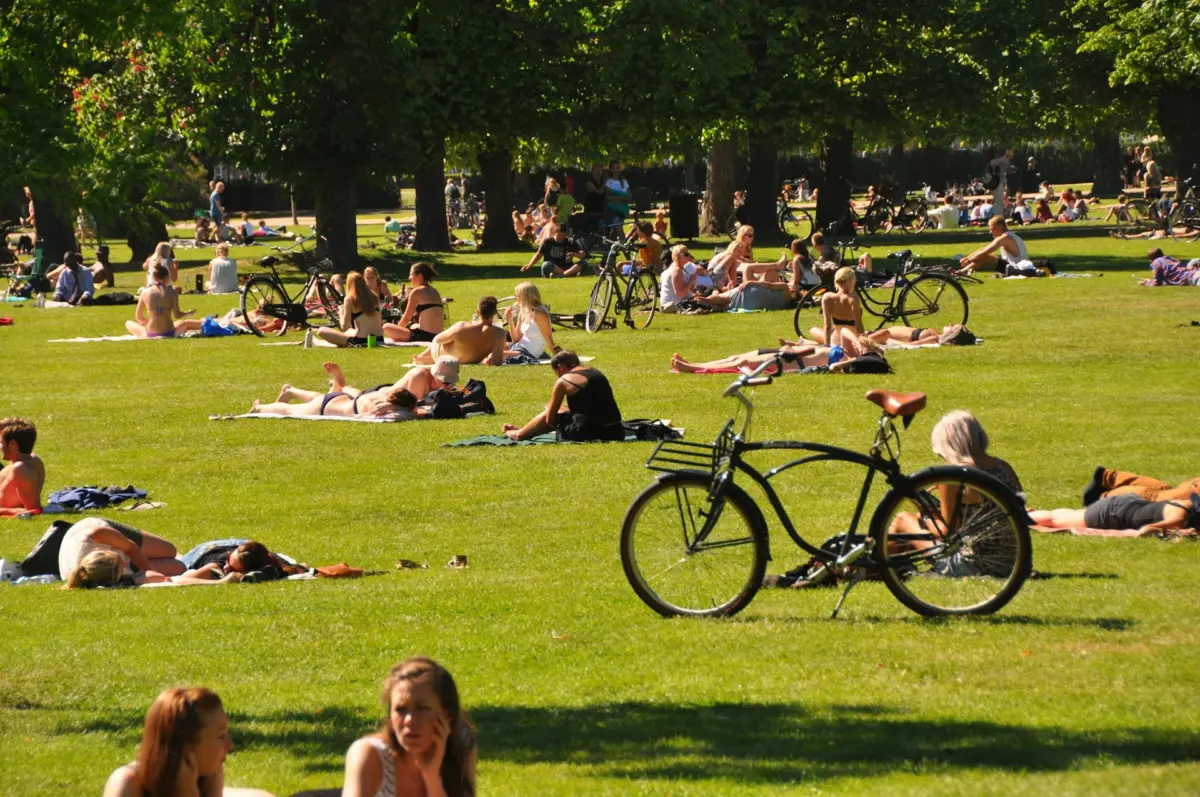
- Activist Networks: Danish gay rights activists formed deep, lasting alliances with burgeoning liberation movements in West German urban centers such as Hamburg and West Berlin, exchanging tactical strategies for social visibility. Concurrently, the Danish naturist movement integrated deeply with the German tradition of Freikörperkultur (FKK).
4. Institutionalization and the Codification of Frisind (1980s–2016)
As decades passed, the practices, products, and ideas that bounced back and forth across the German-Danish border slowly shed their radical, countercultural edge. What was once viewed by conservative Danes as dangerous deviance—and by West Germans as radical liberation—gradually drifted into the mainstream.
By 2016, this historical process of cultural assimilation culminated when the Danish Ministry of Culture launched the Danmarkskanon. Designed to define the core values binding modern Danish society together, the resulting canon explicitly enshrined frisind as a foundational pillar of national identity, citing sexual tolerance, bodily freedom, and alternative lifestyles as inherently "Danish."
Supporting Context & Metrics
The transformation of Denmark’s image from a conventional post-Victorian European state into a utopian beacon of liberalism can be mapped through sociological and economic shifts:
- Economic Spillovers: In the wake of the 1969 pornography legalization, Denmark’s adult entertainment industry saw exponential growth. Economists estimate that within five years, export revenues from cultural and adult media destined for West Germany, the Netherlands, and Scandinavia contributed significantly to the creative sector’s GDP share, proving that social liberation carried substantial economic incentives.
- Demographic Flows: Border transit data from the 1970s indicates a multi-fold increase in cross-border youth travel between West German metropolitan areas (such as the Ruhr Valley, Hamburg, and Frankfurt) and Danish urban centers. For many West German students, a summer pilgrimage to Copenhagen or Christiania became a rite of passage.
- Comparative Sociological Metrics: Modern social attitude surveys consistently place Scandinavian nations at the apex of global indexes measuring interpersonal trust, LGBTQ+ rights, and gender equality. Yet, historians note that these metrics often reflect a self-reinforcing national narrative rather than an absolute historical divergence from neighboring North-Western European states.
Official Statements and Academic Insights
The deconstruction of Denmark’s national mythology has been spearheaded by contemporary historians and cultural sociologists who challenge the notion of innate, isolated Scandinavian exceptionalism.
Dr. Tobias Haimin de Fønss Wung-Sung, a leading researcher studying West German reactions to Danish liberalism during the Cold War, emphasizes the bidirectional nature of the phenomenon:
"Denmark did not develop its reputation for open-mindedness entirely on its own. Some of the people who helped create that image were looking at Denmark from across the border. West Germany served as a crucial sounding board and audience, actively projecting its own desires for liberation onto Danish society."
This perspective aligns with the critical work of the late Danish criminologist Berl Kutchinsky (1935–1995). Kutchinsky, who dedicated decades to studying the empirical effects of pornography decriminalization, maintained a deeply skeptical stance toward claims of Danish moral uniqueness. In his extensive writings, Kutchinsky argued that Denmark firmly belonged to the broader family of "puritanical, post-Victorian" Western European nations.
According to Kutchinsky, Denmark was not a radical outlier of unprecedented human freedom, but rather simply sat toward the more permissive end of a spectrum that included Sweden, the Netherlands, and West Germany. In essence, Danish frisind was—and remains—comparative rather than absolute.
Future Outlook: Identity in a Globalized Era
As Denmark navigates the complex socio-political challenges of the 21st century—including debates over immigration, national security, European integration, and the boundaries of free speech—the mythos of frisind continues to play a central, contested role in public discourse.
Recognizing that this cherished national value was forged through transnational friction, cross-border commerce, and foreign ideological projection offers a vital lesson for the future. National identity is rarely a pristine artifact preserved in amber; rather, it is porous, constantly negotiated, and frequently co-created by the very neighbors we seek to distinguish ourselves from.
By acknowledging the German roots of its own progressive self-image, Denmark opens the door to a more mature, cosmopolitan understanding of national culture—one that looks outward to the world rather than inward at an imagined, pristine past.