Executive Overview
In the upper echelons of contemporary European cinema, few creative partnerships carry the seismic cultural weight of Javier Ambrossi and Javier Calvo, collectively known as "Los Javis." Celebrated for their fearless storytelling and stylistic maximalism, the acclaimed Spanish filmmaking duo have returned with a monumental achievement: La Bola Negra (The Black Ball). Emerging as Spain’s premier submission for the Academy Awards, the film represents an artistic metamorphosis for directors previously famed for their glittering television output.
More than a conventional cinematic biopic or historical drama, La Bola Negra is an ambitious, cross-generational cinematic epic. It breathes brilliant, haunting life into the last, unfinished 1936 manuscript of legendary Spanish poet and playwright Federico García Lorca. Long before his execution by a nationalist firing squad at the dawn of the Spanish Civil War, Lorca penned four pages detailing a harrowing account of institutionalized homophobia. In this foundational text, a young gay man named Carlos attempts to join an exclusive, private club, only to be rejected via a secret ballot system where black balls signify ostracization—the devastating origin of the term "blackballed."
Expanding this fragile literary seed into a sweeping narrative canvas, Los Javis—co-writing alongside renowned queer playwright Alberto Conejero—have constructed a triptych traversing three pivotal epochs of Spanish history: the progressive Second Republic of 1932, the violent rupture of the Civil War in 1937, and the hyper-connected, yet politically fragile contemporary landscape of 2017. Shot on lush 35mm film with cinematography by Gris Jordana and a haunting score by Raül Refree, La Bola Negra has conquered the international festival circuit. Following a triumphant world premiere at the Cannes Film Festival—where Los Javis claimed the Best Director prize—the film swept audience awards at San Sebastián, Toronto, and London before securing a coveted global distribution deal with Netflix.
Boasting an all-star international ensemble that includes Penélope Cruz as a glamorous cabaret singer, Lola Dueñas as a tormented single mother, and Hollywood icon Glenn Close speaking fluent Spanish as a dedicated Lorca scholar, the film balances arthouse rigor with populist appeal. Yet, beneath its glittering surface and heavy layers of queer iconography—ranging from Saint Sebastian to modern-day Grindr notifications—lies an urgent political warning. As historical revisionism and far-right nostalgia gain traction across Europe, La Bola Negra arrives not merely as a cinematic masterpiece, but as a vital cultural intervention into the politics of memory, survival, and resistance.
Detailed Chronology: From a 1936 Manuscript to Global Stardom
To understand the magnitude of La Bola Negra, one must retrace a century of suppressed histories, artistic risk-taking, and monumental career milestones.
1936: The Fragile Seed
In the spring of 1936, Federico García Lorca was at the height of his creative powers. Universally recognized as Spain’s most influential 20th-century poet and playwright, he began drafting a new work—tentatively titled La Bola Negra. Uniquely, it was designed to be his first theatrical production featuring an openly gay protagonist. However, history intervened with catastrophic finality. Following the outbreak of the Spanish Civil War in July 1936, Lorca was arrested and executed by nationalist forces, his body unceremoniously dumped into an unmarked mass grave in his native Granada. His radical ideas were silenced, his sexuality condemned to the shadows, and his final manuscript reduced to just four surviving pages.
2013–2020: The Rise of Los Javis
Decades later, the cultural landscape of Spain began to shift, catalyzed by independent theatre and the streaming revolution. Playwright Alberto Conejero published La Piedra Oscura (The Dark Stone) in 2013, a critically acclaimed drama touching upon Lorca’s legacy and his real-life relationships. Simultaneously, Javier Ambrossi and Javier Calvo carved out a revolutionary space in Spanish pop culture.
Rising to prominence through three groundbreaking streaming series, Los Javis proved their uncanny ability to blend camp, tragedy, and political critique:
- Paquita Salas (Netflix, 2020): A hilarious, bittersweet mockumentary tracking the trials of a has-been talent agent navigating a shifting industry.
- Veneno (HBO Max, 2020): A visually arresting biographical drama exploring the life of Cristina Ortiz Rodríguez ("La Veneno"), a pioneering transgender sex worker and television icon who became a symbol of visibility in 1990s Spain.
- La Mesías (MUBI, 2023): An expansive, deeply psychological religious musical drama that cemented their reputation as visionary auteurs.
Despite these triumphs, their feature film output had previously been limited to La llamada (Holy Camp!, 2017), a joyous musical adaptation about a lesbian awakening in a Catholic summer camp. La Bola Negra marks only their second feature film, representing an exponential leap in scale, production value, and international prestige.
2026: The Festival Circuit and Global Triumph
The rollout of La Bola Negra was nothing short of a cultural earthquake. Following a rapturous, multi-minute standing ovation at the Cannes Film Festival, where Ambrossi and Calvo secured the Best Direction prize, the film embarked on a triumphant tour of autumn festivals. Playing to packed houses in San Sebastián, Toronto, and London, the film quickly became a viral social media phenomenon. Recognizing its commercial viability and prestige value, Netflix acquired global streaming rights, ensuring that Lorca’s long-suppressed vision would finally reach hundreds of millions of households worldwide.
Supporting Context & Metrics
The artistic triumph of La Bola Negra is anchored by a meticulous web of historical references, visual motifs, and intersectional representation. The film is divided into three distinct chronological segments, each utilizing distinct cinematic palettes and lenses to capture the evolving nature of queer existence in Spain.
The Three Epochs and Character Arc Matrix
| Epoch / Setting | Historical Context | Key Characters & Performers | Central Themes & Visual Motifs |
|---|---|---|---|
| 1932 (Second Republic) | A brief window of progressive hope, labor reforms, and cultural blossoming. | Carlos (Milo Quifes) Isabelle (Glenn Close) |
Social exclusion, institutionalized homophobia, the origin of the "black ball" metaphor. |
| 1937 (Civil War) | The fracturing of Spain under fascist violence and ideological purges. | Rafael Rodríguez Rapún (Miguel Bernardeau) Sebastián (Guitarricadelafuente) |
Forbidden desire across enemy lines, war trauma, platonic infatuation, martyrdom. |
| 2017 (Contemporary) | Modern digital dating culture set against a backdrop of rising political anxiety. | Alberto (Carlos González) Teresa (Lola Dueñas) |
Body positivity, digital intimacy (Grindr), intergenerational queer memory, survival. |
Visual Motifs and Iconography
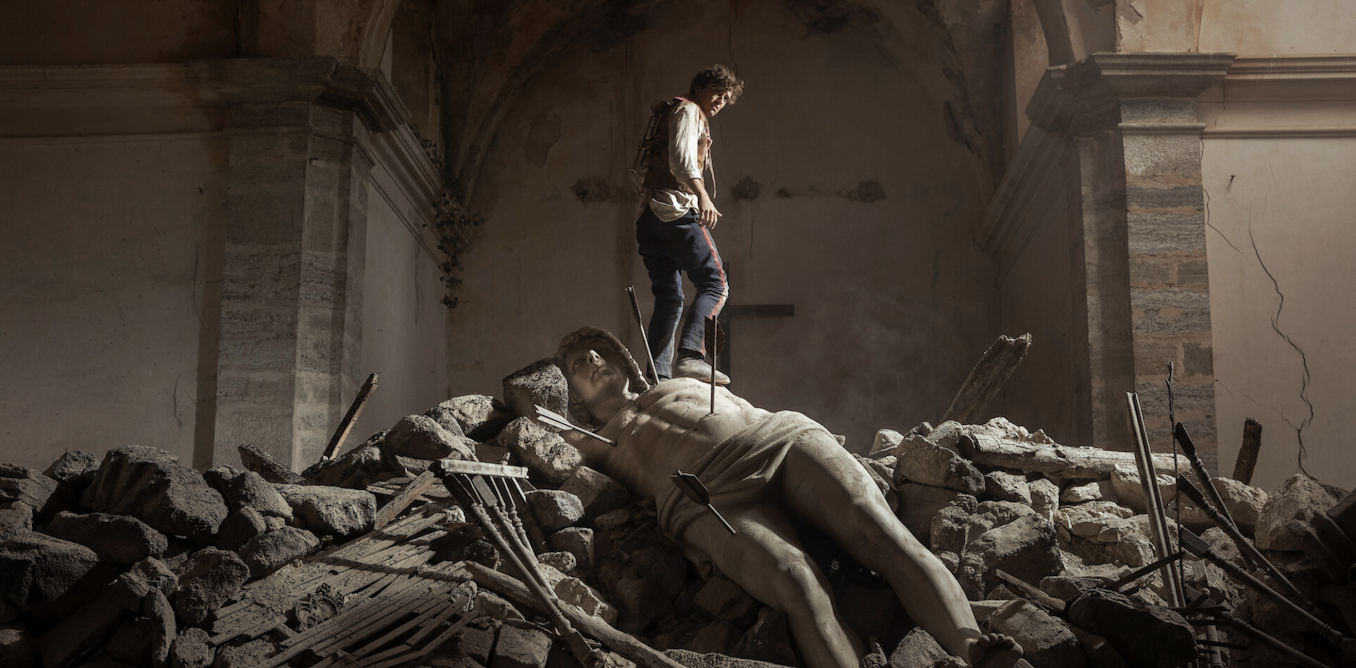
Los Javis weave an intricate tapestry of queer symbolism throughout the narrative. The film features a war-torn statue of Saint Sebastian—a 3rd-century Christian martyr who has evolved into an enduring modern queer icon due to his depiction tied to a tree and pierced with arrows. In another sequence, hypermasculine, brooding sailor archetypes pay direct homage to Rainer Werner Fassbinder’s classic 1982 homoerotic masterpiece, Querelle.

These high-art references sit comfortably alongside contemporary realities, such as the buzzing notifications of Grindr on a smartphone screen. Gris Jordana’s cinematography contrasts claustrophobic, candle-lit domestic interiors with sweeping, desolate Spanish landscapes, all captured on organic 35mm stock to lend the film a tactile, timeless quality.
Representation and Body Positivity
Beyond its historical and political ambition, La Bola Negra breaks new ground in its approach to male physical representation. While featuring the conventional, taut aesthetics of heartthrobs Miguel Bernardeau and breakout actor Guitarricadelafuente (in his acclaimed debut performance), the final segment centers on Alberto, a larger-bodied gay historian portrayed brilliantly by Carlos González. Known for his work in Veneno and Mariliendre (Fag Hag, 2025), González infuses the narrative with vital themes of body and sex positivity, challenging narrow standards of desirability within queer media.
Official Statements & Critical Reception
The cultural impact of La Bola Negra has sparked intense dialogue among filmmakers, historians, and critics worldwide. Speaking at a press briefing following their Cannes victory, co-directors Javier Ambrossi and Javier Calvo articulated the profound responsibility of adapting Lorca’s unfinished work:
"We did not simply want to make a historical museum piece about a dead poet," Javier Ambrossi explained to international journalists. "We wanted to take the four remaining pages of a man who was silenced by bullets and show how his heartbeat echoes through our modern lives. The black ball he wrote about in 1936—the secret rejection of those who do not conform—is still being thrown at marginalized people today. This film is an act of reclamation, survival, and love."
Javier Calvo added: "Working with an international cast like Glenn Close—who learned Spanish specifically to honor this text—alongside icons like Penélope Cruz and a new generation of raw talent, allowed us to bridge the past and the present. Lorca’s closet was imposed upon him by a violent state. Through cinema, we are tearing down the walls of that closet once and for all."
Critical reception has been overwhelmingly ecstatic. Writing for major trade publications, reviewers have praised the film’s structural audacity. Deadline hailed it as "a towering achievement in European queer cinema," while film critics at Cannes noted that the collaboration between Los Javis and playwright Alberto Conejero successfully elevates theatrical dialogue into breathtaking cinematic poetry. The score by Raül Refree has similarly been lauded for creating an auditory landscape that feels simultaneously ancient and avant-garde.
Future Outlook: The Intersection of Art and Politics
As La Bola Negra positions itself as Spain’s foremost contender for the upcoming Academy Awards, its cultural resonance extends far beyond the red carpets of Hollywood. The film arrives at a uniquely volatile moment in contemporary European socio-politics.
On paper, Spain stands as a global beacon of LGBTQ+ progress. Having become the third country in the world to legalize same-sex marriage in 2005, Spain currently ranks first in Europe on the International Lesbian, Gay, Bisexual, Trans and Intersex Association (ILGA-Europe) 2026 Rainbow Map for legal rights and protections. Yet, beneath these legislative victories, a palpable undercurrent of anxiety ripples through civil society.
Nostalgia for the Francoist dictatorship and right-wing extremism has found a potent megaphone on social media platforms, capturing the imaginations of disaffected youth. With political polarization reaching a fever pitch ahead of upcoming national elections, the specter of a conservative-far-right coalition looms large. As cultural historian Nicholas Manganas has persuasively argued, La Bola Negra is ostensibly a film about the traumas of the 1930s, but it is unmistakably an urgent disquisition on our present moment.
Federico García Lorca’s physical remains still lie undiscovered in an anonymous, unmarked mass grave in the rolling hills of Granada—a physical manifestation of a nation attempting to bury its own conscience. Yet, as Los Javis demonstrate through La Bola Negra, truth cannot be permanently interred. By transforming four fragments of lost text into a cinematic baton passed across generations, the directors have ensured that Lorca’s legacy survives not as a tragic relic of state violence, but as an eternal blueprint for queer liberation, resilience, and unyielding artistic defiance.