Executive Overview
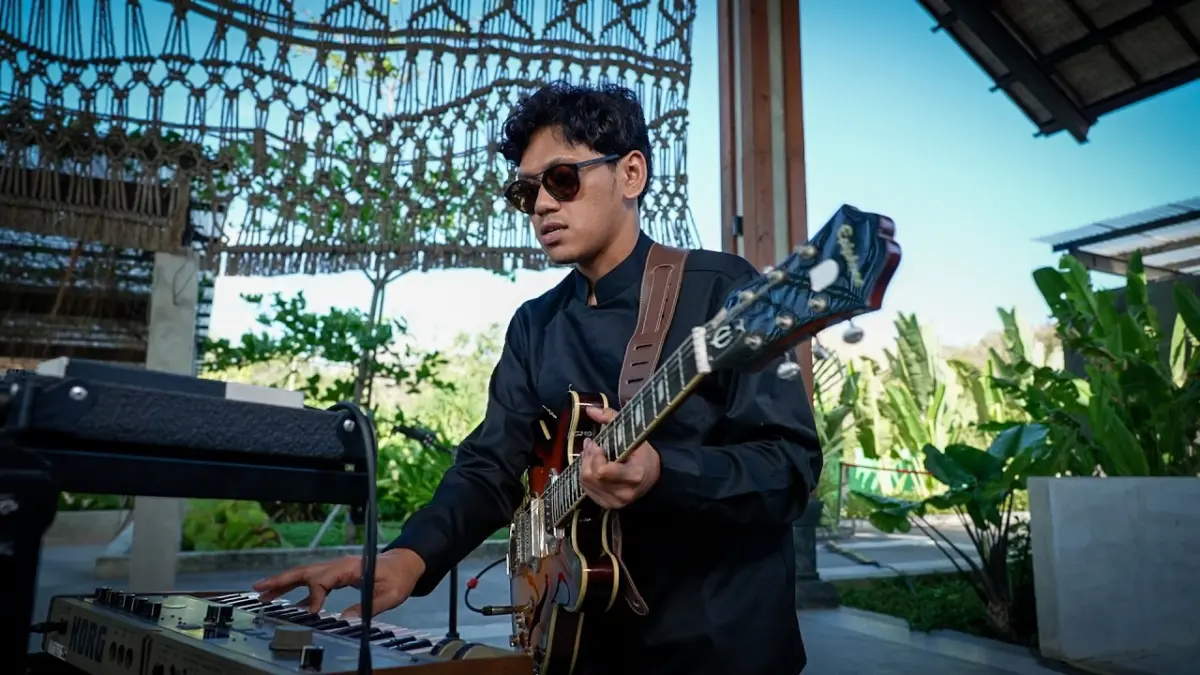
In the sprawling, hyper-urbanized landscape of Jakarta, four musicians from the mist-veiled highlands of West Java are quietly redefining the boundaries of contemporary Indonesian music. Basajan—comprising guitarists Adhitama Putra Prakarsa and Reyhan Gyanie, bassist Dinan Indrayana, and drummer Dandy Rizkiawan—has emerged as a vanguard for a distinct sonic movement they proudly term Priangan Psychedelic Groove.
Drawing its name from the historical moniker for the Sundanese highlands, Basajan’s music is an intoxicating synthesis of traditional indigenous scales, hypnotic hypnotic guitar riffs, analog synthesizer textures, and danceable, driving rhythm sections. Their work does not merely borrow from heritage; it treats local myth, folklore, and spiritual cosmology as living, breathing blueprints for modern psychedelic exploration.
This unique artistic vision recently propelled the band onto one of international indie music’s most prestigious platforms: Seattle-based independent radio station KEXP. Captured live against the dramatic backdrop of the cliffs above Jimbaran in Bali, Basajan’s six-song session marks a watershed moment not only for the quartet but for the broader Southeast Asian underground music ecosystem. Recorded in late August and broadcast globally in late October, the session is the crowning jewel of KEXP’s historic first-ever collaborative project in Asia, realized in partnership with the AXEAN Festival.
For Basajan, the KEXP broadcast arrives on the heels of a triumphant creative period, defined by the April release of their critically acclaimed debut album, Béwara, via Bahasa Ibu Records—an imprint of the prominent Jakarta-based label demajors dedicated to preserving and amplifying regional Indonesian languages and traditions. Spanning local folklore, traditional cosmological philosophies like Tri Tangtu, and hyper-specific cultural concepts like waas, Basajan represents a rare intersection where deep-rooted indigenous preservation meets the bleeding edge of global psychedelic rock. As the band takes the stage at landmark festivals across Asia, their trajectory signals an exciting new era for Southeast Asian music on the world stage.
Detailed Chronology: From the Sundanese Highlands to Global Broadcasts
To fully appreciate the weight of Basajan’s recent international exposure, one must trace the meticulously calculated steps of their recent artistic journey. The band’s path from regional obscurity to global digital ubiquity is a testament to relentless touring, precise conceptual world-building, and strategic partnerships.
The Genesis of a Movement
Originating from Kabupaten Bandung—the fertile, culturally rich regency surrounding the West Javanese capital of Bandung—the members of Basajan eventually relocated to the bustling metropolis of Jakarta. Despite the urban relocation, their artistic anchor remained firmly planted in the Sundanese countryside. They forged a genre identity they call Priangan Psychedelic Groove, merging the trance-inducing properties of Western psychedelic rock with traditional Sundanese musical structures.
The Prelude to Béwara: Singles that Defined an Era
The momentum leading up to their debut album was built on two distinct, highly conceptual singles released between late 2025 and early 2026:
- December 2025 – "1971": The band dropped their first major precursor single, an intricate arrangement written entirely in daminatilada, the traditional five-note system characteristic of Sundanese music. Lyrically and atmospherically, the track follows an out-of-town protagonist who wanders into a night-market ghost house, only to emerge trapped indefinitely in the year 1971. The track established Basajan’s capacity to weave cinematic storytelling into complex groove-based instrumentation.
- February 2026 – "Nadoman": Following closely behind, this single leaned further into traditional spiritual practices. Basajan took the sung verses of religious advice traditionally taught to Sundanese children in neighborhood prayer houses (madrasah or langgar) and dragged them through coarse fuzz guitars and heavy echoing reverb, bridging the gap between sacred heritage and counter-cultural noise.
International Breakthroughs: Wonderfruit and Beyond
As their recorded output gained traction, the physical presence of Basajan began crossing international borders. In December 2025, the band made their international festival debut at Wonderfruit in Thailand, mesmerizing international audiences with their hypnotic stage presence and culturally distinct instrumentation. This was followed by a successful tour of Japan in April 2026, where their cross-cultural musical vernacular resonated deeply with fans of experimental and psychedelic rock.
The Landmark KEXP Session in Bali
The climax of their touring and promotional efforts occurred on August 28, 2026. Setting up at the breathtaking Locca Sea House, perched precariously on the dramatic limestone cliffs overlooking Jimbaran Bay in Bali, Basajan recorded a six-song live session for Seattle’s legendary public radio station, KEXP.
The session was officially broadcast and uploaded to global platforms on October 29, 2026. The performance was anchored by "Waas"—a haunting, three-minute instrumental piece that also serves as the emotional denouement of their debut album. By choosing "Waas" to close their KEXP set, Basajan delivered a masterclass in atmospheric dynamic control, leaving a permanent digital footprint that cements their status as global ambassadors of Sundanese modernism.
The Current Horizon: Rock in Celebes
Building immediately upon the international visibility of the KEXP release, Basajan’s itinerary points directly toward domestic titan status. The band is slated to perform for the first time at Rock in Celebes, hosted at the historic Fort Rotterdam in Makassar, South Sulawesi. This performance underscores their dual ability to command international digital spaces while remaining deeply connected to the archipelago’s vast and diverse regional festival circuits.
Supporting Context & Metrics: Cultural Foundations and Industry Milestones
Basajan’s rise is not an isolated phenomenon; it is powered by deep musicological roots, shifting industry paradigms, and strategic institutional backing within Indonesia’s independent music infrastructure.
Musicological Architecture: Priangan Psychedelic Groove
What distinguishes Basajan from standard psychedelic revival bands is their rigorous integration of Sundanese musical theory. While Western psychedelic music often relies on modal jazz scales, blues progressions, or Eastern sitar scales derived from Indian classical music, Basajan constructs its harmonic world around daminatilada.
This indigenous pentatonic tuning system imparts a distinct melancholic yet celebratory flavor to their melodies. Lead guitar work by Prakarsa and Gyanie mimics the phrasing of traditional Sundanese instruments like the suling (bamboo flute) or kecapi (zither), but routed through pedal chains saturated with delay, phasers, and fuzz. Beneath this melodic interplay, bassist Indrayana and drummer Rizkiawan lock into grooves that borrow rhythmic sensibilities from traditional Sundanese Kendang drumming, transmuting folkloric polyrhythms into hypnotic, dance-floor-ready dance beats.
The Philosophy of Béwara and Tri Tangtu
Released on April 10, 2026, through Bahasa Ibu Records, Béwara is a ten-track conceptual journey structured around Tri Tangtu—an ancient Sundanese philosophical framework that divides the universe into three distinct realms:
- The Sacred Upper World: Domains of the divine and celestial order.
- The Middle World of Daily Life: The earthly realm of human experience, labor, and community.
- The Darker Underworld: A realm associated with endings, transformation, and the shadow side of existence.
The album’s closing track, "Waas," encapsulates the emotional weight of the third realm. Waas is a uniquely Sundanese term that defies direct English translation; it represents the sweet, aching nostalgia—a bittersweet pang—experienced when remembering a time, place, or person that is now entirely out of reach. By framing their psychedelic explorations within such deeply specific cultural lexicons, Basajan elevates their music from entertainment to cultural anthropology.
The KEXP and AXEAN Festival Partnership
The vehicle for Basajan’s global breakout—KEXP’s live session series in Bali—represents a monumental shift in how Western tastemaker institutions interact with Southeast Asian music scenes. Historically, independent music coverage has remained heavily Eurocentric or Anglo-American-focused.
However, KEXP’s inaugural production project in Asia was made possible through a strategic partnership with the AXEAN Festival (formerly ASEAN Music Showcase Festival). AXEAN has spent years operating as the premier showcase festival and conference for the Southeast Asian music industry, bridging the gap between regional talent and global booking agents, label executives, and media curators. By bringing KEXP’s cameras to Bali and capturing twelve stellar acts from across the region—with Basajan serving as a crown jewel—the collaboration effectively shattered geographic silos, providing a direct pipeline from the Indonesian underground to millions of global digital subscribers.
The Role of Bahasa Ibu Records and demajors
Basajan’s release strategy highlights a vital economic and cultural movement within Indonesia. Bahasa Ibu Records, launched in 2023 as a specialized imprint of the legendary independent Jakarta label demajors, was specifically created to support artists working in regional Indonesian languages, dialects, and traditions.
In a music industry historically dominated by Bahasa Indonesia or English-language pop, labels like Bahasa Ibu are proving that radical artistic localization possesses profound global appeal. By backing artists who sing, conceptualize, and structure their art around regional identities—such as Sundanese culture—these labels are creating sustainable ecosystems where traditional heritage is safeguarded not in dusty museums, but on vibrant, pulsing vinyl records and global streaming playlists.
Official Statements & Perspectives
While the band members themselves often let their intricate instrumentation and conceptual frameworks speak for their philosophy, industry insiders, curators, and cultural analysts have been vocal about the significance of Basajan’s ascent.
Reflecting on the ethos driving the creation of Bahasa Ibu Records and its roster of traditional-modern crossover acts, label representatives from demajors have frequently emphasized that contemporary Indonesian youth do not need to shed their local identities to participate in global contemporary culture. Instead, authenticity and hyper-locality are increasingly viewed as the ultimate currency in an oversaturated global digital market.
Curators from the AXEAN Festival have similarly pointed to sessions like Basajan’s KEXP performance as proof of the region’s readiness for global export. In statements regarding the partnership with KEXP, festival organizers noted:
"For too long, Southeast Asia has been viewed by Western media as a destination rather than an origin point for cutting-edge musical innovation. By placing acts like Basajan in front of international cameras in our own backyard, we are reclaiming the narrative and demonstrating that our traditional mythologies, when filtered through modern psychedelic lenses, possess universal emotional resonance."
Music critics reviewing Béwara have been equally enthusiastic, praising the band’s ability to merge academic ethnomusicological concepts with visceral rock energy. Reviewers have highlighted "Waas" and its preceding singles as a masterclass in pacing, noting that the album avoids the common trap of heavy-handed gimmickry. Rather than treating Sundanese culture as a superficial aesthetic prop, Basajan treats it as an organic, living language capable of expressing the full spectrum of modern existential dread, nostalgia, and transcendence.
Future Outlook: The Global Trajectory of Priangan Psychedelic Groove
As Basajan wraps up their debut performances at Rock in Celebes at Makassar’s historic Fort Rotterdam, the question on the minds of international promoters and music aficionados is simple: What comes next for the pioneers of Priangan Psychedelic Groove?
The momentum generated by their KEXP session is expected to open doors to broader international touring circuits across Europe and North America throughout 2027. Festival programmers looking for fresh, non-Western psych-rock exports—audiences who have previously embraced groups like Turkey’s Altın Gün or Thai psych bands like Khana Bierbood—will find in Basajan a fully realized artistic vision that marries rigorous musical composition with hypnotic live performance.
Furthermore, the band’s success serves as an institutional proof-of-concept for the AXEAN-KEXP partnership model. Industry analysts predict that this cross-continental bridge will pave the way for subsequent recording initiatives, bringing global media platforms deeper into the vibrant musical ecosystems of Indonesia, the Philippines, Thailand, Vietnam, and beyond.
Domestically, Basajan’s trajectory points toward a renaissance for regional language music in Indonesia. By proving that a debut album rooted entirely in Sundanese cosmology (Tri Tangtu), local folklore, and daminatilada scales can find a global home on Seattle public radio, Basajan has rewritten the playbook for underground Indonesian artists. They have demonstrated that the path to the global stage does not require dilution of cultural identity; rather, the deeper an artist digs into the soil of their own heritage, the more universally resonant their music becomes.
As the final notes of "Waas" fade out against the cliffside winds of Jimbaran and echo across digital screens worldwide, Basajan stands not just as a band finding its footing, but as the architects of a thrilling new chapter in global psychedelic music.