Executive Overview
At first glance, a new record fronted by a saxophonist immortalized behind a greasy diner counter in a 1980 cinematic comedy might easily be dismissed as a nostalgic novelty. Yet, beneath the pop-culture pedigree of Lou “Blue Lou” Marini lies a masterclass in contemporary transatlantic jazz collaboration. Released via Azzurra Music—headquartered in Pastrengo, near Verona—the self-titled debut from Lou Marini and the Italian Groovers demands far more than a passing glance.
The catalyst for this project was not a record label’s executive suite or a manufactured studio ensemble, but rather the formidable rhythmic engine of Turin-born, London-based drummer Enzo Zirilli. Having forged an undeniable musical chemistry during an impromptu meeting at the legendary Ronnie Scott’s Jazz Club in London, Marini and Zirilli road-tested their synergy across three extensive tours of Italy before ever setting foot in a recording booth. This patient, organic approach yields a rare commodity in modern jazz: a genuinely road-hardened working band captured in its natural habitat, rather than a hastily assembled cast of session players looking for a paycheck.
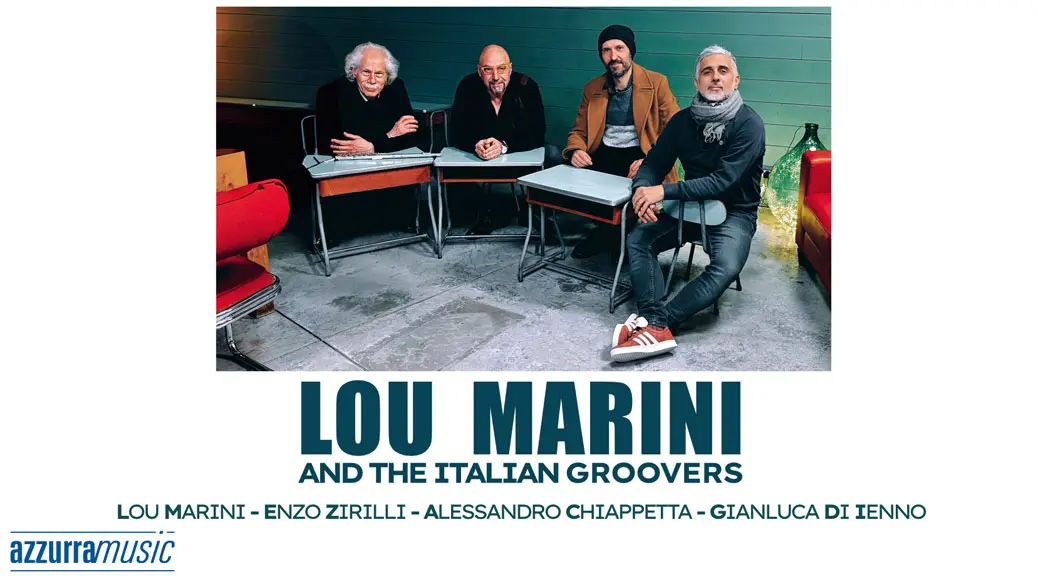
Clocking in at an octogenarian milestone, Marini—who celebrated his eighty-first birthday in May—brings a storied pedigree stretching from the University of North Texas One O’Clock Lab Band and the Woody Herman Orchestra to decades of heavy-hitting sideman work with Blood, Sweat & Tears, the Saturday Night Live house band, and, most famously, The Blues Brothers. His cross-continental partnership with Zirilli, guitarist Alessandro Chiappetta, and keyboardist Gianluca Di Ienno eschews conventional formats. Most notably, the quartet operates completely without an electric or upright bass, relying instead on Di Ienno’s subterranean Hammond C-3 pedal points and experimental Fender Rhodes textures to anchor the lower register.
While the resulting twelve-track (or eleven-track, depending on the format) album is a triumphant showcase of groove-heavy funk, Latin jazz, and cinematic noir, it has also sparked a minor controversy regarding physical versus digital track listings. For jazz aficionados, this record proves that even after decades in the spotlight, veteran innovators can still pull off unexpected sonic science fiction.
Detailed Chronology and Track-by-Track Breakdown
To truly understand Lou Marini and the Italian Groovers, one must trace the record’s sonic journey track by track, observing how a bassless organ quartet manages to command the sonic spectrum with the heft of a much larger ensemble.
Opening Salvos: From Sci-Fi Experiments to Sophisticated Funk
The album’s opening gesture is as startling as it is unconventional. Eschewing a traditional walking bassline or a straight-ahead swing intro, the opening track, “Row, Row, Row Your Blues,” begins with a barrage of otherworldly noises that evoke science fiction soundscapes. Before the listener can fully process the futuristic ambience, Marini’s saxophone cuts through the haze, settling comfortably over Di Ienno’s Hammond organ as the ensemble locks into a deep, undeniable funk footing. Zirilli anchors the rhythmic drift with absolute precision. While speculation points to the Fender Rhodes as the source of these avant-garde noises—stretching the instrument far beyond its traditional sonic boundaries—the result is an unapologetically experimental front door to a record that ultimately invites the listener to the dance floor.
The mood pivots smoothly with “On The Verge,” a track introduced by a luminous guitar figure over which Marini’s soprano saxophone rides the groove. Evoking the shimmering aesthetic of Gary Bartz’s classic Juju Street Songs, the track belongs largely to guitarist Alessandro Chiappetta, whose fluid fretwork steals the show. Momentum builds rapidly with “Tootsie Flootsie,” a fast-paced romp featuring agile flute work and a cascading keyboard wash that keeps the energy high.
Mid-Album Explorations: Blues, Latin Rhythms, and Organ-Trio Heritage
Not every track reinvents the wheel, though each maintains a high standard of musicianship. “Point of View” offers a classic, unhurried blues framework featuring Marini out front on tenor saxophone. Curiously, Marini used this exact title for an album released with Steven Feifke just last August, though this iteration carves out its own distinct, relaxed identity.
The undisputed crown jewel of the disc arrives with “L’uccello d’oro.” A vibrant Latin jazz jam, it captures the quartet at its most joyful and collaborative, showcasing the innate conversational interplay between Zirilli’s polyrhythmic drumming and Chiappetta’s crisp comping. This is followed by “The Diamond Jig,” which opens with an extended, atmospheric drum solo from Zirilli before the Hammond organ roars to life. Swinging effortlessly with the tenor sax soaring overhead, the track captures the timeless essence of classic organ-trio records without falling into the trap of cheap pastiche.
Mid-album highlights continue with “On Cat’s Paws,” an atmospheric flute feature that evokes the pioneering modal work of Jeremy Steig. Providing the album’s sole external composition is a stunning rendition of the classic Jimmy Van Heusen and Johnny Burke standard, “Here’s That Rainy Day.” Reimagined as a smoldering tenor ballad, it brings back the mysterious science-fiction textures heard in the album’s opening moments—proof positive that Di Ienno’s Fender Rhodes is working overtime to expand the group’s sonic palette.
The Closing Act: Cinematic Nostalgia and Modern Jazz
As the album winds down, the arrangements lean into both continental styling and modern introspection. “Soft Shoe” embraces the signature contemporary Italian jazz aesthetic—melancholic yet deeply rhythmic. It is immediately followed by “Com’era, dov’era,” a playful piece driven by sub-bass Hammond lines and tongue-in-cheek triangle taps. The track evolves into a cinematic mid-century stroll, evoking the breezy, satirical charm of a classic commedia all’italiana film like Divorzio all’italiana.

The album concludes with “Blue Halloween,” a striking contemporary jazz departure that strips away the relentless funk groove to showcase the band’s improvisational depth in a more open, modern context.
Supporting Context & Metrics: The Players and the Paradigm
The success of Lou Marini and the Italian Groovers relies entirely on the caliber of its personnel. This is an international collective where decades of American big-band and rhythm-and-blues history intersect with the cutting edge of the contemporary European jazz diaspora.
The Personnel Breakdown
- Lou Marini (Saxophones, Flute): Born in May 1943, Marini’s career is a living encyclopedia of American popular and jazz music. From his formative years in the University of North Texas One O’Clock Lab Band and the Woody Herman Orchestra, Marini transitioned into a premier New York session player. His credits include foundational work with Blood, Sweat & Tears, the original Saturday Night Live band (where he earned the moniker "Blue Lou"), and his unforgettable cinematic tenure in The Blues Brothers. Beyond performing, Marini curates the Brianza Blues Festival in Monza, Italy—a cultural bridge that ultimately laid the groundwork for this Italian collaboration.
- Enzo Zirilli (Drums): A Turin native who relocated to London in 2003, Zirilli has become a linchpin of the British jazz scene. Renowned for his dynamic touch, impeccable swing, and telepathic timing, Zirilli’s previous projects—including his celebrated outfit ZiroBop—have established him as a rhythmic force to be reckoned with. His musical partnership with Marini is the beating heart of the Italian Groovers.
- Alessandro Chiappetta (Guitar): A self-taught prodigy who picked up the instrument at age nine, Chiappetta earned a prestigious Berklee scholarship via the Umbria Jazz clinics. After winning the Moncalieri contest in 2009 and releasing his acclaimed debut Corner Shop on Philology in 2010, Chiappetta moved to London in 2014, embedding himself in Zirilli’s musical circle. His guitar work bridges modern harmonic sophistication with traditional soul-jazz grit.
- Gianluca Di Ienno (Keyboards): Operating out of his own studio in downtown Milan, Di Ienno is a classically trained jazz pianist holding a dedicated degree in the discipline. Notably, Di Ienno chooses to leave the acoustic piano at home for this project, restricting his arsenal to a vintage Hammond C-3 and a Fender Rhodes. Drawing from his professional background in sound design, Di Ienno crafts the avant-garde textures that give the quartet its distinct futuristic edge.
The "No-Bass" Paradigm
Perhaps the most striking metric of this record’s success is its complete omission of a bass player. In conventional jazz theory, an organ trio relies on the organist’s left hand and foot pedals to cover the bassline. However, Marini and his Groovers elevate this format into an art form. Di Ienno manages the low-end frequencies with such authority that listeners rarely, if ever, register the absence of an upright or electric bass. It is the highest technical and artistic compliment an organ-led ensemble can receive: the music feels entirely complete, rich, and structurally sound.
Official Statements and Industry Insights
While the album has garnered critical acclaim across European jazz circles for its fearless blending of tradition and electronic experimentation, it has also sparked a lively debate among physical media collectors and streaming consumers regarding distribution discrepancies.
Steve Williams, writing for prominent jazz publication UK Vibe, articulated both the high praise for the ensemble’s live-wire energy and a notable grievance regarding the physical release:
"If I were out listening to this band live, I would be tapping my foot all night. I would still come home and ask where the hell ‘Cuidado’ is."
The controversy centers on track twelve, titled “Cuidado.” Available exclusively on streaming platforms, this track has been widely cited by early reviewers as one of the absolute finest pieces recorded during these sessions. However, physical CD purchasers find themselves short-changed, holding a physical object that lacks the twelfth track entirely.
Industry analysts point to manufacturing constraints and vinyl/CD run-time limitations as the likely culprits for this discrepancy, yet it highlights an ongoing friction in the modern music industry: the penalty paid by dedicated audiophiles and physical collectors who prefer tangible objects over transient digital files. Despite this administrative hiccup, representatives for Azzurra Music have praised the collaborative cross-border spirit of the project, noting that the Marini-Zirilli partnership represents the ideal blueprint for modern European-American jazz exchange.
Future Outlook
As Lou Marini and the Italian Groovers continues to find its audience across streaming platforms and CD racks, the future looks bright for this transatlantic alliance. At eighty-one years of age, Lou Marini shows no signs of slowing down, proving that a lifetime spent backing blues legends, comedic icons, and rock royalty has only sharpened his instinct for the groove.
For Enzo Zirilli, Alessandro Chiappetta, and Gianluca Di Ienno, this album serves as a definitive statement of intent. It proves that working bands forged in the crucible of live performance—honed across three tours before a single microphone was switched on in a studio—will always outperform hastily assembled session projects.
Looking ahead, fans and critics alike are clamoring for expanded live tour dates outside of Italy and the UK, hoping to experience the bassless, high-octane chemistry of the Groovers in person. Furthermore, one can only hope that future physical pressings—should a vinyl edition or a deluxe CD reissue materialize—will rectify the “Cuidado” omission, uniting digital and physical tracklists once and for all. Until then, Lou Marini and the Italian Groovers stands as a masterclass in jazz hybridity: a record that respects the past, dances in the present, and occasionally beams in sounds from the future.