Executive Overview
Ten years ago, a terrified father and his young daughter boarded a high-speed KTX train racing from Seoul to Busan, completely unaware that the world outside had fractured into an apocalyptic nightmare. Before they could reach the relative safety of their destination, the vast majority of South Korea had been violently overrun by an aggressive, fast-moving zombie contagion. Director Yeon Sang-ho’s Train to Busan was more than a thrilling genre piece; it was a watershed moment in cinematic history. Premiering out-of-competition at the 2016 Cannes Film Festival, the film rapidly transcended language barriers, pulling in more than 11.5 million viewers domestically and shattering box-office records across multiple Asian markets.
As the film returns to global silver screens in a stunning, newly minted 4K restoration for its tenth anniversary, the cultural landscape it re-enters is fundamentally transformed. In 2016, Korean cinema and television were revered by global cinephiles and festival circuits, yet they remained distinct from the mainstream Hollywood hegemony. Today, that paradigm has shifted entirely. Bong Joon-ho’s genre-bending masterpiece Parasite historicized the Academy Awards by claiming Best Picture in 2020, Hwang Dong-hyuk’s dystopian survival drama Squid Game became an unprecedented global cultural phenomenon on Netflix, and South Korean creatives are household names worldwide.
Looking back from the vantage point of 2026, Train to Busan stands out as an indispensable stepping stone in this global ascent. It proved unequivocally that high-concept commercial Korean cinema could capture worldwide attention without sacrificing local authenticity, seamlessly marrying visceral action with profound social critique and deeply entrenched Korean storytelling traditions. This retrospective explores the socio-political undercurrents, the mechanics of its production, its reflection of national trauma, and its enduring legacy as a pillar of modern international entertainment.
Detailed Chronology: From Animated Dissent to Live-Action Blockbuster
To fully understand the triumph of Train to Busan, one must trace the career trajectory of its visionary director, Yeon Sang-ho. Before breaking into live-action filmmaking, Yeon earned a formidable reputation as an auteur of dark, uncompromising animated films. Works such as The King of Pigs (2011) and The Fake (2013) were bleak, harrowing explorations of systemic bullying, grinding poverty, institutional hypocrisy, and religious exploitation. These indie animations established Yeon as a fearless social critic who used genre frameworks to dissect the structural fractures of contemporary South Korean society.
Transitioning to a live-action commercial blockbuster with Train to Busan in 2016 could have diluted his razor-sharp edge. Instead, Yeon successfully scaled up his thematic concerns. He retained his signature pessimism regarding human institutions while packaging it within a universally understood horror framework—the zombie apocalypse.
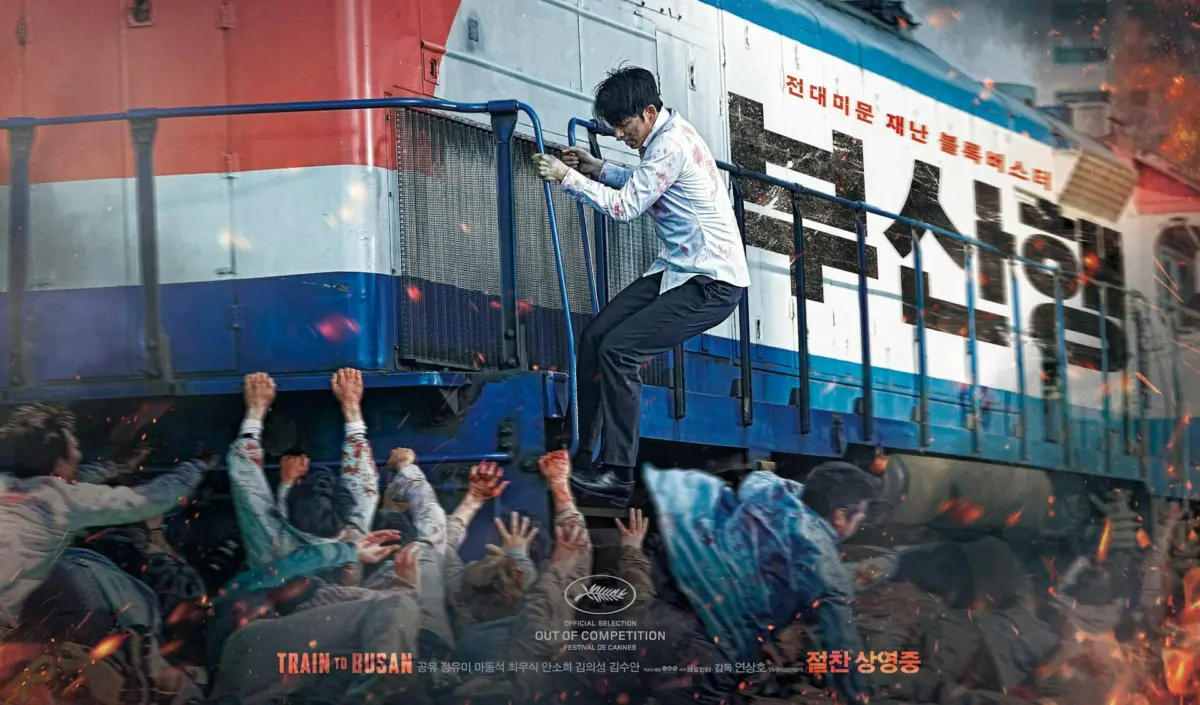
The narrative engine of the film is deceptively simple. Seok-woo (Gong Yoo), a hyper-successful, emotionally detached fund manager, boards the train with his neglected young daughter, Su-an (Kim Su-an), intending to drop her off with her estranged mother in Busan. Almost immediately after departure from Seoul Station, an infected passenger slips on board, sparking a chain reaction of violence. As the train hurtles through the Korean peninsula, the narrow corridors, sliding glass doors, and confined compartments transform into claustrophobic tactical battlegrounds.
Within this steel tube, Yeon traps a microcosm of South Korean society: a devoted pregnant woman and her fiercely protective husband, bickering school pupils, elderly sisters facing mortality side by side, fatigued railway employees, a traumatized homeless man, and a callous, self-preserving wealthy transport executive named Yong-suk (Kim Eui-sung). As the infection spreads like wildfire, socioeconomic status offers zero immunity. Instead, the narrative strips away the veneer of civilization, measuring every character strictly by their response to human vulnerability.
Initially, Seok-woo embodies the hyper-individualistic ethos of modern corporate capitalism. He advises his daughter to look out only for herself and exploits his personal and professional connections to secure safety exclusively for his bloodline. However, Su-an’s quiet empathy acts as a moral compass. Her refusal to abandon strangers forces her father into a harrowing psychological evolution. Through this father-daughter dynamic, Yeon posits a central thematic thesis: blind selfishness and the abandonment of the vulnerable ultimately jeopardize individual survival, whereas radical cooperation and shared sacrifice are the only viable routes through collective crisis.
Supporting Context & Metrics: Societal Trauma and the Sewol Ferry Shadow
While Train to Busan functions brilliantly as a pulse-pounding thrill ride, its enduring resonance stems from how sharply it critiques systemic and institutional failure. As panic engulfs the train, the passengers desperately look to the outside world for leadership and rescue. What they receive instead are hollow, heavily scripted government broadcasts and television news anchors who dismiss the unfolding pandemic as mere "violent unrest," withholding critical tactical information from a panicked citizenry.
When the train makes an unscheduled stop at Daejeon Station—promoted by authorities as a secure military zone—the passengers step out into a ghost town, only to discover that the military apparatus has been completely overrun and decimated.
For South Korean audiences in 2016, these cinematic depictions of governmental incompetence and institutional abandonment carried a raw, agonizing weight. Just two years prior, on April 16, 2014, the ferry MV Sewol sank off the coast of South Korea, resulting in the deaths of 304 people—the vast majority of whom were high school students from Danwon High School. Subsequent investigations into the disaster revealed a catastrophic cascade of regulatory failures, corrupt corporate oversight, delayed emergency management, and, most damningly, an administration that actively misled the public while ordering passengers to stay put as the ship went down.
The national trauma born from the Sewol disaster did not dissipate; it metastasized into a pervasive public distrust of authority. Popular culture repeatedly grappled with the fate of ordinary citizens failed by the very institutions sworn to protect them. The government’s abysmal handling of the crisis severely eroded public trust in then-President Park Geun-hye. By late 2016, millions of citizens poured into the streets of Seoul for historic, peaceful "candlelight protests," ultimately culminating in the historic impeachment of President Park over a massive corruption scandal.
Although Train to Busan was conceived and produced just prior to the peak of these monumental demonstrations, its scathing skepticism toward corporate executives, political authorities, and state-sanctioned safety measures mirrored the deep-seated public discontent of the era. The character of Yong-suk—the wealthy executive who willingly sacrifices others to save his own skin—became a visceral proxy for the unchecked corporate greed and institutional betrayal that haunted the South Korean collective consciousness.
Official Statements & Industry Perspectives
The monumental success of Train to Busan did not happen in a vacuum; it was built upon decades of groundwork laid by South Korea’s cinematic pioneers. Throughout the late 1990s and 2000s, legendary auteurs such as Bong Joon-ho (Memories of Murder, The Host) and Park Chan-wook (Oldboy) cultivated critical acclaim and built a fiercely loyal global audience on the international film festival circuit. However, these art-house and thriller masterpieces largely appealed to discerning cinephiles rather than the mass global box office.
Reflecting on the evolution of South Korean media’s global footprint, director Yeon Sang-ho has repeatedly emphasized that international prominence is the result of a long, deliberate cultivation of trust between creators and global audiences.
"International success does not happen overnight," Yeon noted in discussions surrounding his subsequent genre works, such as the Netflix supernatural thriller series Hellbound. "Korean creators spent many years building credibility, pushing boundaries within our local storytelling traditions, and proving that stories rooted deeply in our specific societal pressures could resonate universally."
Industry analysts point to Train to Busan as the precise bridge that carried this credibility across the chasm from niche festival cinema to mainstream, mass-market entertainment. By utilizing a universally recognizable genre—the zombie horror film—Yeon lowered the barrier to entry for international audiences. The high-stakes action was instantly translatable across linguistic and cultural divides, while the emotional stakes remained universally legible. Yet, beneath the frantic action set-pieces, the DNA of the film remained resolutely South Korean, driven by domestic anxieties regarding class disparity, filial duty, and institutional neglect.
This precise formula—merging familiar, high-concept genre mechanics with sharp, localized socio-economic critique—became the blueprint for the golden age of K-content that followed. When Bong Joon-ho’s Parasite swept the 2020 Academy Awards by using dark comedy and thriller elements to skewer systemic class inequality, and when Squid Game weaponized traditional children’s playground games to comment on crushing household debt and predatory capitalism, they were treading paths firmly packed down by the wheels of Yeon’s speeding train.
Future Outlook: The Next Decade of South Korean Screen Culture
As Train to Busan celebrates its tenth anniversary with a worldwide 4K theatrical re-release in 2026, the question facing the industry is no longer whether South Korean content can conquer the global stage, but rather how the ecosystem will sustain its unprecedented momentum.
The global entertainment landscape has fundamentally evolved. Streaming platforms like Netflix, Disney+, and Apple TV+ have flattened geographical boundaries, ensuring that a series or film produced in Seoul can premiere simultaneously in Los Angeles, London, and São Paulo to millions of concurrent viewers. South Korean actors, directors, and technical crews are increasingly integrated into major international co-productions, cementing a cultural exchange that would have seemed unimaginable back in 2016.
Yet, despite the dazzling budgets and international streaming deals, the enduring power of a film like Train to Busan serves as a vital reminder to creators: spectacle alone is insufficient. The true engine of South Korean cinematic supremacy is its unflinching willingness to engage with real-world anxieties. Whether examining corporate greed trapped inside a runaway train, class warfare in architectural masterpieces, or fatal desperation played out on a playground, Korean storytellers have mastered the art of holding a mirror up to society while delivering world-class entertainment.
Ten years after leaving Seoul Station, Train to Busan remains a masterclass in tension, empathy, and social commentary. As the credits roll on its polished 4K restoration, the film stands tall not merely as a landmark horror milestone, but as the locomotive that pulled modern South Korean cinema out of the regional station and launched it onto the unstoppable tracks of global cultural history.