Executive Overview
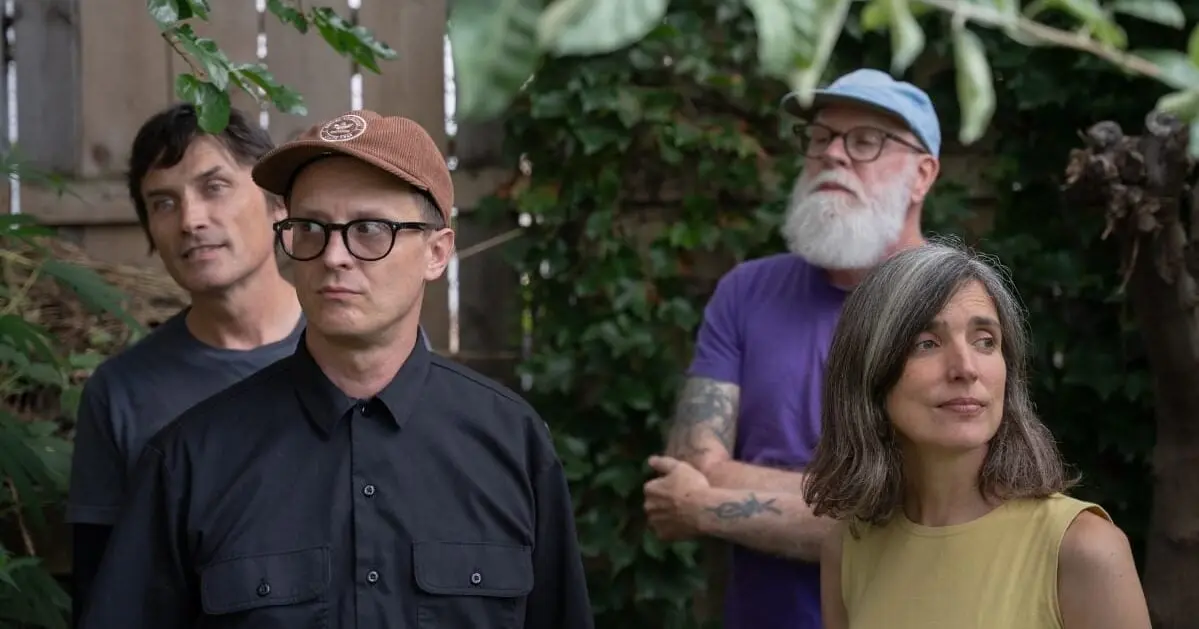
In the ever-evolving landscape of contemporary experimental music, true chemistry is a rare and precious commodity. It requires an alignment of sensibilities, a shared vocabulary of risk, and, above all, an unwavering trust between musicians. Enter Black Duck with Elena Setién, a striking new collaborative long-player arriving via Thrill Jockey on August 28, 2026. This landmark release serves as the Chicago experimental trio Black Duck’s first official dispatch since their widely acclaimed 2023 self-titled debut. Here, the core outfit—comprising guitarist Bill MacKay, bassist Douglas McCombs, and percussionist Charles Rumback—joins forces with the celebrated Spanish-Basque singer, songwriter, and multi-instrumentalist Elena Setién.
What began as a touring partnership forged across the Iberian Peninsula in early 2023 has rapidly blossomed into a studio powerhouse. Rather than painstakingly overdubbing tracks in isolation or burying their ideas beneath layers of digital correction, the quartet adopted a remarkably raw, immediate approach. Recording engineer Nick Broste hit the record button after a mere few hours of rehearsal, capturing the visceral energy, high-wire tension, and unscripted brilliance of a live stage.
The resulting album is an intoxicating masterclass in balance. It marries rigorous, forward-thinking composition with the thrilling unpredictability of free improvisation. Across its runtime, Black Duck with Elena Setién showcases four seasoned virtuosos operating at the absolute peak of their creative powers. It is a record characterized by structural dexterity, melodic warmth, and a subtle, winking sense of humor that prevents high-concept experimentation from ever feeling academic or dry. As both a continuation of their international tour and an entirely new stylistic peak, this collaboration stands as one of the most vital and adventurous musical statements of the year.
Detailed Chronology: From the Spanish Tour to the Studio Floor
To fully understand the organic flow of Black Duck with Elena Setién, one must trace its genesis back to the stages of Spain in the early months of 2023. Black Duck—already celebrated for their telepathic interplay and deep roots in Chicago’s legendary creative music underground—found themselves sharing bills and festival spaces with Elena Setién. A musician renowned for her singular, avant-pop sensibilities and pastoral songwriting, Setién proved to be an ideal foil for the American trio’s muscular yet fluid instrumental approach.
Live performance acts as an unforgiving crucible. On tour, the four artists quickly developed a shared intuition, learning how to breathe together, anticipate sudden shifts in momentum, and leave generous sonic space for one another. Rather than letting this momentum dissipate upon their return home, the quartet made the bold decision to capitalize on their freshly minted synergy. They booked time in the studio, determined to bottle the lightning of their live shows before it could cool or calcify.
The execution phase was notably swift. Under the stewardship of recording engineer Nick Broste, the band dispensed with endless pre-production cycles. After just a few hours of initial rehearsals—essentially shaking off the dust and testing out new thematic fragments—Broste initiated the recording process. This creative gamble paid massive dividends. By committing performances to tape while the ideas were still fresh, dangerous, and unresolved, the ensemble preserved the electric uncertainty of a first-time encounter.
The chronology of the album’s creation is embedded directly into its grooves. The listener can hear the musicians listening to each other in real-time: a guitar string vibrating in response to a rogue piano chord, a drum roll anticipating a vocal cue, a bassline anchoring an otherwise dizzying flight of avant-garde fancy. It is a timeline defined not by months of meticulous editing, but by intense, hyper-focused bursts of collective inspiration.
Supporting Context & Metrics: Anatomy of the Collaborative Sound
To appreciate the sonic architecture of Black Duck with Elena Setién, one must examine the individual pedigrees of its creators and the specific mechanical choices that bring the record to life.
The Players and Their Instruments
- Bill MacKay (Guitars): Known for his kaleidoscopic approach to the fretboard, MacKay bridges folk lyricism, jazz exploration, and muscular rock voltage. On tracks like Sunshine Unlimited, his major-chord flexing sets the emotional temperature of the room.
- Douglas McCombs (Bass): A foundational pillar of Chicago’s underground (Tortoise, Eleventh Dream Day), McCombs provides a sturdy, anchoring pulse. His basslines are both melodic scaffolds and deep-tissue tremors.
- Charles Rumback (Percussion): A master of texture and time, Rumback’s drumming shifts effortlessly from propulsive rhythmic drives to delicate, brush-led whispering.
- Elena Setién (Vocals, Piano, Electronics): Setién brings an idiosyncratic European art-pop aesthetic. Her contributions range from crystalline, arpeggiating piano motifs to jarring vocal manipulations that constantly subvert traditional song structures.
Track-by-Track Sonic Breakdown
The record’s sequencing reads like a masterclass in dynamic contrast, oscillating between structured pop-adjacent gems and wide-open improvisational vistas.
+------------------------+-----------------------------------+--------------------------------------------+
| Track Title            | Primary Sonic Driver              | Key Stylistic Feature                      |
+------------------------+-----------------------------------+--------------------------------------------+
| Sunshine Unlimited     | Bill MacKay / Douglas McCombs     | Muscular major chords, buoyant piano tone. |
| I Am on the Other Side | Elena Setién / Charles Rumback    | Electronic vocals, loose percussion.       |
| Land of the Many Eyes  | Piano-led arpeggios               | Pastoral folk narrative, propulsive drive. |
| Connects by Water      | Douglas McCombs / Ensemble        | Pop-leaning structure, electric feedback.  |
| Cactus Mirror          | Guitar-vocal interplay            | Sparse instrumentation, brush drums.       |
| Duck Walk              | Charles Rumback                   | 3/4 time waltz, synth and chord accents.   |
+------------------------+-----------------------------------+--------------------------------------------+
Sunshine Unlimited
Serving as an early showcase for MacKay’s compositional vision, this track bursts out of the speakers with vibrant energy. Powered by muscular major chords and a flexing electric guitar, it is grounded by McCombs’s rock-solid bass foundations. Setién’s input acts as the secret weapon, introducing a lightness and unassuming confidence that elevates the punchy arrangements.
I Am on the Other Side
Clocking in at under three minutes, this track showcases Setién’s penchant for the strange. It melds electronically manipulated vocal lines with wandering, improvised guitar textures and Charles Rumback’s loose, uninhibited percussion. It is a brief, disorienting, and thoroughly rewarding excursion into the avant-garde.
Land of the Many Eyes
In stark contrast to its predecessor, Land of the Many Eyes boasts a clearer, more traditional structure. Built around Setién’s arpeggiating piano, the piece evokes the pastoral folk music of artists like Juni Habel. However, it refuses to stay entirely within the lines, utilizing a more propulsive, adventurous narrative. MacKay’s thick, understated electric guitar notes and McCombs’s sparse, pronounced bass lines make this a standout moment of subtle beauty.
Connects by Water
Penned by McCombs, this three-and-a-half-minute track plays like an alternate-universe pop song. It opens with a grin, featuring wicked little spikes of guitar, easygoing piano chords, and a calm, stabilizing drum line. Setién’s dreamy, wordless vocals occupy roughly a third of the runtime, washing the arrangement in an airy haze. Just as the listener gets comfortable, the band stomps on the overdrive pedal, weaving scuzzy electric feedback behind the otherwise pristine piano and clean guitar lines.
Cactus Mirror
Embracing a more explicitly improvised aesthetic, Cactus Mirror provides a necessary breath of space within the tracklist. Setién’s vocals flirt dangerously with two wandering, probing guitar lines. Crucially, the absence of bass leaves a massive sonic void, which Rumback fills with minimal, evocative drum brushwork. The mood is light, rangy, and delightfully untethered.
Duck Walk
Written by Rumback in an elegant 3/4 time signature, this charming waltz brings the album to a close. Synthesizer notes hang suspended in the air alongside abrupt, playful guitar chords, while the rhythm section underpins the entire affair with understated grace. It is a whimsical, satisfying conclusion to an unpredictable journey.
Official Statements and Critical Perspective
While formal press releases and corporate soundbites are often stripped of nuance, the artistic philosophy behind Black Duck with Elena Setién speaks for itself through the profound cohesion of the music. Industry insiders and early reviewers have universally praised the project for bridging geographical and stylistic divides with uncommon grace.
"What we are witnessing here is not a mere guest-spot feature, but a genuine fusion of distinct musical ecosystems," notes early critical assessments from avant-garde music circles. By integrating Setién’s Basque sensibilities with Chicago’s storied tradition of post-rock, jazz-improvisation, and experimental composition, the quartet has effectively rewritten the playbook on collaborative cross-pollination.
Recording engineer Nick Broste’s decision to capture the sessions after only a few hours of rehearsal has also drawn significant praise from production purists. In an era dominated by surgical digital editing, grid-locked quantization, and endless revisions, this album stands as a defiant celebration of human frailty, intuition, and immediate reaction. The musicians themselves have emphasized that the record’s success relies entirely on mutual respect. No single ego dominates the soundstage; instead, instruments step forward and recede organically, creating a living, breathing acoustic ecosystem.
Future Outlook: The Legacy of a Transatlantic Alliance
As the release date of August 28, 2026, approaches via Thrill Jockey, the broader implications of Black Duck with Elena Setién begin to come into sharp focus. For Black Duck, this record solidifies their status not merely as a temporary side-project of esteemed veterans, but as a dynamic, evolving entity capable of absorbing external influences without losing its core identity. For Elena Setién, the collaboration introduces her singular songwriting and vocal artistry to new audiences while pushing her own creative boundaries into freer, more unscripted territories.
Looking ahead, the question on the minds of fans and critics alike is whether this transatlantic alliance will remain a studio-bound lightning storm or manifest once again on the live stage. Given the palpable joy and adventurous spirit bleeding through every track, the appetite for a renewed live touring cycle is immense.
Ultimately, Black Duck with Elena Setién is a triumph of process over product. It demonstrates what can happen when world-class musicians throw out the safety net, trust their instincts, and invite a kindred spirit into their creative inner circle. Whether examined through the lens of its intricate compositions, its breathtaking improvisational flights, or its subtle, winking humor, this record is a joyful reminder of why we fall in love with adventurous music in the first place. It is vital, organic, and relentlessly exciting—a benchmark for experimental collaboration in 2026 and beyond.