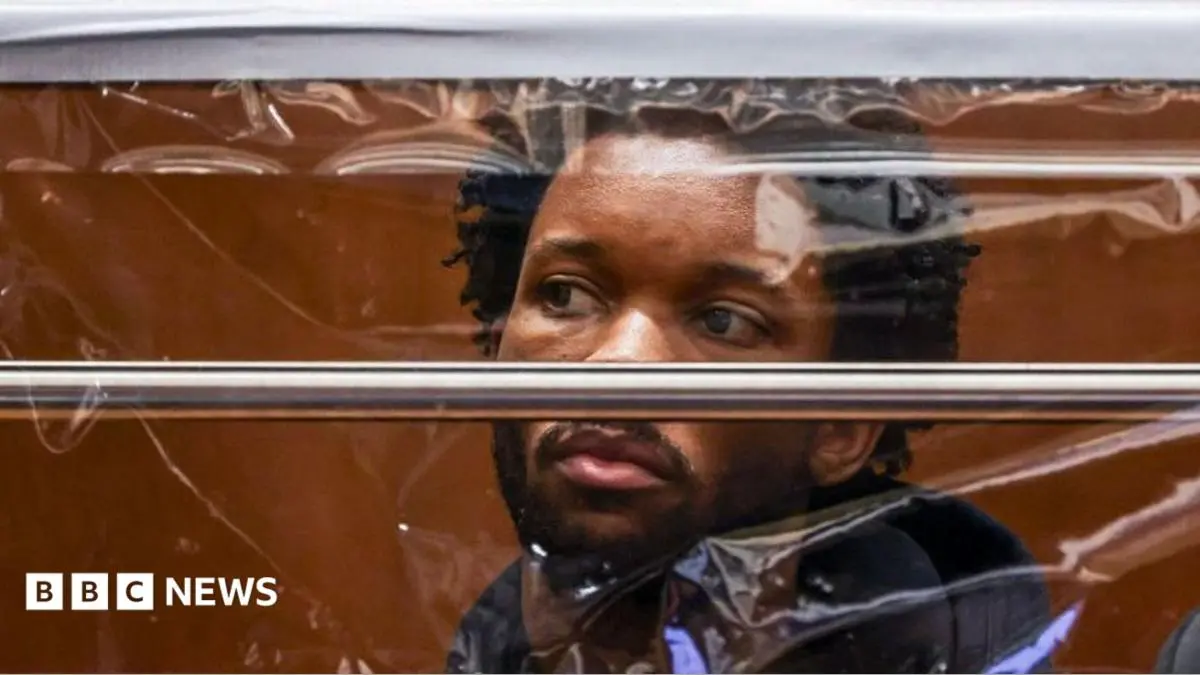
LOS ANGELES — The high-stakes legal battle surrounding American musician D4vd has taken a dramatic procedural turn. The star-studded defense team retained to protect the 21-year-old artist—legally known as David Anthony Burke—has officially withdrawn from his impending murder trial. In their place, the Los Angeles County Public Defender’s Office has been appointed to helm his defense against capital murder charges.
The developments unfolded on Monday inside a Los Angeles courtroom, where Burke formally re-entered a plea of not guilty to a grim slate of accusations. Prosecutors allege that Burke brutally murdered 14-year-old Celeste Rivas Hernandez, a teenager whose remains were discovered in September 2025 inside a Tesla registered to the musician’s residential address.
The sudden exit of his high-profile private attorneys—including renowned legal heavyweights Blair Berk, Marilyn Bednarski, and Regina Peter—marks a seismic shift in a case that has transfixed the entertainment industry and legal observers alike. With a pre-trial hearing slated for October 19, the transition from celebrity defense counsel to public defenders introduces a layer of unpredictability, potentially impacting the timeline of one of Southern California’s most high-profile criminal dockets.
Executive Overview
The legal jeopardy facing David Anthony Burke represents a catastrophic fall from grace for an emerging artist whose career trajectory had previously pointed toward mainstream stardom. Arrested following the grim discovery of Celeste Rivas Hernandez’s remains in late 2025, Burke now confronts first-degree murder charges, alongside enhancements for the mutilation of human remains and historical child sexual abuse.
Compounding the severity of the indictment, prosecutors have attached special circumstance allegations tied to financial gain, opening the legal pathway to pursue the death penalty. According to court filings and preliminary hearing arguments, the prosecution’s narrative is built upon a dark foundation of alleged grooming, escalating domestic friction, and a desperate attempt by the accused to safeguard a multi-million-dollar music career from public ruin.
Monday’s courtroom proceedings underscored the gravity of the situation. While the state’s top prosecutor declared absolute readiness to move forward, the abrupt restructuring of Burke’s defense team introduces immediate logistical hurdles. The Los Angeles County Public Defender’s Office must now dive into a mountain of digital, forensic, and circumstantial evidence—a massive undertaking that could significantly reshape the pre-trial timeline.
Detailed Chronology: From Alleged Abuse to Courtroom Arraignment
To understand the weight of the charges against Burke, investigators and prosecutors have pieced together a timeline that spans years of alleged exploitation, culminating in a violent confrontation in the spring of 2025.
The Foundation of the Allegations
According to statements presented by the prosecution during preliminary hearings, Burke’s relationship with the victim began years prior when Hernandez was well under the age of consent. Investigators allege that what started as an illicit relationship gradually devolved into psychological control and abuse, setting the stage for a volatile dynamic between the adult musician and the minor.
By early 2025, cracks in the relationship began to widen. Court documents revealed that tensions spiked around April 22, 2025, fueled by arguments concerning Burke’s interactions and friendship with another young girl. The jealousy and perceived betrayal ignited a furious reaction from Hernandez, who allegedly recognized the immense leverage she held over the artist’s burgeoning career.
The Threat and the Uber Ride
The breaking point was captured in text message logs read aloud during the Los Angeles court proceedings. On April 22, Hernandez unleashed a torrent of furious text messages directed at Burke.
"I swear to GOD I will kill u," one expletive-laden text read.
The teenager continued with explicit threats to strangle him, fabricate damaging stories for her father, and systematically tear down his professional standing.
"I will end ur career and ur life. I will damage anything," the messages warned.
Prosecutors contend that these threats were viewed by Burke as an existential threat to his livelihood, wealth, and freedom. The following day, on April 23, 2025, matters escalated from digital vitriol to physical proximity. Investigators state that Burke arranged and paid for an Uber to transport Hernandez directly to his Hollywood residence.
Once the teenager arrived at the property, prosecutors allege, Burke launched a fatal attack, stabbing her to death to permanently silence her threats.
The Discovery and Arrest
The tragic aftermath of the alleged homicide remained hidden for months until September 2025, when authorities recovered human remains inside a Tesla vehicle parked near Burke’s residence. Forensic analysis subsequently confirmed the identity of the remains as those of Celeste Rivas Hernandez.
Following a sweeping multi-agency investigation, authorities zeroed in on Burke. Last month, a Los Angeles judge officially ruled that sufficient evidence existed to bind the musician over for trial. During Monday’s court appearance, Burke stood before the bench inside the Clara Shortridge Foltz Criminal Justice Center, formally listening to the charges read aloud before entering a plea of not guilty across all counts.

Supporting Context & Metrics: The Defense Shake-Up
The sudden departure of Burke’s celebrity defense team is one of the most notable elements of the pre-trial phase. The intricate mechanics of how the legal representation shifted shed light on the financial and procedural realities of high-profile criminal defense.
The Exit of the Legal Elite
The defense coalition that initially stepped forward to shield Burke comprised some of the most formidable legal minds in American entertainment law. Led by Blair Berk—whose storied career includes defending high-profile icons such as Mel Gibson, Harvey Weinstein, Britney Spears, and Lindsay Lohan—alongside colleagues Marilyn Bednarski and Regina Peter, the team was built to handle public relations crises as deftly as courtroom cross-examinations.
However, in a formal joint statement issued to the BBC, the attorneys announced that the court had granted their motion to withdraw from the record. The statement clarified that Burke "qualified for appointed counsel," indicating that the financial resources required to sustain private, celebrity-tier legal defense through a capital murder trial had been exhausted or were otherwise unavailable.
Despite their exit, the attorneys expressed continued solidarity with their former client:
"We continue to support David and his defence against these serious charges," the statement read. "We are grateful that the Los Angeles County Public Defender’s Office has taken over the representation and that David has a highly capable and committed team of attorneys and investigators behind him."
Stepping into the Breach: The Public Defender’s Mandate
With private counsel stepping down, the Los Angeles County Public Defender’s Office was formally appointed to manage the remainder of the litigation.
Deputy public defender Walid Kandeel, who has been assigned to lead the defense, issued a measured public statement addressing the immense challenge ahead:
"Burke is entitled to a defence that takes his circumstances seriously and carefully examines the evidence," Kandeel stated. "We are committed to providing him with that defence."
The transition from a boutique private firm to a public defender’s office represents a fundamental shift in strategy. While public defenders in Los Angeles County are renowned for their trial experience, tenacity, and institutional investigative resources, they also manage notoriously heavy caseloads. Assimilating a complex capital murder case featuring extensive digital forensics, forensic pathology reports, and intricate timelines will demand immediate, intensive resource allocation.
Official Statements and Prosecution Perspective
Outside the courtroom on Monday, Los Angeles County District Attorney Nathan Hochman addressed the media, providing an authoritative assessment of the state’s posture and the potential fallout from the defense team’s withdrawal.
Hochman asserted that the prosecution office is entirely prepared to move forward with the trial.
"We are ready to proceed," Hochman told reporters, emphasizing that the evidentiary foundation built by investigators is robust.
At the same time, the top prosecutor candidly acknowledged that substituting defense counsel introduces procedural variables that the court must accommodate. Hochman noted that the transition could potentially trigger delays, as the newly appointed public defenders will inevitably require additional time to review the exhaustive evidentiary disclosures, evaluate expert witness reports, and potentially formulate preliminary motions—including the possibility of a motion to dismiss the case entirely.
Despite the impending procedural turbulence, Hochman welcomed the prospect of a rigorous judicial contest, stating that his team was fully prepared for "zealous representation" by the defense, regardless of who occupies the counsel table.
Future Outlook & Legal Roadmap
As the case transitions from the preliminary phase toward actual trial preparation, several critical milestones loom on the legal horizon.
- The October 19 Pre-Trial Hearing: This upcoming date will serve as the immediate litmus test for the new defense team. Judge and counsel will address scheduling, discovery handoffs, and any preliminary motions filed by the Public Defender’s Office.
- Evaluation of Evidentiary Motions: Legal experts anticipate that Deputy Public Defender Walid Kandeel will scrutinize the admissibility of the text message logs, the circumstances surrounding the search of the Tesla, and the forensic identification of the remains. Motions to suppress evidence or challenge specific special circumstance enhancements are standard playbook strategies in capital cases.
- Trial Timeline Adjustments: While the prosecution remains eager for a swift docket, the sheer complexity of a capital murder trial—compounded by the late-stage change in legal representation—makes it highly probable that the trial will face scheduling extensions well into 2027.
For David Anthony Burke, the stakes could not possibly be higher. Moving from the security blanket of Hollywood’s most expensive defense attorneys to the institutional architecture of the public defender’s office marks a humbling and perilous chapter. As the legal machinery grinds toward the October 19 hearing, the public, the judicial system, and the grieving family of Celeste Rivas Hernandez await the next definitive steps in a tragedy that has forever altered multiple lives.