Executive Overview
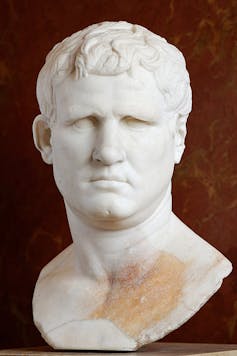
Renowned historical novelist Robert Harris has returned to the blood-soaked marble corridors of antiquity with his latest release, Agrippa. Structured as a fictional autobiography, the novel purports to be the lost personal testimony of Marcus Vipsanius Agrippa—the indispensable right-hand man, military genius, and political architect to the Emperor Augustus. Written from the perspective of Agrippa during the final, reflective days before his death at the age of 50 in 12 BC, the book immediately invites comparison to Harris’s acclaimed 2021 Cicero trilogy. In that earlier work, the intimate narration of Cicero’s secretary, Tiro, offered readers a privileged, behind-the-scenes view of late Republican statesmanship.
With Agrippa, Harris employs a similar narrative lens, utilizing a rediscovered historical phantom—Agrippa’s vanished autobiography—to observe the staggering rise of Octavian, later known to history as Augustus. The historical stakes are monumental. Agrippa was Octavian’s anchor from the chaotic power vacuum that immediately followed Julius Caesar’s assassination in 44 BC until Agrippa’s own death three decades later. By that time, Augustus had successfully dismantled the Roman Republic and established himself as absolute, undisputed autocrat.
Yet, beneath Harris’s masterly prose and fluid storytelling lies a critical tension. While Agrippa succeeds as a fast-paced, highly readable narrative of imperial consolidation, it fundamentally bypasses decades of modern historiographical revolution. Contemporary classical scholarship has cast the triumviral period as an era of profound fluidity, structural experimentation, trauma, and shifting gender dynamics. Harris’s novel, by contrast, presents a teleological march toward world domination, offering a traditional, unchallenging view of autocratic rise. Ultimately, the novel finds its true emotional and narrative heartbeat not in political intrigue, but in physical creation: the engineering feats, architecture, and urban restoration that literally carved the Roman Empire into existence.
Detailed Chronology: The Arc of a Revolutionary Empire
To understand the world of Robert Harris’s Agrippa, one must trace the dizzying, violent trajectory of the late Roman Republic’s death throes. The historical chronology captured—and occasionally flattened—within the pages of the novel spans some of the most turbulent decades in Western history.
The Crucible of Civil War (44–31 BC)
Following the assassination of Julius Caesar on the Ides of March in 44 BC, the teenage Octavian was thrust from the relative obscurity of a patrician youth into the center of a chaotic political storm. Alongside Mark Antony and Lepidus, Octavian formed the Second Triumvirate—an emergency dictatorship that quickly devolved into a reign of terror characterized by proscriptions, mass executions, and total civil war.
Within this maelstrom, Agrippa emerged not merely as a loyal subordinate, but as a military commander of genius. While Octavian possessed the political brand and the ruthless willpower necessary to claim the mantle of Caesar, it was Agrippa who secured his victories on the battlefield. Most notably, Agrippa engineered the decisive naval triumph at the Battle of Actium in 31 BC, which crushed the combined forces of Mark Antony and Cleopatra VII, leaving Octavian as the sole master of the Roman world.
The Institutionalization of Autocracy (30–12 BC)
With rivals eliminated or absorbed, Octavian faced the delicate task of transforming a military dictatorship into a stable, enduring political system—a process that culminated in his transformation into Augustus. Agrippa transitioned seamlessly from military executioner to civil statesman and dynast.

As a high-ranking magistrate and eventual son-in-law to Augustus through his marriage to the emperor’s daughter Julia, Agrippa occupied a central pillar of the newly minted imperial family. His bloodline would ripple down through the terrifying reigns of the Julio-Claudian dynasty; Agrippa was the grandfather of the erratic emperor Caligula and the great-grandfather of the infamous Nero. His life and the reign of Augustus were inextricably intertwined until Agrippa’s sudden death in Campania in 12 BC.
Supporting Context & Metrics: Re-evaluating the Triumviral Age
While Robert Harris’s narrative flows with exceptional clarity, synthesizing the complex factional shifts of the triumviral period into easily digestible plots, it stands in stark contrast to decades of modern classical scholarship. Over the past twenty years, historians of Rome have fundamentally re-evaluated the decades surrounding the fall of the Republic, moving away from the simplistic narrative of inevitable imperial triumph.
Contemporary Scholarship and Fluid Realities
Recent historical research emphasizes the sheer uncertainty, political experimentation, and ideological malleability of the years between 43 and 31 BC. Rather than an orderly march toward one-man rule, the period was characterized by desperate improvisation.
- The Periphery and Rivals: Australian classical historian Kathryn Welch has extensively documented the immense power and geopolitical significance of Sextus Pompeius—the surviving son of Pompey the Great—who seized control of the Mediterranean grain supply and challenged the Triumvirs from naval strongholds.
- The Struggle for Governance: Professor Jeff Tatum of Victoria University of Wellington has explored how figures like Mark Antony genuinely grappled with the administrative and ideological burdens of supreme power, rather than merely playing the role of the tragic antagonist.
- Ideological Roots of Violence: University of Leicester historian Kathryn Tempest has meticulously contextualized the intellectual and political frameworks that birthed Brutus and Cassius’s assassination conspiracy, demonstrating that opposition to autocracy was deeply rooted in Roman political philosophy.
- Cultural Patronage: Maecenas, Augustus’s other principal confidant and minister of culture, has been the subject of four distinct academic monographs since 2014, highlighting the deliberate shaping of public thought through the works of poets like Horace and Virgil.
Furthermore, social historians have increasingly focused on the psychological trauma inflicted upon Roman society by a generation of continuous civil war. Scholars are now acutely sensitive to the gendered consequences of the imperial transition, noting the increased public visibility and political agency assumed by elite women within the newly formed imperial household.
By largely omitting these complex cultural shifts, structural uncertainties, and societal traumas, Harris opts for a streamlined, old-school narrative. In Agrippa, Octavian’s pursuit of world domination is treated as an unvarying inevitability from the moment Caesar falls. The novel leaves little room for the historical reality that alternative outcomes—such as a restored oligarchy or a fractured Mediterranean—were actively debated and genuinely possible during the 30s BC.
Official Statements and Literary Reception
Critical reception of Agrippa highlights the enduring appeal of Harris’s prose balanced against the narrative constraints he imposes upon himself. Reviewers and literary critics have noted that while the book functions brilliantly as an accessible portal into the ancient world, it occasionally stumbles as a psychological thriller or a work of revisionist history.
- On Characterization: Comparisons to Robert Graves’s seminal 1934 masterpiece I, Claudius are inevitable. While Graves presented a vibrant, conspiratorial, and deeply theatrical Rome—complete with Livia functioning as a legendary poisoner—Harris’s Augustus is rendered in colder, more clinical shades of ruthlessness. However, critics point out a certain narrative timidity in Harris’s treatment of his protagonist. Because the author clearly admires Agrippa, the character is shielded from the full-scale moral atrocities and brutalities typical of the triumviral purges. Agrippa’s reactions are largely confined to private, internal disquiet, robbing the protagonist of the complex moral ambiguity that made figures like Tiro in the Cicero trilogy so compellingly human.
- On Narrative Jeopardy: Because the historical outcome is predetermined and Harris presents it without systemic friction, the novel largely lacks narrative suspense. The book’s internal "revelations" do little to disrupt the pre-established plot trajectory. As one literary critic remarked, "Whatever genre this is, it’s not a thriller."
Yet, these very limitations pave the way for the book’s greatest triumph: its deep, tactile appreciation for ancient engineering and urban creation.
Future Outlook: Legacy, Engineering, and the Preservation of Memory
Where Agrippa truly transcends traditional historical fiction is in its detailed, affectionate focus on the tangible acts of building, restoration, and civic infrastructure. When the narrative turns away from high-level political posturing and focuses on Agrippa’s career as a master builder, the novel pulses with life.
Agrippa’s chosen method for reconciling his political conscience with his role in establishing an autocracy is through physical creation. Harris captures this brilliantly through vignettes of Agrippa’s tenure as aedile in 34 BC—a role in which he personally oversaw the repair of Rome’s decaying infrastructure, the dredging of sewers, the construction of aqueducts, and the rebuilding of the Roman navy.
The climax of this thematic obsession is fittingly immortalized in the book’s afterword and its lingering shadow over the entire narrative: the Pantheon. Commissioned by Agrippa during his third consulship, the monumental temple in Rome survived the fires and transformations of millennia, its pristine stone facade still bearing the immortal Latin inscription carved at his behest:
M. AGRIPPA L. F. COS. TERTIUM FECIT
("Marcus Agrippa, son of Lucius, consul for the third time, built this.")
This artifact serves as the ultimate metaphor for Agrippa’s legacy and the core achievement of Harris’s novel. By framing the book around an act of physical and historical preservation, Harris constructs a compelling study of how monumental architecture outlasts political volatility.
While Agrippa may leave revisionist historians wanting more complexity regarding the ideological fluidities of the late Republic, it succeeds profoundly as an elegy to builders. Indeed, the novel leaves the reader with a fascinating counterfactual thought: an appreciation that Agrippa’s true genius—and perhaps the most revealing window into his psyche—lies not in the lost pages of a political autobiography, but in the stone arches, flowing aqueducts, and enduring facades that still define the eternal city today.