Executive Overview
In an era dominated by touchscreen interfaces, endless menu diving, layered digital faders, and the perpetual necessity of firmware updates, a quiet counter-revolution is unfolding in the world of professional audio. Soundcraft, a British audio engineering pioneer with a rich heritage tracing back to the live sound console explosions of the 1970s and 1980s, has returned to its roots with a distinct statement of purpose. The launch of the Signature Plus console range—epitomized by the robust and feature-rich Soundcraft Signature Plus 22—marks a definitive high-water mark for modern analog workflows.
The philosophy behind the Signature Plus series is refreshingly straightforward: a mixing console should never become a barrier between the engineer and the music. Instead of forcing users to wade through labyrinthine digital routing matrices, Soundcraft has engineered a physical workspace that offers an immediate, birds-eye view of signal flow. By marrying decades of analog heritage with contemporary conveniences—such as high-end Lexicon digital effects processing, built-in USB-C interfacing, and meticulously sculpted tactile fader caps—the Signature Plus 22 bridges the gap between old-school reliability and modern practicality.
This comprehensive review explores how the Signature Plus 22 performs in real-world applications, dissecting its preamp topology, dynamics control, EQ versatility, and overall live-sound utility. In doing so, we will evaluate whether this analog powerhouse genuinely succeeds in outclassing its digital competitors and legacy analog counterparts alike.
Detailed Chronology: The Evolution of Soundcraft’s Console Design
To understand the engineering achievement represented by the Signature Plus 22, one must look at the evolutionary trajectory of Soundcraft as a brand. Founded in the UK during the formative years of stadium rock and portable sound reinforcement, Soundcraft built its reputation on functional, logical, and deeply intuitive channel strips. These foundational designs ensured that audio signals flowed effortlessly from point A to point B, earning the trust of touring engineers and studio producers worldwide.
The Shift to Digital and the Birth of Hybrid Solutions
As the audio industry transitioned toward the digital domain in the late 1990s and 2000s, Soundcraft adapted dynamically. The introduction of digital-control platforms, such as the ever-evolving Ui series of remote-controlled digital mixers, proved the company’s technical agility. However, internal market research and feedback from frontline users highlighted a recurring pain point: while digital desks offered immense recallability and compact footprints, they often sacrificed the immediate, tactile intimacy that many live sound engineers and independent artists craved.

Culmination in the Signature Plus Series
This realization sparked years of developmental iteration, culminating in the brand-new Signature Plus range. Soundcraft’s engineers sought to strip away the cognitive load of digital operation—removing menus, shifting layers, and potential mid-show software crashes—while retaining the precise audio performance demanded by modern productions. The Signature Plus 22 is the physical manifestation of this philosophy, representing a synthesis of seventy-plus years of acoustic and electronic innovation wrapped into a streamlined, high-performance analog chassis.
Supporting Context & Metrics: Under the Hood of the Signature Plus 22
I/O Architecture and Preamp Topology
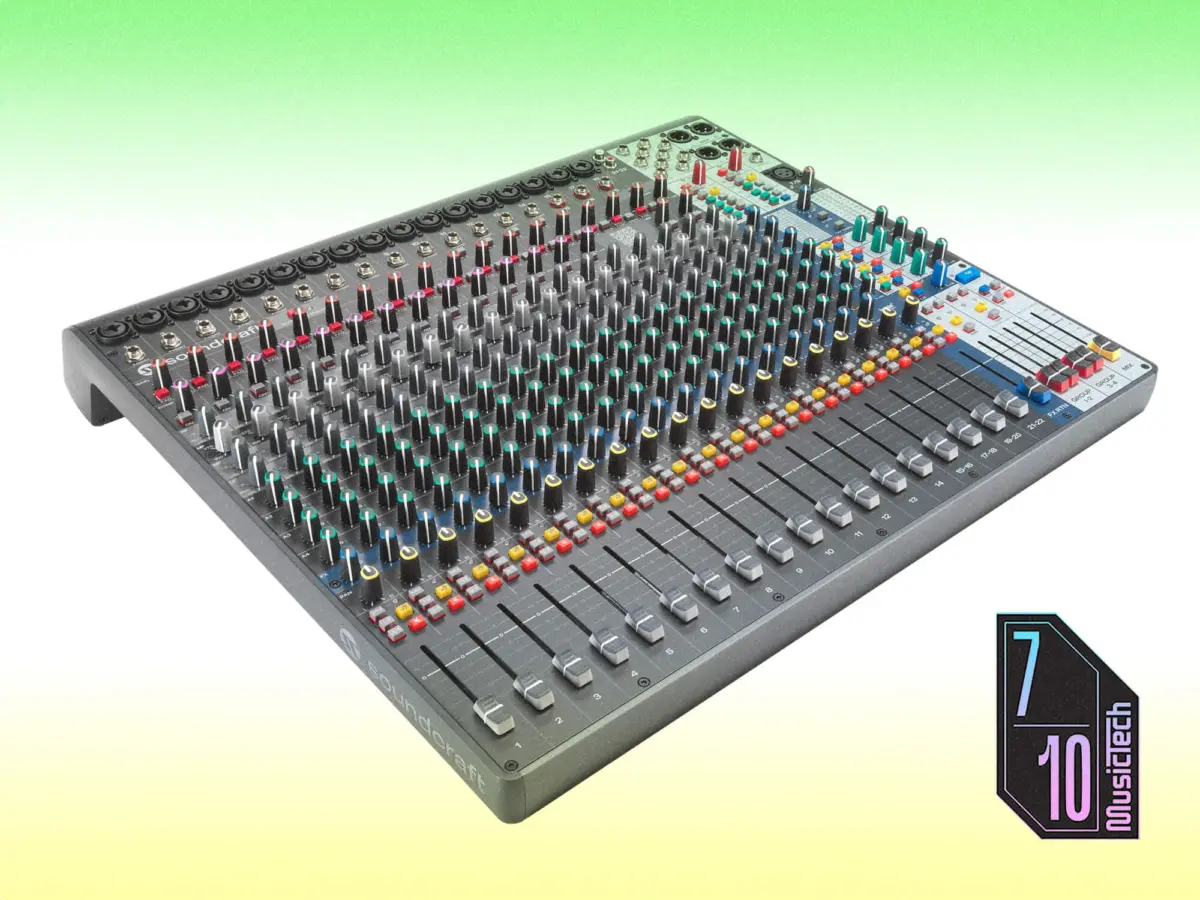
At the heart of the Signature Plus 22 lies a comprehensive layout designed to accommodate complex small-to-midsize setups without clutter. The console features a total of 22 inputs, strategically partitioned into 14 mono channels and three stereo channels. Channels 1 through 17 are driven by Soundcraft’s proprietary Ghost mic preamps, renowned for their ultra-low noise floor and generous headroom. Inputs 21 and 22 are dedicated to RCA connections, facilitating easy playback from consumer audio sources, backing tracks, or mobile devices.
Furthermore, inputs 11 through 14 feature switchable high-impedance (Hi-Z) instrument-level inputs, allowing electric guitars, basses, and passive pickups to be plugged directly into the console without requiring external direct injection (DI) boxes. Every mono channel is also equipped with a physical insert point, granting engineers the flexibility to patch in outboard hardware compressors, EQ units, or spatial processors.
Connectivity and Digital Integration
While firmly anchored in the analog domain, the Signature Plus range acknowledges modern hybrid workflows by incorporating a 4×4 USB-C audio interface operating at up to 192 kHz. This interface allows for seamless stereo playback from laptops or mobile devices, serving as a reliable backbone for backing tracks or intermission music during live sets. (Note: The USB implementation is designed for playback and stereo interfacing rather than full-blown multitrack recording).
Dynamics, EQ, and Lexicon Processing
Signal management on the Signature Plus 22 is both intuitive and deeply musical:

- Preamp Filtering: Each preamp channel includes a -18dB pad and a 100 Hz high-pass filter. While a 100 Hz cutoff might initially feel aggressive in a sterile studio environment, it proves invaluable in live venues, effortlessly stripping away low-end mud and room-resonance rumble generated by rowdy crowds and vibrating stages.
- Onboard Compression: Every mono channel features a single-control rotary compressor. Operating with a preset 10 ms attack time, a 300 ms release time, and a gentle 1.5:1 ratio, the compressor provides a "slow-and-steady" leveling effect that glues sources together without pumping or crushing the natural transient response.
- Three-Band EQ with Sweepable Mids: The EQ section utilizes fixed high (10 kHz) and low (60 Hz) shelving filters, paired with sweepable mid-range frequencies. Capitalizing on the golden audio adage that "the magic is in the mids," this sweepable control allows engineers to meticulously carve out mud or boost vocal clarity with surgical precision.
- Lexicon Effects Engine: Audio can be routed via five auxiliary sends (four standard, one dedicated) into a built-in Lexicon-powered effects processor boasting 32 distinct algorithms. Ranging from pristine reverbs and spatial delays to creative textures like Roto Delay, chorus, and tremolo, these effects feature three adjustable parameters per algorithm. Settings are instantly retrievable or easily wiped with a system reboot—ideal for revolving venue engineers.
Official Statements and Design Insights
The ergonomic and tactile success of the Signature Plus 22 is no accident; it is the result of exhaustive human-factors engineering. Speaking on the meticulous design process, Scott Wood, Product Manager at Soundcraft, shed light on the philosophy guiding the physical architecture:
"The intention was always to offer users the chance to mix directly with their fingers. Every contour, curve, and millimeter of the fader caps was carefully prototyped to ensure they are easy to nudge, slide, and manipulate without the engineer ever needing to take their eyes off the stage.
We went so far as to ensure that all four fingers and a thumb share a uniform tactile experience across multiple faders simultaneously. When you are operating in high-pressure live environments, you need to be able to make blind adjustments with absolute confidence."
This commitment to tactile feedback extends to the console’s visual indicators. Soundcraft implemented a clear, intuitive LED metering system that transitions seamlessly from green (signal present) to yellow (optimal operational headroom) and finally red (clipping or full compression ratio). By removing ambiguity, the hardware communicates mix health instantly. Even the physical buttons have been redesigned for universal comprehension: the "Listen" (PFL/AFL) button features a clean ear graphic, while the Mute button displays a crossed-out speaker icon, transcending language barriers in international touring environments.
Future Outlook: The Resurgence of Analog in Modern Production
As the pro audio market looks toward the future, the rapid proliferation of artificial intelligence, cloud-based mixing, and complex digital ecosystems has inadvertently triggered a counter-movement. Producers, singer-songwriters, and live sound engineers are experiencing digital fatigue—exhausted by the cognitive friction of touchscreens, latency issues, and driver compatibility errors.

The Soundcraft Signature Plus 22 arrives at the vanguard of this cultural shift. By proving that an analog workflow can deliver the sonic power, routing flexibility, and reliability of digital counterparts without the associated technological baggage, Soundcraft has charted a clear path forward for the industry.
For small-to-medium music venues, mobile sound reinforcement companies, house-of-worship technicians, and acoustic artists performing in intimate spaces, the Signature Plus 22 offers an uncompromised sanctuary of sound. It successfully fulfills its ultimate engineering mandate: remaining an invisible, frictionless conduit between the artist’s performance and the audience’s emotional experience.
As the industry embraces this hybrid evolution, one thing is abundantly clear to engineers worldwide: Analogue mixers are back, baby.