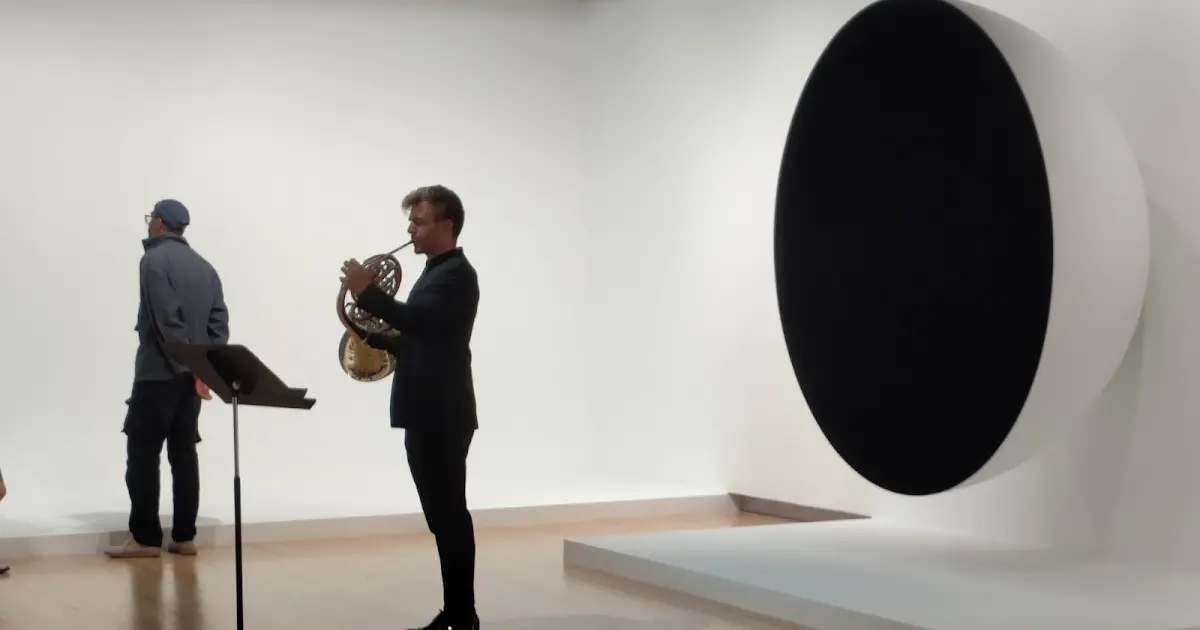
In the contemporary arts landscape, the sensory domains of sight and sound are traditionally curated as sovereign entities. Audiences are conditioned to listen in acoustic isolation within concert halls or to absorb visual stimuli in the hushed, white-walled confines of galleries. However, a groundbreaking collaborative intervention at the Southbank Centre’s Hayward Gallery in London has shattered these conventional boundaries. On Saturday, September 12, 2026, acclaimed horn player Ben Goldscheider stepped directly into the heart of Anish Kapoor’s critically acclaimed, "gobsmacking" retrospective to perform Touching the Quick—a specialized cycle of unaccompanied horn pieces composed by Brian Elias.
Written expressly in response to Kapoor’s monumental and provocative sculptural works, Elias’s composition transforms the gallery into an immersive, multi-sensory landscape. Rather than remaining static, Goldscheider engaged in a perambulatory performance, migrating alongside an enthusiastic audience from room to room. As the spatial dynamics of the Hayward Gallery shifted, so too did the musical architecture of Touching the Quick, with each movement mirroring the visceral geometry, profound darkness, and striking color palettes of Kapoor’s visual art.
This review-analysis explores the convergence of Elias’s sophisticated contemporary classical idiom and Kapoor’s staggering physical installations. By chronicling the journey through the galleries—from the light-swallowing abysses of Vantablack to the blood-red mountainous peaks—we examine how this site-specific sonic-visual synthesis challenges our perceptual faculties, redefines the boundaries of exhibition spaces, and establishes a new benchmark for cross-disciplinary artistic collaboration.
Detailed Chronology: A Perambulatory Journey Through Sound and Vision
The performance commenced at 6:00 PM on September 12, 2026, drawing a substantial crowd of art lovers and contemporary music aficionados willing to follow the musician through the gallery’s winding architectural layout. The structure of the performance was as mobile as it was intentional, mapping a direct psychological and acoustic path through Kapoor’s thematic installations.
Station 1: The Void and the Awakening
The journey began in the opening gallery space, dominated by Anish Kapoor’s deep black installations, including his avant-garde experiments with Vantablack—the revolutionary nanomaterial capable of absorbing virtually all incident light. As visitors gathered in the enveloping shadow of these optical paradoxes, Ben Goldscheider raised his horn.
The initial notes were remarkably quiet, low, and sustained, immediately conjuring subterranean, operatic depths reminiscent of the opening of Wagner’s Das Rheingold. As Elias’s motif gradually developed, accelerating in speed and ascending in pitch, the music evoked a waking giant or a sleeping dragon stirring from an ancient slumber. Despite the introduction of a more defined melodic line, every single note retained a deliberate, meticulously weighted gravity. The movement eventually wound down, dissolving back into the primordial silence from which it emerged.
Station 2: Visceral Geometry and Jagged Lines
From the contemplative dark of the first room, the audience migrated alongside the performer into the second gallery space. Here, Kapoor’s Mount Moriah at the Gate of the Ghetto hung upside down from the ceiling—an astonishing, visceral red mountain that dominated the architectural volume of the room.
Beneath this suspended monolithic mass, Goldscheider launched into the second movement. The music was instantly characterized by a fast, vivid, and restless mobility. Its jagged edges and energetic propulsion easily held their own against the heavy visual gravity of the hanging sculpture. Interestingly, the low, sustained figures from the first movement returned briefly, acting as an anchor against the frantic, jagged material above. The movement ultimately receded into a more reflective, thoughtful mode, bridging the gap between frantic energy and spatial contemplation.

Station 3: Chattering Peaks and Technical Virtuosity
The third stop brought the perambulatory audience face-to-face with Ha Makom, a colossal, mountainous landscape rendered in an aggressive, vivid red (accompanied by strict warnings to visitors that physical contact would result in permanent staining).
Responding to the sheer scale of the landscape, Elias’s score responded with high, rapid, almost chattering phrases. These short, anxious bursts created an unrelenting sense of forward motion. Once again, a slower, meditative section provided a brief emotional reprieve before the opening material forcefully reasserted itself, gradually winding down.
By this third station, the profound technical demands placed upon Goldscheider became glaringly apparent. Touching the Quick requires an extraordinary range of stylistic execution and technical versatility, traversing a wide tessitura. Goldscheider seamlessly bridged the gap between rapid, high-register articulation, deep sustained pedal tones, and complex double-note techniques—all while navigating the physical constraints of a crowded exhibition space.
Station 4: Veiled Melancholy and Bodily Resonance
The final destination of the primary journey was the gallery’s closing room—a space explicitly marked by management warnings regarding "artworks suggestive of blood and entrails."
In this charged environment, Goldscheider utilized advanced hand-stopping techniques on his horn, imparting a veiled, muted, and intensely introverted quality to the timbre. The music adopted a profound, melancholic introspection that bore striking stylistic affinities to the expressive vocal lines of Benjamin Britten. Passages fluctuated between a gentle, rocking berceuse and moments of searing emotional intensity. Yet, this intensity remained perpetually veiled, ultimately resolving into the very same long, low notes that had opened the entire performance in the Vantablack room.
The Cyclical Resolution
Defying expectations of a linear conclusion, the performance looped back on itself. Goldscheider and the audience returned to the first room for a final repetition of the opening piece. This structural loop fundamentally altered the perceptual experience; hearing the opening movement a second time—with ears now sensitized by the blood-red mountains and veiled entrails of the subsequent rooms—transformed the audience’s relationship to both Elias’s score and Kapoor’s light-swallowing voids.
Supporting Context & Metrics
| Metric / Detail | Description & Context |
|---|---|
| Event Date | Saturday, September 12, 2026 (Performances at 6:00 PM and 7:00 PM; further dates scheduled for October 3, 2026) |
| Venue | Hayward Gallery, Southbank Centre, London |
| Visual Artist | Anish Kapoor (Exhibition praised as "gobsmacking" by The Guardian) |
| Composer | Brian Elias (Touching the Quick, a cycle of pieces for unaccompanied horn) |
| Performer | Ben Goldscheider (Solo Horn) |
| Format | Perambulatory, site-specific acoustic intervention moving through four distinct gallery spaces |
| Acoustic Techniques | Muted/hand-stopped horn, expansive tessitura, wide dynamic contrasts, dual-note production |
The pairing of Brian Elias and Ben Goldscheider within the context of an Anish Kapoor retrospective highlights a growing movement within contemporary curation: the dissolution of siloed artistic disciplines. Historically, contemporary classical music and visual art exhibitions occupy parallel tracks. Visitors look at art in silence, while concertgoers stare forward at a stage.
By forcing the audience to physically traverse the gallery behind a lone horn player, the Southbank Centre curatorial team successfully dismantled passive consumption. The physical exertion required by Goldscheider—carrying a brass instrument through crowded galleries, adapting embouchure and projection to four vastly different acoustic environments—mirrored the physical labor inherent in Kapoor’s monumental sculptures. Furthermore, Elias’s composition serves as an analytical framework for Kapoor’s art, translating the visual weight of Vantablack and the aggressive textures of red pigment into sonic equivalents of shadow, velocity, and breath.

Official Statements and Critical Reception
The exhibition as a whole has dominated cultural discourse in the UK arts sector, with The Guardian famously declaring Anish Kapoor’s Hayward Gallery retrospective to be "gobsmacking." The scale, ambition, and psychological intensity of Kapoor’s sculptural output provided a fertile breeding ground for musical interpretation.
Brian Elias, renowned for his refined ear for timbre and dramatic pacing, designed Touching the Quick not merely as background accompaniment, but as an active interlocutor to Kapoor’s physical forms. Speaking on the collaborative ethos of the project, representatives for the Southbank Centre emphasized the desire to create an "immersive dialogue where sound and space mutually interrogate one another."
Ben Goldscheider, recognized internationally as one of the leading horn virtuosos of his generation, has continually pushed the boundaries of his instrument’s repertoire through commissioning and boundary-pushing performance art. His execution of Touching the Quick has been lauded by critics and attendees alike for maintaining absolute tonal beauty and immaculate control amidst the logistical and acoustic unpredictability of a major public art gallery.
Future Outlook
The success of Touching the Quick at the Hayward Gallery points toward a promising horizon for interdisciplinary curation in major cultural institutions. As audiences increasingly seek holistic, multi-sensory engagements with art, the traditional model of isolated gallery viewing and auditorium listening faces mounting pressure to evolve.
Following the initial triumph of the September 12 performances, Ben Goldscheider and the Southbank Centre have scheduled additional presentations of the cycle for Saturday, October 3, 2026. These upcoming dates offer a vital opportunity for wider audiences to experience how contemporary classical composition can successfully inhabit, challenge, and illuminate physical gallery spaces.
Looking forward, the Elias-Kapoor-Goldscheider collaboration serves as a compelling blueprint for future museum and gallery programming. By demonstrating that solo acoustic instruments can successfully converse with massive, hostile, and sublime visual installations—without diminishing the impact of either medium—this project proves that the future of the arts lies not in isolation, but in courageous, site-specific synthesis.