Executive Overview
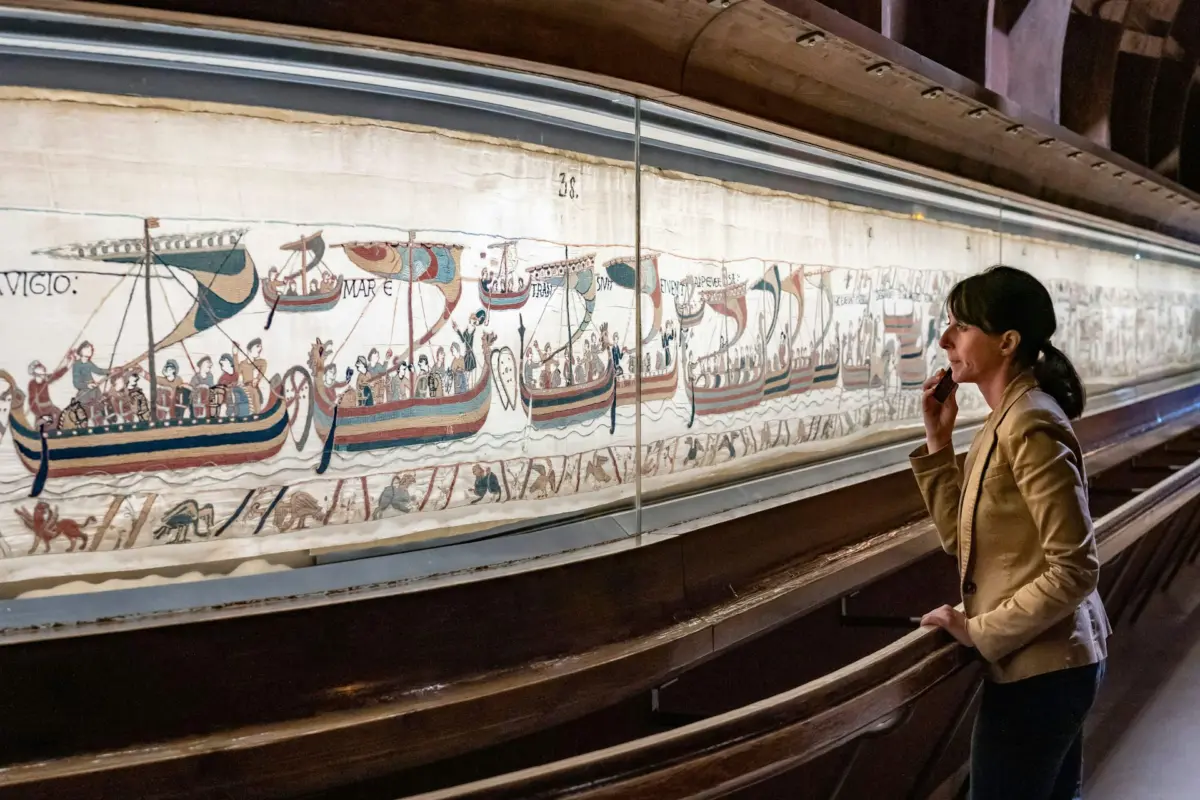
As preparations ramp up for the British Museum’s landmark exhibition of the Bayeux Tapestry—slated to run from September 2026 through July 2027—scholars and heritage professionals are re-evaluating one of the medieval world’s most magnificent and enigmatic survivals. Spanning a monumental 68 meters of embroidered linen, the tapestry has long been scrutinized for its political subtexts, geographical origins, and precise manufacturing techniques. Yet, a paradigm shift is currently underway in early medieval textile archaeology.
Beyond its identity as a static historical chronicle of the 1066 Norman Conquest, the tapestry is increasingly understood as a piece of sophisticated cognitive and sensory material culture. Far from being a quiet museum artifact safely tucked behind climate-controlled glass, the original hanging was designed to move, breathe, catch the light, and interact with the ambient sights, sounds, and smells of an early medieval hall.
By marrying high-resolution micro-analysis of its stitches with immersive historical reconstruction, experts are discovering that the Bayeux Tapestry was an early form of "theatre in the round." It was a kinetic, tactile, and deeply individual psychological experience that bridged the gap between oral tradition and permanent visual art.
Detailed Chronology: From the 11th Century to the 2026–2027 British Museum Exhibition
To fully appreciate the cultural weight of the Bayeux Tapestry, one must trace its journey from a turbulent political landscape in the 11th century to its modern status as a global icon of medieval heritage.
The Mid-11th Century: Genesis and Creation (c. 1066–1080)
- The Historical Backdrop: Following the death of Edward the Confessor in January 1066 and the subsequent coronation of Harold Godwinson, William, Duke of Normandy, launched an invasion of Anglo-Saxon England. The resulting Battle of Hastings on October 14, 1066, fundamentally altered European history.
- The Commission: While exact patronage remains a subject of academic debate, historians frequently point to Bishop Odo of Bayeux, the half-brother of William the Conqueror, as the prime candidate behind the commissioning of the monumental embroidery to cement Norman supremacy and legitimize their claim to the English throne.
- The Craftsmanship: Crafted by skilled embroiderers—likely working in England utilizing traditional Anglo-Saxon stitchcraft techniques (including laid-and-couch stem stitch)—the narrative was wrought using naturally dyed wool yarns stitched onto imported, high-grade plain-weave linen ground fabric.
The Centuries in Hiding (12th–18th Centuries)
- First Written Record: The earliest definitive documentary evidence of the tapestry appears in a 1476 inventory of the treasury of Bayeux Cathedral, where it was traditionally hung along the nave walls during the feast of relics.
- The Revolutionary Rescue: During the French Revolution in the late 18th century, the tapestry narrowly escaped destruction. Local revolutionaries intended to use the long linen strip to cover military wagons. Fortunately, a local lawyer and administrator recognized its historic value and intervened, securing the artifact for safekeeping.
The Modern Era and Conservation (19th–21st Centuries)
- 19th-Century Discovery: Rediscovered by the scholarly community in the early 1800s, the tapestry underwent its first major modern illustrations and scientific surveys, revealing both its exceptional artistry and the scars of previous, heavy-handed restorations.
- The 20th-Century Safe Havens: During World War II, the tapestry was evacuated from Bayeux to secure underground storage locations to protect it from allied bombardments and Axis looting operations.
- The 2026–2027 British Museum Landmark: In an unprecedented cultural exchange, arrangements were finalized for the Bayeux Tapestry to cross the English Channel for a blockbuster exhibition at the British Museum, opening in September 2026 and running through July 2027. This event provides a generational opportunity for contemporary textile archaeologists and the public to re-examine the masterpiece under state-of-the-art analytical conditions.
Supporting Context & Metrics: Anatomy of a Masterpiece
The enduring fascination with the Bayeux Tapestry is underscored by a vast corpus of academic literature, scientific testing, and physical metrics that define its construction.
+--------------------------------------------------------------------------+
|                        BAYEUX TAPESTRY BY THE NUMBERS                    |
+---------------------------+----------------------------------------------+
| Surviving Length          | Approx. 68 meters (223 feet)                 |
+---------------------------+----------------------------------------------+
| Standard Height           | Roughly 50 centimeters (20 inches)           |
+---------------------------+----------------------------------------------+
| Ground Fabric             | Plain-weave cream/white linen                |
+---------------------------+----------------------------------------------+
| Embroidery Threads        | Spun wool in various natural plant/insect dyes|
+---------------------------+----------------------------------------------+
| Academic Publications     | Over 1,000 documented research works         |
+---------------------------+----------------------------------------------+
| Exhibition Window         | September 2026 – July 2027 (British Museum)  |
+---------------------------+----------------------------------------------+
The Materiality of Making
Analyzing the reverse of the tapestry from detailed photographic records, alongside microscopic examinations of the front surface, reveals the deep technical knowledge possessed by early medieval embroiderers. These artisans did not merely follow a static pattern; they understood how different fiber twists, thread thicknesses, and stitch densities would react over time.
The wool yarns—dyed in earthy tones of terracotta, blue-green, yellow, and dark indigo—create stark, dynamic contrasts against the smooth, creamy expanse of the linen ground. When light hits these fibrous wool threads, they absorb and reflect illumination differently than the flat linen background, a subtle physical property that brings the static imagery to life.
A Century of Scholarship
An online bibliographical search yields over 1,000 published scholarly works dedicated to the Bayeux Tapestry. These studies span a remarkably broad range of inquiries:
- Attribution: Debates over whether it was manufactured in Kent, Winchester, or Northern France.
- Narrative Fidelity: Investigations into whether the architectural motifs, armor, weaponry, and flora/fauna accurately mirror 11th-century realities.
- Hidden Iconography: Endless fascination with the marginalia, secular fables, and anatomical curiosities stitched into the upper and lower borders.
Official Statements & Expert Perspectives
The evolving understanding of the tapestry as a multisensory, cognitive artifact is driven by leading voices in early medieval archaeology and textile history.
Reflecting on the tactile and psychological dimensions of the hanging, professional embroiderers and textile specialists working with the British Museum catalogue note:
"When the tapestry was originally displayed within the confined space of a castle keep or cathedral nave, it was far from a static, silent document. The hanging moved. Caught by a draught or brushed by a passing observer, the stitched pictures came alive, turning a linear narrative into something akin to a cinematic experience."
Furthermore, experts emphasize the psychological divergence between the tapestry and contemporary oral traditions:
"While early medieval scops—traditional storytellers—utilized the spoken word to mentally shape a listening audience into a unified, shared consciousness, the Bayeux Tapestry operated on a deeply individual level. The intensely visual nature of the hanging allowed each viewer to interpret what they saw through the lens of their own life experiences, beliefs, and local viewpoints."
Curatorial teams at the British Museum have similarly stressed that the upcoming 2026–2027 exhibition aims to contextualize the embroidery not merely as a trophy of war, but as an advanced feat of medieval engineering and visual communication that invited active audience participation.
Future Outlook: Re-imagining Medieval Material Culture
As the heritage sector prepares for the monumental influx of visitors to the British Museum’s 2026–2027 exhibition, the study of the Bayeux Tapestry is entering a thrilling new phase. Future research will likely rely heavier on non-invasive spectroscopic analysis, digital multispectral imaging, and experimental archaeology to recreate the exact lighting, atmospheric conditions, and acoustic environments of 11th-century great halls.
Key Frontiers for Future Research:
- Sensory Archaeology: Reconstructing the multisensory ecosystem of medieval display spaces—combining the visual undulation of the wool-on-linen tapestry with authentic ambient soundscapes (feasting, clattering crockery, overlapping conversations) and historical olfactory elements (woodsmoke, roasted meats).
- Advanced Dye Analysis: Utilizing non-destructive chemical testing to trace the geographic sourcing of the plant and insect dyestuffs, shedding light on early medieval trade routes and economic networks.
- Cognitive Reception Studies: Exploring how modern museum visitors interact with ancient textiles compared to medieval audiences, bridging the gap between passive viewing and active, tactile engagement.
Ultimately, the Bayeux Tapestry remains a towering achievement of human creativity. By shifting our perspective from flat historical documentation to dynamic, multisensory engagement, we unlock a richer, more vivid connection to the men and women who stitched—and walked alongside—this remarkable medieval masterpiece nearly a thousand years ago.