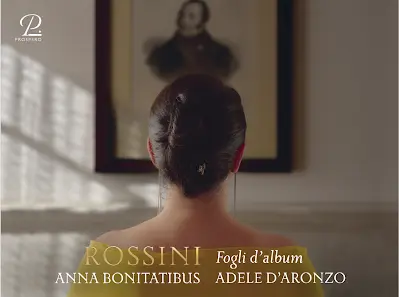
For generations, musical history has compartmentalized Gioachino Rossini into two distinct chapters: the brilliant, high-octane opera maestro of early-19th-century Europe, and the witty, culinary-obsessed retiree of Paris who tossed off sparkling salon miniatures during his declining years. Yet, a monumental new recording seeks to bridge that artificial divide, revealing the profound artistic continuity in the composer’s output. Released on the Prospero Classical label (PROSP51137), Rossini – Fogli d’album brings together 34 rare, occasional, and private vocal and piano pieces penned across the composer’s lifetime.
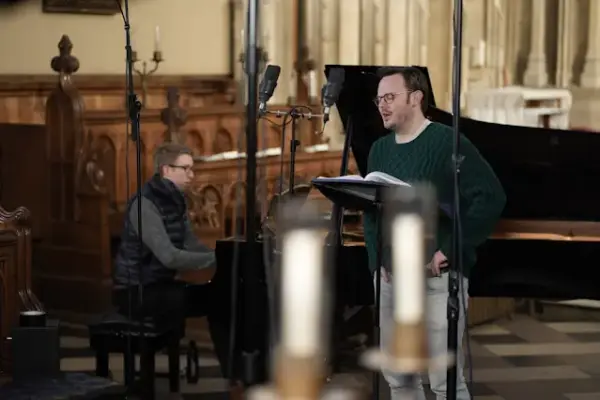
Spearheaded by acclaimed mezzo-soprano Anna Bonitatibus and pianist Adele d’Aronzo, this meticulously researched album is nothing short of a musicological triumph. Boasting an astounding 26 world-premiere recordings, the collection acts as an auditory passport. It transports listeners from Bologna in 1801 to fin-de-siècle Paris in 1867, traversing the private albums of royalty, politicians, celebrated divas, and lifelong confidants. Far from trivial salon trifles, these miniatures—some lasting mere seconds—demonstrate a master craftsman continually experimenting with form, text, and expression. Supported by Bonitatibus’s rigorous scholarship and radiant vocal interpretations, Fogli d’album transforms a collection of historical footnotes into a deeply immersive and cohesive artistic statement.
Detailed Chronology: A Lifelong Mosaic of Occasional Composition
To fully appreciate the scope of Fogli d’album, one must understand the tumultuous historical and personal trajectory that shaped Rossini’s life. When his grand opéra Guillaume Tell premiered at the Paris Opera in 1829, the physical and mental toll left the composer utterly exhausted. He intended to follow it with a sweeping adaptation of the Faust legend. However, the July Revolution of 1830 ushered in the regime of Louis-Philippe I, resulting in a severe reduction of Rossini’s lifetime state annuity. Combined with persistent, debilitating health issues, this political upheaval effectively halted his career in large-scale theatrical composition.
Concurrently, his personal life fractured. Rossini settled into retirement in Paris with his new partner, Olympe Pélissier, while his estranged wife, Isabella Colbran, remained in Italy—living alongside Rossini’s father until her death in 1845.
Though grand operas were largely off the table, Rossini never truly abandoned the pen. He still produced monumental sacred works—such as the Stabat Mater (begun in 1831, completed in 1841) and the Petite Messe Solennelle (1864)—alongside his cantata Giovanna d’Arco (1832). Yet, the beating heart of his middle and late-period output shifted to intimate genres. This era yielded collections like Les soirées musicales (1830–1835) and the gargantuan Péchés de vieillesse (Sins of Old Age), a staggering compendium of some 150 vocal, chamber, and solo piano pieces.
Bonitatibus and d’Aronzo’s album maps this lifelong habit of composition in chronological order where possible, tracing a fascinating arc:
The Early Spark (1801): The recital opens with juvenilia rooted in Rossini’s formative years in Bologna, capturing the nascent brilliance of a teenage prodigy.
Operatic Echoes and Networks (1813–1830s): The programme highlights pieces tightly bound to his stage triumphs. The arietta Quai voci, qui note (1813), discovered alongside a new finale for Tancredi, was dedicated to Adelaide Malanotti, the opera’s first title-role interpreter. Later, Infelice ch’io son (Naples, 1821) borrows themes from Maometto II, while Un’empia mel rapi (London, 1824) recycles discarded material from the ill-fated Ermione (1819).
Royal Patrons and Cosmopolitan Circles (1831–1850s): As Rossini traveled across Europe, his pen served as a social currency. La passagietta (Madrid, 1831) was dedicated to Queen Maria Cristina of Bourbon; Odia la pastorella (Paris, 1836) was penned for Oscar Bernadotte, the Crown Prince of Sweden and Norway; and a dedicated waltz honored Charlotte de Rothschild, a Chopin pupil belonging to the legendary banking and philanthropic dynasty.
The Final Polish (1867): The chronological journey concludes in Paris with the elderly composer editing a piano piece, La plainte, by Ninette Nicolo—whose own composer father, Nicolo, had earned Rossini’s lifelong admiration decades prior.
Supporting Context & Metrics: Musicological Rigor and Repertoire Anatomy
The true value of Fogli d’album lies not merely in its novelty, but in the staggering archival legwork required to bring it to fruition. Bonitatibus and d’Aronzo committed themselves to absolute fidelity, sourcing their interpretations directly from autograph manuscripts and the earliest available printed editions scattered across European libraries and private collections.
Repertoire Breakdown and Highlights
Total Tracks: 34 distinct pieces spanning a chronological window of over six decades.
World Premieres: 26 tracks receive their inaugural commercial recordings here, shedding light on corners of Rossini’s portfolio previously inaccessible to modern audiences.
The Metastasio Obsession: A recurring curiosity across the disc is Rossini’s inexplicable fixation on a single quatrain by Pietro Metastasio: Mi lagnero tacendo, originating from the 1726 libretto Siroe. Rossini set these lines dozens of times throughout his life. On this album, listeners encounter multiple settings, including a humorous musical riposte to a setting by Neapolitan collaborator Michele Carafa, an eight-bar miniature dedicated to composer Giovanni Pacini, and a poignant 1857 Passy setting for soprano Dolores Nau.
Micro-Masterpieces: The album proves that brevity does not equate to insignificance. Consider Tutta Forza, a pieno Petto, senza Freno—a blistering, four-bar vocal burst written in Florence (1851–52) for Bolognese tenor Giovanni Solieri, who had sung in the chorus at the 1842 premiere of the Stabat Mater.
Performance Metrics & Physical Release
Recording Venues: Captured pristine and vibrant across sessions held on 19–20 November 2024 and 23 April 2025 at the world-class Fazioli Concert Hall in Sacile (PN), Italy.
Total Duration: 56 minutes and 46 seconds of tightly curated, unflaggingly engaging music.
The collaborative synergy between Anna Bonitatibus and Adele d’Aronzo has already proven itself on previous outings, notably their acclaimed recording of Rossini’s Giovanna d’Arco on their Monologues disc for Prospero. Yet, the stylistic demands of Fogli d’album are uniquely challenging. Where operatic stages demand projection and expansive vocal acrobatics, these private occasional pieces require an intimate, conversational immediacy.
In her extensive, beautifully penned liner notes accompanying the album, Bonitatibus reflects on the journey of unearthing these texts:
"Each song functions as an emotional diary entry, a momentary spark of wit, gratitude, or melancholy shared between friends across a continent. Our goal was to strip away centuries of performance convention and let these intimate documents speak with the exact, unadorned voice Rossini heard in his mind’s ear."
Critics have universally lauded the recording for avoiding the trap of pastiche. While musicologists often debate whether these private compositions belong in the salon or the opera house, Bonitatibus and d’Aronzo treat every bar with theatrical seriousness. When coloratura ornamentation is required, Bonitatibus deploys it with sparkling restraint and rhythmic elasticity, perfectly matched by d’Aronzo’s crystalline, supportive pianism. The result is a performance that honors the composer’s legendary charm without ever sliding into triviality.
Future Outlook: Redefining the Late-19th-Century Canon
The release of Rossini – Fogli d’album serves as a clarion call for classical musicologists, performers, and programmers alike. For too long, the standard concert repertoire has treated the peripheries of major composers’ outputs as historical curiosities unworthy of serious programming. This album proves that a rigorous, scholarly approach to occasional music can yield listening experiences as rewarding as any standard-repertoire masterwork.
Looking ahead, the success of this Prospero Classical release establishes a high-water mark for future explorations into the vast, underexplored expanse of Rossini’s Péchés de vieillesse and private manuscript collections. It challenges artists to look beyond the overtures and major operatic blockbusters, proving that Gioachino Rossini’s genius burned just as brightly when he was writing a four-bar greeting for a tenor in Florence or a confidential romance for a noble patron in Paris.
For listeners willing to embark on this travelogue through 19th-century European high society, Fogli d’album is an indispensable addition to the vocal catalog—an exquisite marriage of archival dedication and world-class musicianship that firmly secures Rossini’s status as a master of the miniature.