Executive Overview
Nearly half a century after his sudden passing in August 1977, Elvis Presley remains one of the most recognizable and debated figures in human history. Yet, the sheer ubiquity of his myth has created a cultural blind spot. It is easy to view the King of Rock ‘n’ Roll merely as a nostalgic caricature—an image reduced to glittering Las Vegas jumpsuits, velvet paintings, and Saturday-morning tabloid fodder.
To understand Elvis Presley properly is to understand the architecture of modern celebrity itself. Before Presley, the framework for a globally adored, cross-demographic, multi-platform pop icon simply did not exist. When a withdrawn, acne-scarred teenager walked into the Sun Records studio in Memphis in 1954, he did not merely record a few tracks; he stepped onto an unmapped precipice. With no blueprint to follow, every career maneuver Presley made—from cinematic pivots to military service, from genre-blending singles to closed-circuit global television broadcasts—forged the path that every modern rock star, pop diva, and internet influencer unwittingly walks today.
This analysis examines the profound transformation of Elvis Presley across his seventeen foundational months at Sun Records and his subsequent twenty-year reign. By breaking down ten distinct ways he reshaped global culture, we decode how a "hip-shaking bumpkin from Tupelo" became the undisputed architect of the modern entertainment complex.
Detailed Chronology: From Sun Records to Global Folklore
To chart Presley’s trajectory is to witness a masterclass in rapid self-reinvention and cultural disruption.
[1954: Sun Records] ---> [1956: RCA & Crossover] ---> [1960s: Hollywood Slump] ---> [1968: The Comeback] ---> [1969-1977: Vegas & Global Peak] ---> [Post-1977: Folklore]- The Sun Records Genesis (1954–1955): Entering Sam Phillips’ studio as a shy, blonde, deeply insecure teenager, Presley spent seventeen transformative months discovering a sonic middle ground. By combining rural country roots with urban rhythm and blues, he systematically dismantled racial and stylistic boundaries in American radio.
- The RCA Breakthrough and Cultural Shockwave (1956–1958): Signed by RCA, Presley shed his rural anonymity. He adopted his iconic jet-black hair, refined his dynamic stage presence, and triggered a generational earthquake. His televised appearances caused nationwide moral panic among adults while galvanizing a newly empowered youth demographic.
- The Cinematic Exile (1960–1968): Following his discharge from the U.S. Army, Presley entered a decade-long Hollywood purgatory. Bound to restrictive management under Colonel Tom Parker, he churned out more than thirty formulaic musical comedies. While this eroded his critical standing, it laid the groundwork for massive multimedia saturation.
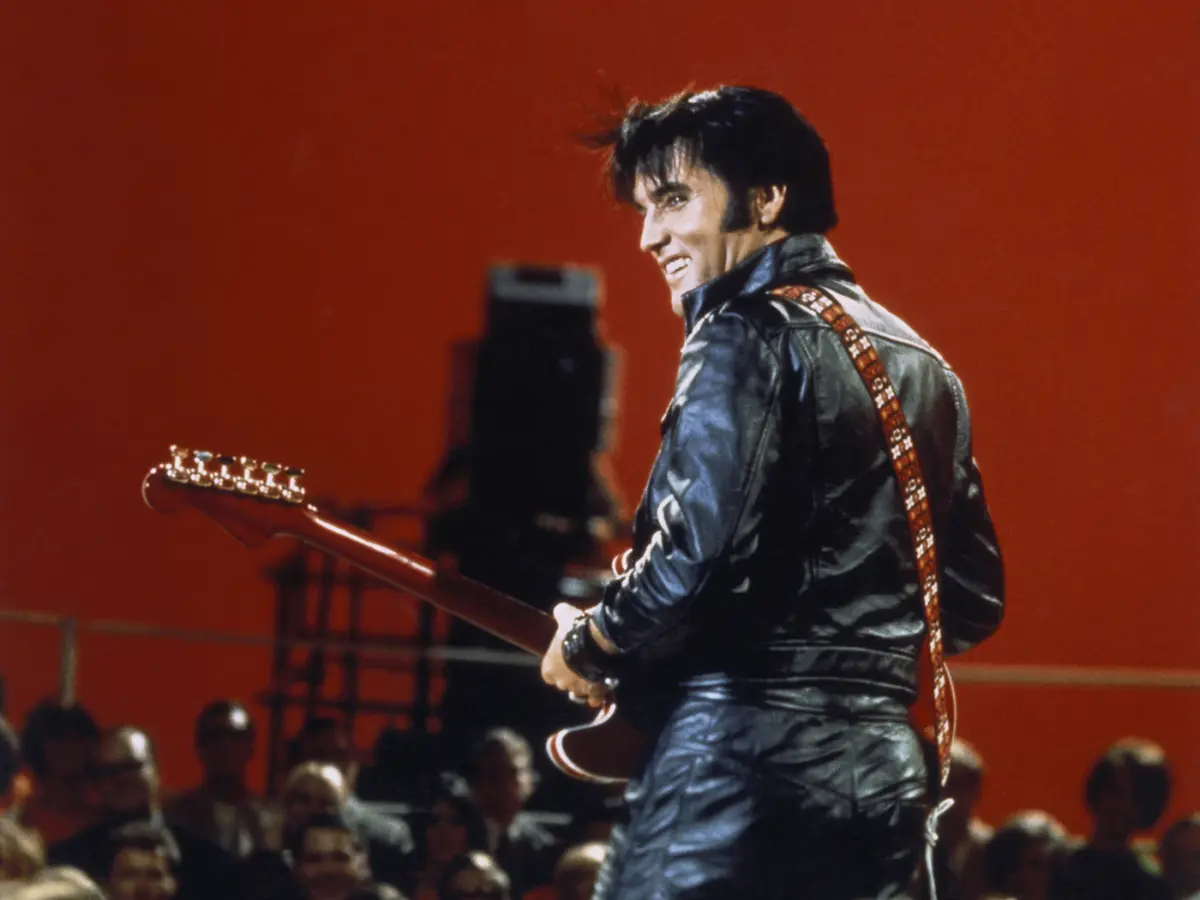
- The ’68 Comeback Special: In December 1968, an hour-long NBC television event rescued Presley from cinematic irrelevance. Stripped down to black leather and raw, unvarnished blues, he reminded the world of his kinetic power and invented the modern pop redemption arc.
- The Las Vegas Residency and Global Satellite Era (1969–1977): Presley redefined live performance through a landmark residency at the International Hotel in Las Vegas, playing over 600 consecutive sold-out shows. This era culminated in Aloha from Hawaii Via Satellite (1973), the largest single-entertainment broadcast in television history.
- Deification and Folklore (Post-1977): Following his death at Graceland at age 42, Presley transitioned from a mortal entertainer into global folklore. He became the first major artist whose commercial value, cultural mythology, and pervasive urban legends eclipsed his living output.
The Ten Pillars of the Presley Paradigm
1. The Birth of the Crossover Artist
Before Elvis, American radio and the recording industry were rigidly segregated by genre and race. Presley’s early singles for Sun Records were deliberate hybrid experiments: a country tune on the A-side, a rhythm and blues track on the B-side. Initially, this strategy confounded programmers—his sound was deemed "too white" for Black stations and "too Black" for white ones.
However, as public demand surged, Presley breached every commercial barrier, conquering country, R&B, pop, and gospel charts simultaneously. In doing so, he established the cross-genre playbook that modern superstars like Taylor Swift and Beyoncé employ today. By proving that genre boundaries were artificial constructs meant to be shattered, he unlocked unprecedented commercial territories.
2. Tailoring the Rock Star Aesthetic
Presley discarded the unpretentious denim-and-t-shirt uniform favored by early rockabilly acts, just as he rejected the conservative suits and ties of the mainstream establishment. Instead, he pioneered a flamboyant, highly personalized performance wardrobe.
Shopping extensively at Lansky Brothers on Beale Street, he curated an unmistakable visual identity defined by flashy jackets, dramatic collars, and bold accessories. His evolution culminated in the legendary 1970s Vegas jumpsuits—characterized by exaggerated bell-bottoms, deep-V necklines, and jewel-encrusted capes—alongside his signature thick gold sunglasses. This hyper-stylized approach taught generations of musicians that fashion is not merely an accompaniment to music, but an essential component of an artist’s mythology.
3. Kinetic Performance and Stagecraft
At one of his earliest live engagements, an overwhelmed Presley experienced stage fright so severe that his legs began to tremble uncontrollably. Rather than freezing, he leaned into the physical reaction, exaggerating the movement into a provocative swivel of the hips and thrusts toward the screaming audience.
To the adult establishment, these movements were viewed as an explicit moral hazard; to teenagers, they were an electrifying liberation. Even during his later, more physically constrained years, Presley remained a commanding, kinetic presence who paced the stage and incorporated dynamic karate stances into his routines. Every rock frontman who has ever prowled, jumped, or thrust a microphone stand into the crowd is a direct descendant of Presley’s physical lexicon.
4. Empowering the Teenager as an Economic Superpower
In the post-World War II economic boom, American adolescents found themselves with disposable income for the first time in history. Adults were entirely unprepared for Presley, but teenagers immediately recognized him as their champion. They funneled their allowance money into singles, concert tickets, fan magazines, and branded merchandise.
While earlier icons like Frank Sinatra and Benny Goodman had enjoyed youth followings, Presley cemented the adolescent demographic as the ultimate driving force of the global pop economy. Without the roaring, wallet-wielding teenagers who chased Presley, the cultural hysteria of Beatlemania—and the modern teen-pop industrial complex—would never have materialized.
5. Pioneering the Megascale Career Misstep
Presley was the first major rock star to experience public failure and artistic compromise on a colossal scale. While contemporaries like Jerry Lee Lewis and Buddy Holly faced personal scandals or tragic ends, Presley endured a decade-long creative exile in Hollywood. Trapped in a rigid contract managed by Colonel Tom Parker, he starred in over thirty formulaic films—some moderately entertaining (Viva Las Vegas), others critically excoriated (Kissin’ Cousins).
While Presley was sidelined by cinematic mediocrity, British Invasion bands like The Rolling Stones and The Beatles rewrote the rules of rock. Presley’s Hollywood slump served as a cautionary tale for the music industry, demonstrating how unchecked commercial opportunism could dilute an artist’s cultural capital.
6. Inventing the Modern Pop Comeback
By late 1968, Presley’s musical relevance appeared permanently compromised by his cinematic output. Recognizing the crisis, television producer Steve Binder collaborated with Presley on an hour-long NBC special simply titled Elvis.
Eschewing the holiday-special conventions of the era, the broadcast paired elaborate musical numbers with raw, unplugged blues jams in front of an intimate audience. The special was an unmitigated triumph, rescuing Presley from pop-culture purgatory, spawning chart-dominating anthems like "Suspicious Minds" and "Burning Love," and introducing an entirely new paradigm: the career resuscitation. By proving that an aging artist could reinvent themselves without surrendering their core identity, Presley invented the modern pop comeback.
7. Redefining the Las Vegas Residency
In July 1969, Presley accepted an extended residency at the newly opened International Hotel in Las Vegas. Over the next seven years, he performed more than 600 consecutive, sold-out shows. While legendary entertainers like the Rat Pack had long established Sin City as a playground for adult sophistication, Presley transformed the Vegas residency into a high-octane rock-and-roll spectacle.
He infused his performances with lavish orchestral arrangements, dramatic lighting, and theatrical pacing. In doing so, he turned the Vegas residency from a semi-retirement option into a lucrative victory lap—a model later adopted and re-engineered by icons ranging from Celine Dion and Lady Gaga to Adele and Bruno Mars.
8. Globalizing the Live Event via Satellite
On January 14, 1973, Presley achieved a technological and logistical milestone with Aloha from Hawaii Via Satellite. Broadcast live to Asian markets and via tape-delay to Europe and Oceania, the concert reached an estimated 1.5 billion viewers across 36 countries, making it the most-watched television broadcast in history at that time.
The accompanying live album debuted at the summit of the charts, proving the immense commercial viability of borderless, multimedia entertainment. This ambitious undertaking laid the immediate groundwork for subsequent global charity events and stadium-spanning spectacles, from Live Aid to Taylor Swift’s The Eras Tour.
9. The Posthumous Profit Paradox
Presley’s death in August 1977 triggered a bizarre economic phenomenon: he became significantly more profitable and culturally ubiquitous in death than he had been during his final, difficult years. Graceland opened to the public as a museum in 1982, quickly transforming into one of the most-visited private homes in the world.
Simultaneously, his catalog continued to generate massive revenues, while his image became the foundation of a multi-million-dollar licensing industry. He also became a favorite subject for unauthorized biographies, critical exposés, and satirical musical tributes. In death, Presley demonstrated that a modern pop icon could transcend biological mortality to become an immortal, self-sustaining corporate and cultural entity.
10. Transmuting into Global Folklore
In the decades following his passing, Presley completed his final, most improbable metamorphosis: he left the realm of pop stardom entirely and entered the domain of modern folklore. Fueled by campfire urban legends—such as the classic tale of the hitchhiker picked up outside Memphis who vanishes at Graceland’s gates—sightings of a living Elvis became a pop-cultural meme throughout the 1980s and 1990s.
Whether spotted working at a Michigan grocery store or living in seclusion with JFK and Marilyn Monroe, Presley achieved a status shared by very few historical figures. He ceased to be merely a man or an entertainer; he became a mythic archetype, deeply embedded in the collective consciousness of humanity.
Supporting Context & Metrics
To fully grasp the magnitude of Presley’s commercial footprint, consider the scale of his achievements within the recorded music industry:
- Global Record Sales: Estimated at over 500 million records worldwide, making him one of the best-selling music artists of all time.
- Chart Dominance: Achieved 18 number-one singles on the U.S. Billboard Hot 100 chart and amassed a record 129 entries on the Billboard 200 album chart.
- RIAA Certifications: Awarded more gold, platinum, and multi-platinum albums than almost any other solo artist in music history.
- Cultural Reach: His televised Aloha from Hawaii concert reached roughly 37% of the global population in 1973—a media saturation rate virtually unmatched before the advent of the internet.
Official Statements & Critical Perspectives
Cultural historians, musicologists, and fellow artists have long grappled with the complex legacy of Presley’s impact on society:
"Elvis is our greatest cultural hero. Without him, the entire landscape of modern music, fashion, and youthful rebellion would be unrecognizable. He didn’t just sing songs; he changed the emotional frequency of the entire world."
— Greil Marcus, Cultural Critic and Author of Mystery Train"A lot of people think he was just a lucky kid who stumbled into the right place at the right time, but that’s nonsense. Elvis had an innate understanding of how to connect with an audience on a cellular level. When he stepped on that stage, time stopped."
— Quincy Jones, Legendary Producer and Composer
Future Outlook: The Indelible Blueprint
As we approach the 50th anniversary of his passing, the legacy of Elvis Presley faces a fascinating duality. For older generations, he remains the visceral embodiment of mid-century youthful rebellion and vocal brilliance. For younger generations navigating the algorithmic landscape of TikTok, streaming, and manufactured pop stardom, Presley serves as the patient zero of modern celebrity culture.
With major biographical cinematic projects continuing to introduce his story to modern audiences, Presley’s cultural footprint shows no signs of receding. The challenges he faced—navigating intense public scrutiny, managing runaway fame, and fighting against artistic confinement—are the exact trials faced by every contemporary superstar. Ultimately, Elvis Presley did not merely change the world of music in the 1950s; he drafted the enduring operating manual for how the world consumes culture, admires icons, and manufactures legends.