Executive Overview
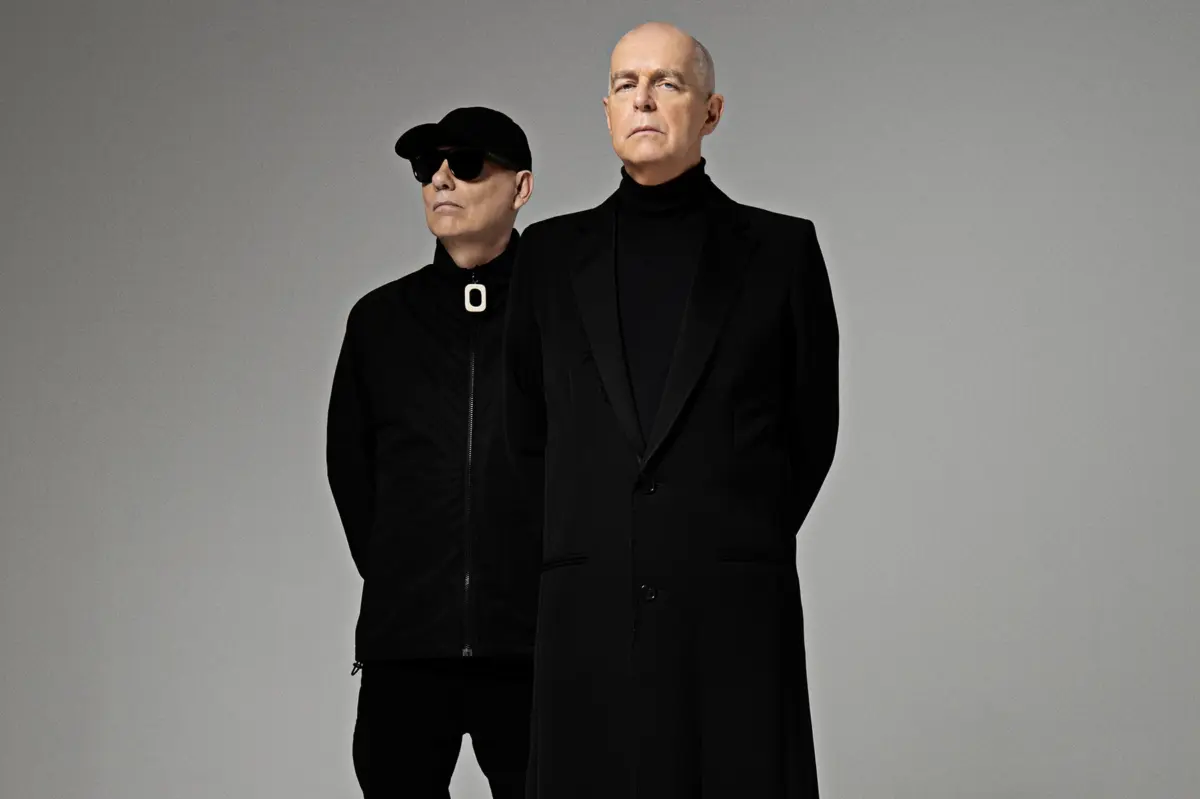
The legendary British electro-pop duo Pet Shop Boys have returned with a sweeping, deeply emotional project that bridges the gap between historical tragedy and forward-thinking electronic composition. Arriving precisely at midnight via Parlophone Records, A Man from the Future is a meticulously crafted concept album exploring eight definitive, transformative chapters in the life, monumental achievements, and tragic death of Alan Turing. Widely recognized as the intellectual father of modern computing and artificial intelligence, Turing’s brilliant mind helped alter the course of human history, only for his life to be cut short by systemic state-sponsored persecution.
Produced collaboratively by Pet Shop Boys (Neil Tennant and Chris Lowe) and German composer and producer Sven Helbig, the album is a striking synthesis of synthesized electronica and organic orchestrations. The classical elements are provided by the Manchester Camerata Octet, breathing cinematic depth into the compositions. Adding a vital layer of narrative gravity, acclaimed actress Juliet Stevenson delivers spoken-word passages adapted directly from Andrew Hodges’ definitive biography, Alan Turing: The Enigma.
Coming on the heels of their critically acclaimed 2024 album Nonetheless—which climbed to No. 2 on the Official U.K. Albums Chart—A Man from the Future represents a monumental artistic evolution. More than just a collection of pop songs, the release stands as an audiovisual monument, a deliberate act of historical restoration, and a profound meditation on genius, persecution, and the relentless march of technological innovation.
Detailed Chronology: The Eight Chapters of Turing’s Life
The structural backbone of A Man from the Future unfolds in a strictly chronological narrative, mapping Alan Turing’s journey from an inquisitive schoolboy to a foundational architect of the digital age, and finally to his unjust persecution and untimely demise.
1. The Formative Years: School and Early Curiosity
The album’s opening movements establish Turing’s early life, capturing his insatiable intellectual appetite during his school days. Long before he was decoding enemy ciphers or theorizing about thinking machines, Turing was a boy deeply captivated by mathematics, physical sciences, and the natural world. These early tracks blend sparse electronic pulses with inquisitive string arrangements, mirroring the awakening of a brilliant, hyper-analytical mind that viewed the universe through the lens of logic and equations. Concurrently, these foundational pieces touch upon the quiet, complex realization of his sexuality during an era governed by rigid, oppressive social norms.
2. Cambridge and the Birth of Theoretical Logic
As the narrative transitions to Turing’s university years at Cambridge, the musical landscape expands. The arrangements grow more complex, reflecting the academic rigor and intellectual stimulation of one of the world’s premier institutions. It was during this period that Turing laid the theoretical groundwork for modern computer science, conceptualizing the "Universal Turing Machine"—a mathematical model that anticipated the architecture of every modern computer, smartphone, and server in use today.
3. Bletchley Park and the Enigma
Perhaps the most historically explosive chapter of Turing’s life occurred during World War II, when he joined the ultra-secret Government Code and Cypher School at Bletchley Park. Tasked with breaking the supposedly unbreakable German Enigma machine code, Turing led the design of the "Bombe," an electromechanical device that successfully decrypted vital military intelligence. Military historians widely credit Turing’s work with shortening the war by years and saving millions of lives. Musically, this section utilizes frantic, driving electronic rhythms intertwined with urgent, ticking string patterns to replicate the high-stakes, pressure-cooker environment of wartime cryptanalysis.
4. Pioneering the Digital Computer and Artificial Intelligence
Following the conclusion of the war, Turing’s vision did not stall; it accelerated. He was among the first scientists to conceptualize digital computing machines capable of executing stored programs. Furthermore, he peered far beyond the mechanical limitations of his era, famously posing the question of whether machines could think, thereby laying the philosophical and practical foundations for modern Artificial Intelligence. The compositions in this phase utilize forward-looking synthetic textures, echoing the futuristic hum of server rooms and data centers decades before they became reality.
5. Trial, Persecution, and Conviction
The triumphant narrative of scientific achievement tragically shatters in the album’s later movements. In 1952, Turing’s private life was exposed when he was arrested and prosecuted by the British government for his homosexual relationship with another man—homosexuality being illegal in the United Kingdom at the time. To avoid a prison sentence that would have halted his academic research, Turing accepted court-mandated chemical castration (hormone treatment). The music shifts dramatically here into minor keys, utilizing mournful, elegiac strings and fractured electronic tones to convey the profound betrayal, humiliation, and state-sanctioned cruelty inflicted upon a national hero.
6. The Final Silence and Suicide
The chronological arc concludes with Turing’s tragic death. On June 7, 1954, just two weeks after his 42nd birthday, Turing was found dead from cyanide poisoning. An inquest established the cause of death as suicide. The final movements of A Man from the Future offer a devastatingly quiet, reflective resolution. Juliet Stevenson’s spoken-word delivery, drawn from Hodges’ text, anchors the sorrow, ensuring that the human cost of institutional bigotry is never overshadowed by the abstract wonder of Turing’s intellect.
Supporting Context & Metrics: From Proms to Parlophone
The journey of A Man from the Future to its commercial release is a decade-long saga of artistic refinement. Neil Tennant and Chris Lowe originally conceived the piece between 2012 and 2013, coincidentally just prior to the theatrical release of The Imitation Game, the Oscar-winning biographical drama starring Benedict Cumberbatch as Turing.

In July 2014, Pet Shop Boys offered the public a tantalizing preview of the project, performing select movements during a special BBC Prom at London’s iconic Royal Albert Hall. However, rather than rushing a studio recording to capitalize on the immediate media buzz surrounding the film, the duo elected to shelve and patiently re-evaluate the material.
More than a decade later, the project has been comprehensively updated, reworked, and rearranged. Working alongside Sven Helbig, Pet Shop Boys infused the original compositions with state-of-the-art electronic production, updated textual integration, and fresh orchestrations performed by the Manchester Camerata Octet.
Commercial Standing and Chart History
The release of A Man from the Future arrives during a period of sustained creative and commercial vitality for Pet Shop Boys. Their previous studio album, Nonetheless (2024), achieved critical acclaim and peaked at No. 2 on the Official U.K. Albums Chart, proving that the duo’s sophisticated songcraft remains as potent as ever.
Over a career spanning four decades, Pet Shop Boys have cemented their status as royalty in the global pop landscape:
- United Kingdom: Amassed 22 top 10 hit singles, including four No. 1s. Achieved ten top 10 albums, highlighted by a No. 1 debut with 1993’s Very.
- United States: Secured 12 entries on the Billboard Hot 100, featuring five top 10 hits and a historic No. 1 single with 1986’s iconic anthem, "West End Girls."
Official Statements and Artistic Intentions
The motivation behind A Man from the Future transcends standard commercial pop considerations; it is an act of historical restitution and cultural memory. In an official joint statement released alongside the album, Neil Tennant and Chris Lowe articulated the core purpose of their labor of love:
"Our motive in creating this work was to make a musical memorial to Alan Turing who gave so much to his country and the world and was rewarded for it by being prosecuted for his sexuality.
Alan made a massive contribution to the defeat of Germany in World War II and was a pioneer of computing, imagining a world with intelligent computers. He also looked forward to a time when being gay would be accepted as normal. In both his professional and private lives, he was ahead of his time."
The statement underscores the painful irony of Turing’s historical trajectory: a man who saved his nation through advanced pattern recognition and logical deduction was subsequently destroyed by the rigid, intolerant social patterns of the very society he protected. By pairing historical text with cutting-edge electronic arrangements, Pet Shop Boys ensure that Turing’s dual legacy—as a brilliant scientific savior and a victim of state homophobia—remains firmly in the public consciousness.
Future Outlook: Legacy and Cultural Impact
As A Man from the Future makes its way into the headphones and living rooms of listeners worldwide, its cultural implications extend far beyond the traditional album cycle. In an era where artificial intelligence dominates technological discourse, ethical questions surrounding machine consciousness, data privacy, and algorithm bias trace directly back to the theoretical frameworks laid down by Alan Turing in the mid-20th century.
By framing these technological breakthroughs within a narrative of personal suffering and political injustice, Pet Shop Boys have crafted a timeless piece of art that speaks urgently to the present day. As society continues to grapple with the ethical dimensions of the digital age—and ongoing struggles for civil rights and bodily autonomy—A Man from the Future serves as both a cautionary tale and a transcendent tribute.
Fans and newcomers alike can now stream A Man from the Future in its entirety across all major digital platforms via Parlophone Records. For Pet Shop Boys, this conceptual triumph reinforces their enduring status not merely as pop hitmakers, but as cultural historians equipped with synthesizers, sequencers, and an unyielding commitment to truth.