In the sprawling, often-mythologized landscape of late-20th-century counterculture, few figures traversed as many creative territories—or defied categorization quite as persistently—as Marsha Hunt. Born in Philadelphia in 1946, Hunt’s trajectory from a classically trained background to the white-hot center of London’s swinging 1960s underground remains a masterclass in artistic reinvention. To view her merely as a footnote in the romantic histories of rock royalty or as a glamorous muse to the era’s titans is to fundamentally misunderstand an artist who operated with rare intellectual rigor, fierce independence, and uncompromising integrity.
Over a career spanning more than five decades, Hunt conquered mediums that rarely intersected seamlessly. She was a pivotal anchor in the original London cast of Hair, breaking racial and cultural barriers on stage; a trailblazing model who challenged systemic exclusion in fashion; a critically admired recording artist who collaborated with master architects of modern pop and rock; a celebrated stage and screen actress; and, ultimately, a searingly honest, accomplished author of memoirs and novels.
Yet, this extraordinary versatility proved to be a double-edged sword. In an industry obsessed with packaging and predictable commercial arcs, Hunt’s refusal to be pigeonholed confounded executives and fragmented her audience. This retrospective examines the life, art, and enduring legacy of an unapologetic polymath—a woman whose uncompromising artistic vision helped define an era, yet whose defiance of industry conventions frequently left her standing entirely alone.
Detailed Chronology: From Philadelphia to the Global Stage
1946–1966: Formative Years and the Exodus to London
Marsha Hunt’s journey began in Philadelphia, where she cultivated early aspirations in acting, singing, and modeling. However, the cultural constraints of the United States in the mid-1960s soon gave way to a gravitational pull toward the United Kingdom. In February 1966, Hunt relocated to London, plunging headfirst into an emerging bohemian metropolis that was rapidly becoming the cultural capital of the Western world.
Her early days in the British capital were marked by proximity to cinematic and musical royalty. After securing a minor extra role in Michelangelo Antonioni’s landmark countercultural film Blow-Up, Hunt transitioned into the music scene. She served as a backing singer in Alexis Korner’s ensemble Free At Last, a crucial incubator for British blues talent. This tenure led to a brief, creatively charged relationship with legendary bluesman John Mayall. On his 1967 album, The Blues Alone, Mayall immortalized her as a fleeting muse, writing and dedicating both "Marsha’s Mood" and "Brown Sugar" to her before she moved onward to join Bluesology—a group featuring a young Long John Baldry and a famously hirsute Reg Dwight (later known to the world as Elton John).
Following a brief stint with the soul outfit Ferris Wheel, Hunt achieved national prominence when she secured a role in the original London cast of Hair. As the first genuine rock musical centered around hippie culture, Hair championed a philosophy of peace, love, and radical bodily liberation, utilizing public nudity as a profound statement against censorship and war. Hunt seized this ethos, singing lead on "White Boys"—a brilliantly satirical send-up of The Supremes—and cementing her status as a radical new voice on the British stage.
1969–1973: The Musical Vanguard and the Visconti Collaboration
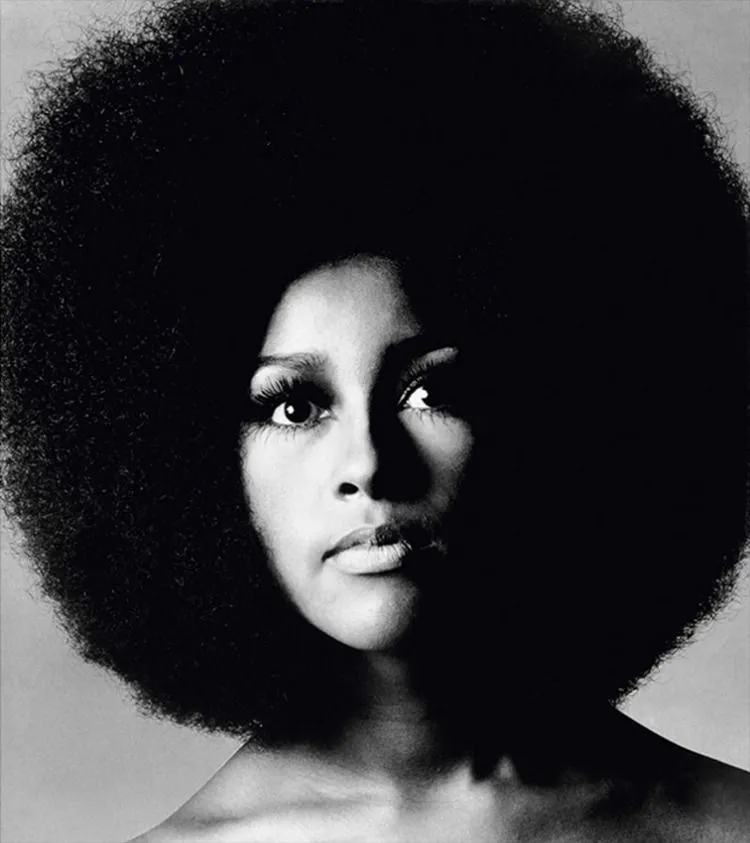
Hunt’s striking visage on the promotional posters for Hair caught the attention of Patrick Anson, the Earl of Lichfield, who invited her to pose nude for American Vogue. At a time when Black models were virtually absent from the glossy pages of high-fashion publications, Hunt accepted the commission not merely as a modeling assignment, but as a deliberate act of political and personal empowerment.
Simultaneously, Hunt signed a recording contract with Track Records, the legendary label that housed The Who and The Jimi Hendrix Experience. She shared a profound artistic affinity with Hendrix, recognizing his unique ability to channel complex sociopolitical and emotional landscapes through his guitar and lyrics.
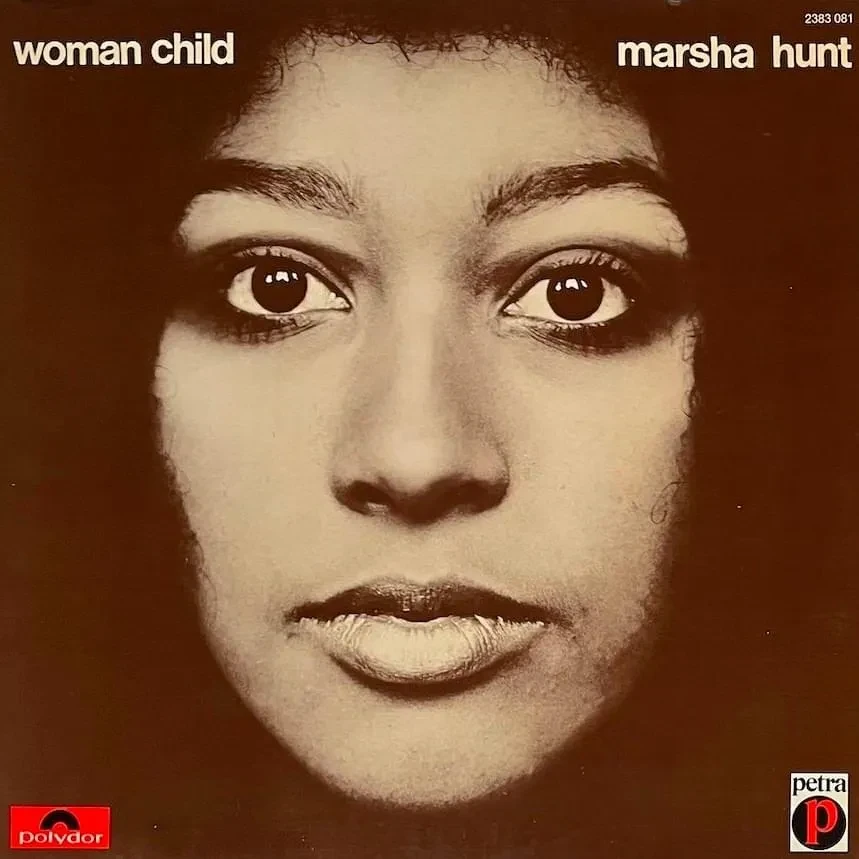
Working alongside visionary producer Tony Visconti, Hunt released her debut single in 1969: a searing, swamp-funk cover of Dr. John’s "Walk On Gilded Splifters." While the track became a minor hit, it arguably did more to elevate Dr. John’s profile than her own. It was during these intense studio sessions with Visconti that Hunt crossed paths with Marc Bolan. Their passionate affair yielded covers of two Tyrannosaurus Rex songs and a striking rendition of Bolan’s "Desdemona" (originally a hit for John’s Children in 1967), all recorded while Hunt was assembling material for her debut solo album, Woman Child.
It was also during this hyper-visible era that Hunt engaged in a high-profile, intense relationship with Rolling Stones frontman Mick Jagger. Their planned pregnancy resulted in the birth of their daughter, Karis. Following a well-publicized paternity battle, Jagger ultimately established a lasting connection with Hunt and their daughter. Notably, Jagger’s earlier composition "Brown Sugar" was written with Hunt’s fierce, defiant independence explicitly in mind.
Produced by Visconti and finally released in 1971 after persistent industry delays, Woman Child stands as a testament to Hunt’s eclectic vocal range and sophisticated interpretive powers. The record featured daring reworkings of Traffic’s "No Face, No Name, No Number," Bessie Smith’s "Moan You Moaners," and the contentious title track penned by Bobby Goldsboro and Kenny O’Dell. Despite critical praise for its bold, psychedelic edge, the album suffered from poor commercial distribution—a persistent tragedy that foreshadowed the hurdles she would face throughout her musical career.
1972–1983: Genre-Hopping, Discos, and Cinematic Turns
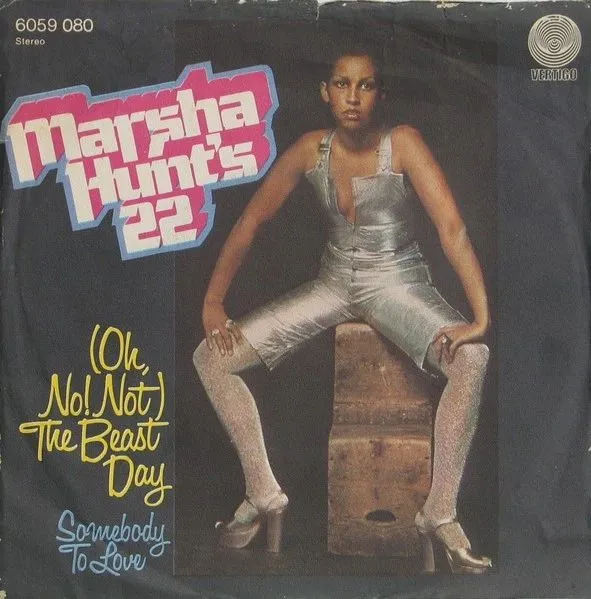
Refusing to stagnate, Hunt transitioned to Phonogram Records, fronting a four-piece outfit named Marsha Hunt’s 22. In 1972, they released "(Oh, No! Not) The Beast Day," a Louisiana-flavored swamp-hoodoo track produced by Steve Rowland, paired with a raucous, unruly cover of Grace Slick’s "Somebody To Love." A second single, the psych-funk hybrid "Medusa / Bop City," co-written by Hunt and guitarist Hugh Burns, met a similar commercial fate due to sparse promotional backing. A second album, Attention! Marsha Hunt! (1973), cobbled together from early demos, saw a limited European release—one that Hunt herself remained entirely unaware of for over four decades.
As her musical momentum slowed due to corporate missteps, Hunt pivoted fluidly back to acting. She starred alongside PJ Proby and Dana Gillespie in Jack Good’s Catch My Soul, a rock-infused adaptation of Shakespeare’s Othello. She subsequently commanded the West End stage during a six-month run in Melvyn Bragg’s musical Mardi Gras. By 1976, she secured a landmark dramatic role: playing Sabina—a part famously originated on stage by Vivien Leigh—in Thornton Wilder’s The Skin of Our Teeth at Manchester’s newly opened Royal Exchange Theatre.
Sensing a shifting cultural tide in 1977, Hunt traveled to Munich to record a disco-oriented album, Marsha 77, produced by Pete Belotte, the close associate of Giorgio Moroder who co-wrote dancefloor anthems like Donna Summer’s "I Feel Love" and "Hot Stuff."
Concurrently, her cinematic footprint expanded. Hunt secured memorable roles in a diverse array of films, including the Hammer horror film Dracula AD 1972 (starring horror icons Christopher Lee and Peter Cushing), Lindsay Anderson’s satirical dark comedy Britannia Hospital (1982), the James Bond installment Never Say Never Again (1983), and Beyond Soho (1989) alongside Ray Winstone.
1982–Present: The Literary Frontier and Enduring Legacy
In 1982, Hunt wrote and produced Man To Woman, a musical exploring four women and their complex relationships with men, staged at London’s Zig Zag Club. When financial challenges hindered the production, Hunt made a momentous life choice: she stepped away from the music industry entirely to dedicate herself to literature.
This pivot proved to be a masterstroke. Her searingly candid 1986 autobiography, Real Life, established her as a formidable literary voice. She followed this with Repossessing Ernestine (1996), a poignant investigative memoir detailing her multi-generational family search for her paternal grandmother, who spent 50 years institutionalized in an asylum. In 2005, she published Undefeated, documenting her courageous, public battle with breast cancer. Concurrently, Hunt carved out a respected career as a novelist, publishing Joy (1990), Free (1992), and Like Venus Fading (1998)—the latter deeply influenced by the historic lives of pioneering Black entertainers Adelaide Hall and Josephine Baker.
Supporting Context & Metrics
To fully appreciate Marsha Hunt’s artistic output, one must analyze the systemic friction between her uncompromising vision and the commercial strategies of 1970s record labels.
- The Genre Fragmentation Matrix: Hunt’s musical output defied simple radio formatting. Over a single decade, she pivoted from blues-rock and psychedelic soul (Woman Child) to Louisiana swamp-funk (Marsha Hunt’s 22) and Euro-centric electronic disco (Marsha 77). While this displayed staggering versatility, radio programmers and marketing departments struggled to categorize her, directly impacting chart longevity.
- Literary Transition Metric: Hunt’s transition from pop culture icon to critically acclaimed author yielded six major published books (three memoirs/non-fiction works and three novels), establishing her footprint in British letters far beyond the shelf life of standard pop-star autobiographies.
- Cinematic and Theatrical Reach: Her career spanned lead roles in prestigious regional theatre (Royal Exchange), West End musicals, Hammer horror classics, James Bond blockbusters, and avant-garde British cinema.
Official Statements and Industry Reflections
Producer Tony Visconti, who helmed Hunt’s most critically revered early recordings, spoke at length regarding her unique approach to the craft and the friction she experienced with corporate entities:
"Marsha was very smart. She approached her music very intellectually. She was totally confident in her innate beauty, but she was also into how we could interpret the material for her album in a very hip, almost psychedelic way. She wanted to make a credible ‘guy’ record, and not come off as a Black Marilyn Monroe, which is how the record company saw her."
Hunt herself has frequently reflected upon the challenges of navigating an entertainment industry determined to reduce multifaceted women to flat archetypes. In interviews surrounding her autobiographical works, she noted that her fierce rejection of passive roles—both on and off the stage—frequently cost her commercial momentum, yet preserved her artistic sovereignty. Her peer, singer-songwriter peer groups, and critics alike have increasingly pointed to her as a vital missing link in the narrative of 20th-century British counterculture.
Future Outlook & Critical Reappraisal
As contemporary musicology and cultural history undergo a sweeping retrospective correction—one that seeks to unearth vital artists sidelined by mid-century record label politics and racial bias—Marsha Hunt is experiencing a well-deserved critical renaissance.
Archival vinyl reissues, academic analyses of 1960s radical theatre, and renewed interest in her literary canon have positioned Hunt not merely as a glamorous artifact of the swinging sixties, but as an intellectual architect of modern artistic independence. Whether through the uncompromising vulnerability of her memoirs, the psychedelic audacity of Woman Child, or her pioneering visibility in fashion and musical theatre, Hunt mapped out a blueprint for modern intersectional artistry long before the term entered the cultural lexicon.
Ultimately, Marsha Hunt’s legacy rests upon her refusal to be managed, packaged, or understood on anyone’s terms but her own. A wild child, a willful rebel, and an intellectual of fierce integrity, she remains a defining force of her era—an artist whose relentless refusal to compromise ensured that, while her commercial peaks may have been scattered, her cultural impact remains indelible.