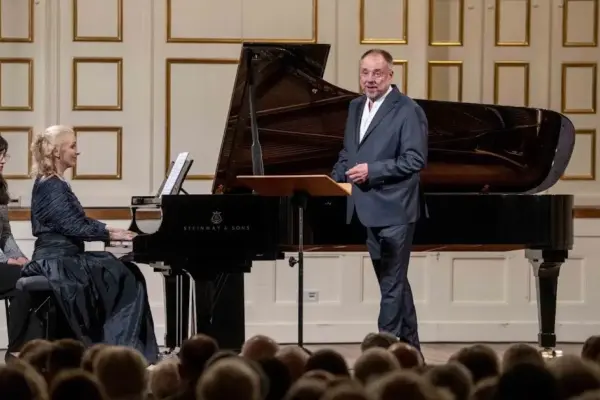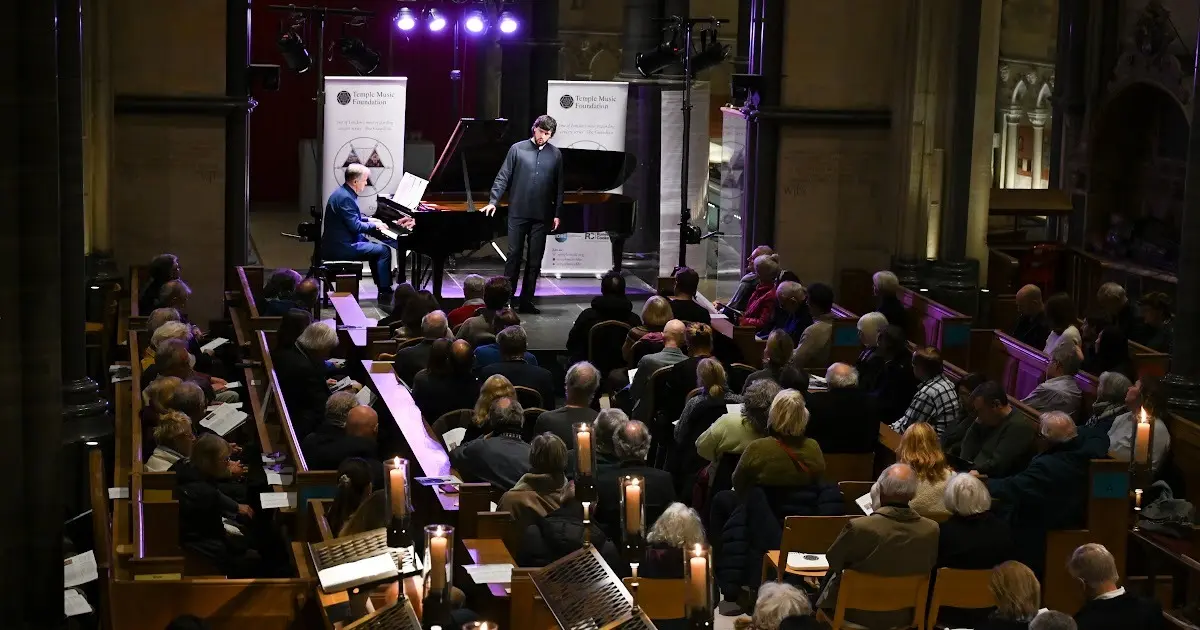
On November 12, 2026, London’s historic Temple Church played host to an extraordinary evening of German Romantic art song, as part of the prestigious Temple Music series. Celebrated baritone Andrè Schuen, joined by master collaborative pianist Julius Drake, delivered a masterclass in vocal interpretation titled A Poet’s Love. The recital focused exclusively on the profound musical chemistry between Robert Schumann and the poetry of Heinrich Heine, spotlighting two monumental song cycles from Schumann’s miraculous "Year of Song" (1840): the Liederkreis, Op. 24, and Dichterliebe, Op. 48.
For an audience gathered within the ancient, acoustically demanding stone architecture of the Temple Church—a space better known for choral majesty than intimate Lieder—Schuen and Drake achieved a rare alchemy. Eschewing operatic grandiloquence in favor of textual clarity, emotional directness, and psychological nuance, the duo navigated the bittersweet terrain of unrequited love, heartache, and artistic torment. Featuring the rare inclusion of songs cut from Dichterliebe prior to publication and an exhilarating encore, the recital reinforced Schuen’s standing as one of the preeminent lieder interpreters of his generation, perfectly partnered by Drake’s peerless keyboard artistry.
Detailed Chronology: The Journey of A Poet’s Love
Part I: The Bitter-Sweet Landscape of Op. 24 Liederkreis
The evening commenced with Schumann’s Liederkreis, Op. 24, a sequence of nine songs drawn from the "Junge Leiden" (Young Sorrows) section of Heinrich Heine’s 1827 collection Buch der Lieder. Written during a turbulent period in Schumann’s life—while he was locked in a bitter legal battle with his future father-in-law, Friedrich Wieck, for the hand of Clara Wieck—the cycle mirrors the emotional volatility of Heine’s verse, which was deeply colored by the poet’s agonizing rejection by his cousin.
Singing entirely from memory, Andrè Schuen commanded the stage with striking poise. Rather than treating the cycle as a continuous narrative, Schuen and Drake mapped an arc of evolving psychological states.

- "Morgens steh’ ich auf und frage" opened the sequence, featuring Drake’s light, fluent piano patterns paired with Schuen’s dark, tightly focused vocal timbre.
- Moving through the vivid vigor of the second song, the performance transitioned into the hushed introspection of "Ich wandelte unter den Bäumen," where Schuen and Drake achieved a moment of genuine stasis, suspending time during the third verse.
- The apparent lightheartedness of "Lieb’ Liebchen" was cleverly subverted by Schuen, who injected a sharp, psychological twist into the denouement.
- "Schöne Wiege meiner Leiden" expanded magnificently, transitioning from lyric beauty into visceral intensity, before the brutal, driving energy of "Warte, warte, wilder Schiffmann" exposed raw bitterness in its second half.
- The first half closed with "Mit Myrten und Rosen," driven by spring-like rhythmic buoyancy that ultimately refused to offer comfortable resolution, leaving the haunting impression of unending suffering.
The Intermission Group: Recovered Gems and Myrthen
Before concluding the first half, Schuen and Drake ventured outside the standard Dichterliebe framework to perform four songs that Schumann ultimately cut from the final publication of Op. 48, alongside a beloved setting from Myrthen, Op. 25.
- "Dein Angesicht" (Op. 127, No. 2) unfolded with agonizingly slow, lyrical grace, proving that textual weight remained paramount for the performers.
- "Lehn’ deine Wang’ an meine Wang’" (Op. 127, No. 4) provided an injection of vivid, concentrated intensity.
- "Es leuchtet meine Liebe" (Op. 127, No. 3) featured a relentlessly urgent, flowing piano part executed with dazzling technical clarity by Drake.
- "Mein Wagen rollet langsam" (Op. 142, No. 4) offered a deeply contemplative atmosphere, rounded out by a long, expressive postlude that lingered in the church’s cavernous vaults.
- The first half culminated in "Du bist wie eine Blume" from Myrthen. Here, Schuen’s inward, confiding delivery laid bare the delicate, devotional beauty of Heine’s verse.
Part II: The Emotional Arc of Dichterliebe, Op. 48
Returning after the interval, the duo tackled Dichterliebe, setting texts from the Lyrisches Intermezzo of Heine’s Buch der Lieder. While Heine’s original collection frames a whimsical, satirical narrative of a knight visiting a fairy nightly, Schumann distilled these poems into a pure emotional distillation of heartbreak.
Schuen’s interpretation of Dichterliebe favored a mellow, retrospective maturity over juvenile histrionics:
- "Im wunderschönen Monat Mai" flowed naturally, its initial intimacy expanding gracefully into "Aus meinen Tränen sprießen."
- "Die Rose, die Lilie, die Taube, die Sonne" flashed past with dazzling velocity, while "Wenn ich in deine Augen seh’" traded bitterness for profound, aching sadness.
- The psychological balance tipped decisively in "Ich will meine Seele tauchen," portraying a poet desperately attempting to master his emotions—a facade instantly shattered by the ferocious, storm-tossed power of "Im Rhein, im heiligen Strome."
- "Ich grolle nicht" delivered the anticipated explosion of suppressed rage, bleeding directly into the acidic cruelty of "Und wüssten’s die Blumen, die kleinen," where Schuen spat out the final line—"For she it was who broke, / Broke my heart in two"—with chilling conviction.
- As the cycle progressed toward its tragic conclusion, the performance balanced fragility and despair. "Hör’ ich das Liedchen klingen" was delivered with devastating interiority, matched by Drake’s bleak, unyielding keyboard postlude.
- "Aus alten Märchen winkt es" introduced a fleeting, ironic swagger before dissolving into the mist of the line: "then comes the morning sun, and it vanishes like smoke."
- The final song, "Die alten, bösen Lieder," resonated with unyielding strength, yet resolved into a tender, haunting postlude that left the audience suspended in silence.
To reward the rapturous applause of the Temple Church audience, Schuen and Drake offered an electrifying encore: Schumann’s "Entflieh’ mit mir und sei mein Weib" from Tragödie, Op. 64, No. 3, bringing a final surge of Heine-inspired dramatic energy to the evening.

Supporting Context & Metrics
The Artistic Partnership: Schuen and Drake
The pairing of baritone Andrè Schuen and collaborative pianist Julius Drake represents a gold standard in contemporary Lieder performance. Schuen, whose career has scaled extraordinary heights—from his celebrated Schubert recitals at the Oxford Lieder Festival to major operatic triumphs such as Christoph Loy’s staging of Mozart’s Così fan tutte at the Salzburg Festival—possesses a voice of rare warmth, dark focus, and velvet depth.
Julius Drake, universally recognized as one of the world’s finest collaborative pianists, operates not merely as an accompanist, but as an equal narrative partner. In Schumann’s songs, where the piano postludes often carry the emotional weight of the poetry—commenting upon, subverting, or resolving the vocal line—Drake’s masterly touch provided the vital structural architecture for the evening.
The Venue: Temple Church
Hosting a Lieder recital in the historic Temple Church presents unique acoustic challenges. Built in the 12th century by the Knights Templar, its vast stone interior creates long reverberation times that can easily swallow the delicate consonances and intimate dynamics of German art song. However, Schuen’s meticulous diction and dynamic control, combined with Drake’s expertly balanced articulation, successfully conquered the space. The venue lent a sacred, contemplative gravity to the secular heartbreak of Heine’s poetry, elevating the recital from a standard concert to an immersive spiritual experience.
Official Statements & Critical Reception
While formal institutional press releases were limited, critical consensus surrounding the recital highlights its exceptional artistic merit:

- On Schuen’s Vocal Approach: Reviewers noted that Schuen’s performances were "not operatic, but possessed an emotional directness in manner as he really inhabited text and story."
- On the Dynamic Balance: Observers praised the seamless integration of voice and piano, observing that "Schuen was often confiding and intimate, never histrionic, but he did not shy away from the big moments, filling the church admirably."
- On the Programming: Musicologists and critics lauded the inclusion of the four cut Dichterliebe songs, noting that performing them at the end of the first half offered "an illuminating window into Schumann’s creative editing process during his miraculous song-writing year of 1840."
Future Outlook
The success of A Poet’s Love at Temple Church cements Andrè Schuen and Julius Drake as essential custodians of the Austro-German art song tradition. As Schuen continues to balance a high-profile international opera career—navigating canonical Mozart and Romantic repertoire on the world’s leading stages—his commitment to intimate recital spaces remains a vital cornerstone of his artistic identity.
Audiences across Europe can anticipate further iterations of this meticulously crafted Schumann/Heine programme, which demonstrates how nineteenth-century psychological turmoil can be rendered with startling, modern relevance. For Temple Music, this landmark evening further burnishes the venue’s reputation for curating world-class vocal recitals in historic London settings, leaving music lovers eagerly anticipating the next chapter in Schuen’s evolving artistic journey.