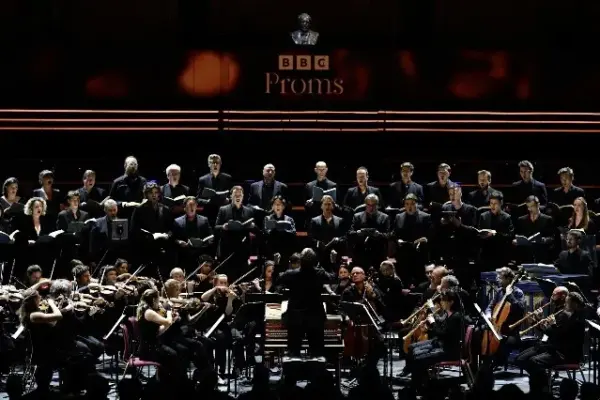
Arthur Honegger’s landmark mystère lyrique, Jeanne d’Arc au bûcher (Joan of Arc at the Stake), has returned to the Czech capital in a striking new recording on the Animal Music label. Recorded live between February 13 and 15, 2025, at Prague’s historic Rudolfinum, the release reunites the exact institutional forces that shaped the work’s iconic 1975 Supraphon recording under Serge Baudo: the Czech Philharmonic, the Prague Philharmonic Choir, and the Prague Philharmonic Children’s Choir.
At the helm of this modern interpretation is Lukáš Vasilek, Principal Conductor and Artistic Director of the Prague Philharmonic Choir. Making his collaborative orchestral debut with the Czech Philharmonic, Vasilek navigates Honegger’s intricate sonic architecture with razor-sharp style, unyielding clarity, and a profound sensitivity to text. He is joined by an elite cast of French actors, led by Audrey Bonnet as Jeanne d’Arc and Sébastien Dutrieux as Frère Dominique.
This new recording does more than merely revisit a mid-century repertoire favorite; it honors a 55-year legacy that links Honegger’s modernist visions with deep-seated Czech historical resilience. By marrying the theatricality of French spoken-word performance with the grand acoustic scope of the Czech Philharmonic, Vasilek and his forces deliver an urgent, hyper-dream-like interpretation of a twentieth-century masterpiece that continues to challenge traditional definitions of opera and oratorio.
Detailed Chronology: A Historical Arc in Prague
The enduring relationship between Arthur Honegger’s music and the premier musical institutions of Prague is a tapestry woven across decades of cultural exchange, political turmoil, and artistic milestones.
1921–1949: Laying the Foundations
Arthur Honegger’s footprint in Prague was established early. In 1949, the composer himself traveled to the city to conduct the Prague Philharmonic Choir during the Czech premiere of his landmark oratorio, Le Roi David (1921). This triumphant collaboration laid the groundwork for an enduring Czech affinity for Honegger’s muscular, rhythmically vital, and harmonically rich compositional style.
January 1970: Resonance and Resistance
The historical genesis of the Czech Philharmonic’s relationship with Jeanne d’Arc au bûcher carries profound political and emotional weight. In January 1970, the orchestra—under the baton of Václav Neumann—performed the dramatic oratorio at the Rudolfinum. This concert was dedicated to marking the first anniversary of the death of Jan Palach, the courageous Charles University philosophy student who set himself ablaze in Wenceslas Square in January 1969 to protest the Soviet-led Warsaw Pact invasion of Czechoslovakia. In this context, Honegger’s depiction of martyrdom, trial, and ultimate spiritual liberation became a searing symbol of contemporary Czechoslovak defiance.
1975: The Supraphon Milestone
Capitalizing on the profound resonance of the 1970 performances, the Czech Philharmonic, the Prague Philharmonic Choir, and the Prague Philharmonic Children’s Choir united in 1975 to record Jeanne d’Arc au bûcher for the Supraphon label under conductor Serge Baudo. This landmark recording achieved international acclaim, serving for decades as the definitive benchmark for interpreting Honegger and Paul Claudel’s hybrid masterpiece.
February 2025: The Rudolfinum Return
Fifty-five years after Neumann’s landmark performances, the institutional triad of the Czech Philharmonic, Prague Philharmonic Choir, and Prague Philharmonic Children’s Choir returned to the Rudolfinum in February 2025. These live performances captured the historic debut of Lukáš Vasilek conducting the Czech Philharmonic. Transferred to disc by Animal Music, this project successfully bridges a half-century gap, proving that the artistic DNA shared between these ensembles remains vital, evolving, and intensely communicative.
Supporting Context & Metrics
To fully appreciate the weight of this new recording, one must examine the genesis of the work, its unique structural demands, and the metrics of its modern realization.
The Genesis: Ida Rubinstein and Paul Claudel
Jeanne d’Arc au bûcher was born out of a unique convergence of aristocratic patronage, theatrical ambition, and modernist experimentation. The work was commissioned by Ida Rubinstein, born into one of late-nineteenth-century Russia’s wealthiest banking families in 1883. Tall, striking, and possessed of an arresting visual presence, Rubinstein studied private dance with Michel Fokine. While her technical limitations precluded her from taking classical ballerina roles under Sergei Diaghilev, her dramatic capacity for mime made her a sensation in Paris. She starred in landmark avant-garde productions such as the title role in Cléopâtre (1909) and Zobéide in Scheherazade (1910).
Transitioning into a legendary diseuse (a female speaker/reciter of artistic texts), Rubinstein cultivated a taste for hybrid theatrical works that blurred the lines between drama, dance, and music. She previously inspired collaborative masterpieces such as Gabriele d’Annunzio and Claude Debussy’s Le Martyre de Saint Sébastien (1911).

In the mid-1930s, Rubinstein envisioned a grand French touring spectacle centered on Joan of Arc. She approached Arthur Honegger, who eagerly accepted. To craft the text, Honegger and Rubinstein enlisted the eminent Catholic poet and diplomat Paul Claudel. Claudel, who had served as the French ambassador to Brazil during World War I (employing Darius Milhaud as his secretary), constructed a multi-layered, surrealist libretto that treats Joan’s final moments at the stake not as linear history, but as a feverish, memory-driven review of her life, framed by animal judges, mocking clergy, and divine grace.
Musical Mechanics and Aesthetic Challenges
Honegger’s score is structurally revolutionary. It blends symphonic development, choral polyphony, children’s voices, jazz-infused grotesqueries (notably in the trial scene featuring the cynical pig-lawyer, Porcus), and extended spoken melodrama.
The aesthetic hurdle of Jeanne d’Arc au bûcher lies in the synthesis of speech and music. At its 1938 world premiere in Basel—starring Rubinstein as Joan and Jean Périer as Frère Dominique—performers contended with the technological limitations of the era. Rubinstein declaimed her monumental role entirely unamplified against a massive late-romantic orchestra, choir, and early electronic instruments like the Ondes Martenot.
In the modern era, recordings often treat the work like an over-produced radio play, pushing the spoken dialogue into an unnatural acoustic space separate from the orchestral fabric. Vasilek’s recording avoids this pitfall. Through careful balancing and the deployment of individual microphones during the live Rudolfinum performances, the production preserves a crisp, theatrical declamation. The French actors—foremost among them Audrey Bonnet—lean heavily into the rhythmic, linguistic cadence of spoken French, ensuring that the poetry retains its razor-sharp edge without sounding swallowed by Honegger’s dense orchestrations.
Production Metrics & Technical Specifications
- Release Jeanne d’Arc au bûcher (H 99)
- Composer: Arthur Honegger (1892–1955)
- Libretto: Paul Claudel (1868–1955)
- Record Label: Animal Music (Catalog No. ANI 153-2)
- Total Duration: 1 hour, 21 minutes, 32 seconds (1:21:32)
- Recording Venue: The Rudolfinum, Prague
- Recording Dates: Live performances, February 13–15, 2025
- Key Personnel:
- Conductor: Lukáš Vasilek
- Orchestra: Czech Philharmonic
- Main Choir: Prague Philharmonic Choir (Choirmaster: Lukáš Vasilek)
- Children’s Choir: Prague Philharmonic Children’s Choir (Choirmasters: Jiří Chvála, Petr Louženský)
- Principal Cast (Spoken): Audrey Bonnet (Jeanne d’Arc), Sébastien Dutrieux (Frère Dominique)
- Principal Cast (Sung): Susanne Bernhard (La Vierge), Veronika Rovná (Marguerite), Anna Goryachova (Catherine), Kyle van Schoonhoven (Porcus / Tenor Solo)
Official Statements and Artistic Vision
In interviews and program notes surrounding the Animal Music release, conductor Lukáš Vasilek and the participating institutions have emphasized the importance of historical continuity paired with stylistic clarity.
Reflecting on his debut collaboration with the Czech Philharmonic for this project, Vasilek noted that his primary objective was to treat Honegger’s multi-layered orchestration not as a thick, amorphous wall of sound, but as an array of distinct acoustic building blocks. By maintaining absolute transparency in the polyphonic textures, Vasilek allows the surreal, hyper-dream-like juxtaposition of pastoral lyricism, jazz idioms, and ecclesiastical terror to cut through with unprecedented immediacy.
Audrey Bonnet, discussing her approach to embodying the historical and spiritual weight of Joan of Arc, highlighted the necessity of treating Claudel’s text as living theater rather than static poetry. Working alongside Sébastien Dutrieux’s grounded, compassionate Frère Dominique, Bonnet’s performance avoids archaic melodrama, opting instead for a raw, visceral vulnerability that builds steadily toward the ecstatic, fiery transfiguration of the final movement.
Representatives from Animal Music underscored that capturing this repertoire in a live setting at the Rudolfinum was essential to preserving the raw electricity of the occasion. Rather than constructing a sterile studio artifact, the recording harnesses the shared energy of the Prague audience, the historic acoustic properties of the Dvořák Hall, and the generational memory of ensembles that have lived with Honegger’s masterwork for over half a century.
Future Outlook
The release of Jeanne d’Arc au bûcher on Animal Music arrives at a crucial juncture for classical music recording, demonstrating that live symphonic documentation can successfully rival studio engineering when executed with uncompromising artistic vision.
Looking forward, this landmark recording is poised to reset international standards for twentieth-century oratorio performance. For the Czech Philharmonic, Vasilek’s triumphant debut opens new avenues for exploring mid-century modernist repertoire outside the traditional Slavic canon, proving the orchestra’s supreme versatility. Furthermore, the album serves as an educational and cultural bridge, introducing modern digital audiences to the profound history of artistic collaboration between French and Czech institutions.
As classical programmers seek fresh ways to present hybrid works that merge drama, poetry, and symphonic scale, Vasilek, Bonnet, and the Prague forces have provided a masterclass in how to honor the past while forcefully claiming relevance for the future. For collectors and newcomers alike, this Animal Music release is an essential addition to the catalog—a fiery, transcendent testament to the enduring power of art in the face of tyranny and time.