Executive Overview
The Digital Audio Workstation (DAW) market has long been dominated by legacy heavyweights—Ableton Live, Apple’s Logic Pro, Avid Pro Tools, and Image-Line’s FL Studio—each carving out specialized workflows for electronic producers, recording engineers, and beatmakers. However, the ecosystem of modern music creation is undergoing a paradigm shift. Cloud integration, on-demand subscriptions, and intelligent automation are no longer peripheral novelties; they are becoming central to the production pipeline.
Entering this high-stakes arena is Splice, a platform historically known for pioneering royalty-free sample subscriptions, cloud-based plugin rent-to-own models, and generative AI workflow enhancements. With the formal announcement and beta launch of its brand-new, full-blown DAW—Splice Create—the company is making its most audacious play yet. Rather than serving merely as an external library accessed via a browser or desktop app, Splice Create positions itself as the central creative hub of the modern studio.
Designed to bridge the gap between asset discovery, project arrangement, and intelligent mixing, Splice Create integrates the platform’s massive library of millions of human-made samples and expanding plugin ecosystem directly into a timeline-based workspace. Furthermore, by incorporating a context-aware, voice-controlled creative assistant, Splice is attempting to solve a paradox that has plagued software developers for decades: how to build a production environment powerful enough for industry veterans like grime pioneer Skepta, yet accessible enough for absolute beginners.
Currently available in beta for macOS, Splice Create arrives with an ambitious manifesto. As the industry watches closely, this deep-dive report analyzes the architecture, features, market strategy, and broader implications of Splice’s bold entrance into the DAW ecosystem.
Detailed Chronology of Splice’s Evolution Toward a Native DAW
To understand the strategic significance of Splice Create, one must examine the evolutionary path of the company itself. Founded as a cloud-based project-collaboration tool for musicians, Splice rapidly transformed into the world’s leading digital marketplace for sounds, presets, and plugins.
From Cloud Backups to the Sample Monopoly
In its early days, Splice established itself as "GitHub for musicians," offering a version-control system that allowed producers to collaborate on Ableton Live and Logic sessions remotely. While the version-control aspect eventually shifted in focus, the company struck gold with Splice Sounds, introducing a revolutionary micro-subscription model for royalty-free samples. Producers no longer needed to purchase expensive, rigid sample CD-ROMs or sprawling gigabyte-heavy expansion packs; instead, they could browse, preview, and download individual one-shots and loops using a monthly credit system.
Expanding the Toolkit: Rent-to-Own and Virtual Instruments
As Splice cemented its grip on the sample market, it systematically expanded upstream into software and hardware integration:
- Rent-to-Own Plugins: Splice dismantled the high financial barrier to entry for professional software instruments and effects (such as Xfer Records’ Serum) by introducing interest-free, modular payment plans.
- Generative AI Tools: Over the past few years, the company introduced ethical, AI-assisted tools designed to match samples harmonically and rhythmically to existing sessions, all while ensuring fair financial compensation for the original sample creators.
- Splice INSTRUMENT: Launched last year, this flagship virtual instrument player served as a proving ground for native, in-house software development, conditioning users to look to Splice not just as a store, but as an instrument maker.
The Leap to a Dedicated DAW
The logical culmination of this trajectory is Splice Create. For years, the friction point of using Splice was the "context switch"—the constant interruption of workflow caused by minimizing your DAW, opening a browser or desktop app, previewing a loop, downloading it to a local folder, dragging it into the timeline, and manually adjusting its tempo and key. Splice Create eliminates this friction entirely. By bringing the cloud library directly into the core timeline, the company has blurred the line between content marketplace and production software.
Core Features and Architectural Breakdown of Splice Create
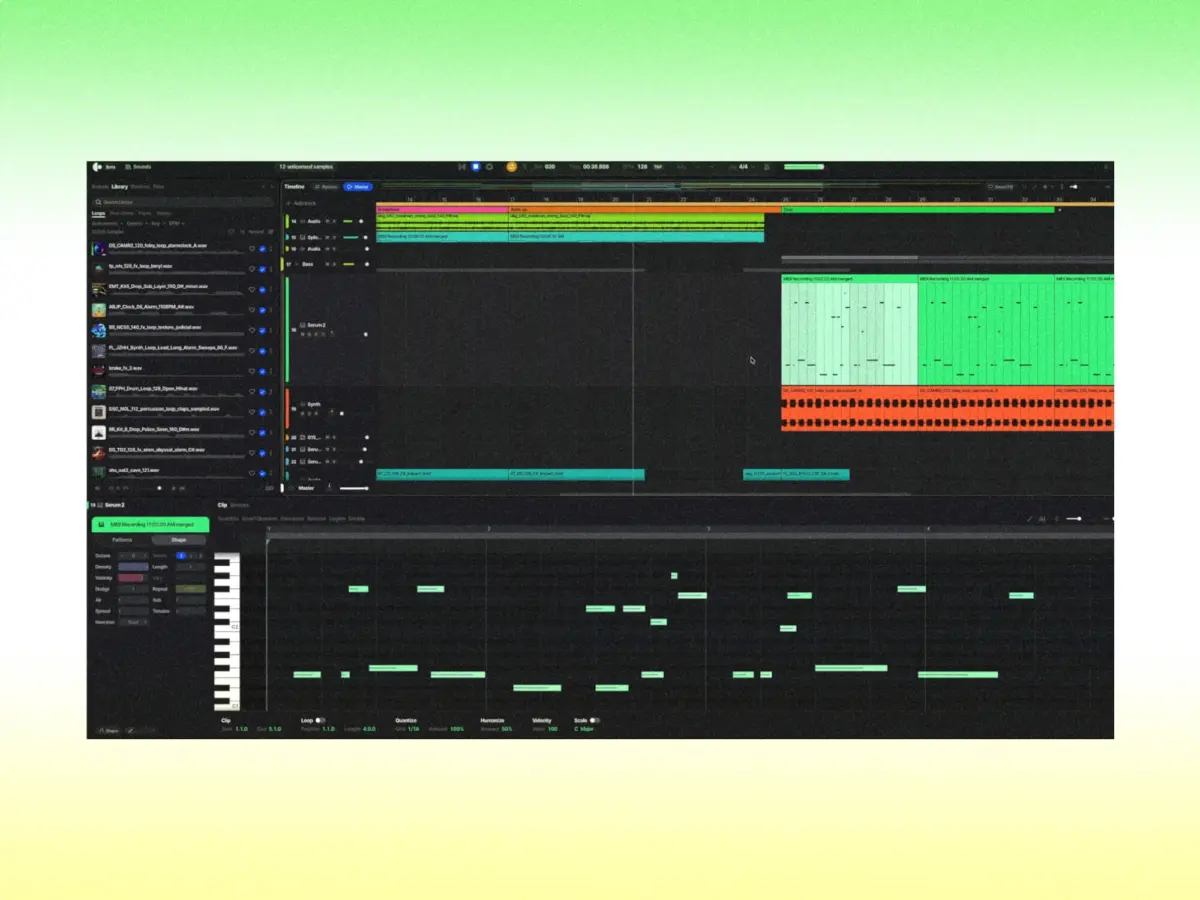
Splice Create is not merely a trimmed-down loop-arranger or a web-browser toy; it is designed as a fully functional production studio. Below is a detailed breakdown of its core technological and workflow features.
1. Unified Cloud-Timeline Integration
At the heart of Splice Create is a unified workspace where the entire Splice catalogue lives natively alongside your multitrack audio and MIDI data. Users can search for specific textures, genres, instruments, or rhythmic feels directly from the timeline search bar.
When a sample is selected, the DAW automatically analyzes its tempo and key, matching it in real-time to the project parameters. This eliminates time-stretching artefacts and pitch-matching headaches that traditionally slow down the ideation phase of beatmaking.
2. Streamlined Cross-DAW Transition Tools
Splice recognizes that very few producers will abandon their primary workstation overnight. To mitigate the steep learning curve associated with adopting a brand-new DAW, the developers implemented a robust preset-shortcut system.
Upon setup, users can select keyboard shortcut profiles that mirror their muscle memory from industry giants like Ableton Live, FL Studio, and Avid Pro Tools. This thoughtful concession dramatically reduces onboarding friction for seasoned engineers and producers.
3. The Voice-Controlled "Creative Assistant"
Perhaps the most polarizing and futuristic feature of Splice Create is its integrated AI-powered creative assistant. Unlike automated composition engines that generate entire tracks at the click of a button—which critics argue remove the human element from music-making—Splice’s assistant acts strictly as a collaborative co-pilot.
- Contextual Commands: Users can instruct the assistant to perform tedious production chores, such as organizing chaotic project files by automatically grouping tracks into drum, bass, vocal, and effects buses.
- Smart Sample Hunting: If a producer is struggling to find a complementary top-loop or bassline, they can ask the assistant to query the Splice library for sounds that specifically fit the harmonic and rhythmic architecture of the existing arrangement.
- Built-In Production Tutoring: Serving as an interactive knowledge base, the assistant can answer technical production queries directly within the interface, sparing the user from breaking creative flow to consult search engines or tutorial videos.
- Full Voice Control: The assistant can be operated entirely via voice commands. This hands-free functionality allows producers to stay physically engaged with MIDI keyboards, hardware controllers, or physical instruments without needing to reach for a mouse and keyboard. Furthermore, this opens up significant accessibility benefits for creators with physical limitations that make prolonged mouse-and-keyboard usage difficult.
4. Native Instruments and Effects Suite
Beyond external samples and third-party plugins, Splice Create comes equipped with a comprehensive suite of native tools. This includes a versatile built-in synthesizer, a wide array of studio-grade audio effects (reverbs, delays, saturation, and compression), and dynamic preset configurations designed to take raw ideas to a mix-ready standard.
Supporting Context & Market Metrics: The DAW Landscape in Transition
To appreciate the weight of Splice’s move, one must examine the current state of the global audio software market.
- The Crowded Software Market: The DAW market is historically stubborn. Producers forge deep emotional and technical attachments to their primary software environments. Ableton Live commands the electronic music and live-performance sectors; Logic Pro dominates the project-studio and Mac-centric markets; Pro Tools remains the entrenched standard for commercial post-production and tracking facilities; and FL Studio maintains a fierce loyalty among hip-hop and trap producers globally.
- The Subscription Economy: While perpetual licenses still exist, the software industry has overwhelmingly shifted toward subscription models and cloud connectivity. Splice already operates effectively within this psychological and financial framework, boasting millions of active subscribers who are accustomed to paying a recurring monthly fee for creative assets. Converting a percentage of these subscribers into active DAW users represents a massive, high-margin expansion of their existing business model.
-
Ethical AI Integration: In an era where generative AI platforms scrape copyrighted material and threaten the livelihoods of session musicians and producers, Splice has tread carefully. The company has publicly doubled down on its commitment
to human-made samples, explicitly guaranteeing that its entire foundational library is created by human artists and compensated fairly through royalty pools. The AI in Splice Create is framed strictly as an administrative and navigational aid—an organizational butler rather than a mechanical ghostwriter.
Official Statements and Industry Reception
The announcement of Splice Create has triggered vibrant discussions across music production forums, developer circles, and industry panels. Company executives and high-profile artists have stepped forward to contextualize the release.
Leadership Vision
Kakul Srivastava, CEO of Splice, articulated the philosophical underpinning of the new software during the launch:
"Most music tools either make the song for you, or assume you already know how to do everything—Create is different. Splice Create is a music creation studio that helps you make the music you want. We’re clearing a path so that anyone who has felt the pull to make music, but has felt blocked by the process, can get started and share their unique stories with the world through song."
Srivastava’s comments target a very specific demographic: aspiring creators who experience "DAW paralysis"—the overwhelming intimidation of staring at a blank timeline, an infinite choice of plugins, and a complex routing matrix. By pairing a frictionless sample engine with intelligent voice assistance, Splice aims to lower the barrier to entry without stripping away artistic agency.
Endorsement from the Elite
Despite being tailored in part for accessibility, Splice Create has already garnered high-profile validation from veteran hitmakers. Grime icon and producer Skepta shared how the software—and its underlying ecosystem—played a pivotal role in the creation of his recent collaboration with Chase & Status, titled Innocent Smile.
"I’d been messing with Innocent Smile for years, added a break beat from Splice, and it came alive," Skepta remarked. Praising the workflow benefits of the brand’s tools, he added: "Create gives people just starting out that same feeling, and you pick up how it works as you go. Big up Splice, always there to cook with, even on my way to Ibiza at 30,000 feet."
Skepta’s endorsement highlights a crucial design philosophy: tools built for beginners often possess the speed and fluidity required by elite professionals operating under tight deadlines or while traveling.
Future Outlook: What Splice Create Means for the Future of Music Production
The launch of Splice Create in macOS beta is only the opening salvo. As the software moves toward a stable public release and inevitable Windows compatibility, several key questions and industry trends will shape its trajectory:
- Third-Party Developer Relations: How smoothly will Splice Create integrate third-party VST3 and AU plugins? The success of any modern DAW hinges on its plugin hosting stability and compatibility. If Splice can handle complex plugin chains as fluidly as Ableton or Logic, it stands a strong chance of winning over seasoned producers.
- The Evolution of Voice Interaction: As speech-to-text and intent-recognition technologies improve, voice-controlled production environments may become the industry standard. Splice is an early mover in integrating voice commands directly into a timeline arrangement workflow; competitors will undoubtedly watch closely to see how producers react to talking to their software in a studio setting.
- The Redefinition of the "Ecosystem": For decades, companies like Apple, Avid, and Ableton built hardware-software loops or comprehensive standalone ecosystems. Splice is attempting something entirely different: building a DAW anchored to a massive, cloud-based, crowdsourced subscription marketplace. If successful, Splice Create could redefine how software companies monetize creative tools, proving that the future belongs not to closed boxes, but to hyper-connected cloud platforms.
As the beta testing phase rolls out across Mac systems worldwide, the global producer community will ultimately decide whether Splice Create is a fleeting novelty or a genuinely disruptive force in music production history. One thing is certain: the conversation around what a DAW can—and should—be has fundamentally changed.