In the realm of electronic music production, few tracks hold the mythic, emotive resonance of LCD Soundsystem’s 2007 indie-dance masterpiece, "Someone Great." Driven by an unmistakable, hypnotic harmonic drone that anchors the composition from its opening seconds, the track remains a masterclass in how profound emotional weight can be extracted from startlingly minimal means.
At its core, the signature sound of "Someone Great" relies on nothing more complex than a single, modulated sawtooth wave, expertly filtered, rhythmically pumped, and spatially processed. Yet, unpacking this iconic patch reveals a rich roadmap for modern sound design. In this comprehensive technical breakdown, we look at how producers can recreate this legendary patch using u-he’s Diva, exploring the subtle interactions of dual oscillators, velocity mapping, octave-spaced EQ notch filtering, envelope-driven modulation, and tape saturation. Far from a rigid, one-trick pony, this versatile patch can be adapted across genres—proving that simplicity, when executed with precision, yields timeless results.
To faithfully capture the spirit of James Murphy’s production wizardry, we will walk through a methodical, ten-step recreation process inside u-he Diva. For instructional clarity, set your project tempo to a sedate 112 BPM—slower than the original tempo, allowing us to closely inspect the micro-movements of our modulations.
Step 1: Establishing the Foundation and Analogue Vibe
The golden rule of subtractive synthesis is simple: the more stripped-back a patch is, the more critical your initial sound source selection becomes.
Open u-he Diva and initialize a blank patch.
Select the Dual VCO architecture to introduce rich, analog-modelled warmth.
Assign Analogue Env to both Envelope 1 and Envelope 2.
Lock your project tempo to 112 BPM.
Step 2: Programming the Core Notes and Dyad Intervals
The rhythmic and harmonic skeleton of the drone relies on a specific fourth-and-fifth interval relationship.
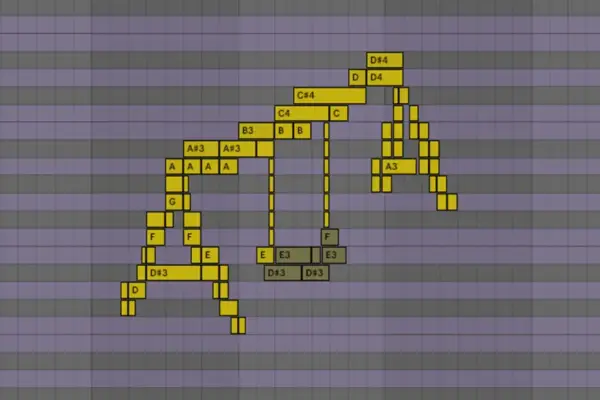
Program a dyad (a two-note chord) utilizing G and D.
The sequence weaves across three distinct octave registers for the D notes (D2, D3, and D4), with G3 sitting precisely between them.
Set the note lengths just shy of a standard quarter note to leave breathing room for rhythmic gating.
Step 3: Oscillator Calibration and Initial Filter Settings
Disable Oscillator 1 entirely.
Leave Oscillator 2 on its default sawtooth wave setting.
Tune Oscillator 2 up exactly one octave (position 4 on the octave knob).
Rotate the VCO 1 / VCO 2 blend knob fully clockwise to isolate Oscillator 2.
Open the filter cutoff up to 108 and dial the Emphasis (resonance) to 15.5. Even at this early stage, the core character begins to mirror the source track.
Step 4: Harnessing Velocity Modulation for Dynamic Bite
To inject organic life into the patch, we must link key velocity to tonal expression.
Set the velocity for the lower D2 note to maximum, while the remaining three notes are set to an expressive velocity of 103.
Navigate to the VCA section, select Velocity as a modulation source from the dropdown menu, and crank the modulation amount to maximum. This introduces immediate bite and harmonic richness.
Step 5: Surgical EQ Filtering and Octave-Spaced Notches
One of the most profound secrets of this sound lies outside the synth engine in the realm of spectral processing.
Introduce a parametric EQ and cut four precise notches at 150Hz, 300Hz, 600Hz, and 1.2kHz.
Observe two crucial mathematical properties here: each frequency is precisely double the previous one (one octave higher), and all four frequencies hover directly around the root frequencies of the D notes.
By carving out these D fundamentals, we intentionally step back to let the G note bloom forward in the mix.
Step 6: Introducing Rhythmic Pumping via Amp Envelopes
To give the drone its characteristic house/dance-music pulse, we need a rhythmic trigger.
Load a robust, 909-style kick drum onto an adjacent channel to act as our timing reference.
On Env 1 (acting as our amplifier envelope), set the Attack to approximately 49 to induce an instant, sweeping pump.
Adjust the Decay to 75 and set a slightly elongated release tail of 29. Restore the VCA master volume to full to compensate for gain reduction.
Step 7: Sculpting Filter Envelopes for Movement
Push the Env 2 filter modulation control to fully positive (+).
Go to Envelope 2 and dial in the following parameters: Attack at 68, Decay at 49, and Sustain at 0.
This dual-envelope approach simultaneously deepens the rhythmic pump and sharpens the transient bite of each step.
Step 8: Spatial Depth via Plate Reverb and Pre-Delay
Insert Diva’s internal Plate 1 reverb algorithm.
Max out the size parameter and push the pre-delay to the halfway mark.
Why pre-delay? In physical acoustic spaces, sound takes measurable time to traverse distance before bouncing off a boundary. A long pre-delay creates a psychoacoustic gap between the dry synth hit and the wet tail, keeping the rhythmic clarity pristine while bathing the mix in expensive-sounding space.
Step 9: Sidechain Compression and Tape Drive Saturation
Layer sidechain compression triggered by your 909 kick track to reinforce the pumping action.
Finally, introduce tape drive saturationafter the sidechain compressor. Because tape saturation harmonics respond dynamically to signal strength, placing it post-compression means the louder peaks of the pumping cycle drive the tape harder, generating richer harmonic saturation precisely when the track swells.
Step 10: Unleashing Versatility Across Genres
The true test of a great patch is its adaptability. By tweaking the envelope shapes from a sustained drone into tight, snappy transients, the exact same Diva patch transforms into entirely new sonic assets—such as the characterful "Big Belgian Snog Trumpet" and "Big Trumpet" patches.
Supporting Context & Metrics: The Anatomy of a Modern Classic
Parameter Category
Target Setting / Value
Production Objective
Oscillator Architecture
Dual VCO (Osc 2 active, +1 octave)
Rich analog harmonic foundation
Filter Configuration
Cutoff: 108, Emphasis: 15.5
Bright, cutting high-mid presence
Spectral EQ
Notches at 150Hz, 300Hz, 600Hz, 1.2kHz
Suppresses root D notes to elevate the G
Envelope 1 (Amp)
Attack: 49, Decay: 75, Release: 29
Generates the core rhythmic "pump"
Envelope 2 (Filter)
Attack: 68, Decay: 49, Sustain: 0
Adds transient bite and filter sweep
Spatial Processing
Plate 1 Reverb (Max Size, 50% Pre-delay)
Immersive depth without masking transients
The enduring appeal of tracks like "Someone Great" lies in a broader industry shift toward intentional minimalism. While modern software synthesizers encourage sound designers to stack dozens of wavetables, unisons, and complex modulation matrices, iconic analog-emulation patches prove that creative routing—such as octave-aligned EQ notches and deliberate compressor placement—often outweighs sheer voice count.
Official Statements & Industry Insights
Sound designers and synthesis educators frequently praise patches that blur the line between melodic pads and rhythmic percussion. Industry commentators note that the brilliance of the LCD Soundsystem patch is its chameleon-like nature:
"When you strip a patch down to a single sawtooth wave, you are forced to make every single modulation count. The magic doesn’t live in the oscillator count; it lives in the space between the notes, the intelligent use of filter envelopes, and how the sound breathes alongside a kick drum."
— Leading Synth Design Analysts
Producers utilizing tools like u-he Diva benefit immensely from this philosophy. By relying on authentic component-level modelling, soft-synths can replicate the subtle instabilities and warmth of hardware units, allowing software-based producers to achieve professional-grade analog tone without hardware overhead.
Future Outlook: The Evolution of Retro-Modern Sound Design
As electronic music production continues to evolve, the appetite for hybrid analog-digital workflows shows no signs of slowing down. Producers are increasingly looking backward to iconic 2000s indie-dance and electro-pop arrangements to find organic alternatives to hyper-quantized, sterile digital loops.
Mastering foundational patches like the "Someone Great" harmonic drone equips producers with transferable skills:
Spectral Awareness: Recognizing how EQ notches can alter perceived chord balances.
Dynamic Pumping: Combining envelope automation with sidechain compression for organic groove.
Multi-Genre Adaptability: Repurposing a single patch across ambient textures, leads, and brass-like stabs.
Whether you are scoring cinematic soundscapes, driving underground techno floors, or crafting emotive indie electronica, dissecting classic synthesizer architecture remains one of the most reliable pathways to timeless, professional-grade music production.