Executive Overview
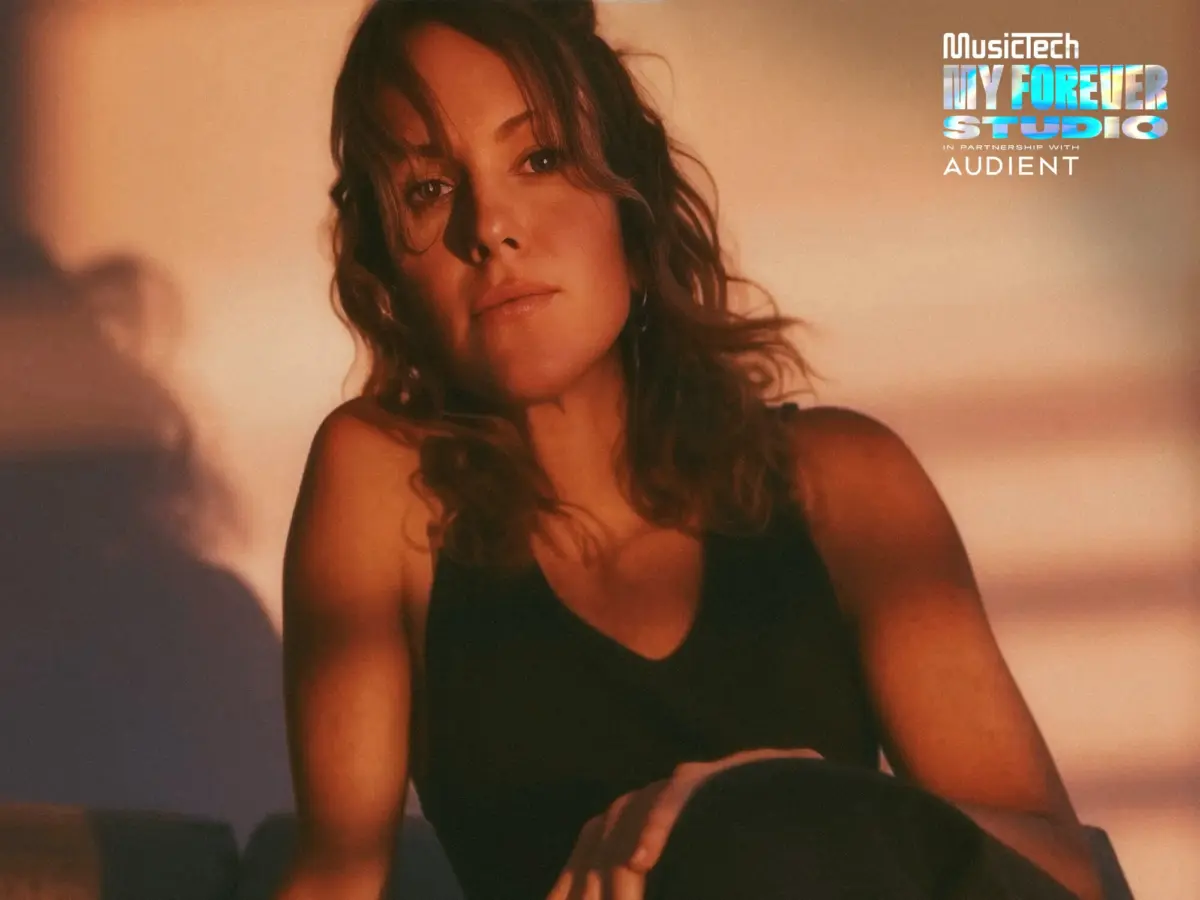
Electronic music has always existed at the intersection of rigorous technical engineering and fluid, emotional human expression. Few contemporary artists navigate this delicate boundary as intuitively as Kaitlyn Aurelia Smith. Renowned for her masterclass manipulation of modular synthesizers—most notably the Buchla system—Smith has carved out a singular lane in modern composition. Her sonic worlds are vivid, tactile, and deeply immersive.
In a recent episode of the My Forever Studio podcast, produced in partnership with Audient and hosted by Chris Barker and Will Betts, Smith stepped up to the microphone to deconstruct her artistic DNA. Delving far beyond standard interview talking points, the acclaimed composer, performer, and producer offered profound insights into her unique relationship with sound.
Throughout the session, Smith discussed how an accidental encounter with a Buchla 100 completely reshaped her compositional philosophy, teaching her patience for what she describes as "irritating" frequencies. She also illuminated the mechanics of her synaesthesia—a neurological phenomenon that translates auditory stimuli into distinct bodily sensations—and explained how this sensory crossover directly dictates her studio workflow. Additionally, the conversation touched upon her notable collaborations with synth pioneer Suzanne Ciani and film composer Emile Mosseri, alongside a preview of her upcoming album, which boldly steps into darker, more club-oriented sonic territory.
As guests on My Forever Studio are challenged to curate their ultimate, unrestricted fantasy workspace under strict, minimalist constraints, Smith’s choices provided a masterclass in efficiency, proving that true creativity thrives not when given infinite tools, but when forced to focus on the essential gear that defines an artist’s voice.
Detailed Chronology: From Accidental Discoveries to Modular Mastery
To understand Kaitlyn Aurelia Smith’s meticulous approach to modern electronic production, one must trace the winding trajectory of her musical evolution. Long before she was manipulating complex voltages on esoteric hardware, Smith’s path was shaped by a series of serendipitous encounters and a relentless curiosity for acoustic exploration.
The Buchla Epiphany
Smith’s artistic turning point arrived when she stumbled upon a Buchla 100 series synthesizer. Unlike standard Western keyboards based on the traditional twelve-tone equal temperament scale, Buchla systems encourage a more organic, voltage-controlled approach to sound generation. For Smith, this initial meeting was nothing short of transformative.
Rather than relying on pre-programmed patches or familiar chord progressions, she was forced to listen to raw electricity shaping itself into timbre. During her My Forever Studio appearance, Smith detailed how those early experiments taught her a vital lesson in patience—specifically, learning to sit with and appreciate "irritating" sounds. In modern production, the instinct is often to immediately filter out harsh resonances, dissonances, or abrasive noise. Smith, however, learned to interrogate those uncomfortable frequencies, finding hidden textures and unexpected musicality within them. This foundational exercise unlocked a workflow where sounds are treated less like static notes and more like living, breathing organisms.
Collaborative Milestones and Expanding Horizons
As her command over modular synthesis deepened, Smith began drawing the attention of electronic music royalty. Her collaborative work with synthesizer icon Suzanne Ciani stands as a landmark bridge between generations of Buchla practitioners. Together, they explored the infinite spatial dimensions of quadraphonic sound, pushing the boundaries of generative composition and live modular performance.
Beyond her work with Ciani, Smith has continuously sought out cross-disciplinary partnerships, including a notable collaboration with acclaimed film composer Emile Mosseri. These projects required Smith to translate her deeply internal, highly experimental spatial concepts into narrative-driven cinematic landscapes. Each collaboration added new dimensions to her technical vocabulary, preparing her for her most daring pivot yet.
Venturing into the Club: The New Album
For years, Kaitlyn Aurelia Smith has been celebrated for her ethereal, vocal-driven ambient and avant-pop releases—works that feel like sunlit forests rendered in synthesizer patches. However, her latest artistic chapter marks a sharp departure from past paradigms.
On her new album, Smith plunges into darker, more driving, and undeniably club-friendly sonic environments. Retaining her signature organic modular warmth while injecting a heavier rhythmic pulse, this new material demonstrates her refusal to remain static as an artist. It is a natural evolution for a creator who has spent her career treating the studio not as a museum for past achievements, but as an experimental laboratory for the future.
Supporting Context & Metrics: The Mechanics of Synaesthesia and Minimalist Design
To fully appreciate the world Kaitlyn Aurelia Smith builds in the studio, one must examine the intersection of her neurology and her gear selection. Two core pillars define her methodology: her experience with synaesthesia and the minimalist constraints of the My Forever Studio challenge.
Translating Frequencies: The Reality of Synaesthesia
Synaesthesia is a neurological condition in which information meant to stimulate one of your senses stimulates several of your senses. For Kaitlyn Aurelia Smith, this manifests as a profound cross-wiring between sound and physical, bodily sensation.
When Smith hears a specific frequency, timbre, or rhythm, her brain does not merely process it as an acoustic wave hitting the eardrum; she feels it physically. Certain textures register as tactile pressures, temperatures, or movements across her skin and muscles. This sensory crossover fundamentally alters how she produces music.

In the studio, mixing and sound design become exercises in physical comfort and spatial alignment. If a synthesizer patch creates a "sharp" or "unbalanced" physical sensation in her body, she knows the mix requires adjustment—not necessarily because it violates a mathematical rule of frequency allocation, but because it feels physically discordant. This unique internal feedback loop allows Smith to sculpt mixes with an astonishing degree of tactile intuition, treating her DAW and modular rigs as extensions of her own nervous system.
[Acoustic Input] ➔ [Modular Synthesis / Buchla] ➔ [Synaesthetic Processing] ➔ [Physical Bodily Sensation] ➔ [Intuitive Mix Adjustments]The My Forever Studio Framework: Resisting the "Bundle" Culture
The premise of the My Forever Studio podcast—created in partnership with Audient and hosted by Chris Barker and Will Betts—challenges artists, producers, and engineers to design their ultimate fantasy studio anywhere in the universe. The catch? Strict rules apply.
Guests are permitted a severely limited inventory of items for their creative sanctuary. In an era defined by software bloat, endless plugin subscription bundles, and digital hoarding, the podcast forces a return to intentional minimalism. As Barker and Betts playfully enforce their primary decree—there will be no bundles!—guests must distill their entire artistic identity down to a handful of indispensable tools.
For Smith, whose hardware setup is notoriously intricate, paring down her workflow to a minimal kit highlights the core philosophy of her career: limitation breeds innovation. Whether she is imagining her studio floating in deep space or nestled in a remote forest, the exercise reinforces the idea that knowing your tools intimately yields far superior results than possessing an overwhelming arsenal of unused options.
Official Statements and Podcast Insights
During her captivating conversation on My Forever Studio, Kaitlyn Aurelia Smith offered several illuminating reflections on her creative philosophy, the psychological weight of sound, and the realities of being a modern electronic voyager.
Reflecting on her early days wrestling with the Buchla 100, Smith noted the psychological shift required to embrace abrasive audio artifacts:
"When you start working with systems that don’t want to cooperate in the way a traditional piano keyboard does, you quickly realize how much of your taste is conditioned. Those first months weren’t about making pretty melodies; they were about breaking my own patience. I had to learn to sit there while a patch sounded genuinely irritating—almost painful—and ask myself: ‘Why is this annoying me, and what happens if I lean into it instead of turning it off?’ That discomfort is usually where the magic lives."
Discussing the intimate, physical nature of her synaesthesia and how it guides her production choices, Smith explained:
"People often ask me how I know when a track is finished or when a synth patch is ‘right.’ For me, it’s rarely an intellectual decision. If I’m building a patch and it physically feels like something sharp pressing against my collarbone or a cold draft on my neck, I know the frequency balance is off. The music has to feel good inside my body before I trust it. My studio isn’t just a place where I make sounds; it’s a room where I translate physical sensations into frequencies that other people can feel."
Hosts Chris Barker and Will Betts praised Smith’s ability to bend the rules of the show’s fantasy studio concept without breaking its underlying spirit. Speaking on the ethos of the episode, the hosts shared:
"Having Kaitlyn on the show was a masterclass in how a true purist thinks. Most guests come in and try to sneak in an extra compressor or a vintage reverb unit. Kaitlyn looked at our strict item limits as an invitation to go deeper into the tactile essence of sound. She doesn’t need a thousand plugins or a massive console; she needs a rig that breathes with her. Her episode completely redefines what a ‘Forever Studio’ can be."
Future Outlook: The Next Wave of Electronic Exploration
As Kaitlyn Aurelia Smith continues to tour and share insights into her creative process, the electronic music community stands at a fascinating crossroads. The release of her club-oriented album signals a broader shift within the ambient and modular communities—proving that artists rooted in avant-garde composition can successfully merge high-concept sound design with driving, visceral rhythm sections.
Looking ahead, Smith’s influence on the next generation of producers is undeniable. By demystifying the intimidating world of modular synthesis and normalizing discussions around neurodivergent sensory processing in music production, she has opened doors for a more inclusive, experimental approach to audio art.
Whether she is imagining her dream studio floating across the cosmos on My Forever Studio or pushing physical club systems to their absolute limits in real-world venues, Kaitlyn Aurelia Smith remains an essential architect of modern sound. Her journey reminds us that true innovation does not come from having endless technological options, but from cultivating the patience to listen deeply to the tools we choose, and the courage to let those sounds transform us from the inside out.