BAKU, AZERBAIJAN — From October 28 to November 8, 2026, the historic shores of the Caspian Sea will transform into a global nexus of high culture as the capital of Azerbaijan hosts the second iteration of the Baku International Arts Festival (BIAF). Spanning more than 20 meticulously curated events across dance, drama, music, and film, the festival is set to convene an extraordinary assembly of world-class performers, institutions, and creative minds from Azerbaijan, the United Kingdom, Israel, Canada, Monaco, Russia, the United States, France, and beyond.
More than a mere celebration of the performing arts, BIAF 2026 places a transformative emphasis on cross-border collaboration. By deliberately pairing internationally renowned artists with Azerbaijani institutions and virtuosos, the festival bridges historical traditions with contemporary vanguard expression. Set against a backdrop of ancient fortifications and hyper-modern architectural marvels, this year’s festival promises to be a watershed moment for the Caucasus region’s cultural calendar.
Executive Overview: A Global Convergence of Arts
The stage is set for a nearly two-week cultural immersion that bridges centuries of history with the avant-garde. The second Baku International Arts Festival arrives with a mandate to elevate Baku’s historical reputation as an ancient trading crossroads into a modern capital of artistic exchange.
Key Highlights of BIAF 2026
- Duration: October 28 – November 8, 2026.
- Scale: Over 20 distinct events covering drama, classical and contemporary music, ballet, modern dance, and multimedia art.
- Global Footprint: Participating artists and companies hail from Azerbaijan, the UK, Israel, Canada, Monaco, Russia, the USA, and France.
- Core Philosophy: Deep collaborative frameworks uniting foreign luminaries with local academies, orchestras, and state theatres.
- Venues: Iconic cultural anchors including the Azerbaijan State Philharmonic Hall, the Heydar Aliyev Center, the National Drama Theatre, and the Azerbaijan State Academic Opera and Ballet Theatre.
Detailed Chronology: A Day-by-Day Journey Through the 2026 Programme
The 12-day festival schedule is packed with milestone performances, historical tributes, and high-profile premieres. Below is the chronological blueprint of BIAF 2026’s marquee events.
+------------------------+-------------------------------------------------------+----------------------------------------------------+
| Date                   | Event / Performance                                   | Key Artists & Ensembles                            |
+------------------------+-------------------------------------------------------+----------------------------------------------------+
| October 28 (Opening)   | Shostakovich 120th Anniversary Concert                | Lukas Geniušas, Tine Thing Helseth,                |
|                        | & Piano/Trumpet Concerto No. 1                        | Dmitry Sitkovetsky, Baku State Chamber Orchestra   |
+------------------------+-------------------------------------------------------+----------------------------------------------------+
| Late October           | "Oh To Believe in Another World" &                    | William Kentridge, Dmitry Sitkovetsky,             |
|                        | Arabian Themes Piano Concerto                         | Farhad Badalbeyli, Festival Orchestra              |
+------------------------+-------------------------------------------------------+----------------------------------------------------+
| Early November         | "Millennium Symphony" Baku Premiere                   | David Garrett (The "Paganini of Pop")              |
+------------------------+-------------------------------------------------------+----------------------------------------------------+
| Early November         | Theatrical Residencies: "The Seagull",                | Maly Drama Theatre (Lev Dodin), Dmitry Krymov,     |
|                        | "Bloody Mary", and "Alfred and Violetta"              | Rezo Gabriadze Marionette Theatre                  |
+------------------------+-------------------------------------------------------+----------------------------------------------------+
| Early November         | Contemporary Dance Showcases                          | Akram Khan ("Thikra"), Shahar Binyamini            |
|                        | & Mentorship Strands                                  | ("New Earth", "Bolero")                            |
+------------------------+-------------------------------------------------------+----------------------------------------------------+
| November 8 (Closing)   | Gala Closing Concert                                  | Maxim Vengerov & Festival Orchestra                |
+------------------------+-------------------------------------------------------+----------------------------------------------------+
The Opening Overture: Shostakovich at 120
BIAF 2026 officially commences on October 28 at the prestigious Azerbaijan State Philharmonic Hall. The opening gala marks the 120th anniversary of Dmitri Shostakovich, a composer whose complex life and musical legacy are profoundly intertwined with Azerbaijan, having directly shaped the nation’s formal school of musical composition.
The evening will feature Shostakovich’s Concerto No. 1 for Piano, Trumpet and Orchestra—a work famously premiered on this very stage by the composer himself in 1934. To breathe new life into this historical score, the festival has enlisted the acclaimed Russian-Lithuanian pianist Lukas Geniušas and Norwegian trumpet virtuoso Tine Thing Helseth. They will perform alongside the Baku State Chamber Orchestra and the newly minted BIAF Festival Orchestra, under the baton of Baku-born violin maestro and conductor Dmitry Sitkovetsky.
Multimedia Explorations and Romantic Legacies
The musical narrative deepens with South African visionary William Kentridge’s multimedia masterpiece, Oh To Believe in Another World. This striking visual and auditory experience serves as a live theatrical interpretation of Shostakovich’s turbulent Symphony No. 10—a score whose encrypted musical motifs (the famous DSCH theme entwined with motives spelling out Elmira) reflect the composer’s secret, unrequited devotion to his brilliant Baku student, pianist and composer Elmira Nazirova.
Conducted once again by Sitkovetsky, the concert programme seamlessly pairs this emotional weight with Fikret Amirov and Elmira Nazirova’s jointly penned Concerto for Piano and Orchestra on Arabian Themes. This masterwork will be performed by Farhad Badalbeyli, Rector of the Baku Music Academy, who shares a unique historical and personal acquaintance with both original composers.
Mid-Festival Crescendo: The Paganini of Pop
Midway through the festival, the architectural marvel of the Heydar Aliyev Center will play host to violin virtuoso David Garrett. The Juilliard-trained artist, widely celebrated as the "Paganini of pop," will deliver the Baku premiere of his Millennium Symphony. This ambitious symphonic reimagining stitches together the defining pop hits of the past 25 years into a seamless, high-octane classical architecture designed to thrill both purists and contemporary music fans alike.
Theatrical Masterclasses: Drama and Marionettes
The dramatic arts strand of BIAF 2026 brings heavy-hitting European theatre to Baku’s stages:
- Lev Dodin’s Staging of Chekhov’s The Seagull: Brought directly from Saint Petersburg’s renowned Maly Drama Theatre, this production offers a psychological, stripped-down examination of human longing and artistic vanity.
- Dmitry Krymov’s Bloody Mary: A radically inventive, image-driven theatrical response to Friedrich Schiller’s Mary Stuart, challenging conventional narrative structures through striking visual metaphors.
- Rezo Gabriadze Marionette Theatre’s Alfred and Violetta: A poignant reworking of Alexandre Dumas’s La Dame aux Camélias, relocated to the melancholic streets of 1990s Tbilisi. The production was lovingly finalized by director Leo Gabriadze following the 2021 passing of his legendary father, Rezo Gabriadze.
Choreographic Triumphs and Mentorship Strands
Dance takes center stage through a series of ambitious contemporary and classical ballet showcases. At the National Drama Theatre, celebrated choreographer Akram Khan presents Thikra: Night of Remembering, an evocative meditation on memory, loss, and endurance.

Concurrently, choreographer Shahar Binyamini brings his explosive works New Earth and Bolero to the festival. Crucially, Binyamini’s engagement goes beyond performance: as part of BIAF’s rigorous mentorship strand, he has spent weeks training and integrating dancers from the Azerbaijan State Academic Opera and Ballet Theatre and the Baku Choreography Academy directly into the production.
Adding further prestige to the dance calendar, the English National Ballet will make its historic Baku debut with Masters in Motion: Forsythe/Pite. This double bill pairs Crystal Pite’s visceral Body and Soul (Part 1) with William Forsythe’s exhilarating, jazz-infused Playlist (EP).
The Grand Finale
The festival draws to a triumphant close on November 8 at the Philharmonic Hall with a gala performance featuring two-time Grammy Award winner Maxim Vengerov. Widely acknowledged as one of the preeminent violinists of our time, Vengerov will helm the evening, bringing down the curtain on twelve days of unbridled artistic brilliance.
Supporting Context & Metrics: The Genius of Baku’s Geography and History
To understand why Baku is uniquely suited to host an international festival of this magnitude, one must look at its geography and deep-rooted history.
The Low-Lying Capital of the Caspian
Baku is the largest city situated on the Caspian Sea, the largest inland body of water on Earth, and serves as the largest metropolis in the Caucasus region. Remarkably, it holds the distinction of being the lowest-lying national capital in the world, sitting 28 meters below sea level.
The city occupies the southern coastline of the Absheron Peninsula, positioned at the narrowest geographic pinch point of the corridor sandwiched between the Caspian Sea and the rising wall of the Greater Caucasus mountain range. For millennia, this natural bottleneck served as the primary transit artery for nomadic caravans, invading armies, philosophical ideas, and—in the modern era—vital energy pipelines.
Icherisheher: Stone Walls and Living History
At the heart of the modern metropolis lies Icherisheher, the Walled Old City, designated a UNESCO World Heritage site. Walking its labyrinthine stone alleys reveals a living museum of human migration:
- Caravanserais: Ancient medieval roadside inns where Silk Road merchants stabled their pack animals and traded silks, spices, and precious gems.
- The Shirvanshahs’ Palace and Maiden Tower: Architectural masterpieces standing mere minutes apart, embodying the sovereign power of the medieval Shirvanshah dynasty.
- The Zoroastrian Roots: Close to these monuments flickers the eternal memory of the ancient Zoroastrian fire temples that famously gave Azerbaijan its poetic moniker, The Land of Fire.
Historically, medieval Baku was far more than a transit stop; it was an intellectual engine. It operated as a major center of Sufi Islamic learning along the international trade network, serving as a primary station of the Khalwati mystical order. Notably, the revered Sufi scholar Seyid Yahya Bakuvi lies buried within the quiet green courtyards of the Shirvanshahs’ Palace grounds, just a short walk from the resting places of the shahs themselves.
The 19th-Century Oil Boom: From Fortress Town to Cosmopolitan Hub
The true catalyst for Baku’s modern architectural and cultural identity occurred during the oil boom of the 1870s. Capital and technology transformed a quiet medieval fortress town into one of the most cosmopolitan, hyper-wealthy industrial cities in the Russian Empire.
By 1900, Baku was producing roughly half of the entire world’s crude oil supply. This sudden, staggering influx of wealth triggered a construction boom, lining the Caspian seafront with opulent mansions built in every conceivable European architectural style—from Neo-Baroque to Gothic Revival.
The Legend of the Mailov Brothers and the Opera House
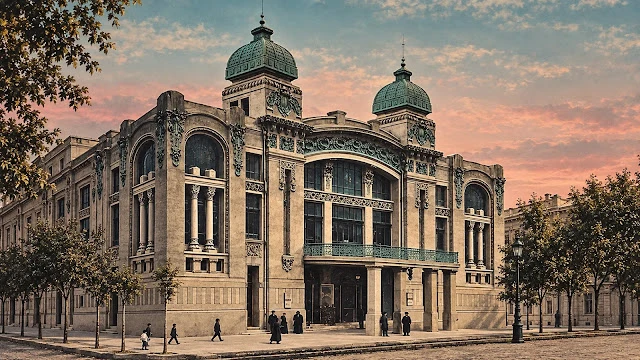
Out of this oil wealth emerged one of the most charming cultural anecdotes in the city’s history: the founding of the historic Baku Opera Theatre.

The theatre was financed by the Mailov brothers, wealthy Armenian-Azerbaijani caviar magnates who operated massive fisheries along the Kura River. According to local lore, during a visit to Baku, a celebrated European opera soprano—most frequently identified as the legendary Russian coloratura soprano Antonina Nezhdanova—remarked casually that she could scarcely imagine returning to perform in a bustling, wealthy metropolis that lacked a proper, dedicated opera house.
Stung by the critique and eager to cement their city’s status as a world-class cultural capital, the Mailov brothers commissioned the building immediately. Remarkably, architects and laborers constructed the magnificent structure in under a year. The theatre officially opened its doors in February 1911 with a grand staging of Modest Mussorgsky’s Boris Godunov, permanently anchoring Baku on the global map of lyrical arts.
Official Statements and Institutional Vision
The structuring philosophy of BIAF 2026 relies heavily on institutional synergy. Festival organizers have repeatedly stressed that the core mission is not merely to import foreign talent, but to foster deep, bilateral artistic growth between visiting luminaries and Azerbaijani artists.
"The second Baku International Arts Festival is designed to reflect Baku’s truest historical identity: a porous, welcoming meeting ground where diverse global cultures do not merely pass through, but converse, collaborate, and create something entirely new," noted festival organizers in a joint curatorial statement. "By placing artists like Lukas Geniušas, Tine Thing Helseth, and William Kentridge side-by-side with our national academies, we are ensuring that the heartbeat of Azerbaijani arts remains dynamically connected to the global stage."
Farhad Badalbeyli, Rector of the Baku Music Academy—who will also perform during the festival’s opening week—highlighted the profound historical continuity reflected in the programme.
"When we perform the Arabian Themes Piano Concerto on the very stages that hosted Shostakovich, we are honoring a living legacy," Badalbeyli stated. "Shostakovich’s deep ties to our musical soil, combined with the personal memories we share of brilliant minds like Elmira Nazirova, prove that music transcends political borders. BIAF 2026 is a testament to the fact that Baku’s cultural resonance is as vital today as it was during the height of the Silk Road."
Future Outlook: Cementing Baku as the Cultural Capital of the Caucasus
As preparations enter their final stages, the anticipation surrounding BIAF 2026 underscores a broader strategic vision for Azerbaijan. Over the past decade, Baku has successfully positioned itself as a premier host city for international mega-events—ranging from athletic championships and Formula 1 Grands Prix to global environmental summits. However, cultural festivals of BIAF’s scale signal a maturation of this strategy, prioritizing deep, intellectual, and artistic soft power.
By successfully merging elite international companies—such as the English National Ballet and the Maly Drama Theatre—with local educational powerhouses like the Baku Choreography Academy and the Azerbaijan State Academic Opera and Ballet Theatre, BIAF is building sustainable institutional infrastructure. Young Azerbaijani dancers, musicians, and actors are receiving masterclass training from world-class directors and choreographers, ensuring that the benefits of the festival will reverberate long after the final notes of Maxim Vengerov’s closing gala fade away on November 8.
In an era marked by geopolitical fragmentation, festivals like BIAF 2026 offer a vital reminder of the unifying power of human creativity. Standing at the historical crossroads of East and West, ancient stone and modern glass, Baku once again opens its gates to caravans of a different kind—caravans of sound, movement, and shared human expression.
For comprehensive scheduling information, detailed ticketing options, and venue access guidelines, visitors are encouraged to consult the official festival web portal at biaf.az.