Executive Overview
History is frequently shaped by its most celebrated episodes. When the medieval conflicts between England and Scotland are brought to mind, the popular imagination instantly turns to the dramatic uprisings of William Wallace at Stirling Bridge (1297) and Falkirk (1298), or the triumphant strategic genius of Robert the Bruce at Bannockburn (1314). Likewise, the triumphs of English arms on the continent—such as Edward III and the Black Prince’s stunning victory at Crécy (1346) and Henry V’s legendary stand at Agincourt (1415)—dominate historical consciousness, textbooks, and cinematic adaptations.
Yet, nestled obscurely between these monumental milestones lies an event of profound geopolitical magnitude that has inexplicably faded from public awareness: the Battle of Neville’s Cross.
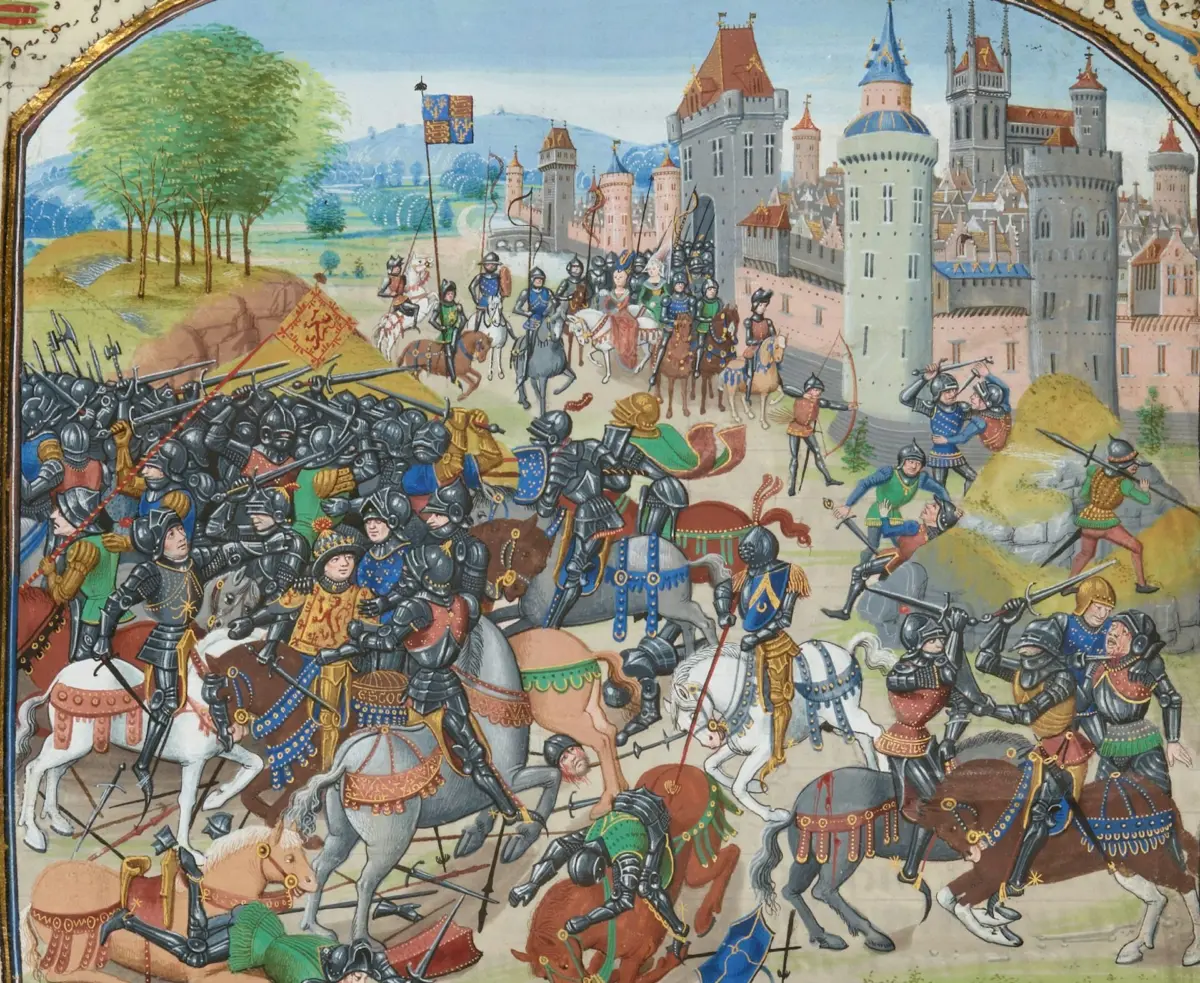
Fought on October 17, 1346, just outside the historic city of Durham in the north-east of England, this brutal engagement fundamentally altered the balance of power in the British Isles. It was engineered not through grand tactical masterstrokes immortalized by Shakespeare, but through a grueling, hard-fought medieval melee that lasted hours, ending in a devastating routing of the Scottish forces. Most remarkably, the battle resulted in the capture of the reigning Scottish monarch, King David II, who spent more than a decade as an English captive and required a staggering ransom to secure his release.
Despite its momentous consequences—securing England’s northern frontier for decades, neutralizing the Scottish threat during the height of the Hundred Years’ War, and reshaping the geopolitical triangle of England, Scotland, and France—Neville’s Cross remains a historical footnote to the casual observer. This investigation examines the tactical realities, political miscalculations, and long-ranging aftermath of a battle that deserves to be recognized as one of the most decisive military encounters in British history.
Detailed Chronology: The Road to Durham
To fully understand how a battle of such magnitude occurred, one must trace the diplomatic entanglements and tactical deceptions of mid-14th-century Europe. In the summer of 1346, King Edward III of England initiated a massive military campaign against France, crossing the English Channel with an army of approximately 15,000 men. This campaign would soon yield the glorious and shocking English victory at the Battle of Crécy in August 1346.
Faced with the crushing weight of the English invasion, King Philip VI of France looked desperately toward his traditional ally under the "Auld Alliance." In June and July 1346, Philip dispatched urgent pleas to King David II of Scotland, imploring him to honor their mutual treaties and exert maximum pressure on England from the north. Philip assured David that with Edward III and the bulk of his military nobility deployed across the Channel, northern England was an undefended void—a defenseless landscape ripe for the taking.
For David II, the temptation was irresistible. On October 7, 1346, the Scottish monarch led a formidable invasion force numbering roughly 12,000 men across the border into England. The Scottish campaign of intimidation and destruction began swiftly: they stormed the Peel of Liddell, exacted a substantial ransom from Carlisle, and mercilessly sacked Hexham Abbey. By October 16, the invading army had reached Bearpark, just outside Durham, settling in for a night of rest before pressing deeper into the English countryside.
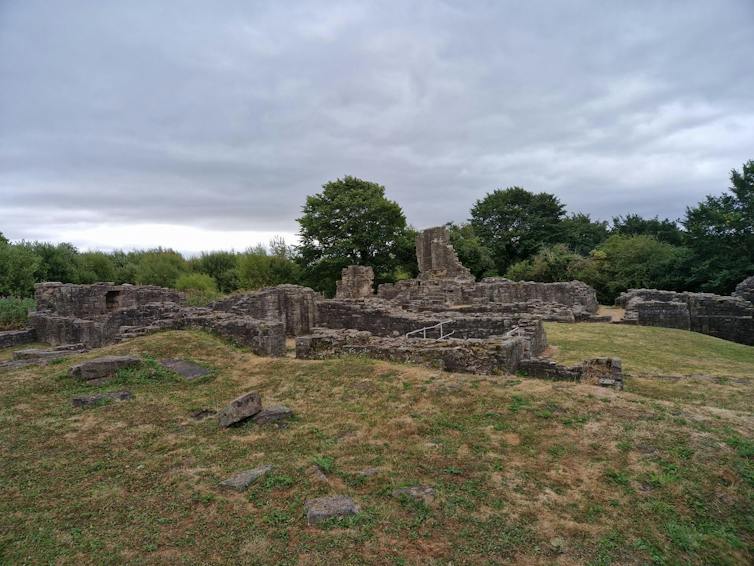
However, King Philip’s intelligence regarding a "defenceless void" proved catastrophically inaccurate. Edward III had not left his northern borders exposed. Anticipating potential incursions, powerful northern English magnates—including Henry Percy, Ralph Neville, and the Archbishop of York—had swiftly mobilized a defensive force numbering approximately 6,000 hardened troops.
Seeking to seize the element of surprise, the English lords marched their forces toward Bearpark before dawn on October 17. As a heavy morning mist hung over the landscape, the advancing English vanguard unexpectedly stumbled upon a Scottish raiding party led by the prominent nobleman William Douglas. Recognizing the immediate peril, Douglas fled headlong back to the main Scottish camp to warn King David that a fully prepared English battle array awaited them.
According to The Anonimalle Chronicle, an anonymous 14th-century account penned within the walls of St Mary’s Abbey, King David reacted to the news with arrogant disbelief. Roused angrily from his bed, the Scottish king reportedly scoffed:
"O man, that cannot be, because in England there are no men left but monks and canons, brothers and priests, swineherds and shepherds, cobblers and skinners; but all the knights are with their king overseas."
David’s dismissal of the English northern defensive capability would prove to be a fatal miscalculation.
The Battle of Neville’s Cross: Hour-by-Hour Engagement
Contemporary documents—most notably letters written by the Prior of Durham and military commander Thomas Sampson—provide a granular look at the unfolding engagement. The English army arrived at the battlefield outside Durham at 9:00 AM on the crisp autumn morning of October 17.
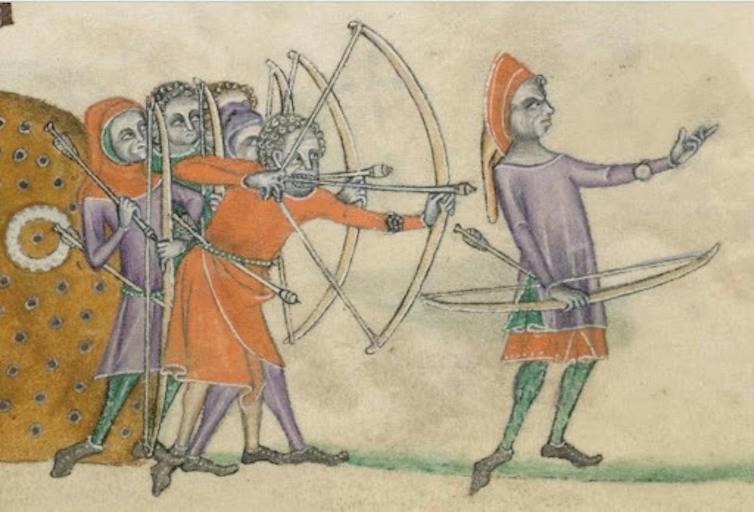
Rather than instantly engaging, both armies spent an agonizing five hours staring each other down across the open moorland. It was not until 2:00 PM that the English longbowmen finally unleashed a volley of arrows, signaling the formal commencement of the battle. By 5:00 PM, the Scottish forces were completely shattered and streaming away from the field in a disorganized rout.
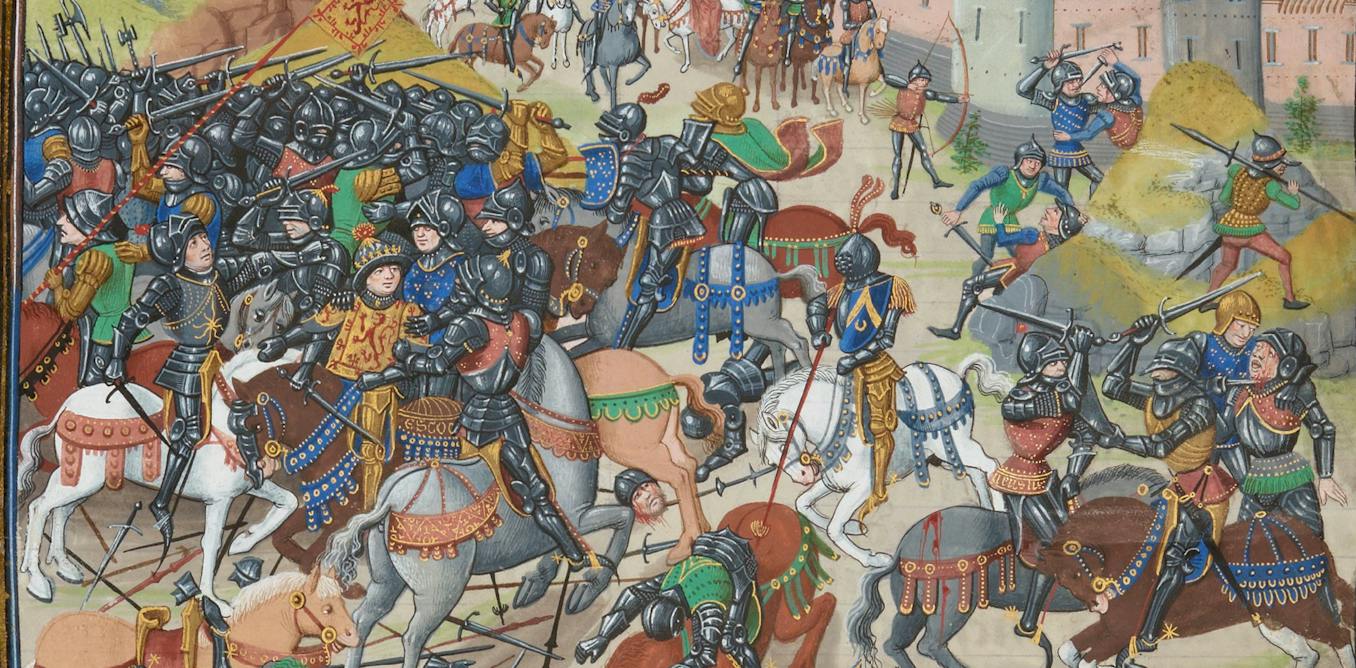
While popular medieval warfare often emphasizes the devastating, clean efficiency of longbow superiority—as seen at Crécy—historians analyzing Neville’s Cross note a different reality. The conflict was decided less by archery and more by the grinding, brutal endurance of close-quarters hand-to-hand combat.
Chroniclers from the period emphasize the sheer physical exhaustion of the combatants. The Chronicle of Meaux Abbey, written at the dawn of the 15th century, records that due to the intense length and brutality of the fighting, the combatants had to periodically pause to rest, leaning heavily upon their spears and weapons. The Anonimalle Chronicle similarly corroborates this tactical rhythm, noting that the armies "rested by agreement and then fought again" on multiple occasions throughout the afternoon.
As the Scottish lines broke and chaos consumed their ranks, King David II fought with notable courage, contradicting later romanticized local myths that claimed he was exclusively found cowering beneath Aldin Grange bridge after being spotted by his reflection in the River Browney. Contemporary chronicles paint a far more visceral picture: the Scottish king sustained wounds from two separate enemy arrows. Despite his injuries, the 15th-century Scottish chronicle Scotichronicon records that David fiercely defended himself, managing to knock out two teeth of his primary captor before being physically overwhelmed.
The man who subdued the Scottish king was not a grand nobleman, but a relatively humble Northumberland squire named John de Coupland. For his monumental capture of a reigning monarch, Coupland was richly rewarded by the Crown: he was elevated to the rank of knight banneret—the highest military status directly beneath the titled aristocracy—and granted a massive annual annuity of £500.
Supporting Context & Metrics
The human and geopolitical tolls of the Battle of Neville’s Cross were as staggering as they were swift. The metrics of the conflict illustrate a lopsided disaster for the northern kingdom:
- Casualties: The Scottish forces suffered catastrophic losses, with up to 2,000 men killed on the field. Conversely, contemporary accounts from the Prior of Durham emphasize that English casualties were remarkably minimal.
- Captives of High Rank: Alongside King David II, four Scottish earls and over a dozen major barons were captured.
- The Fate of Traitors: The Earl of Menteith, who had previously sworn fealty and paid homage to Edward III, was summarily executed for treason, suffering the brutal medieval sentence of being hanged, drawn, and quartered.
- Decapitation of the Scottish Leadership: The list of fallen Scottish nobility included the Earls of Moray and Strathearn, as well as the high offices of the marshal, constable, chancellor, and chamberlain of Scotland.
- Financial Valuations: John de Coupland’s annuity of £500 is equivalent to roughly £290,000 in modern purchasing power. Meanwhile, King David II was ultimately forced to endure an 11-year imprisonment in England before securing his freedom through a colossal ransom of 100,000 marks—an astonishing sum equivalent to more than £39 million today.
Official Statements and Historiographical Analysis
Modern historical consensus emphasizes that the true weight of Neville’s Cross lies in its capacity to prevent historical alternatives. Had the Scottish invasion succeeded, King Edward III would have faced immense, untenable pressure to abandon his grueling, strategic siege of Calais and rush his armies back across the Channel to defend the homeland.
Instead, the resounding success at Neville’s Cross completely neutralized the northern threat for the remainder of Edward III’s lengthy reign. It provided the English Crown with total strategic security at home, allowing Edward to concentrate his resources abroad. Consequently, Edward was able to assemble a staggering force of 30,000 men for the final phases of the Calais siege—the largest single English military force deployed during the entire duration of the Hundred Years’ War (1337–1453).
Historic England, the public body that looks after England’s historic environment, notes the permanent impact of the engagement on the regional landscape:
"The battle of Neville’s Cross was a devastating blow to the political structure of medieval Scotland. It stripped the kingdom of its sovereign, decimated its military administration, and left its southern territories entirely vulnerable to foreign occupation in the years immediately following the conflict."
Future Outlook and Legacy
In the aftermath of the battle, the strategic initiative shifted violently. Within a year of Neville’s Cross, English forces occupied virtually all of Scotland situated south of the Forth and Clyde rivers. It would require decades of arduous, incremental recovery for the Scottish nation to claw back the territories and political autonomy lost during those few fateful hours in October 1346.
Yet, despite its monumental structural consequences, Neville’s Cross occupies an oddly quiet space in popular culture and public memory. Why has it been overshadowed?
Unlike Agincourt, it was never immortalized by the soaring verse of William Shakespeare. Unlike Bannockburn, modern national identities on either side of the border did not crystallize around its memory. It lacks the cinematic romance of a Hollywood epic, fading instead into the dense, bloody tapestry of centuries of Anglo-Scottish warfare.
Nevertheless, as historians continue to re-evaluate the interconnected nature of the Hundred Years’ War and British domestic politics, the Battle of Neville’s Cross demands recognition. It stands as a testament to the fact that history is frequently shaped not by the battles we remember most vividly, but by the quiet, brutal engagements that altered the course of empires behind the scenes. The events of that October afternoon outside Durham were of profound international significance, casting a long shadow over England, Scotland, and France for generations to come.