Executive Overview
The modern digital audio workstation (DAW) ecosystem continues to accelerate at a breathtaking pace, driven by a convergence of vintage analog emulations, boutique hardware repurposing, and streamlined algorithmic design. In the hyper-competitive landscape of music production technology, developers are continually forced to balance the exacting standards of traditional hardware purists with the rapid, workflow-focused demands of modern beatmakers and mix engineers.
Over the past two production cycles, the market has witnessed a fascinating bifurcation in software engineering strategies. On one hand, elite audio software houses are leveraging native processing power to bring legendary, heavy-duty analog hardware—such as the Empirical Labs FATSO and the elusive Gleeman Pentaphonic synthesizer—directly into native workflows without the bottleneck of proprietary DSP accelerators. On the other hand, a vibrant micro-developer community is championing hyper-focused, single-knob utilities (such as Modbap’s oneTHNG: Fidelity Theory) and radical conceptual projects, including granular synthesis ported entirely onto legacy handheld gaming hardware like the Sony PlayStation Portable (PSP).
This comprehensive review provides an authoritative, deep-dive analysis into the most significant plugin releases, virtual instruments, mixing processors, and open-source audio applications to hit the market. Designed for professional producers, mix engineers, and sound designers, this report evaluates each release across architectural design, sonic fidelity, workflow integration, and value proposition.
Detailed Chronology: The Fortnight’s Premier Releases
CableGuys – TimeStop
- Category: Creative Effects / Automation Utilities
- Platform: VST2, VST3, AU, AAX (Windows, macOS)
- Price: $16 (Introductory Black Friday Pricing)
Kicking off the early seasonal software sales, CableGuys has expanded its renowned modulation and rhythm ecosystem with the release of TimeStop. Engineered specifically to eliminate the tedious process of manual audio editing and pitch-envelope drawing, TimeStop allows producers to inject dynamic tape-stop effects, dramatic breakdowns, and rhythmic transition fills into their tracks simply by drawing slowdown gestures directly into DAW automation lanes.
TimeStop features three distinct operational modes, each tailored to different musical contexts:
- Classic Mode: A faithful recreation of traditional mechanical tape drag, where pitch and time decrease in precise unison, mimicking the physical friction of a stopping vinyl record or analog reel.
- Modern Mode: A pitch-manipulation mode that drops the fundamental musical pitch of the audio signal without altering the underlying timing or tempo—ideal for maintaining grid alignment in electronic dance music.
- Loop Mode: A more aggressive, hybrid setting that combines instantaneous tape-slowing gestures with rhythmic stutter effects, catering to trap, hyperpop, and modern beatmaking aesthetics.
Modbap – oneTHNG: Fidelity Theory
- Category: Lo-Fi Saturation & Sample Rate Reduction
- Platform: VST3, AU (Windows, macOS)
- Price: $29 (Introductory) / $39 (Standard)
Modbap, widely celebrated within the Eurorack modular community for hardware monoliths like the Osiris, Trinity, and Per4mer, has officially crossed the threshold into software development. Their debut plugin, Fidelity Theory, spearheads the oneTHNG series—a boutique product line built on the philosophy of exploring a singular psychoacoustic or sonic idea governed by one primary, sweeping macroeconomic control.
Fidelity Theory is a dedicated lo-fi audio processor that mathematically mirrors the relationship between sample rate resolution and audio bandwidth found in vintage digital samplers of the late 1980s and early 1990s. The core engineering principle dictates an inverse relationship: as resolution increases, bandwidth must fall, and vice versa. Sweeping the central macro control morphs the audio engine dynamically from pristine 48 kHz / 16-bit fidelity down to a gritty, crunching 6 kHz / 6-bit profile.
To expand its sonic palette, Modbap has included switchable converter voicings—dubbed "Iron" and "Worn"—alongside a dedicated ring-aliasing stage control, allowing users to dial in everything from subtle dust to destructive digital artifacts.
Light Reft – DZA.grain
- Category: Granular Synthesizer & Hardware Port
- Platform: Homebrew Application / Sony PSP (PlayStation Portable) & Emulator
- Price: €4.99 (Free for newsletter subscribers)
In one of the most unconventional software releases of the decade, boutique hardware manufacturer Light Reft (creators of the Monolit MIDI controller and Concrete effects box) has released DZA.grain, a fully functional granular synthesizer developed not for modern silicon processors, but as a homebrew application built natively for the Sony PlayStation Portable (PSP).
DZA.grain bridges the gap between retro gaming hardware and modern sound design. Users can load custom audio samples via the memory card of a physical PSP unit. Once loaded, the synth engine provides comprehensive tactile control over playback speed, grain size, grain position, polyphonic voice count, and pitch-shifting modulation. Complete with a robust patch preset management system, DZA.grain proves that creative sonic manipulation is hardware-agnostic. For producers lacking a vintage handheld console in their studio drawers, the application runs seamlessly on standard PSP software emulators.
Universal Audio – Empirical Labs FATSO Native
- Category: Analog Tape Simulator & Multi-Mode Compressor
- Platform: VST3, AU, AAX (Windows, macOS)
- Price: $79 (Promotional) / $149 (Standard)
Universal Audio has delivered a watershed moment for mix engineers worldwide by releasing a fully native version of its critically acclaimed Empirical Labs FATSO (Full Analog Tape Simulator and Optimizer). Previously locked behind the proprietary hardware wall of UAD-2 DSP accelerators or Apollo interfaces, the Native FATSO brings the exact saturation, warmth, and nonlinear harmonic distortion heard on diamond-certified records by AC/DC, Pearl Jam, Soundgarden, and Willie Nelson to any standard CPU-based digital audio workstation.

The plugin emulates the elusive behavior of hand-calibrated analog tape and state-of-the-art transformer circuitry. It features four distinct compression topologies:
- Buss Mode: Tuned specifically for master output buses, gluing mixes together with transparent cohesion.
- General Purpose Mode: A versatile setting modeled after classic optical and VCA compressor behaviors.
- Tracking Mode: Designed to tame wild transients on individual vocal and instrumental inputs.
- Spank Mode: An aggressive, heavily limited setting that pushes the compressor into extreme, pumping saturation—ideal for parallel drum buses and electronic rhythm sections.
Significantly, the package includes two distinct plugin iterations: FATSO Jr. for streamlined, fast-workflow saturation tasks, and FATSO Sr. for deep, granular parameter calibration.
Song Athletics – Song Keys
- Category: Multi-Sampled Virtual Keyboard Instrument
- Platform: VST3, AU (Windows, macOS)
- Price: £29 (Introductory until Oct 31) / £49 (Standard)
London-based sample developers Song Athletics have expanded their virtual instrument catalog with Song Keys, an all-in-one keyboard workstation meticulously recorded at the legendary Snap Studios in London.
Rather than overwhelming the producer with gigabytes of multi-mic routing and menu-diving, Song Keys consolidates eight essential keyboard timbres into a unified, streamlined interface driven by intuitive macro controls for delay, algorithmic reverb, master volume, and saturation. The sample library includes pristine captures of a Bösendorfer 225 grand piano, an Eavestaff Pianett upright featuring both standard and felt-dampened mechanical voicings, a classic Rhodes Mk1 electric piano, and warm vintage analog synth patches sourced from Roland SH-101 and Juno-106 hardware architectures.
Retrospective Chronology: The Previous Fortnight’s Highlights
Idealism – Hetki
- Category: Character Piano Virtual Instrument
- Platform: Native Instrument / Kontakt Player & VST/AU
- Price: €24.99
Released earlier in the cycle, Hetki by Idealism redefined the parameters of acoustic piano sampling. Captured from a pristine 1908 Steinway Model O at Greystoke Studio in London, the instrument was recorded using three distinct stereo microphone configurations: inside the lid, directly above the soundboard strings, and ambient room placement.
What elevates Hetki above traditional piano libraries is its granular focus on mechanical artifacts. Every hammer strike, key release, damper lift, and wooden bench creak is assigned to an independent volume fader. Furthermore, the instrument features six alternative processing modes—including half-speed tape degradation, hazy ambient-pad doubling, and generative random-note layering—making it an indispensable tool for cinematic underscore and ambient music production.
Cherry Audio – Pentaphonic
- Category: Virtual Analog Polysynthesizer
- Platform: VST, AU, AAX, Standalone (Windows, macOS)
- Price: Standard Market Rate
Cherry Audio continues its staggering winning streak of rare synthesizer restorations with Pentaphonic, an authentic software recreation of the Gleeman Pentaphonic. Originally manufactured in 1981 by brothers Bob and Al Gleeman, the hardware original was an ultra-rare five-voice analog polysynth with fewer than 70 units ever produced. Renowned for utilizing early Intel microprocessors to maintain pitch stability under harsh stage lighting, the original hardware relied on DCOs and 4-pole VCFs to generate its iconic, aggressive analog bite.
Cherry Audio honors this rare heritage while dragging the architecture into the modern era. The plugin expands the original 5-voice limit to a lush 16-voice polyphony (complete with unison mode), adds pulse-width modulation, oscillator sync, an auxiliary LFO, polyphonic aftertouch support, a syncable arpeggiator, and a 16×4 polyphonic step sequencer featuring integrated humanization algorithms.
Soniccouture – Scanner:Library
- Category: Granular Tape Fragment Sampler
- Platform: Native Instruments Kontakt / Free Kontakt Player
- Price: £139 (Introductory) / £179 (Standard)
Collaborating with electronic music pioneer Robin Rimbaud (globally known as Scanner), Soniccouture has engineered Scanner:Library, a sophisticated "tape fragment sampler engine."
The instrument is built around three identical sample layers, each equipped with dedicated envelope generators, resonant filters, tape saturation models, wow/flutter modulation, and start-position randomization. The accompanying 3.5GB sound library was hand-curated by Rimbaud from his personal tape vault spanning the 1970s onward. Containing raw field recordings, intercepted police scanner audio, and early electronic improvisations processed through extensive modular hardware systems, Scanner:Library delivers an unmatched cinematic texture.
SubverseLab – Kubbe & Kaset
- Category: Algorithmic Reverb & Cassette Tape Saturation
- Platform: VST3, AU (Windows, macOS)
- Price: $9 each / $20 Bundle (Introductory)
Turkish development house SubverseLab made waves with the simultaneous release of two powerful mixing utilities: Kubbe and Kaset.

- Kubbe: An algorithmic reverb plugin centered around three distinct physical space typologies—Hammam, Cistern, and Valley. Parameters include syncable pre-delay, stereo width and distance modeling, high/low cut filters, dynamic ducking, and an infinite freeze function for creating ambient pads.
- Kaset: A master bus saturation and color processor designed to emulate the physical degradation of ferric, chrome, and metal cassette tapes. Beyond standard wow, flutter, and wear controls, Kaset features a unique "Dub" parameter. Setting the control to "Master" maintains a crisp high-frequency response up to 10kHz, whereas switching to "4th Dub" aggressively rolls off the top end at 4.4kHz while saturating the noise floor and tape hiss.
Idle Foundry – CA-72
- Category: Open-Source Monophonic Synthesizer Emulation
- Platform: VST3, AU (Open-Source GitHub Release)
- Price: Free / Open-Source
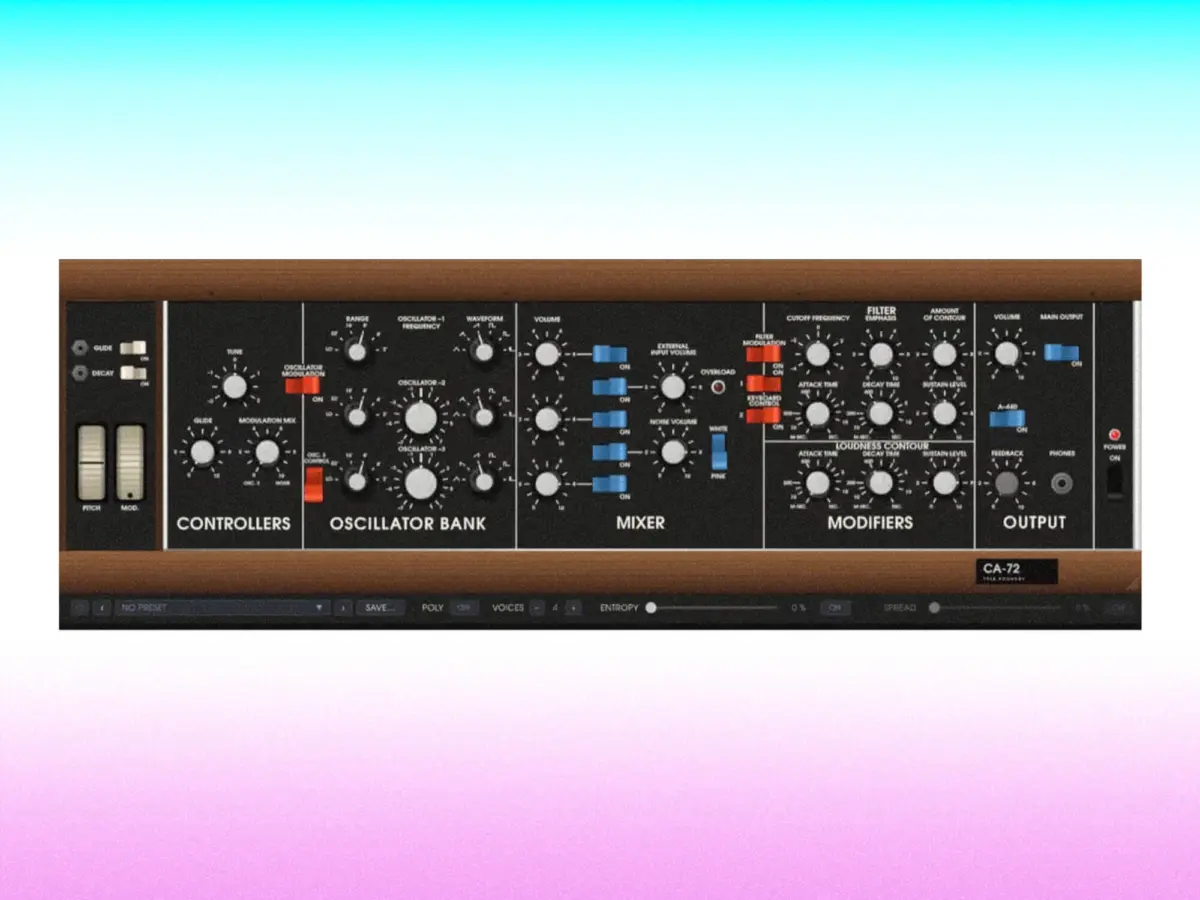
In a monumental win for the open-source audio community, Idle Foundry released CA-72, a meticulously modeled software emulation of the iconic 1970s Moog Minimoog Model D.
Rather than relying on high-level digital approximations, the developers reverse-engineered the synthesizer by transcribing original circuit schematics from vintage service manuals. They simulated the CA3046 oscillator board and tested the virtual circuits against factory calibration procedures (with computational assistance from Claude). Expanding on the monophonic hardware, CA-72 introduces 2- to 10-voice polyphony, per-voice analog drift, stereo spread, feedback routing, and 24 factory presets. The full plugin binary and source code are available free of charge via GitHub.
Supporting Context & Market Metrics
The economic realities governing the audio plugin industry reflect a profound shift in consumer psychology. According to recent market analysis reports from trade organizations such as NAMM, the demand for software-based production tools has stabilized at an all-time high, but consumer spending behavior has shifted into two opposing extremes:
- Ultra-Budget Micro-Plugins & Bundles: Products priced under $20 (such as SubverseLab’s $9 processors and CableGuys’ $16 automation tools) experience massive adoption rates. Consumers are increasingly fatigued by subscription fatigue and bloated $300 plugin suites, favoring modular, task-specific utilities that solve a single mixing problem instantly.
- High-End Boutique Restorations: Conversely, flagship emulations backed by heavy intellectual property and meticulous circuit modeling—such as Universal Audio’s Native FATSO ($149 MSRP) and Cherry Audio’s vintage synths—command strong sales figures because they offer professional studios a reliable, recallable alternative to maintaining temperamental, high-maintenance vintage hardware.
Furthermore, the explosive growth of open-source audio software (exemplified by Idle Foundry’s CA-72) signals an impending democratization of DSP design. As AI-assisted circuit modeling and community-driven GitHub repositories mature, the barrier to entry for building world-class synthesizer emulations is dropping precipitously.
Official Developer Statements & Industry Insights
Industry leaders have been vocal regarding the philosophical shifts driving these recent software cycles.
Speaking on the release of the Native FATSO, a Universal Audio senior product manager noted:
"Engineers no longer want their studio creativity shackled to specific hardware acceleration cards or dongles. The modern workflow demands pristine analog emulation that travels natively inside a project file, sounding identical whether opened on a high-end studio Mac Pro or a mobile laptop in a hotel room."
Similarly, Modbap addressed the minimalist design philosophy behind the oneTHNG series:
"We live in an era of plugin paralysis. Modern producers are inundated with interfaces featuring hundreds of microscopic knobs, complex routing matrices, and over-complicated modulation tabs. With Fidelity Theory, we wanted to strip away the clutter and return to tactile, intuitive sound design where a single physical gesture fundamentally transforms the emotional weight of the audio."
Future Outlook: What to Expect in DAW Technology
As we look toward the final quarter of the production year and into the horizon of audio technology, several clear trajectories are emerging:
- AI-Assisted Circuit Modeling: The success of open-source projects utilizing machine learning models to simulate vintage analog circuit boards (such as Idle Foundry’s CA-72) points toward a future where developers can rapidly prototype and deploy hyper-accurate emulations of rare hardware within days rather than years.
- Platform Convergence: The cross-pollination of bizarre hardware platforms—exemplified by Light Reft porting granular synthesis engines to the Sony PSP—demonstrates a growing appetite among bedroom producers for lo-fi, hardware-emulated constraints. Expect more developers to look beyond traditional computing platforms (iOS, Windows, macOS) to find unique sonic signatures in legacy embedded systems.
- The Rise of Task-Specific Utilities: As producers prioritize workflow velocity, heavy all-in-one channel strips are steadily losing ground to ultra-specialized micro-plugins designed to execute one specific task—whether that is dynamic tape-stopping (CableGuys TimeStop), sample-rate crushing (Modbap Fidelity Theory), or spatial algorithmic coloring (SubverseLab Kubbe).
Producers and engineers are advised to audit their current plugin folders, leverage ongoing seasonal promotional sales wisely, and embrace the influx of hyper-focused tools designed to accelerate creativity while preserving sonic integrity.