Executive Overview
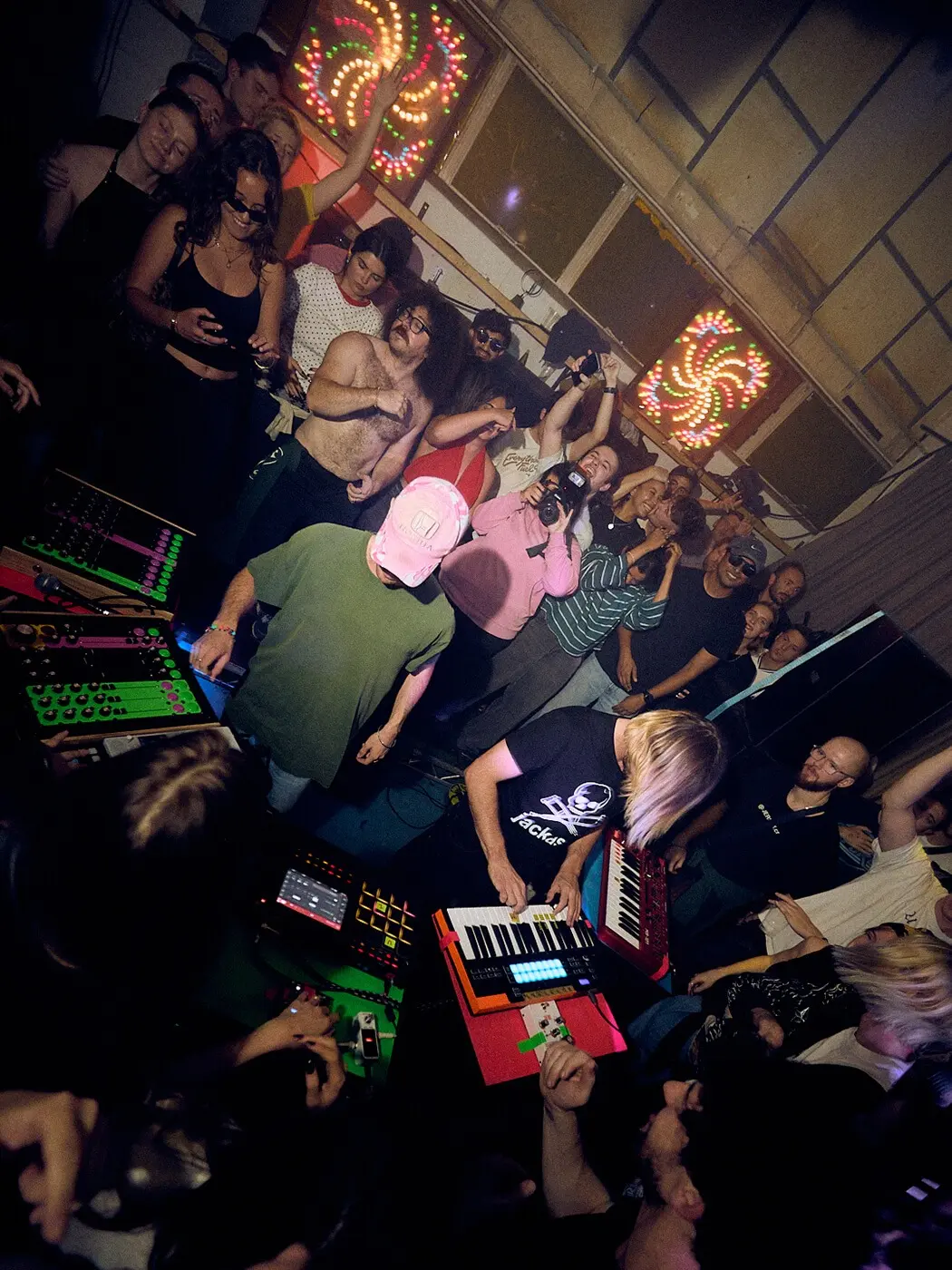
At 9:00 PM inside London’s Avalon Cafe—a compact, high-humidity sweatbox tucked away in Bermondsey—the air is thick with anticipation. A packed crowd of 250 uninhibited, sweat-drenched electronic music fans presses inward, their eyes locked on a cluster of audio hardware that sits unceremoniously at the center of the room. There are no decks, no towering CDJ setups, and conspicuously, no laptops glowing with the unmistakable blue timeline of a Digital Audio Workstation (DAW).
Instead, the focal point is an astonishing labyrinth of kit: an RME Fireface UFX III audio interface, OTO Machines BAM reverb units, a Behringer MS-1 MKII synthesizer, a Traktor Z1 MK2 DJ mixer controller, a Novation FLkey 37 MIDI keyboard, a Dreadbox Disorder Fuzz pedal, a Teenage Engineering OP-1 Field, a Mooer Baby Tuner, Bastl Instruments’ Kastle 2 FX Wizard, an Akai Professional MPC Live II standalone workstation, two custom-built Hackintoy MIDI controllers, and a trusty Shure SM58 microphone.
Moments later, French brothers Carl and Renaud Amiard—collectively known as the fast-rising electronic duo Jersey—casually weave their way through the tightly packed throng. The energy in the room immediately spikes to a fever pitch. Without a safety net of pre-recorded tracks or automated software timelines, the Normandy-born siblings dive straight into their performance, triggering hardware synths and sequencers with surgical precision as fans crane their necks for a closer look at their hands.
This 360-degree, equipment-heavy setup has become Jersey’s calling card. Over the past few years, their visceral live parties have gone viral across social media platforms, accumulating millions of views on YouTube and redefining what an underground electronic show can feel like. Blending indie-rock sensibilities with hyperpop aesthetics, their genre-mashing live edits—incorporating nods to Phoenix, MGMT, and Skrillex alongside originals like Talk Tonight and The World I’m Searching For—prove that dance music doesn’t need a screen to captivate a room.
As they tour in support of their debut album, NOTHING’S FAKE, Jersey is proving that the friction, unpredictability, and sheer physicality of hardware performance are the ultimate antidotes to an increasingly automated musical landscape.
Detailed Chronology: From Garage Rock Roots to Electronic Innovators
The story of Jersey does not begin in a Parisian techno club or a sleek electronic production suite. It spans a fifteen-year evolution of deep musical study, starting out as a traditional rock band. This foundational background in playing physical instruments profoundly shapes how Carl and Renaud approach electronic composition today.
The Studio-to-Stage Feedback Loop
Unlike many electronic acts who produce entirely in-the-box and then attempt to translate their studio creations to a live stage, Jersey operates in reverse. From the earliest days of conceiving their debut album, NOTHING’S FAKE, the creative mandate was clear: every sound had to be testable, tweakable, and performable in real time.

“We created the record with the idea of playing it live,” Carl explains, sitting down with MusicTech in the venue’s unlit outdoor alcove. “There are some echoes that we already did in the studio, and a few synths, but the crucial element is to have access to something very random, but very playful.”
Renaud expands on this philosophy, emphasizing ergonomics and workflow: “Not too many knobs to get the right sound… It’s great to have instruments that are really intuitive, where you can play around with every feature in a spontaneous way.”
This hands-on methodology turned the album-making process into an extended live experiment. Over a grueling two-year period, NOTHING’S FAKE took shape across a nomadic circuit of professional studios, friends’ apartments, and Airbnb rentals in London and Los Angeles. However, the core of the record was forged simply by the two brothers locking themselves away in Paris, surrounded by gear, “playing with instruments.”
The Genesis of a Live-First Track
For Jersey, the studio and the stage are inextricably linked. The duo uses their live shows as a proving ground for unreleased material and experimental sound design.
“We create a lot of new effects, and after trying them at a live session, if it’s good, we keep it,” Renaud notes.
This trial-by-fire approach ensures that by the time a track is finalized, it has already been stress-tested in front of hyper-critical club audiences. It explains why their hour-long performances—which regularly culminate in double encores and rapturous receptions for older fan favorites like I Want You—feel so breathless and alive. There is no passive consumption; the audience is witnessing two musicians actively composing, dismantling, and rebuilding their sonic universe in real time.
Supporting Context & Metrics: The Hardware-Only Renaissance
The Anatomy of a DAWless Setup
The decision to abandon the laptop represents a deliberate ideological stance in modern electronic music production and performance. While the vast majority of touring electronic acts rely on Ableton Live, Logic Pro, or Rekordbox running on a portable computer to manage backing tracks, multitrack stems, and lighting cues, Jersey’s rig is entirely hardware-dependent.

By routing their audio through an RME Fireface UFX III and utilizing standalone powerhouses like the Akai MPC Live II alongside analog synthesizers and boutique pedals, the brothers introduce a vital element of human error and happy accidents.
“We like letting ourselves get surprised by the sounds we create, then shaping them and using those textures as raw material to build something from,” Carl explains. “We love tweaking knobs live and seeing what happens while the other person records.”
Viral Phenomenon Meets Intimate Spaces
Jersey’s rise has been heavily catalyzed by digital media, yet ironically, their viral success stems from how aggressively analog their presentation is. In an era where festival stages are dominated by massive LED walls and DJs pressing play on pre-mixed USB drives, videos of Jersey performing shoulder-to-shoulder with fans in 250-capacity rooms have struck a chord.
Accumulating millions of views across YouTube and TikTok, these clips showcase a level of intimacy and raw dexterity that has been largely lost in contemporary dance music culture. By stripping away the physical barrier of the DJ booth, Jersey has tapped into a growing audience appetite for authenticity, vulnerability, and genuine musicianship.
Official Statements & Artistic Philosophy
Despite their embrace of cutting-edge hardware and unconventional production techniques, Jersey is deeply rooted in the lineage of iconic electronic-pop acts. Throughout the creation of NOTHING’S FAKE, the duo looked toward artists who successfully bridged the gap between underground electronic textures and massive pop songwriting.
Channeling the Greats
“Gorillaz is a band that uses vocals in a very pop-oriented way while having a really distinctive approach to sound and texture,” Carl observes. “Daft Punk have done something similar, and we love how instantly recognisable and personal their sound is.”
Alongside Daft Punk and Gorillaz, the brothers cite Justice, The Prodigy, and Skrillex as foundational inspirations. This eclectic mix of French touch house, big beat aggression, and indie-pop songcraft forms the bedrock of Jersey’s sonic identity.

Navigating the AI Frontier
Perhaps the most nuanced aspect of Jersey’s artistic philosophy involves their approach to artificial intelligence. While many musicians in the electronic community view AI with suspicion or outright hostility, Jersey employs it with surgical precision—not to generate music, but to sculpt vocal identity.
Rather than relying on traditional human vocal takes or standard plug-in pitch correction, the duo uses text-to-speech AI models.
“We approached it as the journey of half robot and half human,” Carl explains. “We don’t hide it because it’s not generating the music at all. It’s just for the vocals, and it is closer to a vocoder.”
Renaud breaks down the exact workflow behind this process: “We made a model of our voice, then we use the model to do text-to-speech, then we tune every note after, and we cut samples to add entire sentences. This is the only use of AI we do within our music.”
Carl reiterates their stance against shortcutting art: “We don’t like to erase the process of making music.”
Instead, they view AI as an artistic medium to create intentional ambiguity. By deliberately leaving artifacts and imperfections in the synthesized vocal models, they invite listeners to question reality.
“We want our vocals to sound a little bit like AI and like a real human voice,” Renaud reflects.

Carl adds: “We want to have this little play with the notion of fake. We purposefully didn’t make the vocals too high because we want people to wonder whether a certain part is AI or not. We are actively looking for this effect.”
Yet, they draw a hard line when it comes to the stage. When asked about the prospect of bringing automated elements into their live shows, Carl is unequivocal: “If you go to see an artist perform, you can’t have a robot in front of you.”
Future Outlook: Rejecting the DJ Booth for the Live Arena
As NOTHING’S FAKE establishes Jersey as a major force in contemporary electronic music, the duo faces a crossroads familiar to many successful underground acts: the temptation to scale up, transition into traditional DJ sets, and play massive festival mainstages with minimal gear.
For Carl and Renaud, however, traditional DJing is simply off the table.
“We take so much pleasure from trying to perform as well as we can with synths and our gear,” Carl says, while acknowledging that while they respect DJ culture, it is simply “not for this project.”
Renaud echoes this sentiment, emphasizing the physical and psychological need for tactile engagement during a performance: “We don’t feel good when we DJ. We need to have something to do with our hands, and it’s easier for us to feel the music and connect with the crowd.”
As they look toward future tours and further sonic exploration, Jersey remains committed to the sweatboxes, the tangled cables, and the unpredictable thrill of live hardware performance. By keeping humans firmly at the controls—even while playing with the uncanny aesthetics of AI vocals—they have carved out a unique, uncompromising space in the modern electronic music landscape. In a world of infinite digital perfection, Jersey proves that the most exciting music is the kind that feels like it could fall apart at any second.