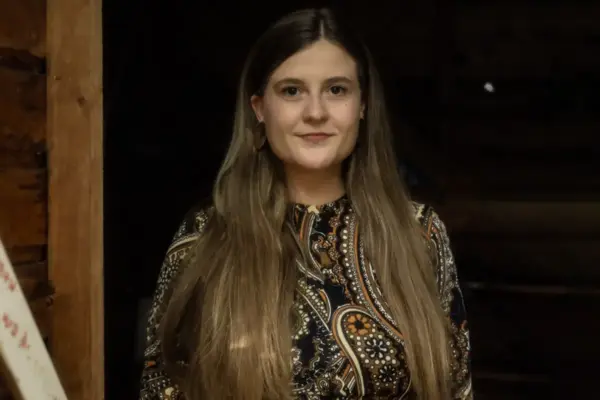
For over a decade and a half, Elly Jackson has built the sonic universe of La Roux on the foundational premise of pop archeology—excavating, recontextualizing, and elevating bygone eras of electronic and dance music. Her 2009 self-titled debut synthesized the neon synth-pop of the 1980s; 2014’s Trouble in Paradise dove headfirst into late-70s and early-80s disco; and 2020’s Supervision lingered comfortably within those sleek, retro-futuristic soundscapes. Yet, it was that first album—spurred by the omnipresent, era-defining singles "Bulletproof" and "In For the Kill"—that rocketed Jackson to a level of dizzying, global fame she was entirely unequipped to handle at age 21.
Now, at 38, Jackson is stepping into a deeply reflective and radically transparent chapter with her new album, Old Flames. Moving away from the avant-garde tailoring and androgynous, alien aesthetics that historically defined La Roux, Jackson is embracing a distinctly American, pre-internet warmth. Drawing aesthetic and sonic cues from late-90s and early-00s R&B, Gap advertisements, LL Bean catalogs, and Pacific Northwest cabins, Old Flames is an exercise in millennial yearning and artistic rebirth.
More than just a stylistic pivot, however, the album represents a profound personal reckoning. Old Flames chronicles the agonizing end of a 17-year romantic relationship, a battle with marijuana addiction, a late-blooming coming-out narrative, and a desperate, necessary "breakup with herself" as she finally permits herself to grow up. Speaking candidly from Australia while on tour opening for Hilary Duff, Jackson opens up about the ghosts of her past, the comfort of nostalgia in an era of technological anxiety, and why she is finally ready to tell the unvarnished truth about who she is and what her music has always meant.
Detailed Chronology
The Whirlwind of 2009: Global Stardom and Instant Discontent
When La Roux dropped in 2009, its impact on the global pop landscape was seismic. "Bulletproof" spent an astonishing 27 weeks on the Billboard Hot 100, peaking at No. 8 and embedding itself into the cultural consciousness of a generation. But behind the sudden ubiquity of her sharp red hair and futuristic blazers lay deep internal turmoil.
Rather than feeling validated by her instantaneous success, Jackson felt alienated. Thrust into the global spotlight across America, Australia, and Russia at a formative age, she experienced a profound sense of impostor syndrome. She had not labored for years in obscurity before finding an audience; success had simply materialized overnight.
"I resented it," Jackson reflects. "I’m one of those people that likes to work hard for something. I like to feel like I’ve gotten somewhere for a reason, and I just put this song out, and it was suddenly globally famous. It actually felt really unsatisfying."
Compounding her frustration was the disconnect between the music she actually wanted to make and the pop-leaning, hyper-feminine energy of "Bulletproof." While remixes transformed the track into a global club fixture, Jackson viewed the song as a statistical anomaly in her catalog—one that unfairly pigeonholed her as a pure dance artist rather than the intricate, idiosyncratic songwriter behind tracks like "Let Me Down Gently" and "Tropical Chancer."
The 17-Year Chapter and the Untold Coming-Out Narrative
Beneath the glittering surface of La Roux’s early success lay private realities that Jackson guarded fiercely. While "In For the Kill" famously mapped the emotional trajectory of her falling in love with her best friend, Jackson steadfastly refused to address the personal origins of the track at the time. Fearing the invasive glare of the media while already struggling to process global fame, she kept her private life tightly sealed.
In retrospect, Jackson acknowledges the weight of that silence. While La Roux became an accidental coming-out anthem for countless young queer listeners navigating their identities, Jackson herself never officially made her coming-out clear to her audience.
That foundational relationship—begun when Jackson was just 20 years old—anchored her life for nearly two decades. Through various professional peaks and valleys, the partnership endured until it finally fractured through a series of painful transitions, ultimately ending in 2024. The dissolution of that 17-year bond serves as the emotional bedrock of Old Flames, providing the stark, human contrast to the album’s glossy, nostalgic sheen.
The Stagnation of ‘Peter Pan-ism’ and the Breakup With Self
While the end of her romantic relationship devastated Jackson, she quickly realized that a more urgent separation was required: a breakup with herself. Approaching her late thirties, Jackson recognized that her lifestyle as a touring pop star had fostered a state of arrested development—a chronic "Peter Pan-ism" that allowed her to bypass the traditional milestones of adulthood.
For years, she had taken pride in remaining detached from societal norms, traditional employment, and the conventional markers of growing up. However, as the years ticked by, that detachment transformed into a source of deep personal shame. Her thought patterns remained frozen in her mid-twenties, a stagnation fueled in large part by heavy marijuana use.
"I smoked a lot of weed, which I think really holds you back," Jackson admits. "You just stay in this haze. There are behaviors around being a stoner that you justify, and I was like, ‘What am I doing?’ It keeps you stuck in a dream world. I’m a Pisces anyway, and I used to daydream constantly… and I don’t think it was healthy."
This internal reckoning birthed the thematic arc of Old Flames. Songs like "Cabin Fever" capture the frantic, racing thoughts of an artist questioning her relevance and capabilities, while "Lose Myself" acts as a direct confrontation with substance dependence and the deliberate choice to walk away from it.
Supporting Context & Metrics
The Millennial Ache: Seeking Refuge in the Pre-Internet Era
To build the sonic and visual architecture of Old Flames, Jackson cast her gaze backward to a simpler time: the late 1990s and early 2000s. Eschewing the British musical touchstones that informed her previous work, Jackson immersed herself entirely in American R&B and pop luminaries—citing SWV, All Saints, Mariah Carey, Rodney Jerkins, and peak Justin Timberlake as foundational influences.
Visually, the album abandons La Roux’s historical preference for avant-garde tailoring and alien androgyny in favor of a distinctly vintage American sportswear aesthetic. Drawing inspiration from Ralph Lauren advertisements, LL Bean catalogs, Gap campaigns, and solitary cabins tucked into the forests of the Pacific Northwest, Jackson sought to evoke the warmth and psychological safety of a pre-internet childhood.
"It goes back to a period of my childhood when I was about nine; it was one of the last times I think our generation… felt safe," Jackson notes. "It was just before phones took over our lives… Everything from about 2000 on was just getting scarier and scarier, and just going back to that period where everything wasn’t so scary—I genuinely ache for it."
Navigating the Arena Scale on Tour with Hilary Duff
As Jackson introduces this new era to the world, she has spent considerable time on the road opening for Hilary Duff—another iconic artist managing the delicate balance between career-defining legacy hits and compelling new material.
Stepping onto massive amphitheater and arena stages night after night to perform in front of 15,000 to 20,000 seated ticket-holders presented an initial psychological hurdle for an artist unaccustomed to such configurations. Yet, after a decade-long hiatus from extensive touring, the trial by fire has sharpened Jackson’s stagecraft.
Remarkably, time has also healed her complicated relationship with her own past. Standing on stage today and performing "Bulletproof" no longer triggers the resentment of her youth. Instead, she views the track with profound gratitude:
"It’s kind of a one-off. But thank f—k, because it has paid for me to have the mental-health crisis I needed to have, and I’ll be eternally grateful to the song for that. It’s really lucky to write a song when you were young that can carry your whole career."
Official Statements
On the Aesthetic Shift of Old Flames: "The whole album is not meant to feel British at all. The music it’s referencing was born out of America… When I listen to it in L.A., it feels right. All the visual references are American Pacific Northwest and LL Bean, Gap, Ralph Lauren. That whole time when casual wear was king, that vintage male look where you could just wear a white t-shirt and jeans and it was iconic."
On Technological Anxiety and the Rise of AI: "Yeah, in flashes. But you only have to look out the window to realize you’ll never be able to go back. I think our generation is having a really rough time with the rise of AI, the climate, everything changing so quickly. Everyone wants it to stop, but no one’s stopping it. It’s like watching a burning building. Unfortunately, the effect it has on people, including me, is it makes you not want to engage. It makes you want to escape."
On the Juxtaposition of Pain and Joy: "You don’t get the light without the dark. There’s a lot of fantasy and delusion on this record, but there’s also a lot of genuine pain… I do think the reason ‘Babyline’ and ‘Old Flames’ feel so joyful at the end is because, whether you’ve been listening intently or not, you feel like you’ve had to get there. You’ve had to go through something to earn that payoff."
On the Realization of Adulthood: "I realized that I was aging, but my thought patterns were not those of somebody my age, and it was starting to really bother me. Something I’d previously been proud of—staying out of society, staying out of normal jobs, the normal process of getting married and having children—stopped becoming something I was proud of. I was like, ‘I’m actually missing out on some of the joys of adult life, and I can’t mature in my mind.’"
Future Outlook
With the release of Old Flames, Elly Jackson stands at an unprecedented crossroads of artistic and personal alignment. Having confronted the ghosts of her early fame, dismantled her reliance on self-medicating habits, and processed the grief of a 17-year partnership coming to a close, she is operating from a place of hard-won equilibrium.
Looking forward, Jackson’s primary objective for this cycle is not merely commercial chart dominance, but holistic creative resonance. She aims to demonstrate her capacity as a master world-builder and creative director, ensuring that listeners fully immerse themselves in the comforting, nostalgic ecosystem she has meticulously constructed.
Furthermore, she hopes Old Flames will serve as a bridge to a new demographic of listeners—those who may have previously bypassed La Roux due to the inescapable pop ubiquity of "Bulletproof," but who will find a kindred spirit in her mature, reflective, and deeply human songwriting. By successfully marrying the lighthearted, fun-loving pop sensibilities of her childhood memories with the raw, unedited pain of her adult realizations, Jackson has not only salvaged her relationship with her past—she has successfully forged a path forward into a clearer, wiser future.