The television adaptation of Jilly Cooper’s iconic 1980s "bonkbuster" Rivals has proven that high-gloss escapism and profound social commentary are not mutually exclusive. When Disney+’s smash-hit drama reached the midpoint of its second season, it delivered a watershed moment of prestige television that left audiences reeling. Episode six—pivoting on a masterfully orchestrated, metaphorical tempest—shattered the polite, suffocating social conventions of the fictional English county of Rutshire, subverting the expectations of longtime literary fans and television critics alike.
What began as a web of tangled aristocratic affairs, teenage awakenings, and ruthless media rivalries culminated in a domestic tragedy that upended the narrative architecture of the series. By shifting the emotional core of the story away from its powerful, charismatic male figures—such as television magnate Tony Baddingham (David Tennant) and dashing sporting icon Rupert Campbell-Black (Alex Hassell)—and placing it squarely upon the shoulders of its most overlooked female characters, the show executed a radical transformation.
Monica Baddingham (Claire Rushbrook) and Lizzie Vereker (Katherine Parkinson)—traditionally portrayed as the downtrodden, overlooked wives of the Rutshire elite—stepped out of the shadows to claim agency over their lives. In doing so, Rivals transcended its trashy, high-society roots to explore the heavy toll of domestic duty, the radical necessity of female solidarity, and the enduring quest for authentic desire. As the series prepares for the final six episodes of its second season, the landscape of Rutshire has changed irreversibly, proving that beneath the chintz, polo fields, and designer couture, a quiet revolution is underway.
Detailed Chronology: The Anatomy of a Mid-Season Cataclysm
To understand the seismic shift that occurs in episode six of Rivals Season 2, one must trace the rapid, cascading domino effect of revelations that tear through the Gloucestershire countryside against the backdrop of an advancing, violent storm.
The episode’s narrative engine begins in domestic intimacy before exploding into public scandal. Teenage Caitlin O’Hara (Catriona Chandler)—daughter of Declan O’Hara (Aidan Turner) and Maud O’Hara (Victoria Smurfit)—finds herself drawn to Archie Landau (Louis Landau), the teenage son of her father’s bitter adversary, Tony Baddingham. While developing photographs captured on Tony’s professional camera equipment, the young couple stumbles upon a deeply incriminating piece of evidence: a photograph of Maud posing naked in a mirror, unwittingly capturing Tony’s voyeuristic reflection in the glass.
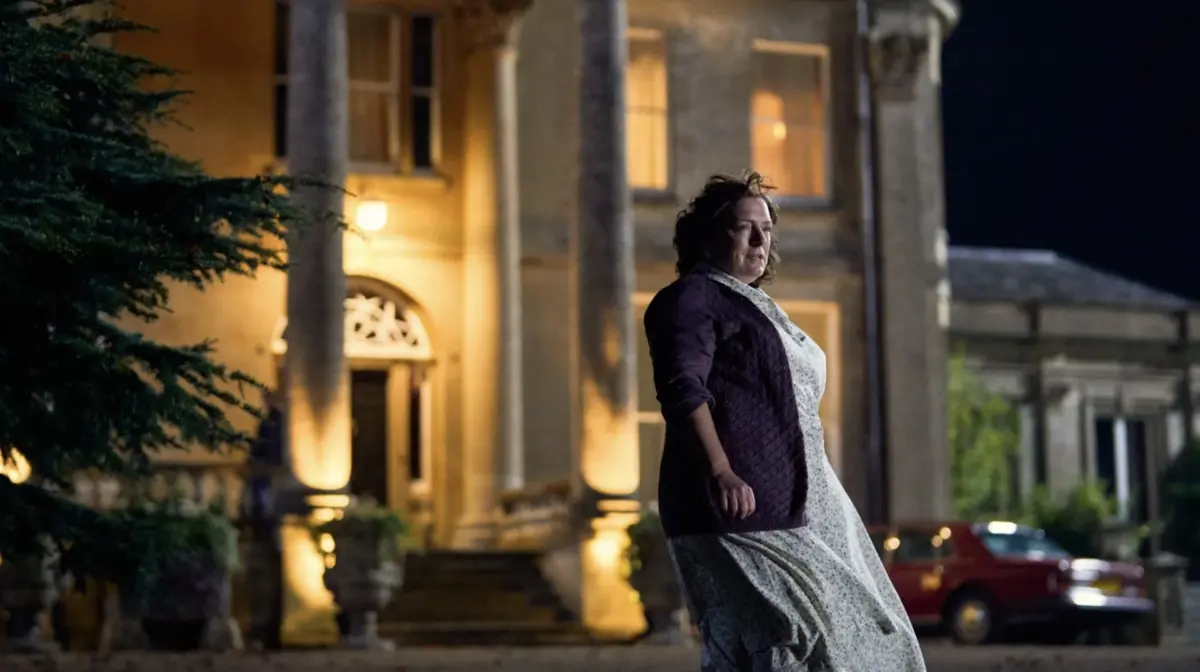
The discovery lays bare the hypocrisy and rampant infidelity underpinning the lives of the Rutshire elite. Worse still, it arrives precisely as Monica Baddingham returns home. Unlike lesser melodramas that might drag out the tension across multiple episodes, Rivals accelerates the dramatic timeline with ruthless efficiency. Monica immediately lays eyes upon the photograph, comprehends the utter betrayal of her husband, and makes a swift, decisive move. She casts the photograph into the open fireplace, confronts Tony upon his return with cold, unyielding clarity, and walks out of the matrimonial home and directly into the escalating storm.
What follows is an explicit homage to classic theatrical tragedy. Monica’s solitary trek through the elements mirrors King Lear upon the heath; exposure to the howling winds and driving rain strips away her societal inhibitions, guiding her from a state of acute emotional shock into absolute, piercing clarity. She eventually finds refuge on the doorstep of Lizzie Vereker, initiating a sequence that serves as the emotional bedrock of the season.
Over cups of tea rapidly transitioned to brandy, the two women strip away decades of repression. Monica, newly liberated from the stifling expectations of her marriage, actively encourages Lizzie to pursue her own affair with tech millionaire Freddie Jones (Danny Dyer), free from the crushing weight of guilt or social censure.
However, the catharsis is tragically short-lived. Leaving Lizzie’s house later that night, Monica meets a grim fate. As the tempest reaches its destructive crescendo, a massive falling tree crushes her vehicle, ending her life instantly. This tragic turn of events not only robs Monica of the peaceful resolution she sought but sets the stage for a volatile second half of the season, scheduled to premiere on November 11.
Supporting Context & Metrics: Adapting the 1980s Bonkbuster for a 21st-Century Audience
The monumental success of the Rivals television adaptation lies in its delicate balancing act: honoring the intoxicating, escapist pleasure of Jilly Cooper’s original 1988 Rutshire Chronicles novel while injecting modern psychological depth and feminist critique.
The Literary Deviation
For purists, the fate of Monica Baddingham in the television series represents a massive departure from Cooper’s extended universe. In Cooper’s 2007 novel Appassionata, Monica eventually receives a narrative reward for her decades of quiet endurance. She successfully divorces Tony Baddingham and finds genuine, peaceful happiness living in an open relationship with her childhood friend, Dame Enid Spink.
By killing Monica off at the midpoint of Season 2, the showrunners have chosen dramatic tragedy over literary continuity. This bold creative choice elevates the stakes of the series, transforming a lighthearted soap opera into a biting exploration of systemic female oppression within high-society British circles.
A Lineage of Subversive Women’s Writing
Scholars of English literature have noted striking parallels between the social ecosystem of Cooper’s Rutshire and the Restoration London depicted by Aphra Behn (1640–1689), the Western world’s first professional female writer. Both Behn’s plays and Cooper’s novels dissect identical societal pressure points:
Desire and marriage as economic transactions
The pursuit of fame, power, and political influence
The stark double standards applied to female sexuality versus male promiscuity
Just as Behn used the hedonistic, scandal-ridden court of Charles II to critique the patriarchal structures of 17th-century England, the adaptation of Rivals uses the honey-colored Cotswold mansions, elite polo clubs, and television boardrooms to expose the emotional starvation of the women who inhabit them. The glossy aesthetics—costly couture, champagne receptions, and sun-drenched polo matches—serve as a glittering facade masking deep-seated societal sadness.
Character Dynamics and Demographic Impact
The series deliberately upends the traditional television hierarchy. While characters like the American television producer Cameron Cook (Nafessa Williams) represent modern, hyper-competent professional success, they are not the true agents of societal change in Rutshire. That honor belongs to the "frumpy" housewives, Monica and Lizzie, whose kitchen-table confessionals dismantle the patriarchal triumvirate of Tony Baddingham, Declan O’Hara, and Rupert Campbell-Black.
Viewership metrics for Disney+ indicate that the series has struck a chord across diverse demographics. While older audiences tune in for nostalgic fidelity to Cooper’s 1980s setting, younger viewers—particularly women aged 18 to 34—have embraced the show for its frank, unvarnished depictions of female agency, sexual autonomy, and the rejection of traditional domestic martyrdom.
Official Statements and Production Insights
The creative team behind Rivals has been vocal about the intentionality behind the second season’s darker, more character-driven narrative arcs. Speaking on the adaptation process, executive producers and head writers emphasized the necessity of giving emotional depth to characters who were historically treated as background furniture in the original pulp novels.
"We didn’t just want to recreate a nostalgic romp; we wanted to investigate the human cost of the Rutshire lifestyle," noted a senior production source close to the Disney+ development team. "Characters like Monica and Lizzie represent generations of women expected to maintain the social machinery of the British upper-middle class while absorbing every emotional blow dealt by their ambitious, narcissistic husbands. Episode six was designed as a reckoning."
Cast members have similarly praised the scripts for allowing them to explore complex emotional terrain. Claire Rushbrook, reflecting on Monica’s final hours, described the character’s journey through the storm as an essential shedding of invisible armor:
"Monica spends years shrinking herself to fit into Tony’s orbit. The storm isn’t just a weather event; it’s the external manifestation of her internal rage and awakening. Walking out that door was the first truly autonomous act of her adult life."
Meanwhile, Katherine Parkinson’s portrayal of Lizzie Vereker has been widely lauded for capturing the painful, awkward, yet ultimately liberating transition from downtrodden spouse to a woman unapologetically claiming her own desires alongside Danny Dyer’s Freddie Jones.
Future Outlook: What to Expect in the Final Six Episodes
As Rivals looks ahead to the release of its final six episodes on November 11, the narrative chessboard has been completely rearranged. The sudden, violent death of Monica Baddingham sends shockwaves through Rutshire, forcing Tony Baddingham to confront the wreckage of his personal life just as his corporate empire faces unprecedented internal pressure.
With Monica gone, the emotional focal point of the series shifts definitively to Lizzie Vereker. Having articulated her disillusionment with domestic servitude and her desire for genuine romantic fulfillment, Lizzie is positioned to become the ultimate trailblazer of the season’s second act. Her evolving relationship with Freddie Jones will test whether personal liberation can truly take root in a society built on hypocrisy and backstabbing.
Furthermore, the fallout from the affair between Tony and Maud O’Hara—now exposed to Declan and the wider community—promises to ignite bitter professional and personal vendettas. Teenage sweethearts Caitlin and Archie must navigate the toxic debris left behind by their parents’ catastrophic indiscretions, while Rupert Campbell-Black continues his slow, agonizing realization that his heart belongs to Taggie O’Hara (Bella Mclean) rather than the dazzling Cameron Cook.
As the promotional materials and atmospheric foreshadowing suggest, storm clouds are gathering once more over the Cotswolds. Whether the women of Rutshire can sustain their hard-won clarity or whether the magnetic pull of aristocratic excess will drag them back into the shadows remains the central, gripping question as Rivals hurtles toward its explosive season finale.