For centuries, the boundary separating history from myth has seemed definitive. While historical records rely on physical artifacts, contemporary documentation, and verifiable dates, folklore and legend occupy a more fluid, imaginative realm. Nowhere has this division been more apparent than in the study of medieval Welsh literature, where tales of magic, shape-shifting kings, and supernatural entities have long been dismissed as purely creative products of the medieval imagination.
However, a groundbreaking archaeological discovery in the windswept Preseli hills of Pembrokeshire, south-west Wales, is challenging this rigid paradigm. The recent unearthing of a Roman timber fort at Y Frenni Fawr has breathed startling new life into Breuddwyd Macsen Wledig (The Dream of Macsen Wledig), a revered medieval Welsh-language tale. For generations, academic consensus viewed the text’s specific geographical references—particularly a remote imperial camp perched atop a Welsh hilltop—as pure literary invention.
The physical recovery of a Roman military installation, complete with numismatic evidence contemporaneous with the late fourth century, forces a dramatic re-evaluation. This finding poses a profound methodological question for historians and archaeologists alike: To what extent can ancient oral traditions and medieval texts preserve authentic historical memories of places and events that were otherwise lost to the written record?
By bridging the gap between archaeological science and medieval philology, this discovery suggests that folklore is not merely fantasy, but a potential repository of forgotten historical data. This report examines the convergence of the recent Pembrokeshire excavation, the enduring legacy of the Mabinogion, the historical reality of Magnus Maximus, and the expanding horizons of interdisciplinary historical research.
Detailed Chronology
To understand the magnitude of the Pembrokeshire discovery and its relation to medieval literature, it is necessary to trace a dual chronology spanning over sixteen centuries—tracking the evolution of Roman Britain into medieval manuscript culture, and tracing its eventual rediscovery in the modern era.
Antiquity and the Roman Twilight (383–410 AD)
383 AD: Magnus Maximus, a native of Hispania serving as a high-ranking Roman general in Britain, is proclaimed emperor by his mutinous troops. He launches an invasion of Gaul, taking much of the Western Roman Empire’s military capability out of Britain.
388 AD: Magnus Maximus is defeated and executed by Emperor Theodosius I at Aquileia, marking a decisive turning point in the waning imperial control over the British Isles.
c. 410 AD: Emperor Honorius issues the "Rescript of Honorius," effectively telling the civitates of Britain to look to their own defense. The formal administrative and military presence of Rome in Britain comes to an end, paving the way for the emergence of native kingdoms and the crystallization of early Welsh identity—a transition heavily romanticized in later Welsh lore.
The Preservation of Oral and Manuscript Traditions (11th–14th Century)
11th–12th Century: Stories concerning early British history, regional heroes, and Arthurian legends circulate widely across Wales via an oral tradition of bards and storytellers (cyfarwyddion).
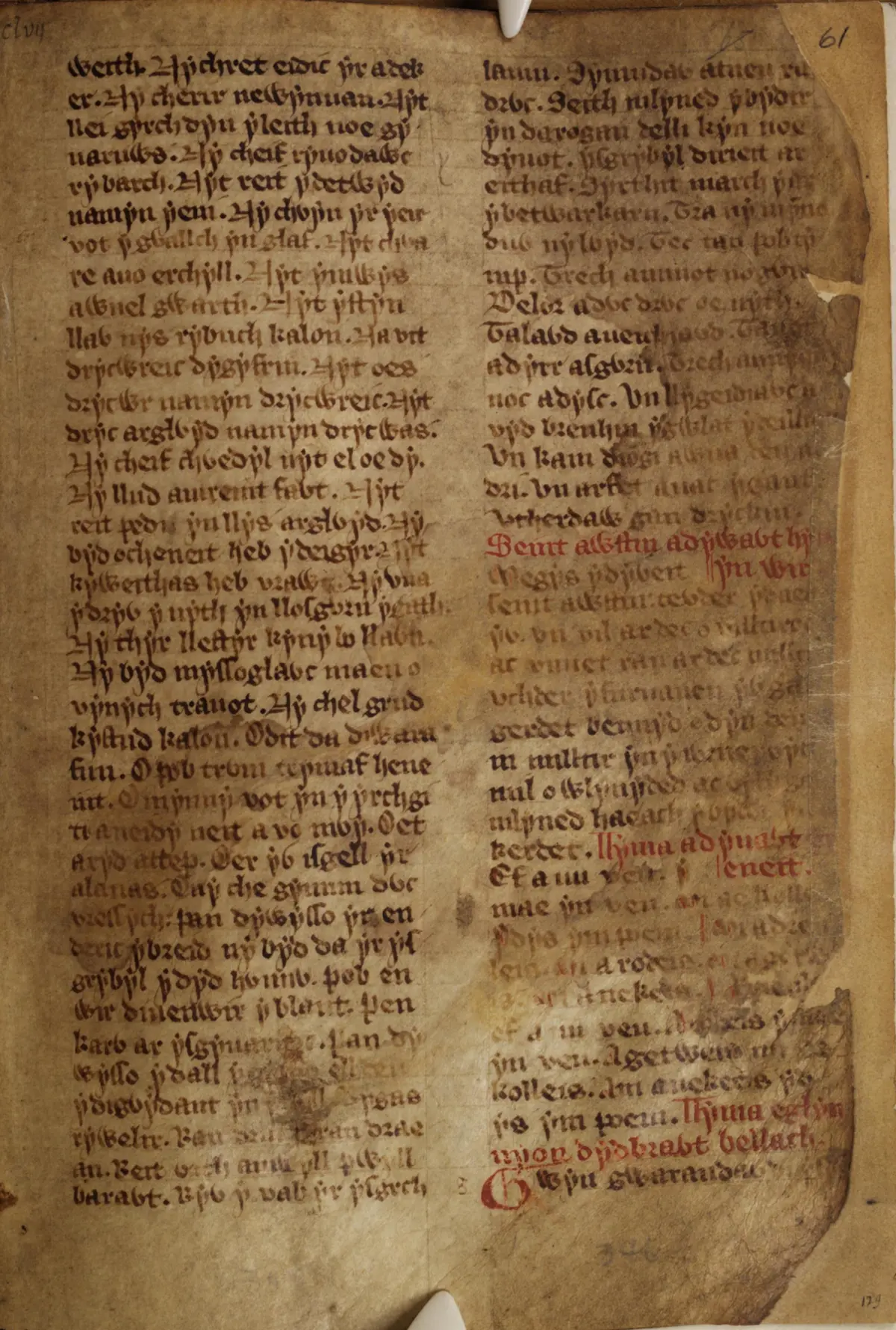
c. 1350: Scribes compile the Llyfr Gwyn Rhydderch (the White Book of Rhydderch), one of the foundational Welsh-language manuscripts preserving The Dream of Macsen Wledig alongside other tales of the Mabinogion.
c. 1382–1410: The Llyfr Coch Hergest (the Red Book of Hergest) is compiled, ensuring the survival of these texts through a second major textual witness, capturing the rich tapestry of medieval Welsh myth and pseudo-history just before the sweeping political transformations of the late Middle Ages.
The Modern Archaeological Breakthrough (21st Century)
2020s: Archaeological surveys intensify in south-west Wales, driven by advanced remote sensing, LiDAR technology, and targeted field walking aimed at identifying previously overlooked military infrastructure.
Recent Excavation: Archaeologists uncover the structural remains of a Roman timber fort at Y Frenni Fawr in the Preseli hills of Pembrokeshire. Excavations yield crucial finds, including Roman coins minted during the era of Magnus Maximus.
Present Day: Scholars re-evaluate The Dream of Macsen Wledig, transitioning the text from a purely fictitious narrative to a document containing verifiable geographical and structural memory.
Supporting Context & Metrics
The significance of the Y Frenni Fawr discovery cannot be fully appreciated without examining the literary ecosystem from which it emerges, as well as the historical mechanics of Magnus Maximus’s reign.
The Mabinogion and Medieval Welsh Identity
The Dream of Macsen Wledig is one of the eleven prose tales traditionally collected under the umbrella title of the Mabinogion. Surviving primarily in the White Book of Rhydderch and the Red Book of Hergest, these tales represent the pinnacle of medieval Welsh narrative art. They are divided conceptually into several groups:
The Four Branches of the Mabinogi: Mythological cycles exploring the intertwined fates of families, kingdoms, and the supernatural.
Native Tales and Historical Legends: Stories like Macsen Wledig and Lludd and Llefelys that appropriate classical or early medieval historical actors and place them squarely within the Welsh landscape.
Arthurian Romances: Tales featuring Arthur and his court, which eventually helped shape European chivalric literature.
In these texts, landscape is destiny. Features such as rivers, mountains, and Roman roads are consistently explained through legendary narratives. For instance, Sarn Elen (Elen’s Way), the expansive network of Roman roads connecting north and south Wales, is attributed in the tale to the empress Elen Luyddog.
The Historical Realities of Magnus Maximus
The literary figure of Macsen Wledig is an amalgamation of folklore, saintly hagiography, and genuine late-antique history, centered primarily on Magnus Maximus (known in Welsh as Maxen Wledig or Maximus the Leader).
Imperial Ambition: Born in Gallaecia (modern Spain/Portugal), Maximus commanded respect within the Roman military machine in Britain. In 383 AD, he capitalized on soldier discontent to launch a cross-channel invasion against the Western Emperor Gratian.
Geographical Control: For five years, Maximus ruled as a legitimate Augustus in the West, controlling Britain, Gaul, Hispania, and Africa, before his defeat in northern Italy in 388 AD.
Cultural Resonance: The departure of Roman legions under Maximus underpins the creation myth of Wales. As famously invoked in Dafydd Iwan’s 1983 patriotic anthem Yma o Hyd ("Still Here"), the vacuum left by Maximus’s army marks the genesis of an independent Welsh nation that has survived centuries of external pressure.
Key Metrics of the Archaeological Find
Site Location: Y Frenni Fawr, Preseli hills, Pembrokeshire, south-west Wales.
Structural Type: Roman timber fort, indicating tactical positioning and temporary or semi-permanent strategic control in a region previously thought to be largely untouched by formal Roman military installations of this nature.
Datable Material: Roman coinage matching the late 4th-century temporal window of Magnus Maximus’s historical horizon (c. 383–388 AD).
Textual Correlation: Direct alignment with the narrative episode in The Dream of Macsen Wledig wherein the emperor travels from Carmarthen to the summit of the Preseli hill to hunt and establishes an encampment named Cadair Facsen (Macsen’s Chair).
Official Statements
The intersection of field archaeology and textual scholarship has elicited profound commentary from leading academics, cultural historians, and heritage preservationists across the United Kingdom.
Dr. Elin ap Hywel, senior research fellow in medieval Welsh literature, emphasized the philosophical shift necessitated by the excavation:
"For generations, literary scholars have treated the topographical specificity of texts like The Dream of Macsen Wledig as a masterclass in imaginative world-building. We assumed that bards plucked names like Cadair Facsen out of thin air to give their stories an air of localized authority. This discovery forces a complete recalibration. It tells us that oral traditions were capable of preserving hyper-local historical data across a millennium of transmission. The people who wrote down these tales in the fourteenth century were drawing upon an archive of physical memory that we foolishly believed was entirely lost to time."
Lead field archaeologist on the Pembrokeshire excavation project offered critical insight into the material evidence uncovered at Y Frenni Fawr:
"When we first identified the postholes and defensive earthworks characteristic of a Roman timber fort on Y Frenni Fawr, our immediate questions were operational: Why here? Why this remote upland? The discovery of coins minted during the exact reign of Magnus Maximus provided the anchor we needed. It transforms our understanding of late Roman military deployment in south-west Wales. This wasn’t merely a literary fantasy; a Roman commander—or forces operating under imperial authority—truly marked this landscape. The folklore preserved the memory of boots on the ground."
Cultural preservation advocates have likewise pointed to the broader implications for Welsh heritage tourism and education. A spokesperson for Cadw, the historic environment service of the Welsh Government, noted:
"This discovery powerfully demonstrates that Wales’s cultural heritage—our stories, our songs, and our stones—cannot be neatly compartmentalized. The landscape of Wales is a living archive. When poetry, prose, and archaeology speak the same language, the past becomes strikingly vivid for contemporary audiences, reinforcing why the preservation of both our ancient monuments and our intangible literary traditions is of paramount national importance."
Future Outlook
The identification of the Roman timber fort at Y Frenni Fawr is not an isolated academic triumph; rather, it serves as a catalyst for a broader methodological revolution in how researchers approach ancient and medieval landscapes.
Interdisciplinary Synergy
The traditional divide between "hard" archaeology and "soft" philology is rapidly dissolving. Future research initiatives are expected to increasingly rely on interdisciplinary methodologies where folklorists, linguists, and field archaeologists collaborate from the inception of a project. By analyzing medieval vernacular texts for unrecognized topographical clues, researchers can deploy advanced remote-sensing technologies—such as drone-mounted LiDAR and ground-penetrating radar—to target promising rural and upland locations throughout Britain.
Re-examining the Mabinogion Corpus
With The Dream of Macsen Wledig yielding verifiable archaeological correlates, attention naturally turns to the remaining ten tales of the Mabinogion and associated Arthurian romances. Scholars are actively re-examining descriptions of structural ruins, defensive earthworks, and subterranean enclosures mentioned in stories such as Culhwch and Olwen and The Four Branches of the Mabinogi. While many elements will undoubtedly remain firmly rooted in the realm of magic and myth, the presumption of total fictionality has been permanently shattered. Every topographical reference must now be treated as a potential site of dormant historical memory.
Preservation and Public Engagement
As climate change and shifting land-use patterns threaten archaeological sites across the British uplands, discoveries like the one at Y Frenni Fawr underscore the urgency of comprehensive heritage management. Preserving these fragile upland zones ensures that future generations can explore the physical anchors of national storytelling. Moreover, public engagement initiatives that pair archaeological discoveries with traditional storytelling are poised to enrich cultural tourism, offering visitors a holistic experience where the myths of the past are illuminated by the scientific discoveries of the present.
Ultimately, the Roman fort in the Preseli hills reminds us that history is not solely found in official Roman dispatches or monumental inscriptions. It lingers in the cadence of ancient songs, the verses of medieval manuscripts, and the enduring contours of the land itself. By listening closely to the old stories and looking carefully beneath the soil, modern science and ancient legend walk hand in hand, unlocking a deeper, more resonant understanding of our collective past.