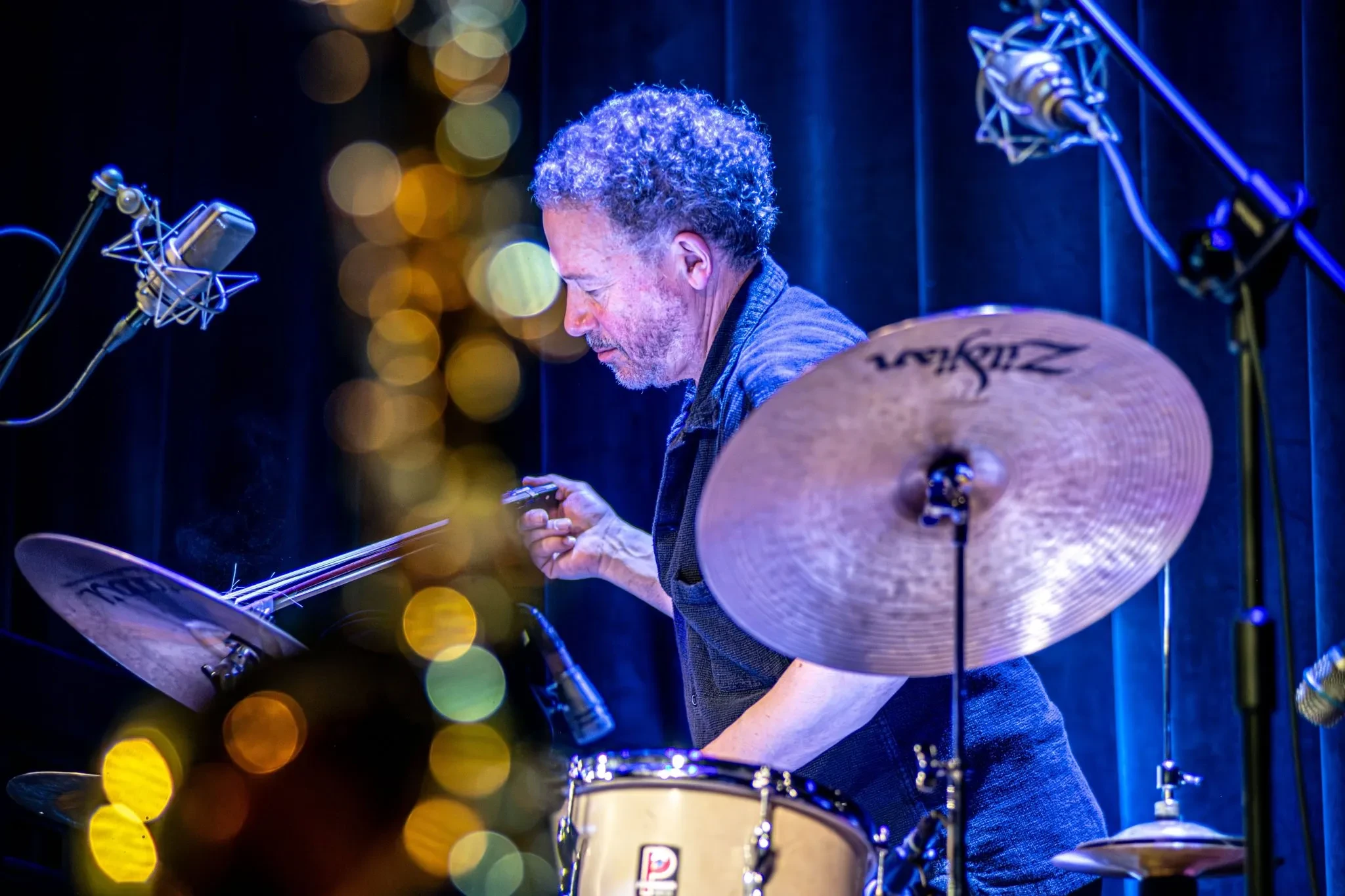
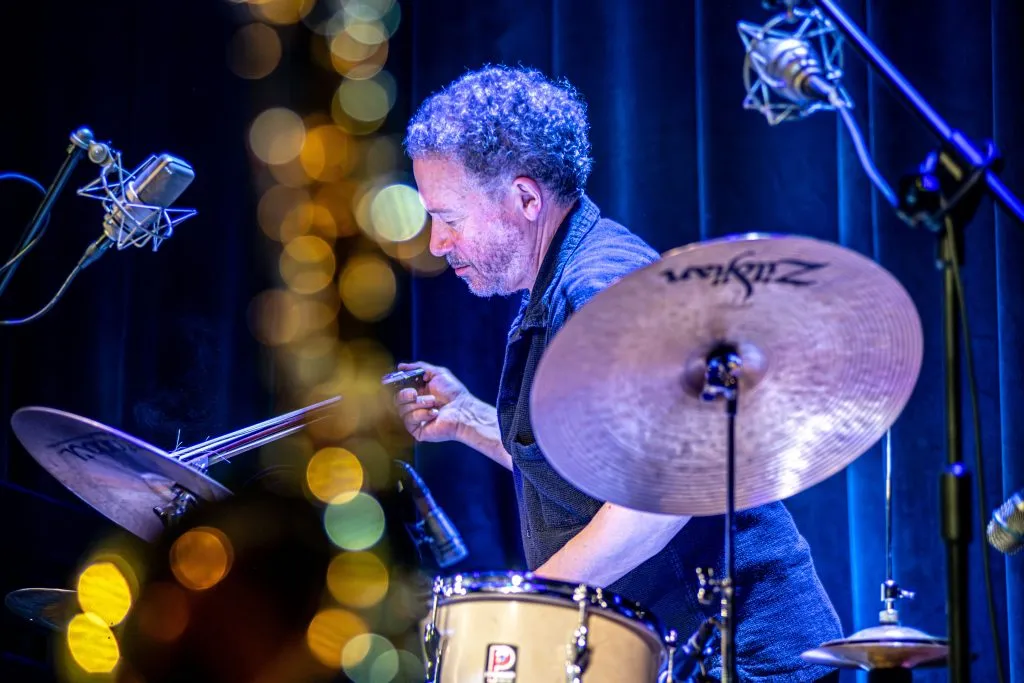
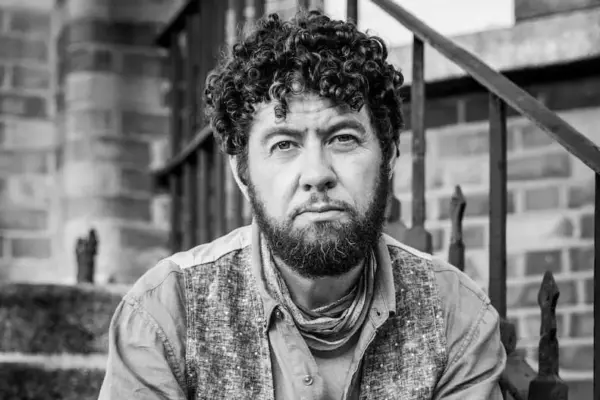
To understand the trajectory of modern British free jazz and improvised music over the past four decades is to trace the musical footprint of Mark Sanders. Born in Beckenham, Kent, in 1960 to a British-Belizean family, Sanders has quietly and powerfully established himself as one of the most indispensable and fiercely versatile drummers in contemporary avant-garde music. With a discography spanning more than 200 recordings, Sanders has traversed a vast sonic landscape that stretches from workingmen’s club disco covers and post-punk alternative outfits to transcendental free jazz, electronic soundscapes, and international sacred music collaborations.
Operating from his home in Birmingham via Zoom, Sanders reflects on a career built not on rigid blueprints, but on radical listening, relentless practice, and an insatiable appetite for creative risk. From his formative days in a communal Stockwell musicians’ house rubbing shoulders with the burgeoning post-punk intelligentsia, to gracing the stages of major international festivals alongside avant-garde icons like Evan Parker, Wadada Leo Smith, and Jah Wobble, Sanders’ journey encapsulates the vibrant, cross-pollinated history of underground British music. This retrospective explores the life, philosophy, and extensive catalog of a percussionist who refuses to be pigeonholed, continuing to rise at dawn to chase new sonic horizons.
Detailed Chronology: From Beckenham Beats to the Avant-Garde Vanguard
1. Formative Years and the Eclectic Soundtrack of Youth
Mark Sanders’ entry into music was catalyzed by an immersion in domestic record collections. Growing up in Kent, his early musical awakening was sparked by his uncle’s eclectic tastes in rock music.
"He was listening to good rock music," Sanders recalls. "I fell in love with it all. I loved Keith Moon. The Who was it for me, but I really enjoyed the jazz my dad was listening to as well."
This dual exposure—the theatrical, explosive dynamism of 1960s rock drumming alongside the cerebral, shifting structures of jazz—laid the psychological and technical foundation for Sanders’ approach to the kit. As he entered his late teens, his aspirations crystallized into formal pursuit when he began taking drum lessons from Warrington-based musician Nobby Clark.
These lessons served as Sanders’ passport into London’s burgeoning countercultural scenes. Relocating to a communal house in Stockwell filled with working musicians, Sanders found himself immersed in a creative pressure cooker. His housemates included future members of alternative royalty: the drummer for Lene Lovich, and Ted Emmett, trumpeter for The Teardrop Explodes. Upstairs lived double bassist Paul Rogers, who would go on to work with British jazz titans Stan Tracy and Evan Parker.
Immersed in this environment, Sanders absorbed the raw energy of the era. He frequented punk gigs at the Roundhouse, watched The Jam, and witnessed Motörhead supporting The Damned—experiences that burned an appreciation for high-octane performance into his musical psyche.
2. The Crucible of the Underground: Covers, Post-Punk, and Jazz Education
Before diving headfirst into the cerebral world of free improvisation, Sanders earned his stripes in the trenches of commercial and alternative gigging. His earliest professional performances involved playing in a disco covers band alongside a bass-playing friend.
"We did all the workingmen’s clubs up north. Three sets of ABBA a night," Sanders notes with a chuckle. "We went to Germany and played American Air Force bases. It was a good education."
Returning to London, Sanders fell under the spell of the alternative post-punk movement spearheaded by groups like The Slits and The Raincoats. Seeking kindred spirits, he placed an advertisement in the legendary music publication Melody Maker. The ad drew a response from a musician named Simon Rose, leading to the formation of Animal Answer. The band secured a minor record deal with Bonaparte Records and earned second place at the Woolwich Tramshed Battle of the Bands.
At age 20, Sanders deepened his technical foundation by enrolling in council-run evening jazz classes in Brixton, led by trumpeter Brian Tueson. Through Tueson’s mentorship and his connection with bassist Paul Rogers, Sanders’ network expanded exponentially. He began playing alongside reggae session masters like Tony Uta (of Linton Kwesi Johnson’s band) and saxophonist Michael "Bami" Rose (of Cymande and Aswad).
3. Near Misses, Free Improvisation, and the 1980s Jazz Boom
In 1978, Sanders auditioned for Public Image Ltd (PiL), the pioneering post-punk outfit formed by former Sex Pistol John Lydon.
"It was between me and Jim Walker, who got the job," Sanders recalls. "He’d just left Berklee. He was fantastic. I was just starting out."
Though he missed out on the PiL slot, the universe eventually looped back; decades later, Sanders would forge a prolific, long-term creative partnership with PiL’s legendary bassist, Jah Wobble.
Simultaneously, Sanders began attending afternoon classes in free improvisation taught by renowned violinist Philipp Wachsmann. There, he met electronic musician and violinist Phil Durrant. The pair initiated a weekly duo residency, inviting rotating guest musicians. When saxophonist Evan Parker stepped in as a guest, the trajectory of Sanders’ career accelerated dramatically.
"He called me the next day for a gig," Sanders says. "Then [saxophonist] Elton Dean called me and I joined his band. It was instant."
As one of the few young jazz drummers operating within London’s avant-garde circles, Sanders balanced commercial lounge and restaurant gigs with high-level improvisational work alongside Evan Parker and composer Barry Guy. This hustle positioned him perfectly for the 1980s London jazz boom—a genre resurgence fueled heavily by Black British artists. During this era, Sanders became a fixture of the scene, collaborating with free jazz musicians like Jon Lloyd, Paul Rogers, and John Edwards.
4. International Expansion and the Digital Age of Touring
Throughout the 1990s, Sanders solidified his reputation as an elite collaborator across Europe and the UK. He recorded consistently with Evan Parker, Elton Dean, composers Tim Richards and Simon H. Fell, and pianist Veryan Weston. In 1996, he teamed up with British improviser Steve Beresford for the critically acclaimed albums Fish Of The Week and Cue Sheet, alongside contributing to recording sessions for pop-art icon David Sylvian.
Despite his growing prestige, Sanders experienced the financial precarity typical of the avant-garde artist.
"You have this sort of feast and famine, especially playing improvised music," he admits. "In the mid-90s, I was able to come off the dole. I started touring more high-profile gigs. I started working in Europe. I was getting calls from France and Germany. When EasyJet and Ryanair started, it was easier."
5. The Jah Wobble Era and Global Collaborations
The turn of the millennium marked the beginning of Sanders’ decade-long, highly fruitful creative partnership with Jah Wobble. Introduced via mutual collaborator and Asian wind instrument specialist Clive Bell, Wobble and Sanders locked into a deeply hypnotic groove.
"He [Bell] brought Wobble around to my place, we had a play, and that was it," Sanders says. "I learned a lot from Wobble. He was great for long, improvised grooves, each lasting about half an hour."
Sanders performed on 10 albums with Wobble over the ensuing ten years. This fertile decade also saw him record with experimental sound designer John Wall, electronic duo Spring Heel Jack, the expansive London Improvisers Orchestra, avant-garde trumpeter Wadada Leo Smith, and Art Ensemble of Chicago saxophonist Roscoe Mitchell.
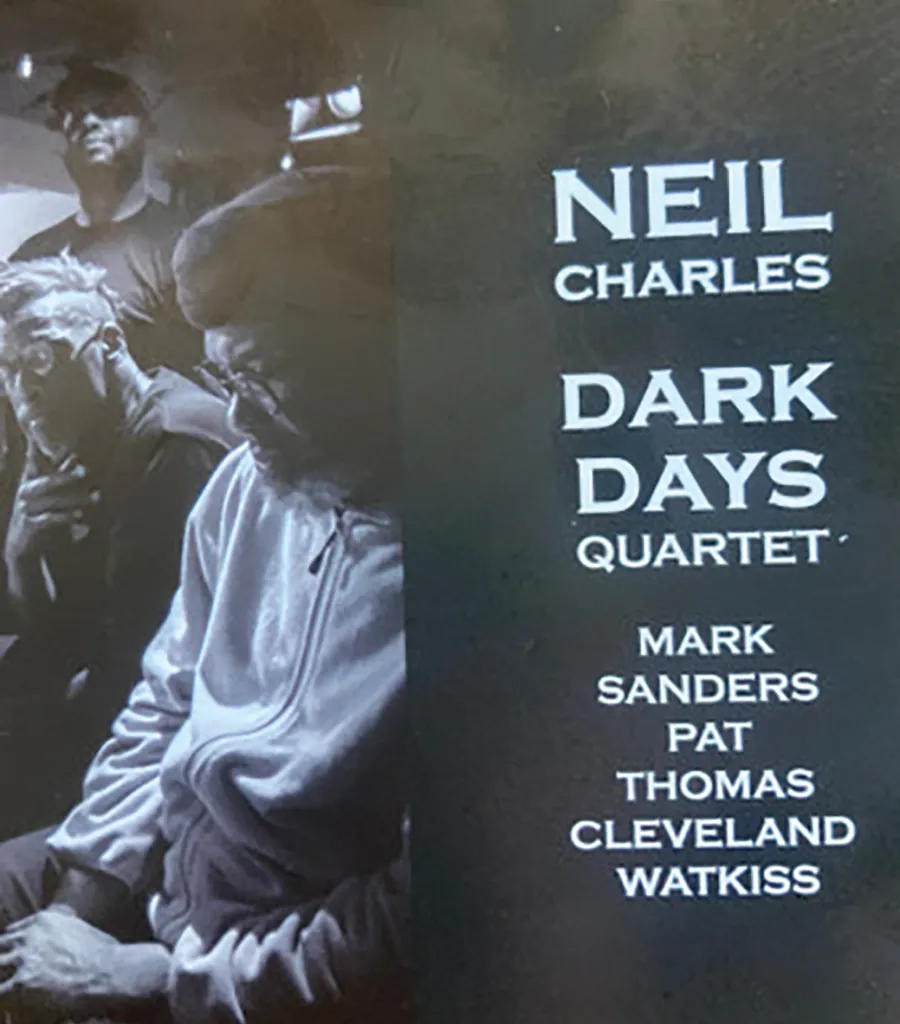
In recent years, Sanders’ discography has continued to expand through recordings with bassist-composer Neil Charles, saxophonist Larry Stabbins (of Working Week), and sonic explorer John Butcher.
Supporting Context & Metrics
To fully comprehend Mark Sanders’ stature within contemporary music, one must examine the quantitative and qualitative scope of his career:
Discographic Output: Sanders is officially credited on over 200 studio and live recordings, reflecting an extraordinary commitment to documentation and cross-genre exploration.
Geographic Reach: His career has taken him from local London workingmen’s clubs and community halls to international stages in Brazil, Lebanon, the United States, and Japan.
Stylistic Diversity: His portfolio bridges diametrically opposed musical worlds:
Commercial Disco & Pop Covers (ABBA tribute sets, American Air Force bases)
Post-Punk & Alternative Rock (Animal Answer, sessions bordering the UK post-punk explosion)
Reggae & Dub (Collaborations with members of Aswad, Linton Kwesi Johnson’s band, and Jah Wobble’s Molam Dub project)
Avant-Garde Jazz & Free Improvisation (Evan Parker, Elton Dean, Wadada Leo Smith, Roscoe Mitchell, John Butcher)
Career Highlights by Decade
Decade
Key Collaborators & Projects
Defining Characteristics
1970s
Nobby Clark, Animal Answer, Brian Tueson, early Brixton jazz workshops
Formation of technical skills, immersion in punk and reggae scenes.
1980s
Evan Parker, Elton Dean, Barry Guy, Jon Lloyd, Paul Rogers
Integration into the UK free jazz boom; establishment as a first-call avant-garde drummer.
1990s
Steve Beresford, David Sylvian, Tim Richards, Simon H. Fell, Veryan Weston
European tour expansion, increased recording output, transitioning to full-time professional viability.
2000s–Present
Jah Wobble, Wadada Leo Smith, Roscoe Mitchell, John Butcher, Neil Charles
Global festival headlining, deep electronic/dub fusions, long-form improvised conceptual works.
Official Statements and Personal Reflections
When asked to pinpoint his favorite career moments, Sanders reflects not on commercial chart success, but on moments of profound cultural and spiritual resonance. Among his most treasured memories is traveling with Jah Wobble to Hiroshima, Japan, to perform at a sacred music festival curated by the Dalai Lama.
"It was Wobble’s band and a group of Laotian musicians [as featured on the album, Molam Dub, 2000]. It was a wonderful band, and an amazing experience."
Another cornerstone of his career has been his ongoing work with free jazz saxophonist John Butcher.
"John Butcher is a big part of my career. I’d wanted to play with him for so long. He had this project called Tarab Cuts with improvising and soloing. We went to Brazil, the USA and to Beirut, which was a wonderful experience."
Sanders also treasures memories of sharing stages with ambient pioneer Harold Budd, performing alongside trumpet luminary Wadada Leo Smith, and playing a landmark duo set at Glastonbury alongside saxophonist John Tchicai.
Future Outlook: The Endless Practice
Despite a CV that spans more than two hundred releases and four decades at the cutting edge of global improvised music, Mark Sanders exhibits none of the complacency of an elder statesman resting on his laurels. For Sanders, the drum kit remains an ongoing research laboratory.
"I’m always practising," he asserts, noting his disciplined morning routine. "I was up at six this morning to avoid the heat. I love working on possible new directions. I’ve tried sticking to one area, but I really just love being versatile."
As modern improvised music continues to fracture, evolve, and cross-pollinate with electronic, global, and contemporary classical traditions, Mark Sanders stands as a vital anchor and a ceaseless innovator. Whether anchoring a thirty-minute hypnotic dub groove with Jah Wobble or navigating the razor-thin, telepathic tightrope of a free jazz conversation with Evan Parker and John Butcher, Sanders proves that true mastery lies not in repeating what works, but in listening intensely to what happens next.
Recommended Listening: Neil Charles, Cleveland Watkiss and Pat Thomas – Dark Days is out now on Jazz Now Records.