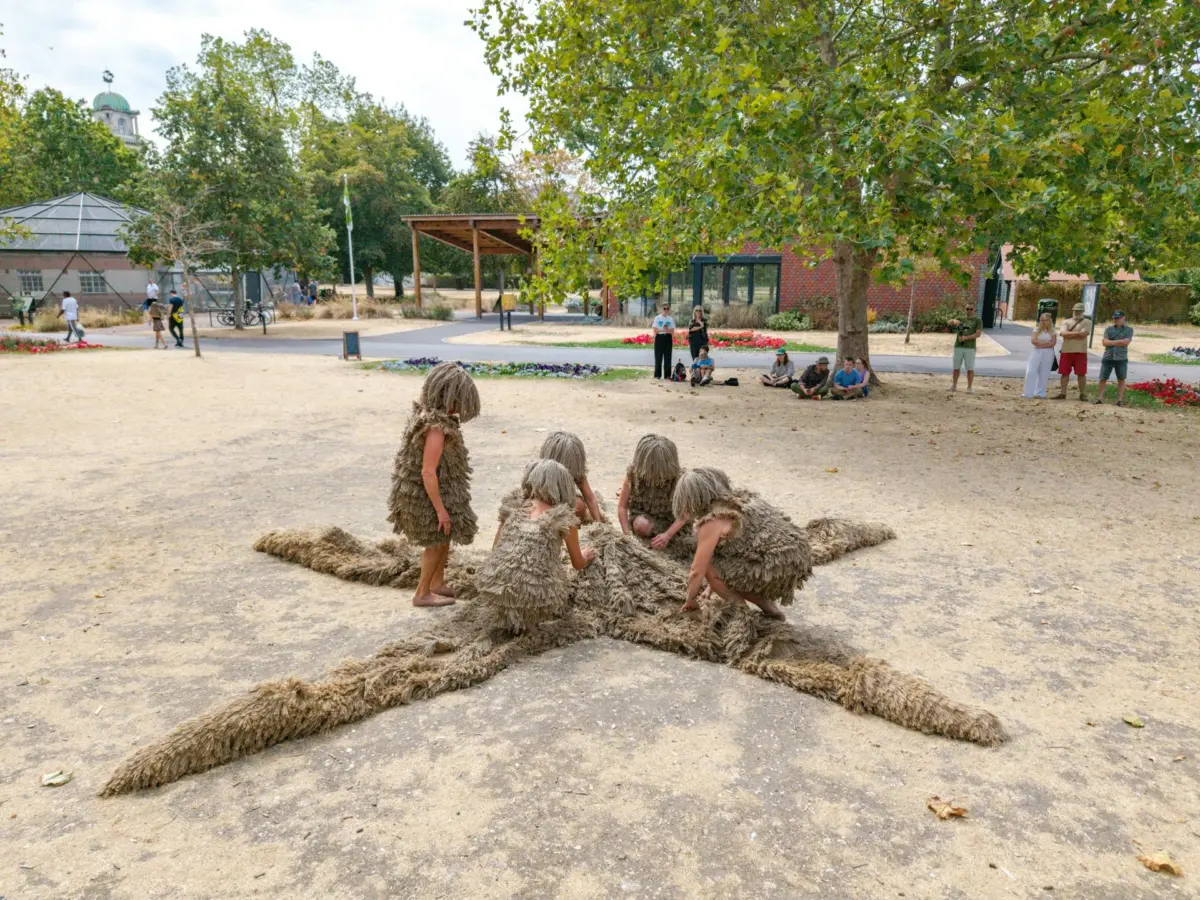
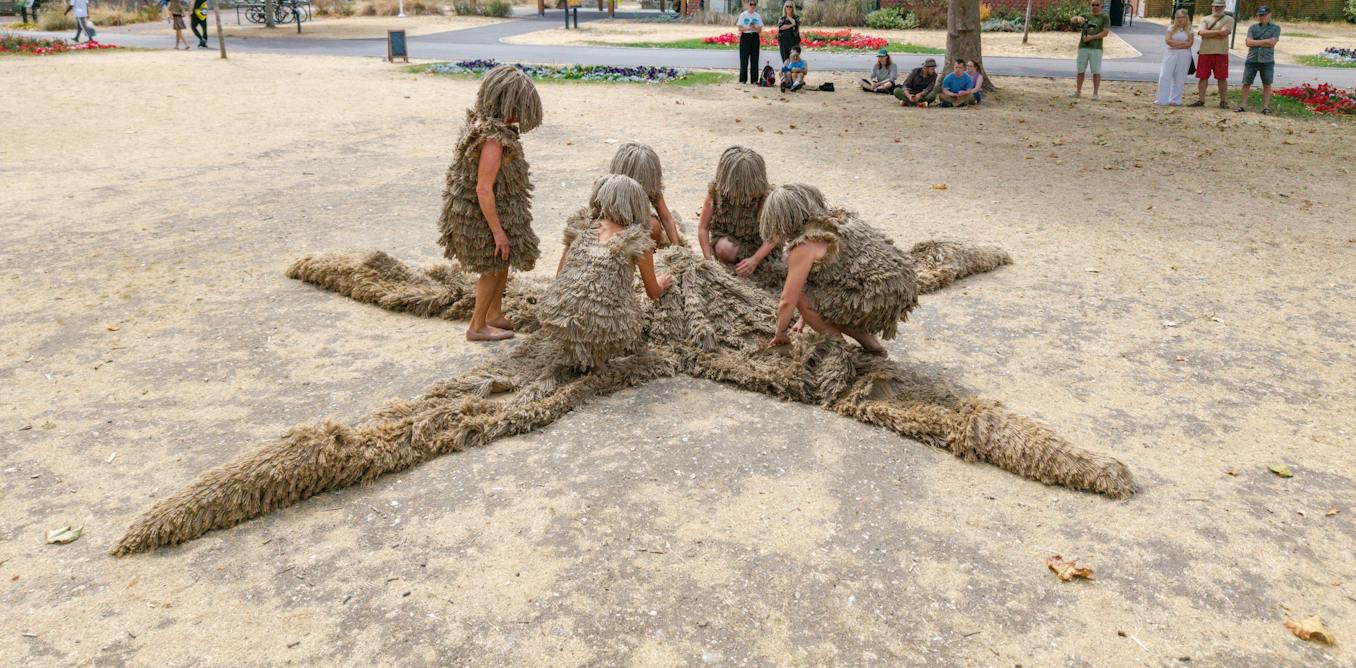
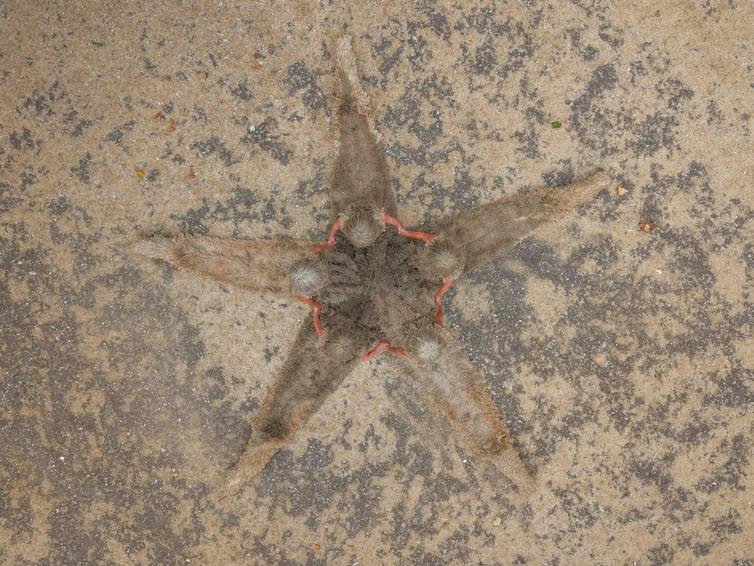
Against the sun-baked, drought-yellowed grass of a municipal park in Portsmouth, a strange collective organism moves with slow, deliberate precision. Five figures, cocooned in layered hessian-coloured fabrics and crowned with organic, root-like extensions resembling overgrown dreadlocks, process in unison. They are drawn toward a deflated, five-pointed starfish form splayed across the scorched earth. What follows is not merely a dance, but a living, breathing ritual of performance art.
Conceived by Portsmouth-based artist Olana Light in close collaboration with local dancers, this striking installation is titled Between Land and Tide. Set to run throughout the summer and deep into the autumn months—with final performances scheduled through September 2026—the project bridges the gap between contemporary sculpture, environmental theater, and ecological activism.
By immersing human bodies inside uncanny, organic hybrids made of natural materials, Between Land and Tide challenges the anthropocentric worldview that positions nature merely as a resource or a backdrop for human enterprise. Instead, it invites audiences to contemplate a climate-ravaged future, echoing the apocalyptic visions of mid-century science fiction while establishing a vital lineage within feminist land art. Part of a broader cultural push to reimagine how humanity communicates the climate crisis, Light’s work transforms public municipal space into an arena of ecological empathy, vulnerability, and imaginative resistance.
Detailed Chronology of the Performance
To witness Between Land and Tide is to watch a slow-motion evolutionary drama unfold across urban turf. The chronology of the performance is designed to disrupt the fast-paced, utilitarian rhythm of modern city life, replacing it with the deep time of geological and marine ecosystems.
Phase One: The Processional Approach
The performance begins at the periphery of the municipal park. Five performers materialize, their identities entirely obscured by textured, hessian garments. Their layered fabrics mimic the muted tones of mud, sand, and dried kelp, while the strange, braided structures crowning their heads bind them visually into a single, multi-headed entity. They do not march; they process. Their movement is weighted and intentional, communicating a sense of displacement. They are marine beings cast ashore, navigating an alien terrestrial landscape that has been scorched by drought and neglect.
Phase Two: The Awakening of the Inert Form
As the collective reaches the center of the performance space, they encircle a dormant, deflated hessian star shape resting on the parched ground. The dancers begin an obtuse, pagan choreography of stark gestures and sharp angles. Their bodies connect and disconnect in a shifting geometric rhythm.
Slowly, they descend into the limbs of the starfish structure, using their breath, pulses, and bodily pressure to pump life into the inert fabric. In nature, starfish possess no muscles; instead, they rely on hydraulic water pressure systems to navigate their watery environments. The performers meticulously mimic this "liquid opacity," translating the mechanics of marine propulsion into slow, agonizingly deliberate human movements.
Phase Three: The Apocalyptic Metamorphosis
At the height of the performance, the boundary between human and object dissolves entirely. To onlookers, the performers momentarily resemble a set of textured, oversized sleeping bags violently coming to life. They writhe, breathe, and pulse, transforming the five-legged fabric form into a giant, stranded sea creature gasping for breath on scorched earth.
There is an undeniable air of science-fiction dread to the scene. The undulating limbs search the air and the ground blindly, as if hunting for the lost solace and safety of an ocean that is miles away. This visceral display evokes the uncanny mutations found in the novels of John Wyndham, author of The Day of the Triffids (1951), where humanity faces the chilling architectural consequences of ecological and biological upheaval.
Phase Four: The Post-Apocalyptic Exit
After a prolonged period of visceral struggle, the human protrusions within the sculpture begin to tear the form apart from the inside. Human limbs split the synthetic carapace, and the augmented performers finally detach themselves from the installation. Dragging the deflated starfish arms behind them like post-apocalyptic slugs, they slowly retreat from the space, leaving behind a scarred impression in the grass—a temporary monument to loss and endurance.
Supporting Context & Metrics: The Intersection of Land Art and Climate Communication
Between Land and Tide does not exist in a vacuum. It is part of an ongoing, critical dialogue within contemporary art regarding how creative practices can address the climate crisis. The climate movement has long faced a communication problem: how do creators move audiences past paralyzing eco-anxiety and spur them toward systemic imagination and action?
The Lineage of Feminist Land Art
Olana Light’s living sculptures find deep resonance with the pioneering work of historical women artists who utilized their own bodies directly within the natural landscape to challenge traditional, male-dominated sculptural paradigms.
Most notably, the performance echoes the transcendent, earth-bound rituals of Ana Mendieta. Mendieta’s seminal body-art works, such as her Silueta series and Tree of Life (1976–79), explored the deep-seated spiritual and physical connection between the female body and the earth, frequently using blood, mud, flowers, and tree bark to imprint human presence onto the wilderness.
While Mendieta worked primarily in natural, untamed environments to highlight a symbiotic return to the earth, Light brings a similar somatic philosophy directly into the heart of municipal, human-controlled urban parks. By using performance art to fuse human anatomy with organic, marine-inspired textiles, Light constructs "uncanny hybrids" that interrogate the boundary between humanity and the biosphere.
The "Taskscape" and Ecological Impermanence
Anthropologist Tim Ingold conceptualizes spaces shaped by human labor and routine over time as a "taskscape." Municipal parks are classic urban taskscapes—managed lawns, trimmed hedges, and promenades designed exclusively for human leisure.
By introducing Between Land and Tide into this manicured environment, Light disrupts the functional utility of the park. The performance leaves ephemeral traces upon the drought-yellowed turf: flattened grass, disturbed dust, and the lingering visual memory of a stranded sea creature. According to Ingold’s framework, these marks are destined to be erased by the relentless passage of time, weather, and municipal maintenance. This impermanence underscores what Light’s work seeks to expose: the precarious entanglement between fragile marine ecosystems and terrestrial human survival.
Official Statements and Artistic Intentions
Speaking on the conceptual framework driving Between Land and Tide, creator Olana Light emphasizes that the project is designed to make audiences physically feel the displacement of climate disruption rather than simply viewing it from an intellectual distance.
"We are living in an era where ecological collapse feels abstract, flattened into statistics and news chyrons," Light notes in her artist statement. "By bringing marine anatomies—specifically the hydraulic, muscle-less mechanics of echinoderms—into the dry, sun-scorched earth of a municipal park, we externalize an internal crisis. These performers are not just dancing; they are embodying the suffocation of marine life forced out of balance by a warming, shifting planet."
Local dancers collaborating on the project have echoed the immense physical and emotional toll required to bring the living sculptures to life. Rehearsals involved intense somatic training centered around breath control, weight distribution, and synchronizing group movements to mimic the radial symmetry and hydraulic shifts of starfish.
Art critics and environmental humanities scholars who have witnessed early runs of the Portsmouth performances have praised the work for avoiding heavy-handed didacticism. Instead, it relies on surrealism, tactile aesthetics, and bodily vulnerability to engage onlookers.
"The audience response is fascinating," remarked one observer during a July performance. "Passersby are initially amused, perhaps slightly confused by these hessian-clad figures crawling across the grass. But as the performance deepens—as the bodies begin to writhe and fight within the starfish structure—the atmosphere shifts. Amusement gives way to an eerie, quiet mesmerization."
Future Outlook: The Role of Art in the Climate Storytelling Movement
As global temperatures continue to break historical records and urban heat islands expand across European municipalities, public spaces are increasingly becoming frontline battlegrounds for climate adaptation and awareness. Initiatives like the Climate Storytelling series—which explores how the arts and sciences can forge new coalitions for public understanding—demonstrate a growing recognition that scientific data alone is insufficient to drive systemic cultural change.
Between Land and Tide is scheduled to continue its run in Portsmouth through September 27, 2026. The extended exhibition window allows the performance to shift alongside the seasonal transitions of the park, moving from the parched yellows of mid-summer drought into the damp chill and decaying foliage of late autumn. This seasonal evolution will inevitably alter the resonance of the piece, allowing the hessian-clad marine hybrids to interact with an entirely different meteorological landscape.
Looking ahead, arts organizers and environmental advocacy groups are increasingly looking to place-based, somatic performance art as a model for community engagement. By transforming sterile urban parks into mythic theatrical stages for stranded sea creatures, Olana Light and her collaborators offer a blueprint for a new genre of ecological performance—one that does not lecture its audience, but instead invites them to feel the shared vulnerability of life on a rapidly transforming planet.