From Christopher Nolan’s cinematic spectacles to Stephen Fry’s best-selling literary adaptations and Disney’s animated features, the Western world remains permanently under the spell of ancient Greek mythology. Stories first forged nearly 3,000 years ago continue to command blockbuster budgets and dominate contemporary cultural conversations. Yet, this modern appetite for the classical world is merely the latest manifestation of an ancient, adaptive tradition.
Long before Hollywood studios recognized the commercial viability of Homeric heroes, 18th-century British political caricaturists were hard at work repackaging the pantheon of gods and monsters to skewer the Westminster establishment of the Georgian era. During a period defined by fierce political rivalries, social upheaval, and the cultural revival known as Neoclassicism, master satirists like James Gillray, Thomas Rowlandson, and Charles Williams discovered a brilliant shortcut to public consciousness: classical myth.
By casting real-world prime ministers, socialites, and bankrupt MPs as Hercules, King Midas, or the captive Odysseus, these artists transformed elite classical scholarship into accessible, highly lucrative popular entertainment. Far from being dry academic exercises, these hand-colored single-sheet prints served as the viral memes of their day. They hung in London print shop windows, sparked lively debates in coffee houses, and could decisively shatter a politician’s career.
This article explores how 18th-century satirists weaponized antiquity, the mechanics of how Greek archetypes were mapped onto Georgian elites, and why the plastic nature of mythology ensures that humanity will forever see its own political anxieties reflected in the mirror of the ancient world.
Detailed Chronology: The Evolution of Classical Satire in Georgian Britain
To understand how Greek myths became the currency of 18th-century political cartooning, one must trace the convergence of elite education, the birth of the commercial print market, and the volatile political landscape of Georgian Britain.
The Rise of Neoclassicism and Classical Education
Throughout the 18th century, knowledge of Greek and Roman antiquity was the defining cultural capital of the British ruling class. Through the "Grand Tour" and rigorous grammar school education, the educated elite were steeped in the epic poetry of Homer and Virgil, as well as the histories of Livy and Plutarch. However, Neoclassicism—a cultural movement that revived classical aesthetics, ideals, and political philosophies—did not remain exclusively locked within university walls or aristocratic libraries.
As the century progressed, publishers and printmakers realized that the archetypal narratives of antiquity possessed a universal visual grammar that could be democratized for a rapidly growing, literate urban middle class.
The Golden Age of British Caricature (1780s–1800s)
The final decades of the 18th century witnessed a golden age of British satirical print culture. Figures like James Gillray and Thomas Rowlandson elevated political caricature from crude woodcuts to sophisticated, hand-colored engravings. Operating out of shops in prominent London districts like St. James’s and the Strand, these artists produced biting political commentary that responded almost instantaneously to parliamentary developments.
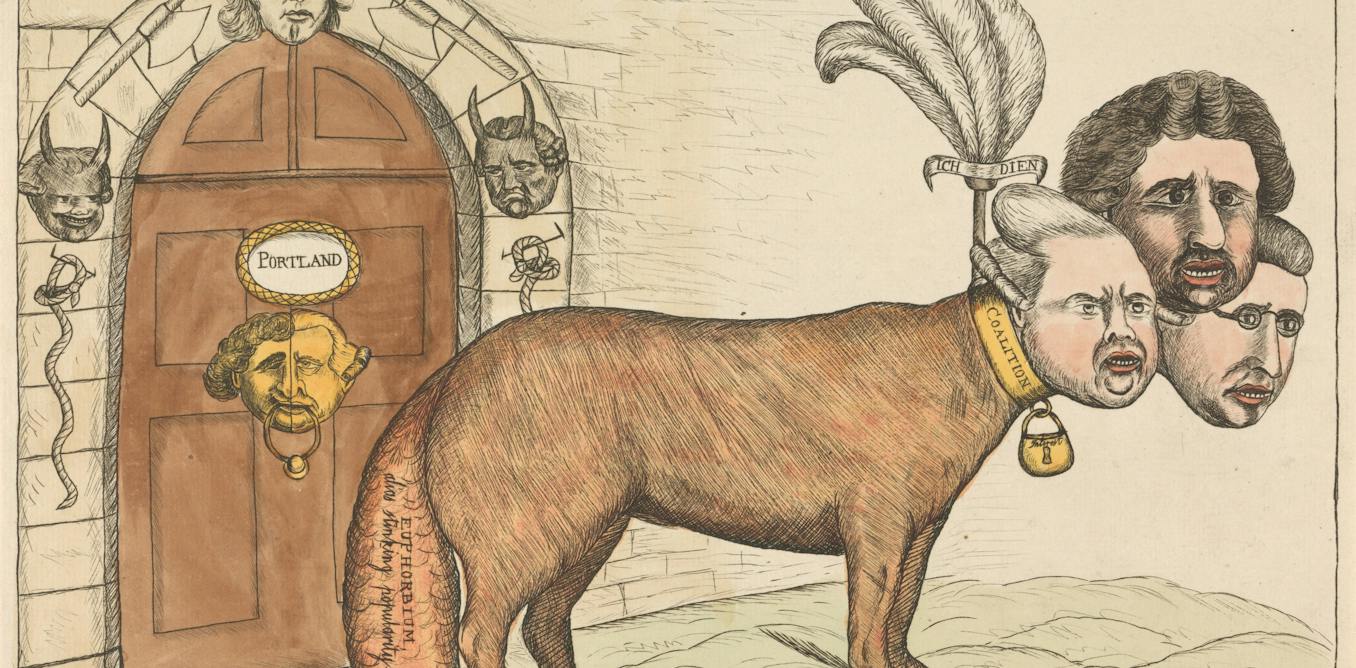
During this era, three dominant political figures—William Pitt the Younger, Charles James Fox, and Richard Brinsley Sheridan—played out their personal scandals, policy victories, and bitter rivalries in a sustained "visual soap opera." Caricaturists found that framing these men within the familiar plots of Greek mythology instantly elevated petty parliamentary squabbles to the level of epic cosmic struggles.
Key Satirical Milestones:
1783: William Pitt the Younger becomes prime minister at the astonishingly young age of 24, instantly making him a primary target for cartoonists seeking to lampoon both his unprecedented youth and his family’s political dynasty.
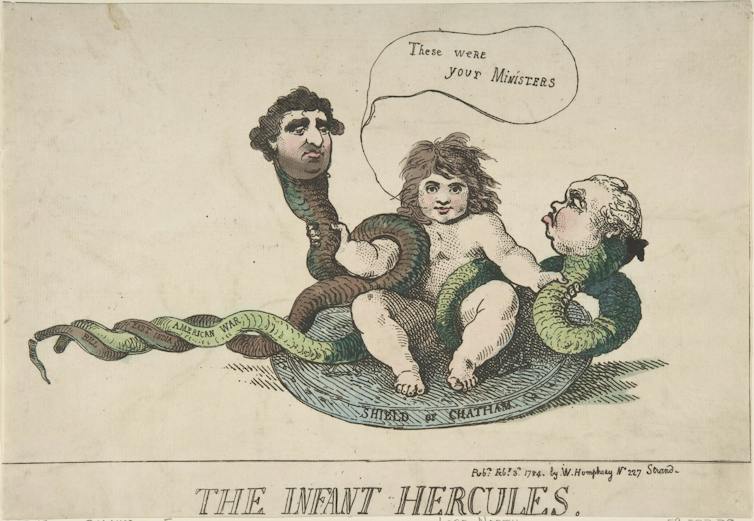
1784: Thomas Rowlandson publishes The Infant Hercules, depicting the youthful Pitt strangling serpents representing his political rivals, brilliantly subverting the heroic trope to mock his inexperience.
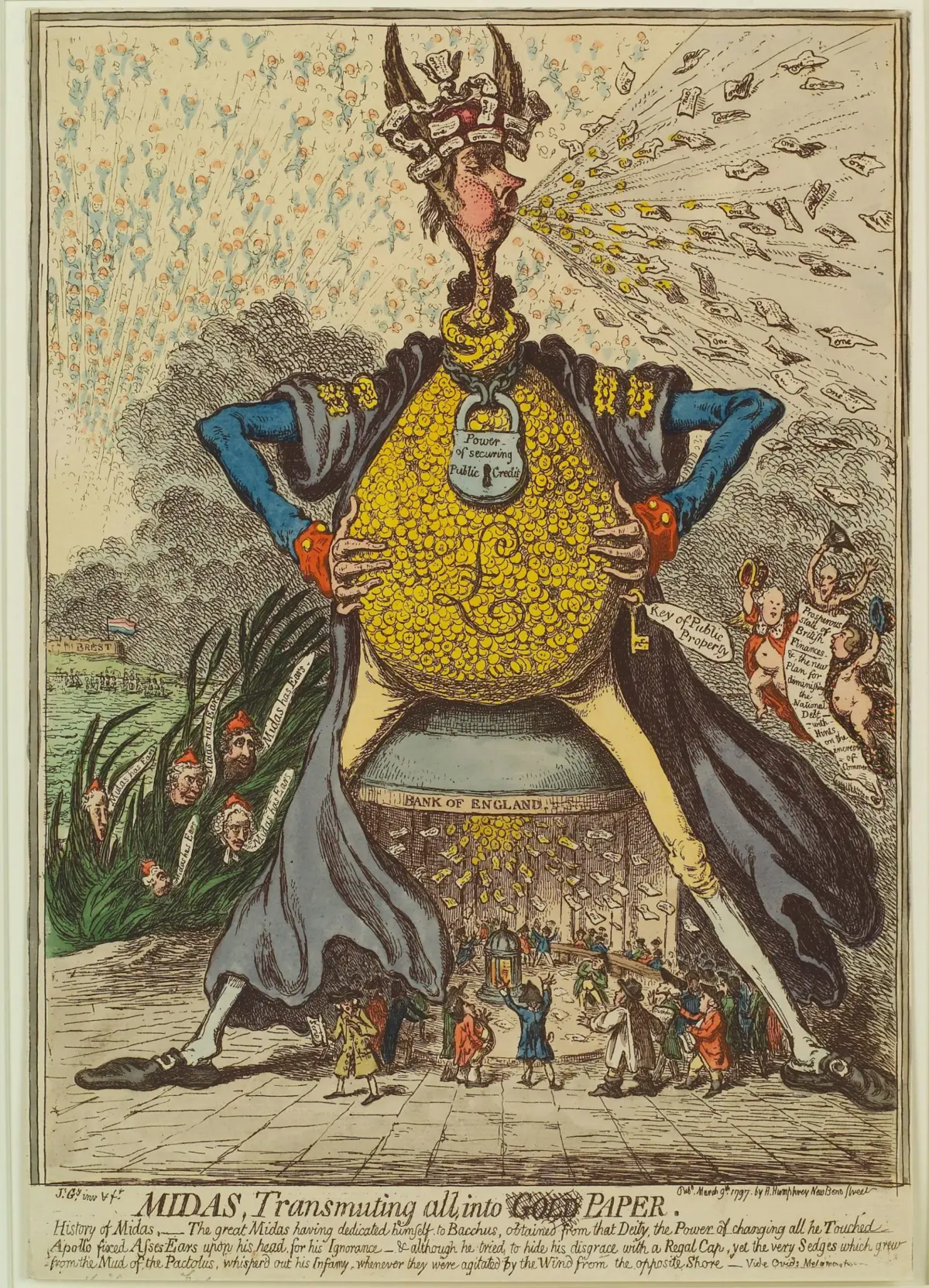
1797: James Gillray publishes Midas, Transmuting all into Gold [Gold crossed out] PAPER, transforming Pitt into the mythical king whose touch turns everything to valueless paper currency, sharply criticizing his wartime taxation and monetary policies.
Late 1790s: Charles Williams publishes The Modern Calypso, using Homeric exile to satirize Richard Brinsley Sheridan’s notorious alcoholism and financial ruin.
Supporting Context & Metrics: The Anatomy of a Georgian Political Print
The brilliance of 18th-century satirical prints lay in their multi-layered architecture. They operated on a dual frequency: providing an immediate, visceral visual joke for the illiterate or uneducated passerby, while offering a complex, intellectually satisfying allegorical puzzle for the classical elite.
The Economy of the Print Shop Window
Caricatures in Georgian London were not passive artworks; they were aggressive commercial commodities. Single-sheet copperplate engravings were printed in large batches, meticulously hand-colored by teams of low-paid colorists (often women and children), and displayed in shop windows to entice pedestrians.
Pricing & Accessibility: While a deluxe, hand-colored print could cost several shillings—putting it out of reach for the laboring poor—middle-class merchants, lawyers, and tradesmen regularly purchased them. Moreover, thousands more viewed them for free simply by gathering outside shop windows on bustling streets like Fleet Street and Piccadilly.
The Coffee House Circuit: Prints purchased in these shops were routinely taken into coffee houses and taverns, where they served as focal points for spirited political debates, functioning much like viral social media threads do today.
Ready-Made Meanings: Why Greek Myths Worked
Greek mythology provided caricaturists with a brilliant semantic shortcut. Because ancient characters came pre-loaded with universally understood cultural associations, artists did not need to waste valuable visual space explaining who a figure represented or what character trait they embodied:
Mythological Figure
Cultural Association
Political Application in Georgian Britain
Hercules
Superhuman strength, divine lineage
Used to elevate young leaders like William Pitt, while ironically mocking their youthful hubris.
King Midas
Unbridled greed, foolishness (donkey ears)
Deployed against chancellors and prime ministers whose economic policies generated wealth for the state at the expense of ordinary citizens.
The Hydra
A many-headed monster that regrows heads when severed
Represented seemingly insurmountable systemic crises, parliamentary opposition factions, or national debt.
Calypso
A seductive nymph who traps heroes in idle luxury
Utilized to mock politicians trapped by their vices, addictions (such as alcoholism), or ruinous social lifestyles.
Character Profiles in the Visual Soap Opera
The recurring cast of Georgian politics was meticulously branded by caricaturists through consistent visual tropes:
Charles James Fox: Cast as the quintessential rogue hero or tragic anti-hero. Famously characterized as a high-stakes gambler, habitual debtor, and enthusiastic womanizer, Fox’s personal vices were constantly held up against his brilliant parliamentary rhetoric.
William Pitt the Younger: Portrayed as cold, stiff, reclusive, and unnaturally ambitious. As the ultimate political prodigy, his youth was both his greatest shield (tied to his father’s legacy) and his most vulnerable target.
Richard Brinsley Sheridan: Depicted as an endearing disaster—a bankrupt playwright and politician whose legendary fondness for the bottle frequently landed him in mythical scenarios of entrapment and ruin.
Official Perspectives: Art Historians and Classical Scholars on Mythic Adaptation
The enduring relevance of classical mythology in political satire and popular culture has drawn extensive commentary from art historians, classicists, and cultural critics.
Dr. James Dempsey, a specialist in 18th-century satirical art, notes that the genius of artists like Gillray and Rowlandson lay in their understanding of audience psychology:
"Caricature requires a shared visual language. If an artist has to spend five minutes explaining the premise of a joke, the punchline is dead. By anchoring contemporary politicians to the tales of Homer and Ovid, Georgian satirists bypassed the barrier of explanation. Every educated Briton knew what Midas represented; the artist’s only job was to pin those donkey ears onto the prime minister’s head so effectively that the public could never unsee it."
Furthermore, classical scholars emphasize that the ancient Greeks themselves would likely have appreciated these irreverent modern retellings. Unlike rigid religious dogmas, Greek mythology was never a static text; it was an oral, highly fluid tradition designed to be reshaped, parodied, and weaponized by poets, dramatists, and citizens to reflect the immediate concerns of the polis.
Cultural historian Dr. Elena Vance observes a direct lineage between Georgian print culture and modern political memes:
"When we look at a James Gillray print translating Pitt’s financial policies into the curse of Midas, we are looking at the 18th-century equivalent of a viral internet meme. They take a complex socio-economic issue, wrap it in a universally recognizable cultural template, add a heavy dose of ridicule, and launch it into the public square to sway opinion. The medium has shifted from copperplate engravings to digital screens, but the underlying cognitive mechanism remains completely unchanged."
Future Outlook: Why We Will Keep Rewriting the Classics
As Christopher Nolan’s The Odyssey proves in the modern era, humanity’s fascination with ancient myth shows no signs of abating. But why do these specific stories—born in the Bronze Age, transcribed in archaic Greek, and passed down through millennia—refuse to fade into obscurity?
The answer lies in the inherent plasticity of myth. As long as human societies grapple with the same fundamental dilemmas—hubris, greed, mortality, political corruption, love, and war—the archetypes of antiquity will remain infinitely elastic.
The Digital Age and Mythic Satire
In the 21st century, the democratization of content creation has democratized the use of classical myth in political discourse. While 18th-century satirists required the technical skill of copperplate etching and access to print shops, contemporary digital creators utilize deepfakes, AI-generated art, and rapid-fire image macros to cast modern politicians as mythical figures within seconds of a political scandal breaking.
Whether a modern world leader is cast as Icarus flying too close to the sun, or a tech billionaire playing the role of Prometheus stealing fire, the underlying impulse remains identical to that of James Gillray and Thomas Rowlandson: to use the timeless mirror of antiquity to expose the absurdities and frailties of contemporary power.
Conclusion
Greek mythology has survived for nearly 3,000 years precisely because it is not a museum piece. It is a living, breathing toolkit of human experience. From the print shop windows of Georgian London to the IMAX screens of the 21st century, these ancient tales endure because every generation discovers the comforting, sobering, and often hilarious realization that our modern political dramas are, and always have been, ancient history.