Executive Overview
For decades, the modern music producer’s desk has suffered from a persistent architectural conflict. On one side sits the computer keyboard—the indispensable interface for writing code, navigating DAWs via key commands, and managing emails. On the other side sits the MIDI controller, a sprawling plastic or metal deck featuring velocity-sensitive pads, modulation wheels, and piano keys that invariably monopolizes precious workspace.
Enter Polyend, a manufacturer renowned for defying convention with grooveboxes and sequencers like the Play, Tracker, and Medusa. At Gamescom 2026 in Cologne, Germany, the company pulled back the curtain on its most conceptually disruptive hardware experiment to date: Keys.
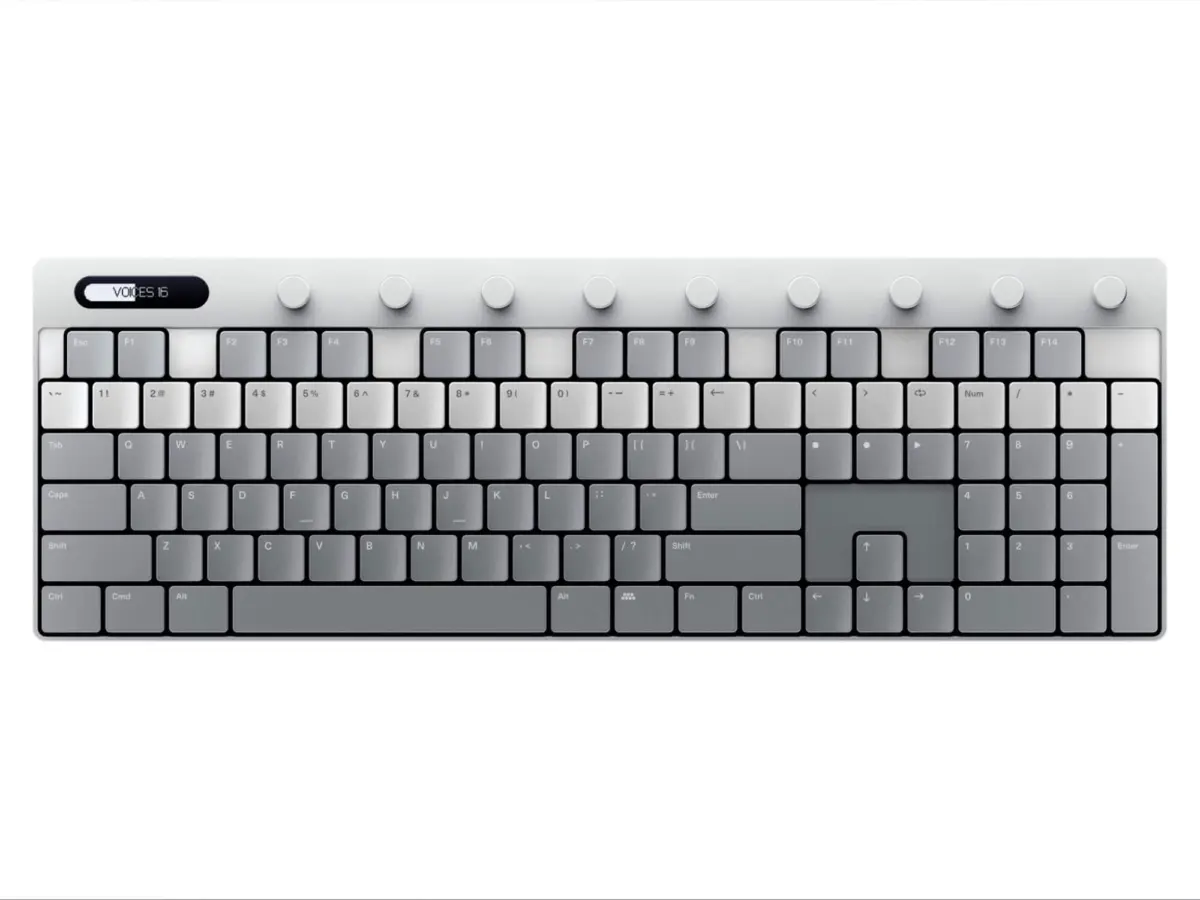
Billed as a dual-purpose peripheral, Keys bridges the chasm between a traditional QWERTY computer typing deck and a fully fledged, three-octave musical performance instrument. Built around a precision-milled single piece of aluminum, it features hot-swappable Kailh low-profile mechanical switches, customizable backlighting, standalone hardware control via TRS MIDI, and a series of assignable rotary encoders equipped with visual feedback. Most radically, Polyend is exploring an open-source firmware model that invites developers to rewrite the rules of how a computer input device can interact with sound.
While currently functioning as a prototype, Keys signals a potential paradigm shift in studio design. By consolidating dual-purpose hardware into a single footprint, Polyend is addressing workspace fatigue while opening new avenues for hybrid productivity and live performance. This report explores the design philosophy, technical architecture, and industry implications of Polyend’s most ambitious hardware concept yet.
Detailed Chronology: From Concept to Gamescom 2026
The genesis of Polyend Keys did not stem from a traditional musical instrument trade show like NAMM or Superbooth. Instead, its public debut at Gamescom—Europe’s massive interactive gaming and hardware expo held from August 26 to 30, 2026—hints at Polyend’s broader ambitions. By positioning Keys at an event dominated by PC gamers, typists, and technology enthusiasts, the company immediately telegraphed that this device is intended for digital creators of all stripes, not just traditional keyboardists.
The Problem of Desk Real Estate
Polyend’s product development team set out to solve a ubiquitous ergonomic nuisance: desk clutter. Producers working in hybrid environments often find themselves constantly shuffling hardware. Moving a bulky 49-key MIDI controller out of the way just to type out track notes, or conversely, struggling to play expressive musical passages on cramped, non-weighted mini-keys, has long been an accepted workflow compromise.
The company’s design mandate was straightforward yet technically challenging: engineer a deeply satisfying, playable keyboard that eliminates the need for a separate, full-size controller deck on the desktop.
The Prototype Phase Unveiled
First showcased via Polyend’s backstage community channels and live demonstrations in Cologne, the Keys prototype immediately drew comparisons to custom mechanical computer keyboards, but with crucial performance-oriented modifications.
- The Aluminum Chassis: Eschewing the lightweight plastics common in consumer computer keyboards, Keys is anchored by a rigid, single-piece aluminum bed designed to withstand both energetic typing sessions and expressive musical performances.
- Hot-Swappable Kailh Switches: Recognizing that typists and musicians have vastly different preferences for tactile resistance and travel distance, Polyend integrated Kailh low-profile mechanical switches. Crucially, these switches are hot-swappable without requiring soldering, allowing users to tailor the feel of individual keys or entire sections to their exact liking.
- Backlit Customization: Each key features integrated backlighting, serving not only aesthetic purposes in dimly lit studios or gaming rigs, but potentially functioning as a real-time visual guide for scale modes, step sequencing steps, or active MIDI mappings.
Polyend has maintained a transparent stance regarding the device’s development stage. Executives and developers at Gamescom stressed that Keys is firmly in its prototype phase. Aesthetics, colorways, core hardware features, and final pricing remain fluid as the company gathers feedback from the audio and tech communities.
Supporting Context & Metrics: The Mechanics and Ecosystem of Keys
To understand why Polyend Keys represents a significant technical departure from standard market offerings, one must examine its hardware specifications, control architecture, and ecosystem integration.
Hardware Specifications and Ergonomics
While full technical spec sheets are still being finalized ahead of a commercial rollout, early hardware breakdowns reveal a robust feature set tailored for both computer workflows and live music production:

- Keybed Layout: A three-octave span optimized to balance portability with sufficient range for two-handed chord voicing and melodic performance.
- Switch Technology: Kailh low-profile mechanical architecture. Low-profile switches reduce travel distance, making rapid computer typing comfortable while providing a snappy, responsive rebound desirable for rhythm programming and synth riffing.
- Rotary Encoders: Nine assignable rotary controls occupy the chassis. These knobs possess dual-function capabilities: they can be mapped to standard MIDI Control Change (CC) messages to tweak soft synths and hardware parameters, or mapped to everyday desktop utilities such as system volume, horizontal/vertical scrolling, and monitor brightness.
- Integrated Display: A dedicated built-in screen provides instant visual feedback whenever a rotary control is adjusted, eliminating guesswork when tweaking filter cutoffs, envelopes, or computer OS settings.
- Connectivity: Moving beyond USB computer tethering, Keys includes a physical TRS MIDI output. This allows the unit to interface directly with external hardware synthesizers, drum machines, and grooveboxes without routing through a host computer.
| Feature Category | Polyend Keys Specification / Capability | Primary Benefit |
|---|---|---|
| Chassis Construction | Single-piece milled aluminum | Enhanced structural rigidity, durability, and premium tactile weight |
| Key Switches | Hot-swappable Kailh low-profile | Solderless customization for varied typing or playing preferences |
| Control Surface | 9 assignable rotary encoders with screen | Dual-purpose control over DAW parameters, hardware, and OS functions |
| Connectivity | USB + TRS MIDI output | Seamless hybrid integration with both software DAWs and hardware gear |
| Firmware Architecture | Proposed open-source model | Unlimited community-driven layout, sequencing, and MIDI tool development |
The Open-Source Horizon
Perhaps the most compelling metric for long-term longevity is Polyend’s intention to open-source the firmware behind Keys. In an era where proprietary software locks users into rigid corporate ecosystems, opening the codebase to the community is a powerful differentiator.
Polyend notes that an open-source framework unlocks vast creative territory. Alternative keyboard layouts (such as Colemak or Dvorak alongside QWERTY), specialized control modes, custom MIDI utility tools, on-board sequencers, and experimental generative algorithms can all be engineered directly into the hardware via community software contributions. This transforms Keys from a static hardware purchase into a living, evolving platform.
Official Statements and Industry Perspective
While Polyend has kept formal press announcements concise while gathering prototype feedback, the design philosophy articulated by the brand highlights a growing industry demand for unified, multi-functional tools.
"The brand says it wanted to make a playable keyboard that did not require a full-size controller deck on your desk."
This simple mission statement strikes at the heart of modern music production ergonomics. As home studios and mobile rig setups become increasingly compact—often centered around laptops, minimalist desks, and portable interfaces—every square inch of workspace is at a premium.
Industry analysts observing the prototype at Gamescom noted that while mechanical keyboard enthusiasts have long experimented with using custom QWERTY boards to send MIDI notes via software bridges, a native hardware solution designed from the ground up for both computing and music-making fills a glaring market gap.
Furthermore, the inclusion of physical TRS MIDI output distinguishes Polyend Keys from generic "music production keyboards" that rely entirely on computer USB bus power and software drivers. By ensuring that Keys can command external hardware gear independently, Polyend has future-proofed the device for DAWless jammers and modular synth enthusiasts alike.
Future Outlook: What Lies Ahead for Polyend Keys
As Polyend transitions Keys from the convention floor at Gamescom toward a finalized retail product, several critical questions remain for the manufacturer and prospective buyers:
- Pricing and Accessibility: Will the premium build quality—featuring a milled aluminum chassis and hot-swappable mechanical switches—position Keys as an elite, high-cost boutique item, or will it remain accessible to bedroom producers?
- Durability vs. Playability: Balancing the tactile requirements of heavy typing (which benefits from tactile feedback and specific spring weights) against the smooth, expressive demands of musical performance is a delicate engineering act. How Polyend tunes the Kailh switches for production units will dictate its success among pianists.
- Software Ecosystem Support: If the firmware goes open-source, how robust will the initial companion software be? Will casual users have access to an intuitive desktop editor for mapping MIDI CCs and customizing backlight colors without diving into code?
Conclusion
Polyend Keys represents a refreshing reimagining of studio hardware architecture. By refusing to treat the computer keyboard and the MIDI controller as mutually exclusive entities, Polyend has designed a hybrid device that honors the muscle memory of writers, coders, and gamers while offering the expressive depth required by modern electronic musicians.
As the prototype undergoes refinement, the music technology community will be watching closely. If Polyend successfully balances ergonomic typing comfort with high-performance MIDI control and an open-source ecosystem, Keys could fundamentally redefine what sits on our desks when we create. Further details regarding pricing, release dates, and final specifications are expected to be announced by Polyend in the coming months.