The intersection of pioneering science, social justice, and the arts is set to take center stage as the Electric Voice Theatre prepares for its upcoming production, The Peaceful Crystallographer – and other songs. Scheduled for October 15, 2026, at the historic Conway Hall as part of the landmark 20th Bloomsbury Festival, the multimedia musical performance will honor the multifaceted life and enduring legacy of Dame Kathleen Lonsdale (1903–1971).
Lonsdale was a titan of 20th-century science—a crystallographer whose breakthroughs fundamentally reshaped organic chemistry, laid the groundwork for modern medical treatments, and shattered entrenched gender barriers in academia. Notably, she achieved the historic distinction of becoming the first female professor at University College London (UCL) and the first woman ever elected as a Fellow of the Royal Society. Yet, her contributions extended far beyond the laboratory. Lonsdale was an ardent pacifist, a fearless prison reformer, a vocal advocate for women’s rights, and a moral philosopher who interrogated the ethical obligations of scientists in an atomic age.
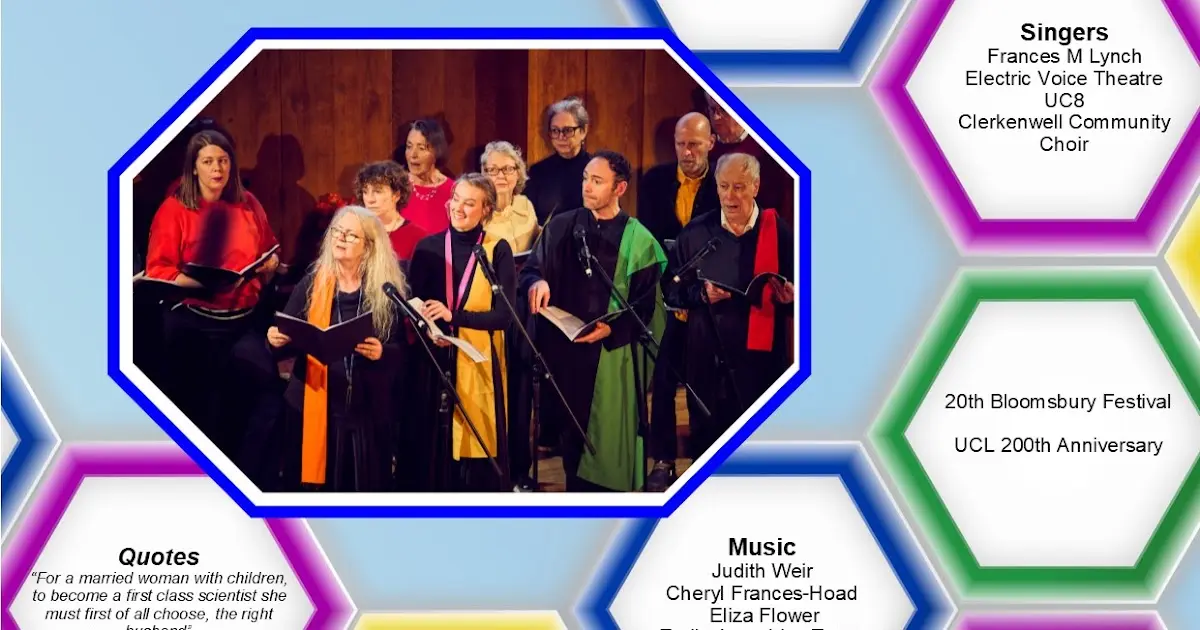
This upcoming production seeks to capture the breadth of Lonsdale’s extraordinary existence through a rich tapestry of a cappella arrangements, historical folk songs, music-hall tunes, and contemporary choral compositions. Featuring the Electric Voice Theatre, alongside young a cappella performers UC8 from UCL and the Clerkenwell Community Choir, the event promises to be both a cultural celebration and a critical intellectual inquiry. Coinciding with UCL’s bicentennial celebrations, the evening will also feature an authoritative post-performance panel discussion comprising prominent historians and leading modern scientists, examining Lonsdale’s ongoing relevance in contemporary STEM and sociopolitical landscapes.
Detailed Chronology: The Life and Legacy of Dame Kathleen Lonsdale
To fully appreciate the scope of The Peaceful Crystallographer, it is essential to trace the arc of a life defined by intellectual rigor, moral courage, and relentless boundary-pushing.
Early Promise and Academic Breakthroughs (1903–1930s)
Born in Newbridge, Ireland, in 1903, Kathleen Yardley displayed an exceptional aptitude for mathematics and science from an early age. Moving to London with her family, she pursued her higher education at Bedford College for Women (later part of Royal Holloway, University of London), where she graduated with a Bachelor of Science degree in physics in 1922, earning the highest marks in her class.
Her brilliance quickly caught the attention of Sir William Henry Bragg, a pioneer in X-ray crystallography and a Nobel laureate. Bragg invited Yardley to join his prestigious research group at University College London, and later at the Davy Faraday Research Laboratory of the Royal Institution. During this era, X-ray crystallography was in its infancy, and using it to map the structure of complex molecules was fraught with technical hurdles.
In the late 1920s and 1930s, Lonsdale (who married Thomas Lonsdale in 1927) accomplished what many thought impossible: she conclusively proved the planar, hexagonal structure of the benzene ring using X-ray methods. This monumental discovery resolved a decades-long organic chemistry debate and cemented her reputation as a world-class scientist. Furthermore, her definitive work on the crystal structure of hexamethylbenzene provided the empirical foundation for modern stereochemistry.
Breaking the Glass Ceiling at UCL and the Royal Society (1940s–1950s)
World War II brought disruptions to academic life, but Lonsdale’s research continued unabated. In 1945, alongside microbiologist Marjory Stephenson, she achieved a milestone long denied to women: she was elected a Fellow of the Royal Society (FRS), breaking a 285-year-old gender barrier.
Following the war, in 1946, she returned to University College London to establish a laboratory dedicated to crystallography. By 1949, she was appointed Professor of Chemistry and head of the Department of Crystallography at UCL, making her the first female professor at the institution. Her academic leadership transformed UCL into a global hub for crystallographic research, attracting scholars from around the world and mentoring a new generation of scientists—particularly women entering a heavily male-dominated field.
Activism, Pacifism, and the Ethics of Science (1950s–1971)
Lonsdale’s Quaker faith, adopted later in life, deeply influenced her worldview and turned her into a passionate pacifist and social reformer. During World War II, she served a month in Holloway Prison rather than register for civil defense duties or pay fines associated with her pacifist stance. This firsthand experience of the carceral system catalyzed a lifelong commitment to prison reform and human rights.
In the post-war nuclear era, Lonsdale became an outspoken critic of nuclear proliferation and militarism. She traveled extensively, lecturing on the moral responsibilities of scientists. Her seminal 1953 book, Is Peace Possible?, explored the intersections of geopolitical conflict, wealth inequality, and the destructive potential of nuclear physics. She famously quipped about the tightrope walked by female academics of her era:
"For a married woman with children, to become a first class scientist she must first of all choose the right husband."
This quote underscores both the pragmatic humor with which she navigated institutional sexism and the vital domestic partnership that allowed her to balance a demanding career with raising three children. Lonsdale passed away in 1941 at the age of 67, leaving behind a legacy that bridges the two cultures of scientific inquiry and humanistic ethics.
Supporting Context & Metrics: The Cultural and Scientific Landscape
The decision by Electric Voice Theatre to stage The Peaceful Crystallographer at Conway Hall is deeply symbolic. Conway Hall has long been a bastion of radical thought, freethought, and ethical culture in London—making it the ideal venue for an artist who blended empirical science with profound moral philosophy.
The Musical and Cultural Framework
The performance draws on a diverse sonic palette designed to mirror Lonsdale’s multifaceted life. The program juxtaposes historical material with cutting-edge contemporary compositions:
Contemporary Masterpieces: Works by renowned modern composers Judith Weir and Cheryl Frances-Hoad.
Historical Contemporaries: Pieces by pioneering female composers of Lonsdale’s era, including Elizabeth Maconchy, Shena Fraser, and Novello Davies.
Radical Roots: Anthems and ethical hymns by historic Conway Hall thinkers such as Eliza Flower and Emily Josephine Troup.
Folk and Popular Traditions: Traditional Irish folk songs honoring her birthplace, interwoven with music-hall numbers reflective of early 20th-century British culture.
Institutional Significance: UCL at 200
The production is timed to align with University College London’s bicentennial celebrations. As UCL reflects on 200 years of history, the university is evaluating its historic milestones—none more significant than the appointment of Dame Kathleen Lonsdale to its professorial ranks.
Metric / Milestone
Detail / Date
Year of Birth / Death
1903 – 1971
Royal Society Fellowship
Elected in 1945 (First female Fellow alongside Marjory Stephenson)
UCL Professorship
Appointed Professor of Chemistry in 1949 (First female professor at UCL)
Key Scientific Contribution
Proof of the planar structure of benzene via X-ray crystallography
Major Literary Work
Is Peace Possible? (1953)
Event Venue & Date
Conway Hall, London — October 15, 2026
Participating Ensembles
Electric Voice Theatre, UC8 (UCL a cappella), Clerkenwell Community Choir
Official Statements and Artistic Vision
The creative team behind The Peaceful Crystallographer views the production not merely as a historical retrospective, but as a living dialogue between past achievements and present-day challenges in science and society.
Producers and artistic directors from Electric Voice Theatre emphasize that Lonsdale’s ability to synthesize rigorous mathematical analysis with compassionate social advocacy offers a vital blueprint for modern researchers. In an era where the ethical implications of artificial intelligence, biotechnology, and environmental science are fiercely debated, Lonsdale’s insistence on the moral accountability of scientists resonates more powerfully than ever.
Furthermore, the integration of student performers from UC8 and community voices from the Clerkenwell Community Choir underscores the production’s democratic ethos. By bringing together professional artists, university students, and local community members, the performance breaks down the artificial barriers between high art, academic science, and public engagement.
Future Outlook: The Post-Performance Discussion and Beyond
The October 15, 2026 performance at Conway Hall will culminate in a high-level symposium designed to contextualize Lonsdale’s achievements for contemporary audiences.
The post-performance discussion will feature two distinguished academic figures:
Dr. Patricia Fara: A leading historian of science whose extensive work on women in science has illuminated the hidden histories of figures who were sidelined by traditional historiographies.
Professor Zoë Waller: Professor of Drug Discovery, Pharma & Bio Chemistry at University College London, whose own pioneering research in medicinal chemistry echoes Lonsdale’s commitment to applying molecular science for the betterment of human health.
They will be joined by a cohort of current female scientists and researchers from UCL. This panel discussion will address pressing contemporary themes, including:
The persistence of gender disparities in STEM fields and strategies for institutional reform.
The social responsibility of scientists in navigating global ethical crises.
The importance of interdisciplinary collaboration between the arts and sciences in public engagement.
As the Bloomsbury Festival marks its milestone 20th anniversary, The Peaceful Crystallographer – and other songs stands out as a flagship cultural event—one that honors a remarkable woman who looked deep into the atomic architecture of crystals, and outward toward a more peaceful and just world.

.jpg)