Executive Overview
In the grand historical narrative of the 1969 Apollo 11 moon landing, the spotlight has traditionally fallen on a select group of figures: the astronauts who took "one small step," the visionary engineers at Mission Control, and the political architects of the Cold War space race. Yet, beneath the roaring thunder of the Saturn V rocket lay an invisible yet absolute foundation of hand-woven technology.
Long before silicon microprocessors dominated computational architecture, the memory systems and integrated circuits governing the Apollo guidance computer were meticulously, painstakingly woven by hand. This monumental task fell largely to marginalized hands: Navajo women recruited from remote reservations and female factory workers laboring at the Raytheon plant. For decades, their indispensable contributions remained buried beneath the monolithic myth of mid-century industrial engineering.
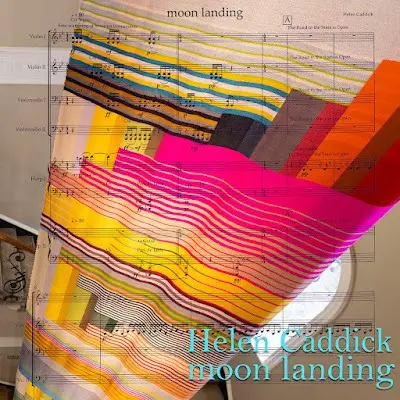
Today, that silence is finally being broken through a breathtaking convergence of contemporary music and textile art. moon landing, an immersive, cross-genre installation created through the visionary collaboration of composer Helen Caddick and textile artist Margo Selby, resurrects this hidden history. Originally debuting to critical acclaim at Collect 2024 at Somerset House, the work has found a prestigious second home at London’s renowned Saatchi Gallery as part of the landmark exhibition The Sun and Moon – Art Inspired by the Celestial.
By bridging the sensory worlds of sound and tactile fiber, Caddick and Selby have crafted an installation that is as intellectually rigorous as it is emotionally stirring. This feature explores the deep intersections of mathematics, science, music, and weaving that birthed moon landing, examining how two distinct artists transformed forgotten industrial labor into a transcendent, celestial monument.
Detailed Chronology: From Industrial Looms to Contemporary Galleries
To truly appreciate the multi-layered depth of moon landing, one must retrace a chronology that stretches across six decades, moving from the high-stakes manufacturing floors of the 1960s to the avant-garde galleries of modern-day London.
1960–1969: The Loom and the Cosmos
During the height of the Apollo space program, the Massachusetts Institute of Technology (MIT) Instrumentation Laboratory and defense contractor Raytheon faced a critical hardware bottleneck. The Apollo Guidance Computer (AGC) required a form of read-only memory that was entirely immune to power failures, vibrations, and magnetic interference. The solution was "Core Rope Memory"—a storage medium so physically durable and reliable that NASA engineers nicknamed it "LOL memory" (an acronym for "Little Old Ladies memory," a tongue-in-cheek nod to the demographic performing the work).
In practice, copper wires were threaded through tiny magnetic ferrite cores using sewing needles. A wire passing through a core represented a binary "1," while a wire passing around a core represented a "0." Because this work required immense patience, acute manual dexterity, and unwavering precision, Raytheon outsourced a significant portion of this intricate weaving to Navajo women living on reservations in the American Southwest, alongside factory workers in Massachusetts. These women treated the work like traditional textile weaving, creating life-saving digital tapestries that guided Neil Armstrong and Buzz Aldrin safely to the lunar surface and back. Despite the critical nature of their work, their names were rarely recorded in official mission logs.
2022–2023: The Spark of Collaboration
Decades later, composer Helen Caddick and textile artist Margo Selby found themselves independently and collectively meditating on the hidden parallels between their respective crafts. Selby, celebrated globally for her mastery of complex structural weaving and geometric color theory, recognized that weaving is, at its core, a binary system of warp and weft—not entirely dissimilar to early computing code. Caddick, meanwhile, was plumbing the historical depths of mid-century technological development when she uncovered the story of the Navajo and Raytheon weavers.
The two artists began a series of intensive dialogues, exploring how music and textiles share a structural DNA based on rhythm, repetition, permutation, and mathematical precision. They realized that a collaborative project could not merely illustrate the moon landing; it had to enact the physical and conceptual labor of the women who made it possible.
February 2024: The Collect 2024 Premiere
The culmination of their partnership debuted at Collect 2024, the international art fair for modern craft and design held at London’s historic Somerset House. Titled simply moon landing, the piece immediately captured the attention of critics and attendees alike. It presented an immersive environment where Selby’s monumental, texturally dense woven wall-hanging acted as a visual and tactile score, while Caddick’s ethereal acoustic composition enveloped the gallery space.
July–September 2024: The Saatchi Gallery Showcase
Building upon its initial triumph, moon landing was selected for inclusion in The Sun and Moon – Art Inspired by the Celestial at the Saatchi Gallery in London. Running through September 8, 2024, the exhibition placed Caddick and Selby’s collaborative masterwork within a broader global dialogue regarding humanity’s age-old fascination with cosmic bodies, bridging ancient celestial mythologies with modern industrial history.
Supporting Context & Metrics: The Intersection of Art, Math, and Engineering
To understand the profound resonance of moon landing, one must analyze the technical and conceptual architecture underpinning both the art and the history it honors.

The Mathematics of Weaving and Music
At first glance, music and textiles appear to occupy vastly different sensory realms—one fleeting and auditory, the other static and tactile. However, as Caddick and Selby discovered, both disciplines are fundamentally mathematical languages.
- Textile Weaving: Margo Selby’s artistic practice relies on complex multi-shaft loom setups, where patterns are generated through the precise mathematical permutation of warp threads (vertical) and weft threads (horizontal). The resulting grids mirror the pixelated matrices of digital displays and the binary routing of computer logic gates.
- Compositional Scoring: Helen Caddick’s musical realization of moon landing was specifically scored for an intimate, highly resonant ensemble: two harps, two cellos, and two violins. This specific instrumentation was chosen not by accident, but for its textural transparency and harmonic warmth. The plucked strings of the harps and the sustained resonance of the bowed strings mimic the tension of stretched threads and the vibrational hum of industrial machinery.
The Metrics of Apollo Core Rope Memory
To grasp the sheer scale of the labor performed by the women of Raytheon and the Navajo reservations, consider the following metrics:
- Storage Capacity: A single Apollo Guidance Computer rope memory module held a mere 72 kilobytes of data—a fraction of the storage capacity found in a modern digital watch.
- Labor Intensity: Each rope required weeks of meticulous, hand-threaded labor. A single error meant unpicking days of work to start over.
- Reliability: Despite the primitive nature of hand-woven magnetic cores, the Apollo Guidance Computer experienced zero hardware failures during six lunar landings. The "Little Old Ladies memory" was, statistically speaking, the most reliable component of the entire spacecraft.
| Medium / Dimension | Historical Reference | Artistic Translation (moon landing) |
|---|---|---|
| Technology | Apollo 11 Core Rope Memory | Multi-shaft woven textile structures by Margo Selby |
| Acoustics | Industrial factory noise & rocket propulsion | Chamber ensemble for 2 harps, 2 cellos, 2 violins by Helen Caddick |
| Demographic | Navajo weavers & Raytheon female factory workers | Honored through contemporary feminist art critique |
| Exhibition Venue | Raytheon assembly plants & NASA clean rooms | Somerset House (Collect 2024) & Saatchi Gallery |
Official Statements & Artistic Vision
The conceptual weight of moon landing is best articulated through the reflections of its creators, who view the piece as an act of historical restitution and sensory synthesis.
Helen Caddick on the Unsung Architects of Space Exploration
Reflecting on the impetus behind the musical composition, Helen Caddick emphasized the urgent need to correct historical oversights:
"Margo Selby and I had long been fascinated about the crossovers between music and textiles, mathematics and science, which sparked our initial conversations and desire to collaborate. But the heart of moon landing quickly became anchored in a little-known, vital human story. It was Navajo women and the women at the Raytheon plant who literally wove the integrated circuits and memory cores for Apollo 11. Without their hands, humanity never would have reached the moon. By creating this piece, I wished to bring their extraordinary story out of the footnotes of history and into greater public consciousness."
Margo Selby on Tactile Engineering and Spatial Design
Margo Selby approached the visual component of the installation as an exploration of structural rhythm, treating thread as a physical manifestation of data and time:
"Weaving is inherently computational. Every time a shuttle passes through a shed, a binary choice is made—up or down, dark or light, active or passive. Working alongside Helen allowed us to translate those physical choices into an auditory experience. When visitors stand before the textile installation while listening to the score for strings and harps, they aren’t just observing an artwork; they are stepping inside a woven machine, feeling the rhythm of the looms that built the modern world."
Future Outlook: Legacy, Recording, and Cross-Genre Innovation
As the curtain closes on exhibitions like The Sun and Moon at the Saatchi Gallery, the journey of moon landing is far from over. The project establishes a compelling blueprint for how contemporary fine art can engage with industrial history, feminist critique, and interdisciplinary collaboration.
Accessibility and Archival Preservation
Recognizing that physical gallery installations are inherently temporary, Caddick and Selby have ensured that moon landing maintains a permanent digital footprint. The musical composition for two harps, two cellos, and two violins has been officially released and is available for public streaming and download via Bandcamp.
Art critics and musicologists alike have noted that while listening to the recording independently offers a deeply atmospheric experience, encountering the music in direct spatial dialogue with Selby’s textile installation elevates the work into a totalizing, synesthetic masterpiece.
The Future of Interdisciplinary Art
The success of moon landing signals a growing appetite within the global arts community for projects that break down traditional disciplinary silos. By proving that textile art can converse fluently with contemporary chamber music—and that both can serve as vehicles for rigorous historical research—Caddick and Selby have opened new pathways for artists exploring technology, gender labor, and material culture.
As humanity looks toward future lunar and Martian expeditions, the cultural legacy of moon landing serves as a poignant reminder that every leap into the cosmos rests on the quiet, meticulous, and brilliant labor of those who weave the fabric of our technological reality.
Further Information & Resources
- Listen to the Composition: Explore and download the musical score via Helen Caddick’s Bandcamp.
- Exhibition Details: Learn more about the curatorial framework via the Saatchi Gallery Official Exhibition Page.
- Critical Commentary: Read original reflections on the Somerset House premiere via Planet Hugill.