Executive Overview
In an aggressive push to capture the high-end professional audio market, British pro audio manufacturer Audient has officially announced Horizon—its new flagship line of professional-grade Thunderbolt 3 audio interfaces. Five years in development and representing the most substantial research and development investment in the company’s history, the Horizon series arrives as a direct challenge to legacy heavyweights in the elite recording and mixing space.
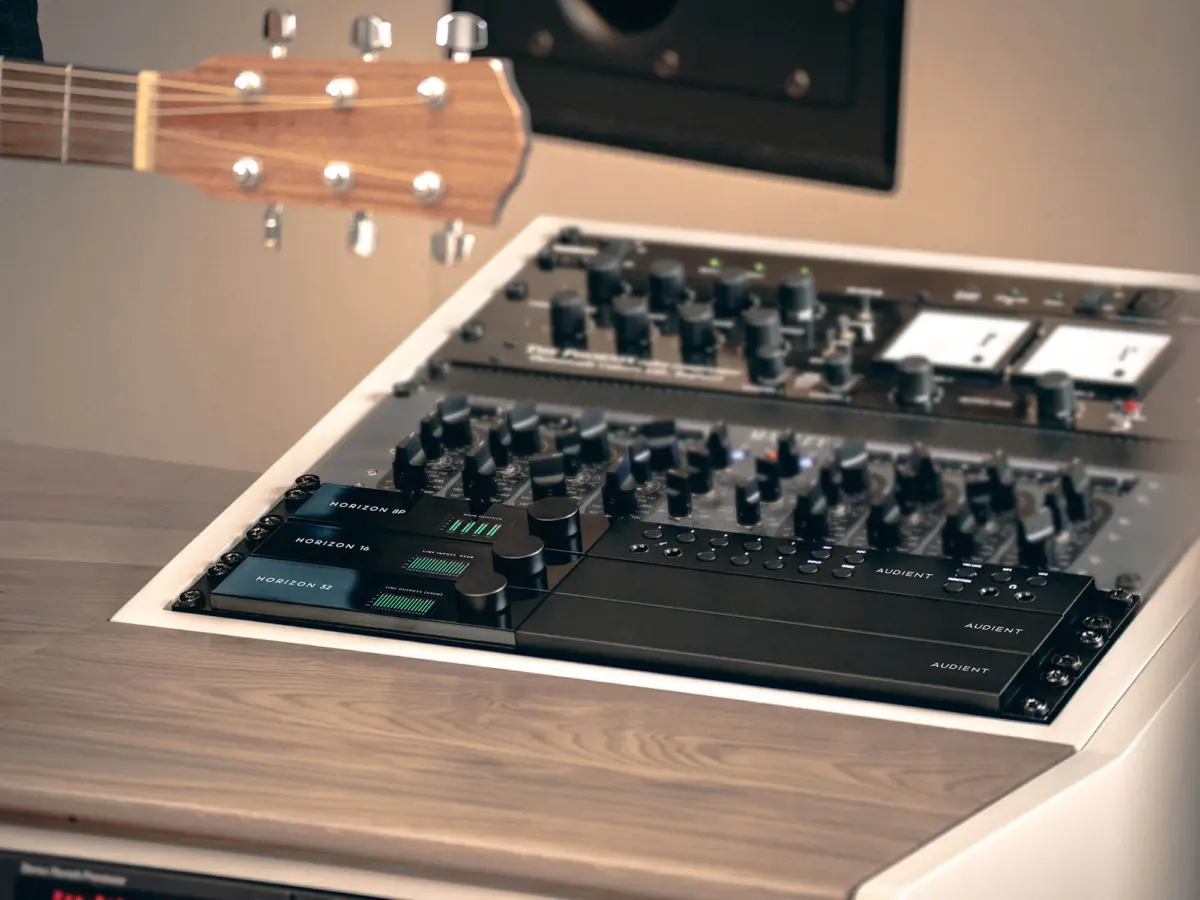
Comprising three distinct, rack-mountable hardware iterations—the Horizon 8P, the Horizon 16, and the Horizon 32—the lineup is unapologetically tailored for commercial studios, tracking facilities, and hybrid production environments. Beneath its sleek exterior, the Horizon series leverages top-tier engineering specifications: 32-bit mastering-grade analog-to-digital and digital-to-analog conversion, a blistering round-trip latency of under one millisecond (0.99ms at 192 kHz), and a deeply scalable architecture that permits the seamless daisy-chaining of up to four individual Horizon units on a single macOS driver.
By abandoning closed, proprietary digital signal processing (DSP) ecosystems in favor of a lightning-fast, native-driven workflow, Audient is positioning Horizon as the ultimate bridge between classical analog outboard hardware and the soaring processing power of modern Apple Silicon computers. With universal features such as complete digital recall of input gains, flexible ADAT expansion, BNC Word Clock input/output, and precise selectable reference levels for analog gear calibration, the Horizon series is engineered to disappear into the signal chain, allowing producers, tracking engineers, and mix heavyweights to focus purely on the art of the performance.
Detailed Chronology and Product Architecture
The journey to the Horizon series began half a decade ago, born out of a realization within Audient’s R&D labs that the professional recording industry was undergoing a fundamental paradigm shift. As host processing computers grew exponentially more powerful—culminating in the absolute dominance of Apple Silicon architectures—the traditional utility of external DSP accelerator cards began to wane. Modern tracking engineers no longer needed closed ecosystems to run demanding monitor mixes or track through complex plugin chains with zero perceptible delay.

Instead, Audient recognized a widening gap in the market: professional-grade interfaces that combined uncompromising, large-format console-grade analog circuitry with the blazingly fast throughput of Thunderbolt 3, all while maintaining an open, flexible native software architecture.
The Universal Foundation
While the three models cater to different structural requirements within a professional facility, every unit in the Horizon range shares an uncompromising foundation of universal specifications:
- 32-Bit Mastering-Grade Conversion: Delivering ultra-high dynamic range and crystal-clear transient capture, ensuring that subtle details in tracking and mixing are preserved without coloration from the conversion stage.
- Ultra-Low Latency: Achieving a remarkable 0.99ms round-trip latency at 192 kHz. This performance enables artists and producers to track directly through native software plugins in real-time, completely bypassing the need for separate hardware monitoring software.
- Total Digital Recall: Every parameter, from input gain stages to internal routing and system settings, features precise digital recall, bridging the gap between analog warmth and digital DAW integration.
- Professional Clocking and Expansion: Built-in ADAT expansion capabilities and BNC Word Clock I/O ensure seamless integration into larger studio synchronization grids.
- Selectable Reference Levels: Designed explicitly for hybrid studios, users can calibrate I/O headroom to match external analog gear precisely, accommodating varying operating levels (+4dBu, -10dBV, etc.).
The Three Models: Tailored for Every Professional Use Case
1. Horizon 8P: The Ultimate Tracking Engine
- Configuration: 24 inputs / 32 outputs (1U Rack-mount)
- Preamp Architecture: 8 Audient Console Mic Preamps featuring ORBIT Control variable impedance.
- Target Audience: Tracking studios, live tracking rooms, and mobile recording rigs capturing acoustic bands, complex drum kits, vocal ensembles, or orchestral sections.
- Deep Dive: For the first time, Audient has crammed the exact same discrete Class-A preamp topology found in its legendary flagship ASP8024-HE large-format recording console into a single rack-space unit. The addition of ORBIT Control allows engineers to dynamically alter the impedance stage of the preamp, subtly shifting the harmonic distortion profile and transient response to perfectly match everything from delicate vintage ribbon microphones to hyper-fast modern condensers.
2. Horizon 16: The Hybrid Mix Hub
- Configuration: 34 inputs / 34 outputs (1U Rack-mount)
- Conversion Mapping: 32 channels of mastering-grade conversion via four industry-standard DB25 multi-pin connectors.
- Routing Highlights: Features a dedicated stereo mix-bus path.
- Target Audience: Mid-to-large-scale mix engineers and production rooms loaded with hardware compressors, EQ racks, and summing mixers.
- Deep Dive: The Horizon 16 is engineered for facilities that rely heavily on outboard analog gear. By utilizing multi-pin DB25 connectivity, it streamlines studio patching, allowing engineers to effortlessly send multi-track stems out to analog summing mixers and outboard processors and route them back into the DAW with absolute phase coherence and pristine 32-bit clarity.
3. Horizon 32: The Large-Format Flagship
- Configuration: 50 inputs / 50 outputs (1U Rack-mount physical footprint, scaling immensely via architecture)
- Analog I/O: 64 channels of pure analog I/O routed across eight DB25 connectors.
- Target Audience: High-end commercial studios, sprawling hybrid facilities, and multi-room tracking complexes.
- Deep Dive: The Horizon 32 is the crown jewel of the new product line. Designed to serve as the central nervous system for massive, complex studio environments, it allows engineers to simultaneously interface multiple outboard equipment racks, large-format analog consoles, and complex multi-room routing schemes through a single cohesive audio interface.
Supporting Context & Metrics
To truly appreciate the engineering leap represented by the Horizon series, one must examine the competitive landscape of professional Thunderbolt 3 audio interfaces. Historically, high-channel-count audio interfaces have forced studios into compromises: either settling for DSP-locked ecosystems that restrict plugin choice, or dealing with high round-trip latencies that necessitate complex hardware cue-mixing software.
| Feature / Metric | Audient Horizon Series | Legacy DSP-Locked Systems | Standard USB-C Interfaces |
|---|---|---|---|
| Connection Protocol | Thunderbolt 3 (Daisy-chain up to 4 units) | Proprietary PCIe / Thunderbolt | USB 2.0 / 3.0 / USB-C |
| Round-Trip Latency (192 kHz) | 0.99ms | Varies (DSP Dependent) | 3ms to 7ms+ |
| Conversion Resolution | 32-bit Mastering-Grade | 24-bit / 32-bit Floating | 24-bit |
| Preamp Lineage | ASP8024-HE Console Design w/ ORBIT Control | Variable depending on model | Entry-to-Mid Tier Integrated ICs |
| Ecosystem Philosophy | Open Native Architecture | Closed / Proprietary Plugin Walls | Generic Driver Support |
The decision to lean entirely into Apple Silicon and modern native host processing reflects a broader philosophical shift in audio engineering. By relying on the raw computational muscle of modern central processing units, Audient’s Horizon interfaces free engineers from the artificial limitations of proprietary chipsets. You are no longer restricted to a curated list of manufacturer-approved plugins; instead, any native plugin—whether from Universal Audio, FabFilter, Slate Digital, or Waves—can be tracked through in real-time without introducing audible delay.

Furthermore, the hardware’s scalability via Thunderbolt 3 daisy-chaining means that a studio can start with a single Horizon 8P or Horizon 16 and expand their setup up to four units on a single macOS driver, creating a massive, synchronized audio network without PCIe chassis overhead or unstable aggregate device workarounds.
Official Statements & Industry Insights
According to Andrew Allen, Chief Product Officer at Audient, the Horizon line is the culmination of years of meticulous research, listening to industry feedback, and refusing to cut corners at the component level.
"Horizon has been five years in the making; the most significant R&D investment we’ve ever put into a product range," states Allen. "We spared no compromise at component level, and the result is the best-on-the-market audio and latency performance. This is a modern system built for modern workflows."
Addressing the obsolescence of older studio paradigms, Allen elaborated on the strategic decision to reject closed DSP environments:

"As Apple Silicon and modern host processing get more capable, the value proposition of the DSP walled-garden model continues to diminish. Engineers no longer need to lock themselves into proprietary plugin ecosystems to get pro-level performance. Horizon’s native architecture is built exactly for this shift, and we expect it to land well with customers who’ve been waiting for a credible alternative."
Crucially, Audient designed the accompanying control software with a singular guiding philosophy: the hardware and software must stay entirely out of the way of the creative process.
"We designed Horizon so engineers can focus on the performance, not the routing," Allen explains. "And we redesigned the software from the ground up, paying close attention to the user experience. Whether that’s using ORBIT Control on the 8P to shape a ribbon mic at the analogue stage, or streaming an entire console through the Horizon 32, the hardware stays invisible and the workflow stays fast."
Future Outlook & Market Impact
The launch of the Audient Horizon series marks a defining moment for the company, historically celebrated for bridging the gap between project studio affordability and professional-grade fidelity (such as their popular iD series and ID44 interfaces, as well as their renowned analog mixing consoles). With Horizon, Audient has firmly planted its flag in elite territory, competing directly with titan manufacturers like Avid, Antelope Audio, Apogee, and Universal Audio in the high-end professional sector.

As commercial recording studios continue to evolve into hybrid spaces—blending software flexibility with tactile analog outboard gear—demand for ultra-reliable, low-latency, high-channel-count conversion is skyrocketing. The ability of the Horizon range to scale across a single macOS driver, coupled with pristine 32-bit conversion and the inclusion of genuine ASP8024-HE console preamps, gives it a unique competitive edge.
Industry analysts predict that the Horizon line will be particularly well-received by modern boutique studios and producers who run heavy native processing templates on M-series Mac Studio and MacBook Pro hardware. By providing a transparent, lightning-fast conduit between the analog world and the digital domain, Audient has ensured that the Horizon series will not just meet the demands of today’s elite studios, but remain future-proof for years to come.
Availability and Pricing
The Audient Horizon range is scheduled to hit the global market on 28 September 2026, available worldwide through authorized Audient dealers and professional audio distributors. Prospective buyers and studio owners looking to upgrade their infrastructure can find detailed technical specifications, wiring diagrams, and dealer locators directly on the official Audient website.