Executive Overview
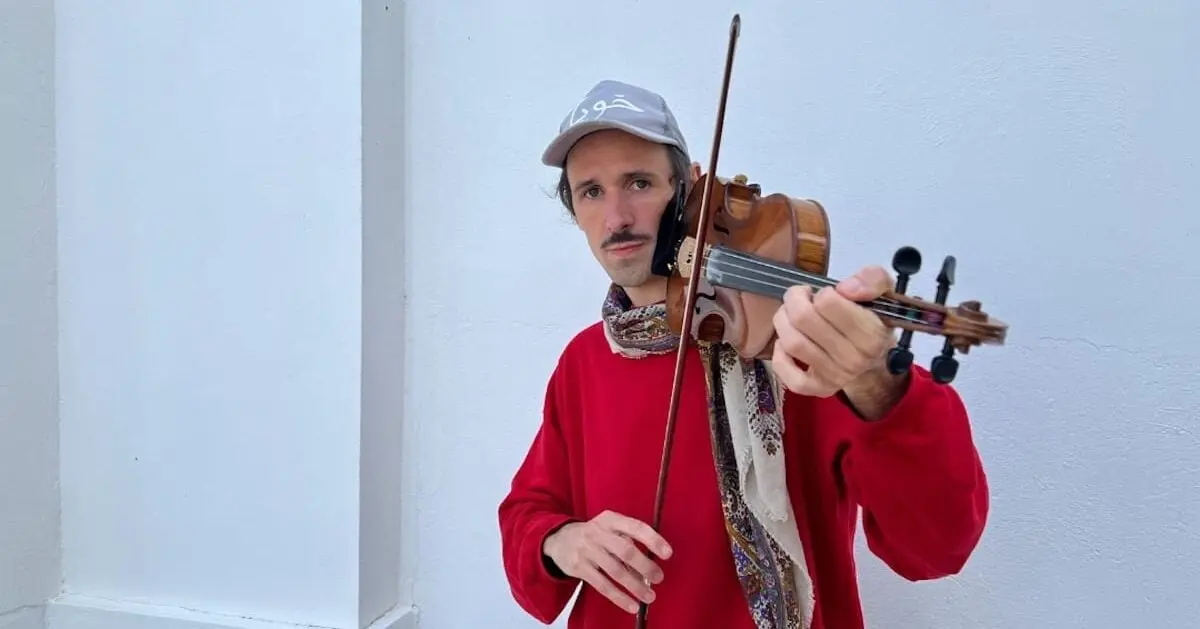
To place a needle on Outredore, the upcoming full-length release from French sonic experimentalist Sourdure (multidisciplinary artist Ernest Bergez), is to step onto shifting tectonic plates. Scheduled for release on September 25, 2026, via Pagans and Murailles Music, the album opens with “Flor,” a track that initially masquerades as a degraded 1970s French avant-folk artifact. Yet, this antiquity is a phantom. Within seconds, micro-interruptions, synthetic pulses, and uncanny spatial textures shatter the illusion, revealing the work of an artist operating in a post-folktronica, post-musique concrète reality.
Sourdure’s music resists historical localization. It feels simultaneously pre-historic and post-apocalyptic, bridging the ancient vernacular traditions of Occitania and France with a thoroughly idiosyncratic, DIY electronic deconstruction. Across tracks like “Cinq,” “Le Pebre,” and the stripped-back closer “Manieiras de vent,” Bergez—alongside a coterie of formidable collaborators including Lisá Langlois, Le Diable Dégoutant, and Eloïse Decazes—constructs a sonic universe that is deeply unsettling yet profoundly magnetic.
This review-analysis explores the anatomy of Outredore, charting its trajectory through structural manipulation, ancestral vocal traditions, and futuristic world-building. Furthermore, it details the upcoming international tour supporting the record, tracing Sourdure’s path from French cultural centers to iconic experimental hubs across the UK, Ireland, and Italy.
Detailed Chronology: The Evolution and Anatomy of Outredore
The Genesis of a Singular Practice
Ernest Bergez has spent the better part of a decade carving out a solitary, highly specialized niche within the European underground. Beyond his solo output as Sourdure, Bergez maintains a restless creative footprint, collaborating as a duo in Kaumwald and as a member of the acclaimed quartet Sourdurent. Singing primarily in Occitan and French, Bergez treats language not merely as a vehicle for narrative, but as a textured acoustic instrument capable of being fractured, stretched, and looped.
Sourdure’s foundational ethos is rooted in a rigorous, uncompromising DIY methodology. Traditional folk songs—often passed down through generations or unearthed from regional archives—are treated not as museum pieces to be preserved in amber, but as volatile raw materials. Bergez subjects them to electronic friction, introducing rhythmically jarring interventions that feel beamed in from an alternate timeline. The uncanny, improvisational spirit of the early Third Ear Band echoes through his work, yet it is thoroughly filtered through Mediterranean warmth and a contemporary, disquieting digital aesthetic.
Deconstructing the Tracklist: From Archaic Whispers to Future-Primitive Maelstroms
Outredore is sequenced as an intentional journey through shifting sonic states, balancing moments of harrowing abstraction with pockets of stark, devastating beauty.
- The Opening Gambit (“Flor” & “Ainani”): The album opens with the deceptive “Flor,” where the lo-fi aesthetic masks sophisticated post-genre mechanics. Later, “Ainani” offers a breathtaking exercise in minimalism. Here, accompaniment is stripped to its absolute skeleton: Bergez’s soft, vulnerable vocals trace a malleable melody dictated entirely by the plucking of his strings. Clear North African influences seep into the French folk architecture, establishing a cross-cultural dialogue that feels both ancient and immediate.
- The Futuristic World-Building (“Cinq” & “Peira”): As the album progresses, the manipulation intensifies. “Cinq” sounds like field recordings beamed back from a future-primitive civilization. Scraping, microtonal melodies strain against relentless, chattering percussion as Bergez’s voice fights for dominance. Two-thirds of the way through, the track undergoes a seismic shift, collapsing into a swirling maelstrom where traditional instrumentation and synthetic noise merge into an unstoppable vortex. Similarly, “Peira” leverages glitchy stop-start dynamics, rapid-fire vocal samples, and frantic cadences to execute an avant-garde incursion into the structural territory of hip-hop.
- The Collaborative Dark Rituals (“Le Pebre,” “L’or des fous,” & “Pauvre cirque”): The album’s collaborative centerpieces introduce distinct thematic and historical precedents. “Le Pebre,” featuring Lisá Langlois, channels the spirited, eccentric domestic avant-pop of mid-1970s Brigitte Fontaine and Areski before a sudden sonic derailment dismantles any lingering notions of traditional songcraft. “L’or des fous” (featuring Le Diable Dégoutant) presents a jaunty, folky duet underpinned by chilling, monotonous notes, screeching bowed strings, and an insistent, ritualistic pulse. This tension evokes a dark, celebratory village rite out of time. Meanwhile, “Pauvre cirque,” crafted alongside Eloïse Decazes, pairs clattering, industrial percussion with near-robotic vocal deliveries. It is as though a glamorous French pop song had been left to mutate in a damp cave for a century, growing a vibrant, post-industrial sonic fungus.
- The Lyrical and Harmonic Resolution (“Primabocha” & “Manieiras de vent”): The compact “Primabocha” foregrounds Bergez’s resonant singing, counterbalancing it with synthesized flutter and a muted, free-jazz horn solo that cuts through the mix like a distant foghorn. The album closes with “Manieiras de vent,” a profoundly desolate and striking piece. Pairing Bergez’s voice—alternating between impassioned declarations and breathless intimacy—with wandering, lost-at-sea brass and a persistent, low-end drone, the track floats outward, leaving a piercing, lingering resonance long after the final note fades.
Supporting Context & Metrics: The Production and Release Landscape
To understand the weight of Outredore, one must examine the institutional and physical infrastructure supporting its release. Slated for September 25, 2026, the album is a joint venture between two vital European independent labels: Pagans and Murailles Music. Both imprints have long championed music that exists in the interstitial spaces between folk preservation, free improvisation, and electroacoustic composition.
| Album Metadata Metric | Detail |
|---|---|
| Artist | Sourdure (Ernest Bergez) |
| Release Title | Outredore |
| Release Date | September 25, 2026 |
| Primary Labels | Pagans, Murailles Music |
| Primary Languages | Occitan, French |
| Key Collaborators | Lisá Langlois, Le Diable Dégoutant, Eloïse Decazes |
| Physical Formats | Digital (Bandcamp), Vinyl LP |
The choice of collaborative partners on Outredore highlights Bergez’s central role within the wider French and European underground networks. By weaving voices like Lisá Langlois and Eloïse Decazes into his compositions, Bergez prevents the album from becoming a purely academic exercise in solo auteurism. Instead, it functions as a communal gathering—a gathering where each vocalist brings their own distinct lineage, timbrel quality, and emotional urgency to the overarching sonic tapestry.
Official Statements and Artistic Vision
While formal press statements from Ernest Bergez regarding Outredore emphasize the organic and intuitive nature of his composition process, the structural choices within the music speak volumes. In past interviews concerning his work with Sourdure and Sourdurent, Bergez has frequently articulated a desire to dismantle the nostalgic distance often associated with traditional music.
By refusing to treat Occitan folklore as a static museum artifact, Bergez positions his work within a living, breathing lineage of cultural disruption. The integration of modern electronic glitch art, musique concrète tape manipulation, and raw acoustic performance is not deployed as a gimmick; rather, it is an acknowledgment that historical folk music was, in its own time, experimental, disruptive, and deeply tied to the immediate physical and social environments of its makers. Outredore translates this historical immediacy into the 21st century, proving that true tradition requires transformation, friction, and risk.
Future Outlook: Live Itinerary and Tour Logistics
The release of Outredore will be accompanied by an extensive live tour spanning France, the United Kingdom, Ireland, and Italy throughout the autumn of 2026. Sourdure’s live performances are renowned for translating the intricate studio production of his albums into visceral, highly physical encounters, where traditional acoustic instruments collide dynamically with live electronics and unbridled vocal improvisation.
Comprehensive 2026 Tour Dates
- 19th September 2026 – Poitiers (FR) — Grand Mess, Confort Modern
- 25th September 2026 – Brighton (UK) — Rose Hill
- 26th September 2026 – London (UK) — Cafe OTO (Promoted by Baba Yaga’s Hut, with La Tène)
- 27th September 2026 – Birmingham (UK) — Artefact
- 1st October 2026 – Belfast (UK) — The Accidental Theatre (Promoted by Moving on Music)
- 2nd October 2026 – Dublin (IE) — Bello Bar (Promoted by Enthusiastic Eunuch Promotions)
- 17th October 2026 – Castrignano de’ Greci (IT) — Ogni Altro Suono, KORA, Palazzo Baronale de’ Gualtierisi
- 21st November 2026 – Aurières (FR) — La Pie Folle
The routing highlights key epicenters of European avant-garde and improvised music, notably London’s legendary Cafe OTO (where Sourdure will perform alongside the hypnotic trance-folk stylings of La Tène) and specialized regional arts spaces like Belfast’s Accidental Theatre and Dublin’s Bello Bar.
As Outredore hits shelves and streaming platforms on September 25, 2026, via Pagans and Murailles Music, it stands poised to challenge listener expectations and redefine the boundaries of what contemporary European folk music can achieve. For those eager to secure physical copies or digital releases, pre-orders and music streaming are available directly via the official Sourdure Bandcamp page.