Rarely does the contemporary operatic landscape offer an opportunity to witness a true historical artifact reimagined with such youthful vigor and acute stylistic intelligence. On September 18, 2026, the Bampton Classical Opera brought its acclaimed summer production of André Ernest Modeste Grétry’s Zemira e Azor to London’s prestigious Smith Square Hall.
While Grétry’s original French opéra comique, Zémire et Azor (1771), enjoyed massive international acclaim in the late eighteenth century, Bampton opted for a significantly scarcer and historically fascinating iteration: the 1776 Italianization crafted for the court of the Elector in Mannheim. Featuring a bespoke libretto by Mattia Verazi, recitatives composed by the Elector’s kapellmeister Ignaz Holzbauer, and interpolated arias by Niccolò Jommelli, this version bridges French opulence with Italian dramatic urgency.
Under the brisk, stylish musical direction of Andrew Griffiths leading the period-ensemble CHROMA, and guided by the imaginative, unfussy stage direction of Jeremy Gray, a talented young cast anchored by Ffion Edwards (Zemira) and Gwilym Bowen (Azor) brought sparkling vitality to this neglected score. Sung in a fresh, witty English translation by Gilly French and Jeremy Gray, the production proved that historical musicological recovery need not be a dry academic exercise, but rather a thoroughly engaging theatrical event.
Detailed Chronology and Production Analysis
Historical Roots and the 1776 Mannheim Transformation
To understand the significance of Bampton’s undertaking, one must retrace the remarkable career of André Ernest Modeste Grétry. Born in Liège in 1741, Grétry forged his reputation in Paris, cementing his status as a master of opéra comique. Across a prolific career spanning from his first breakthrough in 1768 to his final operatic efforts in 1803, he composed upwards of 50 operas. Despite surviving the political turbulence of the French Revolution—retaining his property, being appointed inspector of the Conservatoire by the Republic, and ultimately receiving the Legion of Honour and a pension from Napoleon—Grétry’s works eventually slipped from the standard international repertory.
Among his greatest triumphs was Zémire et Azor (1771), with a text by Jean-François Marmontel based on traditional Beauty and the Beast motifs. The original work was an immediate sensation, notching over 120 performances in its inaugural year and remaining a staple of French stages until at least 1820.
However, as was common practice in an era when transnational cultural exchange dictated localized performance styles, works with spoken dialogue often underwent radical surgery when traveling abroad. For its 1776 staging at the Elector’s summer court theater in Schwetzingen, the opera was thoroughly Italianized:
Mattia Verazi restructured the text into a seamless Italian libretto.
Ignaz Holzbauer, the Mannheim court kapellmeister, replaced the original spoken dialogue with driving, expressive accompanied recitatives.
Niccolò Jommelli, a celebrated composer who had passed away in 1774, posthumously contributed two virtuosic arias, integrated into the score likely at Verazi’s suggestion.
This unique hybrid score languished in historical obscurity for centuries, save for a modern revival at the Schwetzinger SWR Festspiele in 2023, before Bampton Classical Opera selected it for their 2026 season.
The London Performance at Smith Square Hall
Following regional tours across Oxfordshire and the Cotswolds, Bampton’s production settled into the acoustically pristine environment of Smith Square Hall on September 18, 2026. The staging favored smart, economical design choices over bloated period reconstructions. Director Jeremy Gray, alongside costumers Pauline Smith and Anne Baldwin, framed the narrative in a loosely contemporary aesthetic.
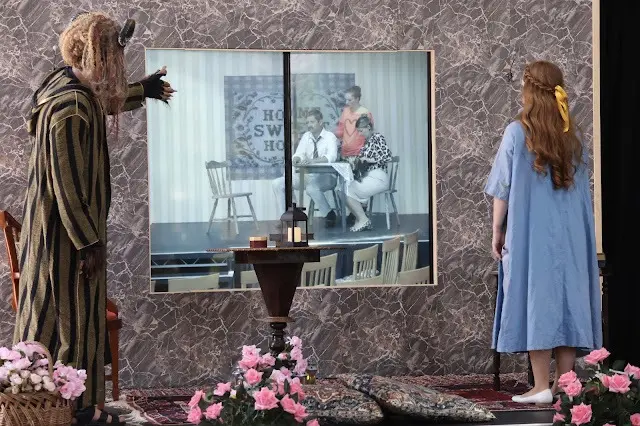
The stage picture was anchored by clever multimedia integration: two electronic screens managed by David Hudd and Keith Farr projected evocative, shifting video backdrops while doubling as the "magic mirror" through which Azor allows Zemira to gaze upon her grieving family. Meanwhile, domestic scenes in the merchant Sandro’s household utilized a whimsical, oversized pop-up book detailing the classic fairytale, instantly orienting the audience within a familiar storytelling tradition.
Instrumentally, Andrew Griffiths commanded the players of CHROMA, positioned tastefully at the rear of the stage. The instrumental textures—featuring expressive writing for flutes, oboes, bassoons, and horns, supported by Alex Norton on harpsichord continuo—revealed a surprisingly sophisticated orchestral palette. The performance opened with a remarkably intricate, multi-movement overture that immediately challenged any lingering preconceptions of late-eighteenth-century lightness.
Supporting Context and Character Analysis
The Narrative Arc: Beauty, Beasts, and the Strait of Hormuz
Marmontel’s libretto derived its framework from classic French fairy tales penned by Madame de Villeneuve and Madame de Beaumont, though the character names themselves were borrowed from exotic literary romance tropes.
Acts I and II: The story is split between two distinct worlds: the bustling commercial hub near the Strait of Hormuz, where the impoverished merchant Sandro (Samuel Pantcheff) and his beleaguered servant Ali (Andrew Irwin) attempt to recover from catastrophic shipwrecks; and the enchanted, seemingly vacant palace of the Persian prince Azor (Gwilym Bowen). When Sandro plucks a single rose as a gift for his youngest, most virtuous daughter Zemira (Ffion Edwards), he awakens the wrath of Azor, who condemns the merchant to death. A reprieve is granted only when Sandro pledges that one of his daughters will voluntarily return to take his place. Driven by guilt, Sandro plans to go back, but Zemira preemptively takes his place, accompanied by the terrified Ali.
Acts III and IV: The latter half of the opera compresses the developing psychological bond between Zemira and Azor. Azor provides a magic mirror allowing Zemira to check on her family—specifically her bickering, self-absorbed sisters Fatima (Sian Dicker) and Lesbia (Rachel Roper), who evoke the comedic sibling rivalry later seen in Rossini’s La Cenerentola. Overcome by homesickness, Zemira is permitted a brief furlough. A gorgeous family quartet unites the household before Zemira rushes back to a despairing Azor. Her profound love breaks his monstrous curse, restoring him to his true human prince identity, aided by a whimsical fairy intervention (doubled here by Andrew Irwin).
Vocal and Dramatic Performances
The vocal ensemble approached the demanding score with striking technical assurance and theatrical commitment:
Gwilym Bowen (Azor): Bowen delivered a compelling portrayal of the Beast, blending heroic vocal weight with profound tenderness. Though his major Act III despair aria was initially somewhat detached, being delivered from the upper balcony, Bowen successfully humanized the monster through dignity and vocal nuance.
Ffion Edwards (Zemira): Edwards was a revelation in the title role. Balancing deep filial piety with resilient bravery, her stage presence was magnetic. The dramatic apex arrived in Act III with her showpiece aria—a brilliant display of vocal agility in which she actively emulated birdsong—capturing the house in spellbound silence and rendering Azor’s instantaneous devotion entirely believable.
Samuel Pantcheff (Sandro) & Andrew Irwin (Ali): Pantcheff grounded the production with a warm, deeply sympathetic vocal line, portraying a father whose financial failures are completely eclipsed by paternal devotion. Irwin injected a rich strain of comic relief as the perpetually panicked servant Ali, a character study that clearly prefigures Mozart’s quintessential everyman, Papageno.
Sian Dicker (Fatima) & Rachel Roper (Lesbia): The supporting sisters brought delightful comedic friction to the stage. Their interpolated Jommelli arias added unexpected moments of musical gravity, which both sopranos met with confident, soaring execution.
Official Statements and Artistic Vision
While formal corporate press releases from municipal bodies were minimal, the artistic intent behind the production was clearly articulated by director Jeremy Gray and translator Gilly French in program notes and production briefs:
"Grétry’s masterpieces deserve to be judged outside the museum vitrine. By utilizing the 1776 Mannheim adaptation, we bypass the cumbersome spoken dialogue of the French original in favor of driving Italian recitative, allowing the dramatic pacing to mirror the breathless immediacy of a true classical dramma giocoso."
— Jeremy Gray, Co-Director and Translator
Furthermore, musical director Andrew Griffiths emphasized the technical rewards of unearthing such rare repertoire:
"The orchestral writing by Holzbauer and the interpolated gems by Jommelli elevate Grétry’s melodic charm into something genuinely symphonic. CHROMA relished navigating these stylistic cross-currents, demonstrating that the late-eighteenth-century European exchange was far more fluid and adventurous than standard music history textbooks often suggest."
— Andrew Griffiths, Conductor
Future Outlook: Reassessing the Eighteenth-Century Canon
Bampton Classical Opera’s staging of Zemira e Azor marks a vital milestone in modern performance-practice curation. For decades, opera companies seeking pre-Mozartian repertory have remained trapped within a safe, highly canonical loop, repeatedly staging standard works by Gluck, Haydn, and early Mozart while ignoring the vibrant cosmopolitan network of European theatrical exchange.
By successfully mounting the 1776 Mannheim Italian version, Bampton has proven that Grétry’s works—when pruned of sluggish dialogue and energized by dynamic translations and period-informed playing—hold immense viability for modern regional and touring houses. The production demonstrated that audiences do not need hyper-conceptualized, avant-garde framing to appreciate rare works; instead, they respond enthusiastically to intelligent design, rigorous musical preparation, and exceptional young vocal talent.
As opera companies globally search for innovative ways to expand their repertoires without alienating ticket-buyers, Bampton’s Zemira e Azor serves as a gold standard. It proves that within the vast archives of eighteenth-century European opera houses, countless masterworks are waiting quietly in the wings, ready to charm modern audiences anew.

_Ffion%20Edwards%20(Zemira).jpg)
_Ffion%20Edwards%20(Zemira).jpg)
.jpg)
_Ffion%20Edwards%20(Zemira)%203.jpg)
_Samuel%20Pantcheff%20(Sandro).jpg)
_Sian%20Dicker%20(Fatima).jpg)