Executive Overview
Six decades after its premiere, Irish playwright Samuel Beckett’s seminal 1961 theatrical masterpiece, Happy Days, has transcended its traditional classification as an absurdist or existentialist drama. Modern literary and environmental scholarship increasingly views the play’s stark, sun-baked landscape not merely as a metaphysical void, but as a chillingly prescient portrait of ecological collapse.
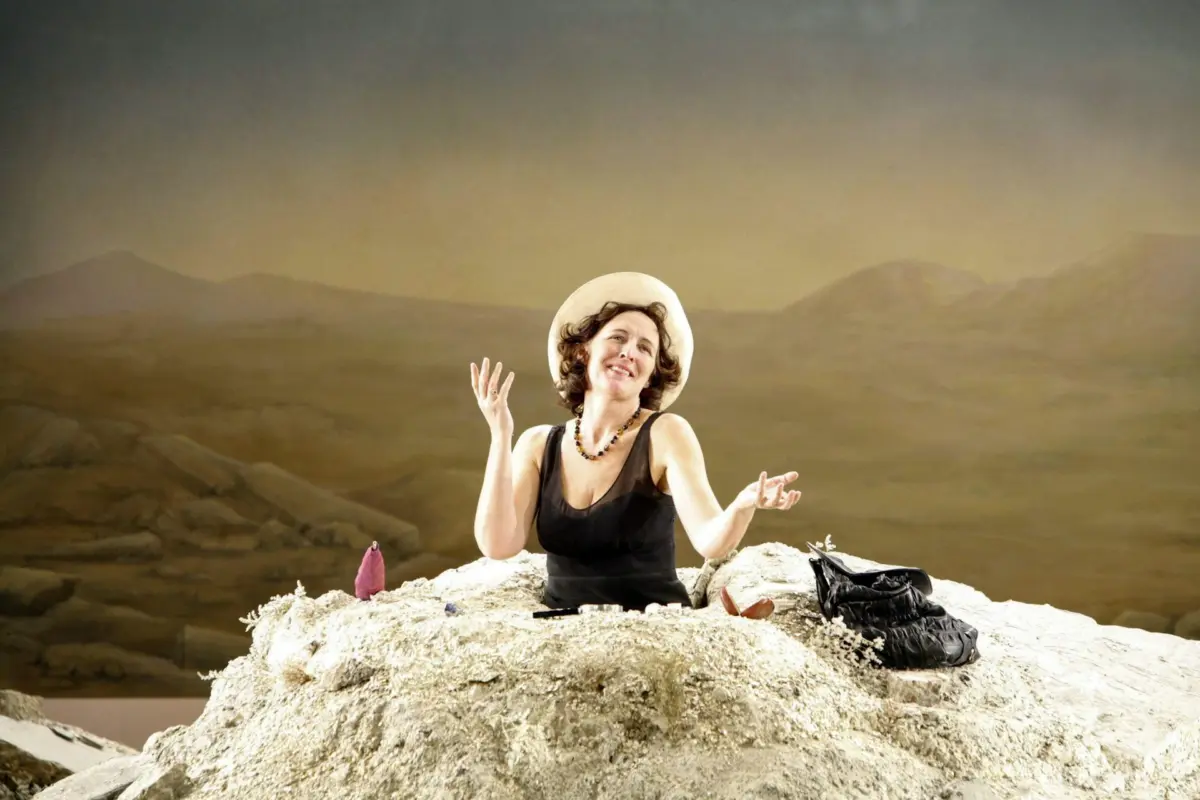
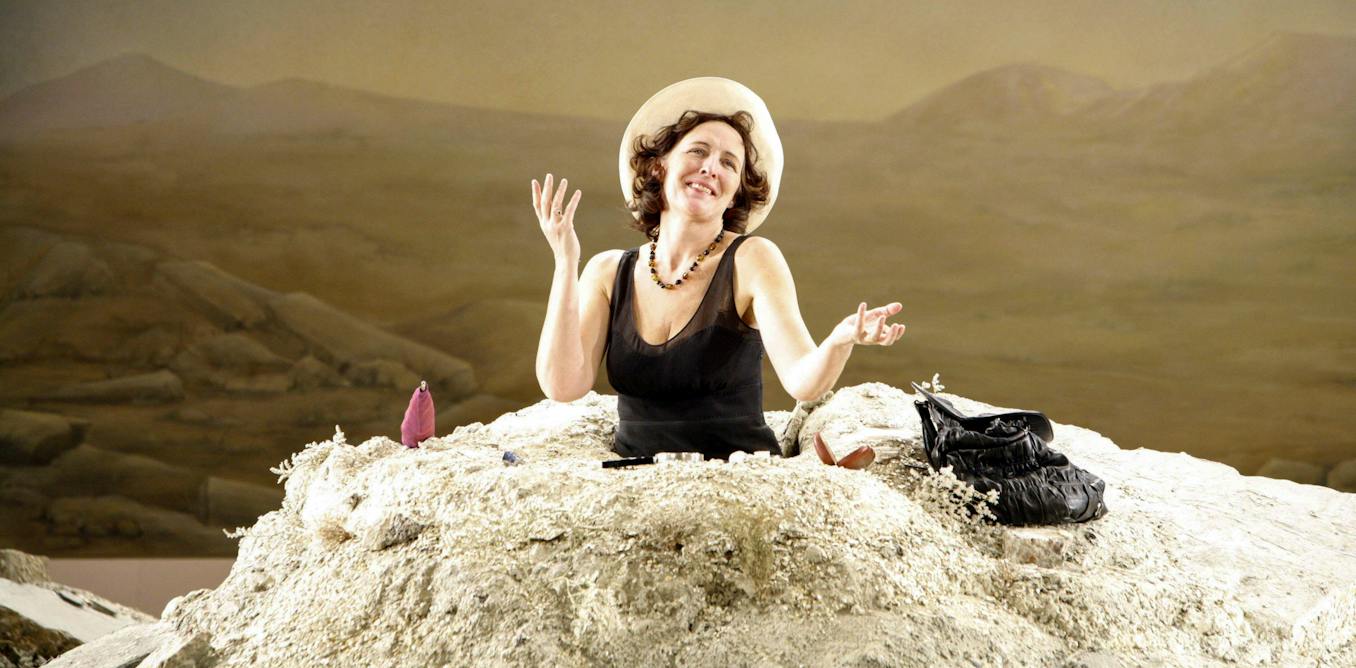
In Happy Days, the protagonist, Winnie, is systematically consumed by the earth itself—buried to her waist in the first act and up to her neck by the second. Surrounded by scorched earth and an oppressive, blinding light, Winnie’s physical entrapment mirrors humanity’s growing entanglement with a degraded biosphere.
Recent academic research, spearheaded by scholars such as Fraser Cattini at the University of Liverpool, bridges Beckett’s personal encounters with wartime devastation and formative childhood walks with contemporary anxieties surrounding climate change. Far from being a dated relic of mid-century avant-garde theatre, Happy Days serves as an urgent, prophetic warning. By examining Beckett’s staging through the lens of modern environmental crises—ranging from industrial oil spills to rising sea levels—we are forced to confront an uncomfortable truth: Winnie’s fictional engulfment by the earth is no longer an abstract theatrical metaphor, but a growing ecological reality.
Detailed Chronology: From Dublin Hills to the Ruins of Normandy
To understand the profound ecological undercurrents in Beckett’s work, one must trace the biographical and historical coordinates that shaped his worldview.
The Formative Dublin Excursions (1906–1920s)
Born in Dublin in 1906, Beckett’s earliest and most intimate interactions with the natural world occurred far away from academic lecture halls. To evade the rigid social and religious obligations of Sunday church attendance, young Samuel frequently joined his father, William, on exhaustive, multi-mile walks through the Dublin hills.
These long ambles deeply imprinted the topography of the Irish landscape onto Beckett’s artistic consciousness. The stark elevations, sparse vegetation, and sweeping horizons of the Dublin uplands would quietly infiltrate the settings of his future literary and dramatic works. Yet, these early pastoral impressions were soon juxtaposed against industrial and human catastrophe on a continental scale.
The Crucible of War and Devastation (1939–1945)
After abandoning a promising academic career to move to Paris and pursue life as a writer, Beckett’s life was irrevocably altered by the outbreak of the Second World War. Opting against remaining safely outside the conflict, he joined the French Resistance, operating as a courier and intelligence gatherer.
When his cell was compromised, Beckett fled occupied Paris for the relative safety of the Vaucluse region, eventually volunteering as an interpreter and storekeeper for the Irish Red Cross. He was stationed in the heavily bombed Normandy town of Saint-Lô, which had been reduced to rubble by Allied bombing campaigns.
As biographer James Knowlson chillingly recalls in his definitive 1996 work, Damned To Fame: The Life of Samuel Beckett, the playwright bore witness to unprecedented ecological and human devastation:
"Beckett witnessed real devastation and misery … Possessions blown to pieces; a ward full of patients ill with tuberculosis … People in desperate need of food and clothing, yet clinging desperately onto life; a hospital created out of nothing on fields that became churned into a sea of mud."
The churned-up earth of Saint-Lô—where human suffering and environmental destruction were inextricably fused—left an indelible mark on Beckett’s psyche. The landscapes of his plays would henceforth bear the scars of a world fractured by violence, displacement, and ecological ruin.
Supporting Context & Metrics: Re-reading Happy Days in the Anthropocene
When Happy Days premiered in 1961, critics largely categorized it through the established frameworks of the Theatre of the Absurd, existentialism, and post-war modernism. However, a deeper examination of Beckett’s stage directions reveals an uncanny anticipation of twenty-first-century environmental anxieties.
Staging the Post-Human Landscape
In the opening stage directions of Happy Days, Beckett specifies a precise, hostile environment: an "expanse of scorched grass rising centre to low mound" under a "blazing light."
There are no trees, no rivers, and no signs of industrial infrastructure—only an exhausted, hyper-irradiated earth. Winnie and her companion, Willie, exist in a post-human wasteland where civilization has retreated or collapsed. Winnie’s constant rummaging through her black handbag—her toothbrush, lipstick, and magnifying glass—represents a desperate, futile assertion of bourgeois domesticity and human agency against an overwhelming, indifferent geological force.
The Metaphor of the Oil-Sullied Bird
The ecological resonance of Beckett’s vision is further amplified by his own rehearsal notes. During preparations for a 1979 staging of the play at the Royal Court Theatre, Beckett instructed scholar Martha Fehsenfeld that Winnie is fundamentally "like a bird with oil on its feathers."
This striking simile transforms Winnie’s paralysis from an abstract existential condition into a visceral victimhood of environmental degradation. In an era plagued by catastrophic offshore oil spills, marine plastic pollution, and toxic industrial runoff, the image of a helpless bird trapped by viscous, human-made contamination strikes a raw nerve. Winnie’s paralysis is not merely personal; it is systemic, symbolizing how ecological harm inevitably rebounds upon all living organisms.
Official Statements & Academic Insights
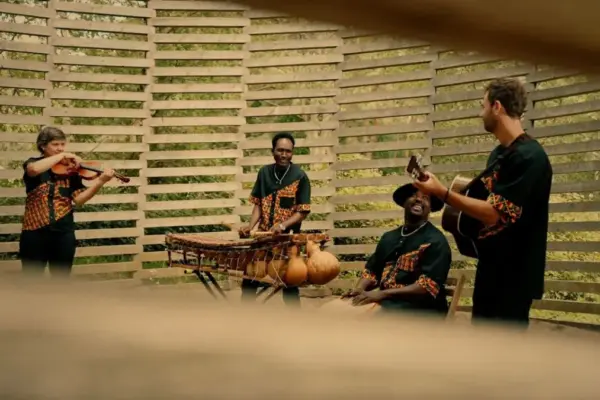
Current academic initiatives continue to unpack the ecological and historical layers of Beckett’s oeuvre. At the University of Liverpool—which hosts a prestigious biennial festival dedicated to the playwright—researchers are actively redefining how classic texts intersect with contemporary crises. The festival, Beckett: Lieben 2026, features multidisciplinary interpretations, including stagings, musical adaptations, photography, and scholarly panels examining Beckett’s engagement with landscape, trauma, and topography.
Fraser Cattini, a leading researcher at the University of Liverpool whose PhD focuses on Beckett’s work, notes that the playwright’s theatrical spaces directly anticipate modern climate anxieties.
"Within the earth that constricts her body, Winnie’s only remaining signs of life are her physical movements and, in the second act, her words," Cattini explains. "In a contemporary sense, action and communication are vital tools for engaging effectively with our ecological crisis, before the situation worsens and the fiction of Winnie’s environmental collapse becomes a reality."
Cattini emphasizes that Winnie’s gradual engulfment mirrors our own terrestrial vulnerability:
"Seeing or reading Happy Days in the light of frequent ecological disasters, audiences are reminded that Winnie’s body is inextricable from the earth in which it is buried—just as human bodies are inseparable from the Earth we inhabit."
Expanding the Canon: The Art of Ana Mendieta
To further contextualize the themes of Happy Days, scholars are increasingly looking outside traditional literary canons to kindred spirits in contemporary visual art. Cattini highlights the groundbreaking performance art of Cuban-American multimedia artist Ana Mendieta (1948–1985).
Mendieta’s work—which utilized natural materials such as blood, dirt, moss, and feathers—focused intensely on the symbiotic relationship between the human body and the landscape. Her landmark 1974 performance piece, Burial Pyramid, bears striking aesthetic and thematic similarities to Beckett’s vision. In the three-and-a-half-minute video, Mendieta is buried beneath a heavy pile of dark volcanic rocks, recalling pre-Columbian Indigenous Cuban burial traditions. As the video progresses, the stones slowly shift and fall away, revealing her earth-shrouded body.
Through works like Burial Pyramid, Mendieta—like Beckett—erased the boundaries between human anatomy and the terrestrial sphere, demonstrating that identity, heritage, and survival are anchored directly in the soil.
Future Outlook: A Warning Before the Mound Closes In
As global temperatures continue to rise, weather anomalies intensify, and coastlines face unprecedented erosion from rising sea levels, theatrical and literary classics are undergoing a necessary radical re-evaluation.
Directors have already begun adapting Beckett’s stagecraft to reflect contemporary ecological realities. Notably, Katie Mitchell’s 2015 production of Happy Days in Hamburg, Germany, departed from the traditional desert mound, instead placing Winnie inside a domestic kitchen where water steadily rose to engulf her body. This directorial choice explicitly linked Beckett’s text to coastal flooding and extreme hydrological events driven by climate change.
Ultimately, Happy Days functions as a theatrical mirror held up to an imperiled planet. Beckett’s ambiguous, stifling landscape—whether visualized as a sun-scorched desert mound, an oil-drenched wasteland, or a flooded kitchen—serves as an urgent mandate. It warns modern audiences that humanity risks sharing Winnie’s tragic fate: sinking slowly into a crisis of our own making, speaking eloquent words while the earth inexorably closes over our heads.