Executive Overview
In the contemporary real estate market, browsing for a new home or simply indulging in casual neighborhood curiosity is frictionless. Prospective buyers and digital window-shoppers alike turn to online property platforms—Rightmove and Zoopla in the UK, Zillow in the United States, or Magic Bricks in India—to navigate digital marketplaces. These platforms provide sophisticated 3D floor plans, interactive architectural blueprints, and high-definition video walkthroughs that simulate an on-site visit down to the square foot.
To the modern consumer, this digital immersion feels like the absolute bleeding edge of PropTech. Yet, historical records reveal that the marriage of real estate marketing and immersive visual technology predates commercial photography, digital computing, and the internet by more than a century.
Long before the advent of the camera, a pioneering London estate agency was already offering its elite clientele sophisticated, 3D visual walkthroughs of luxury properties. Utilizing an optical novelty known as the "cosmorama," high-end Georgian and early Victorian brokers transformed property sales from flat, dry prospectuses into captivating, stereoscopic virtual experiences. This deep dive explores how 19th-century innovation anticipated modern virtual reality (VR), mapping the forgotten history of how early real estate pioneers captured the imagination—and fortunes—of the newly monied British elite.
Detailed Chronology: The Evolution of Victorian Virtual Property Tours
The professionalization of the estate agency in the United Kingdom occurred against the backdrop of the mid-19th century. Rapid industrialization, sweeping urban migration, and unprecedented social and geographic mobility triggered a massive surge in housing demand. As fortunes were forged in trade, manufacturing, and the railway boom, a new class of wealthy industrialists and merchants emerged, desperate to acquire country seats and London townhouses that signaled their elevated social status.
However, this commercial expansion took place in a strictly pre-photographic era. For the newly enriched classes seeking to invest their capital in landed estates, evaluating prospective purchases was an arduous logistical challenge. Buyers relied primarily on text-heavy written prospectuses, crude 2D engravings, or undertook expensive, time-consuming carriage journeys across the countryside to inspect properties in person.
This friction in the marketplace demanded a creative commercial solution. In 1838—coinciding with the dawn of the Victorian era and the year preceding Queen Victoria’s coronation—an ambitious Old Bond Street estate agency named Brooks & Green revolutionized the property market.
The Birth of the Cosmoramic Gallery
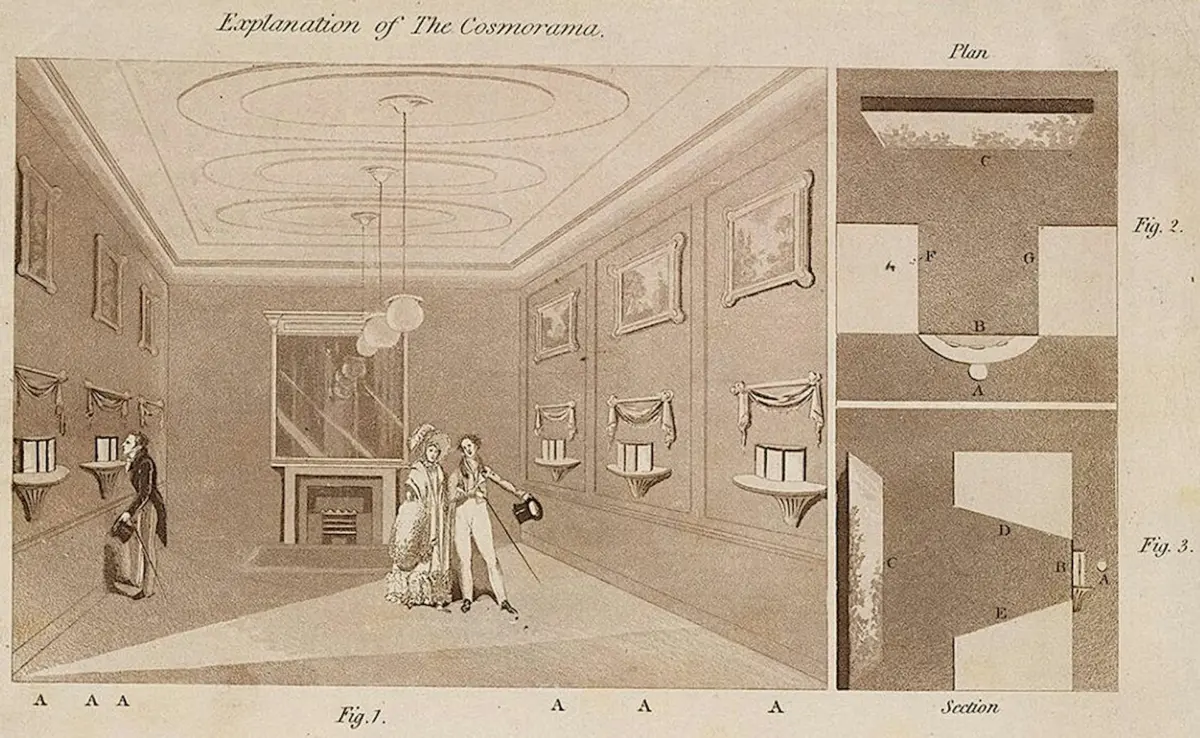
Brooks & Green began advertising an early form of immersive visual technology to provide prospective buyers with a virtual tour of properties on their books. Central to this strategy was the cosmorama, a popular optical entertainment device that had previously been reserved for public exhibitions of exotic foreign landscapes and classical architecture.
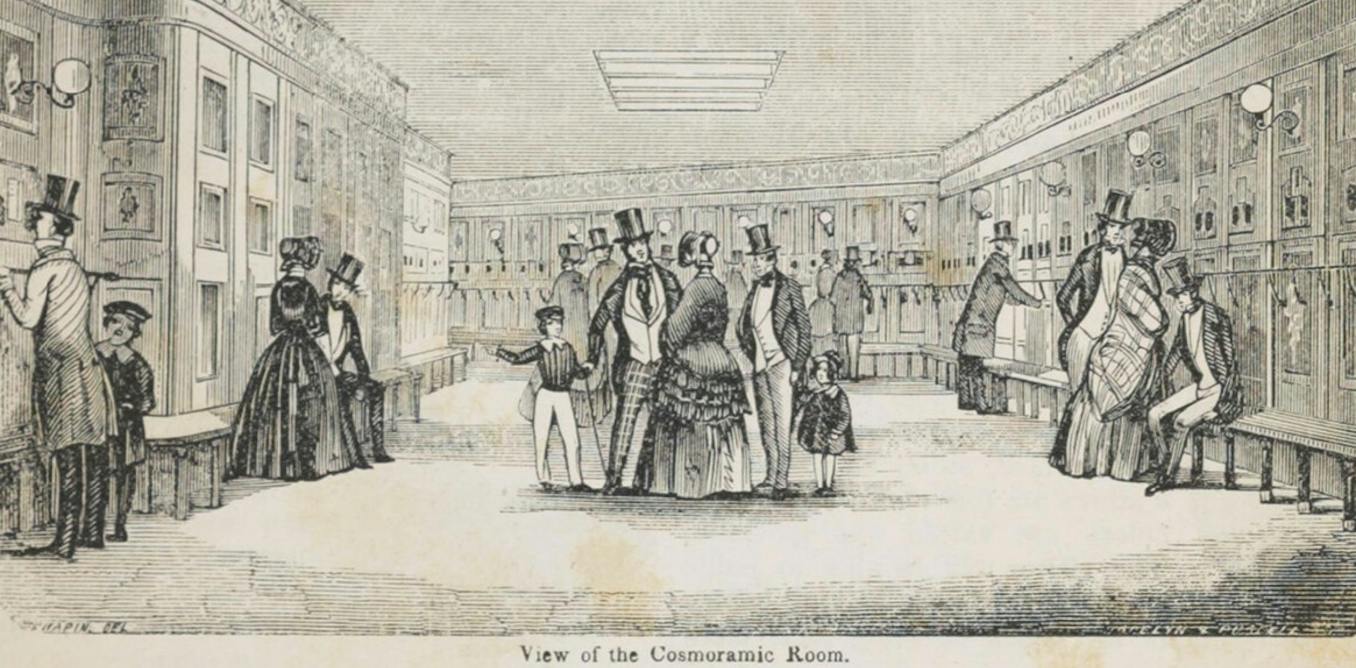
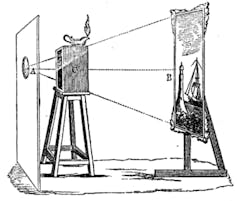
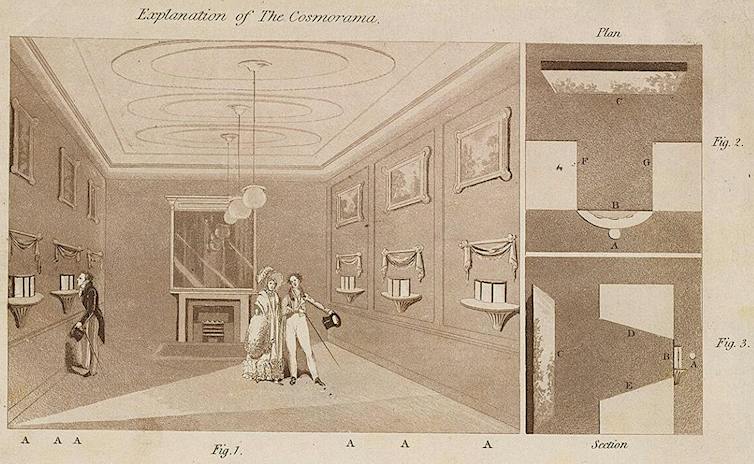
A cosmorama operated on clever optical principles. Viewers looked at hand-painted canvases or detailed artists’ prints through a large convex lens. This lens magnified the artwork and dramatically enhanced its perspectival depth, creating a striking illusion of three-dimensional space. To heighten the effect, a blackened square frame positioned between the lens and the picture masked the edges of the canvas. This ingenious framing device tricked the human brain into believing it was peering out through an extended architectural opening—such as a window or a doorway—at a vast, real-world scene.
Furthermore, gallery curators employed sophisticated lighting effects, utilizing ambient and directed natural light to alter the illumination on the paintings, further accentuating depth, texture, and atmospheric realism.
To curate these cosmoramic property views, Brooks & Green employed skilled topographical artists. These draftsmen traveled directly to the estates, executing precise on-site sketches that captured the sweeping scale of parklands, architectural elevations, and interior flourishes. For two decades, Brooks & Green promoted its exclusive "cosmoramic gallery" as the ultimate sales tool—a clear historical precursor to today’s digital walkthroughs, operating nearly 50 years before photography became commercially viable for advertising real estate.
Supporting Context & Metrics: Marketing Mansions to the Elite
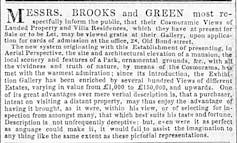
Brooks & Green aggressively marketed its innovative service through the prominent London press of the era. An archival advertisement recovered from The Patriot newspaper in April 1842 boasted that the agency’s office property gallery housed "several hundred views of different estates."
For prospective buyers considering a major country house, the agency’s promotional materials promised an extraordinary sensory preview. Advertisements guaranteed clients an experience featuring:
- An "aerial perspective" of the entire estate.
- Detailed layouts of the site and the formal architectural elevation of the mansion.
- Renderings of the surrounding local scenery and prominent features of the private park.
- Intimate depictions of the estate’s ornamental gardens and pleasure grounds.
The Economics of Exclusivity
While modern property portals democratize real estate browsing for millions of users worldwide, the 19th-century cosmorama was strictly an elite affair. This immersive service was reserved exclusively for high-value mansions, sprawling country seats, and grand urban estates. Ordinary working-class families, who faced acute housing shortages in expanding industrial cities, had no access to these luxury previews.
Admission to the Brooks & Green gallery on Old Bond Street was technically advertised as free, but entry was tightly controlled via an admission card system. In practice, these cards were likely distributed solely to individuals who demonstrated sufficient financial standing—those with deep enough pockets to invest in prime British real estate. By offering a virtual inspection method, Brooks & Green spared wealthy London buyers the physical toll of traveling hundreds of miles across muddy, unpaved roads to inspect properties that might ultimately prove unsuitable.
Global Context: From Public Exhibitions to Global Phenomenon
While Brooks & Green cleverly repurposed the technology for commercial real estate, the cosmorama was already a dominant cultural touchstone during the first half of the 19th century. It stood as one of the most common forms of popular visual show across Europe and the Americas.
The craze began in Paris in 1808, when French showman Abbot Constant Gazzera unveiled the format to the public. The staggering commercial success of Gazzera’s exhibition sparked a wave of similar installations throughout major European cultural capitals during the 1820s and 1830s.
In London, the famous Cosmorama Rooms opened in 1821 at 29 St James’s Street, relocating to Regent Street in 1823. This permanent gallery captivated London audiences, remaining a premier urban attraction for over three decades. Given that Regent Street is situated a mere mile from Brooks & Green’s Old Bond Street headquarters, it is highly likely that an imaginative agency employee visited the public gallery and recognized its commercial potential for property marketing.
Etymology and Cultural Appetite
The term cosmorama is derived from the Greek words kosmos (world) and horama (sight or view), translating literally to "views of the world." True to its name, public cosmoramas were primarily used to display picturesque natural landscapes, renowned European tourist sites, and striking architectural interiors. Viewers could marvel at the erupting caldera of Mount Vesuvius, drift virtually down the canals of Venice, or stand inside the cavernous nave of Saint Peter’s Basilica in Rome—all without leaving London, Paris, or New York.
This explosive public appetite reflected a broader cultural shift: a burgeoning middle-class desire for self-improvement, global literacy, and visual engagement with the wonders of the wider world.
A Worldwide Phenomenon
Academic research projects—such as Curiositas: Peeping Before Virtual Reality, a historical mapping initiative led by the Universidade Lusófona in Lisbon—have cataloged the global footprint of these optical devices. Researchers have identified more than 650 individual cosmorama exhibits across Portugal, Spain, and the UK alone.
The technology’s reach extended far beyond Europe. Cosmoramas were exhibited in pleasure gardens, popular science institutions, retail bazaars, and fairgrounds across North America, Brazil, Cuba, and Australia. Most notably, legendary American showman P.T. Barnum installed a dedicated cosmoramic gallery within his famed American Museum in New York City, cementing the format as a global pillar of early mass entertainment.
Future Outlook: The Enduring Human Fascination with Virtual Worlds
The history of the cosmorama does not exist in an optical vacuum. It forms a crucial chapter in a broader 19th-century revolution in immersive pictorial entertainment. Alongside the cosmorama, Victorian audiences flocked to experience peepshows, panoramas, and dioramas, each offering distinct variations of virtual travel.
- Panoramas functioned as the IMAX cinemas of their era—massive, circular, 360-degree paintings housed in specially constructed rotundas that enveloped the viewer in historic battles or sweeping cityscapes.
- Dioramas created theatrical, illusionistic spectacles using shifting 3D models and dynamic backlighting.
- Peepshow boxes, carried by itinerant showmen across rural fairgrounds and city streets, delivered intimate visual snapshots of sensational national events, royal coronations, and notorious criminal trials.
Ultimately, the cosmorama and its commercial offshoots were superseded by the stereoscope, an optical device that paired binocular lenses with dual photographic prints to create an advanced, true-to-life 3D photographic experience.
The PropTech Echoes of Tomorrow
Looking back from the vantage point of modern virtual reality headsets, algorithmic property valuations, and instantaneous global video walkthroughs, the journey of real estate marketing comes full circle. The 1838 innovation of Brooks & Green demonstrates that humanity’s fundamental desire to experience spaces before physically occupying them is not a byproduct of the digital age.
Whether peering through a convex lens at a hand-painted canvas on Old Bond Street or strapping on a wireless VR headset to tour a penthouse across an ocean, the psychological drive remains unchanged: we have always sought technologies that can transport us beyond our immediate physical boundaries and immerse us in the spaces of our future.