Executive Overview
The National Library of Wales (Llyfrgell Genedlaethol Cymru) has boldly bridged the gap between traditional fine art and cutting-edge digital exhibition technology. For the first time, the iconic, heavily textured works of Sir Kyffin Williams—widely regarded as the defining Welsh artist of the 20th century—have been pulled from static gallery frames and thrust into a dynamic, 360-degree immersive environment.
Utilizing technological frameworks previously reserved for blockbuster touring exhibitions of international masters like Vincent van Gogh, Paul Cézanne, and L.S. Lowry, this groundbreaking project envelops visitors in the rugged majesty of Welsh mountain ranges, isolated hillfarms, and violent, churning seas. Yet, unlike virtual reality headsets that isolate the user, this shared physical space allows families, art historians, and casual visitors alike to collectively step inside the painter’s distinctive canvas.
Backed by £500,000 in dedicated project funding, the exhibition represents a strategic paradigm shift for the Aberystwyth-based institution. By marrying state-of-the-art digital animation with a deep-rooted cultural heritage, the National Library is actively redefining the museum-going experience. The bilingual presentation is further elevated by the resonant voice of world-renowned Welsh bass-baritone Sir Bryn Terfel, who narrates the artist’s life story, anchoring the visual spectacle in the rich cultural soil of Wales.
Beyond the towering walls of animated projections, the exhibition features tactile installations, high-fidelity digital scans, and rare archival pieces that celebrate a symbiotic relationship spanning more than half a century. As cultural institutions worldwide grapple with how to engage younger, digitally native audiences while preserving heritage artifacts, the National Library of Wales has offered a masterclass in modern curation.
Detailed Chronology: From Anglesey Beginnings to Digital Immersion
To understand the magnitude of this technological leap, one must trace the remarkable trajectory of Sir Kyffin Williams himself—a journey intrinsically linked to the very institution now broadcasting his art into the 21st century.
The Formative Years and Early Patronage (1918–1950)
Born on Anglesey in 1918, John Kyffin Williams overcame severe personal and health challenges—including struggles with epilepsy during his youth—to find his calling in the fine arts. After serving in the military, he formally honed his craft at the Slade School of Fine Art in London, graduating in the post-war period just as the art world was beginning to modernize.
It was during this vulnerable, formative window that the National Library of Wales made a fateful decision. In 1950, shortly after Williams finished his studies, the library acquired its first two pieces from the fledgling artist. Art curator Morfudd Bevan notes that the institution paid a modest £15 for an oil painting of Cader Idris and just £7.10 for an ink-and-wash drawing of Tre’r Ceiri on the Llŷn Peninsula.
At a time when Williams was struggling to establish himself as a professional, this early institutional backing proved vital. It laid the foundation for a lifelong bond. The library recognized a singular talent capturing the soul of the Welsh landscape—a vision characterized by dark, brooding palettes, stark contrasts, and an unflinching honesty.
A Lifelong Alliance and Posthumous Legacy (1950–2006)
Over the decades, Williams’s relationship with the Ceredigion library deepened. As his reputation grew, so did the institution’s holdings of his work. When Sir Kyffin passed away in September 2006 at the age of 88, his commitment to the library was cemented in his final testament. He bequeathed a substantial portion of his estate to the institution, creating the single largest collection of his works in existence.
Today, the National Library of Wales safeguards roughly 2,000 pieces by Williams, making it the undisputed global epicenter for the study and appreciation of his oeuvre. This colossal archive includes:
- Approximately 200 oil paintings.
- More than 1,200 works on paper (drawings, watercolors, and sketches).
- Over 300 original prints.
- Sir Kyffin’s comprehensive personal archives, correspondence, and notebooks.
The Digital Renaissance (2023–Present)
Fast forward to the current decade, and the library faced a modern curatorial challenge: how to make this vast, priceless collection resonate with contemporary audiences who consume visual media at a hyper-accelerated pace.
Collaborating with specialized creative agencies Focal Studios and leo&hyde, the library embarked on an ambitious multi-year development phase. The goal was simple yet technically daunting: translate Williams’s deeply physical, earthen oil paintings into fluid, moving digital projections without losing the raw emotion of the originals.
Following rigorous testing, high-fidelity scanning of archival canvases, and sophisticated 3D modeling, the project reached its climax. The experience was formally launched to invited guests and dignitaries on a Thursday in mid-November, opening its doors to the general public shortly thereafter on November 18.
Supporting Context & Metrics: The Science of Impasto and Immersion
To appreciate what Focal Studios and leo&hyde achieved within the "projection cave," one must understand the distinct artistic technique of Sir Kyffin Williams: impasto.
Decoding Impasto
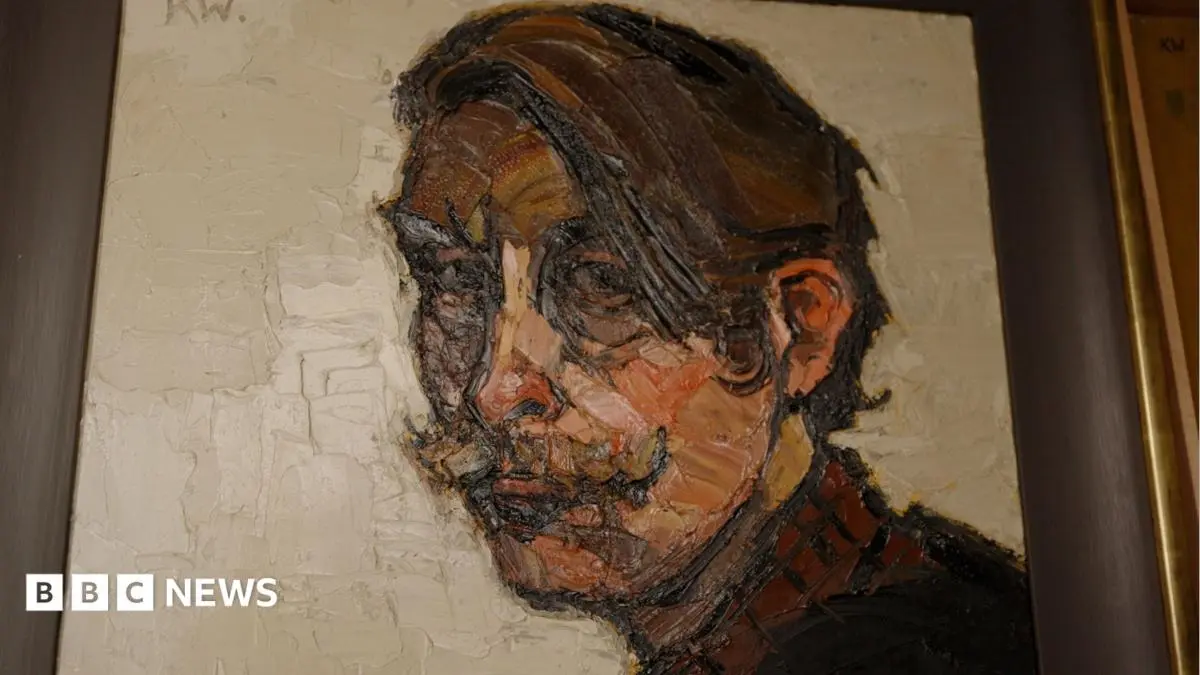
Unlike painters who strive for smooth, blended surfaces, Williams applied oil paint with an extraordinary thickness—often using palette knives as much as brushes—so that the pigment literally stood out in three-dimensional relief on the canvas. When viewed in person, a Williams painting is as much a tactile sculpture as it is a visual window. Light catches the ridges of dried white lead and deep blues, creating shadows and textures that change as the viewer moves.
Replicating this digitally without reducing the art to a flat cartoon required immense technical precision. Outten and the production teams utilized ultra-high-resolution fidelity scans capable of mapping the topographical contours of the paint.
Furthermore, the team constructed a 3D digital model of Williams’s signature figures—most notably the rugged hill farmer and his steadfast sheepdog. Using advanced digital puppeteering, these static entities were given motion. Within the 360-degree projection space, visitors do not merely watch a slide show; they watch cattle graze down sloped valleys, waterfalls cascade over digital stone, and farmers navigate Welsh weather alongside their animals.
Accessibility vs. Virtual Reality
A critical design choice for the exhibition was avoiding head-mounted virtual reality (VR) headsets. While VR offers isolating immersion, the National Library’s creative partners prioritized communal, human experiences.
As Outten observed during the exhibition’s setup, the projection cave allows a visitor to hold the hand of their child, sit side-by-side with an elderly parent, or share whispered impressions with a friend in real time. This social dimension elevates the installation from a solitary tech demo to a shared cultural event.
Financial and Institutional Metrics
- Total Project Funding: £500,000 in capital grants and cultural funding.
- Library Collection Size: ~2,000 total works by Sir Kyffin Williams.
- Bequest Breakdown: 1,200+ works on paper; ~200 oil paintings; 300+ original prints.
- Historical Valuation Shift: From early 1950s purchases (£7.10 to £15) to contemporary secondary market values routinely exceeding tens of thousands of pounds per original canvas.
Official Statements and Curatorial Perspectives
The convergence of heritage preservation and cutting-edge digital wizardry has elicited passionate commentary from the cultural leaders, curators, and creative minds steering the project.
Rhodri Llwyd Morgan, Chief Executive of the National Library of Wales:
"This new immersive experience is a direct expression of our institutional strategy to be more popular, more appealing, and more accessible to the wider public. Our aim is to break down the invisible barriers that sometimes separate historic archives from everyday citizens. Sir Kyffin belongs to the cultural fabric of Wales, and this technology invites everyone—regardless of their prior art-historical knowledge—to step directly into his world."
Morfudd Bevan, Art Curator at the National Library of Wales:
"Looking back at our early ledgers from 1950, it is fascinating to see the institution paying just £15 for an oil painting of Cader Idris and £7.10 for an ink-and-wash drawing of Tre’r Ceiri. The library saw the potential of this young artist long before the commercial market caught up. It was really important at that time that we were encouraging and supporting young artists at the beginning of their careers, when Kyffin was trying to establish himself as a professional artist. That early faith blossomed into a legacy that now allows us to pioneer this kind of digital storytelling."
Creative Collaborator Insights (Focal Studios / leo&hyde):
"It’s like you’re literally standing inside one of his paintings; I love it. It’s not like virtual reality, because you can hold the hand of your child, you can sit there with your grandmother or your friend, and you experience it together. I think that’s incredibly powerful. By creating 3D models of Kyffin’s farmer and dog, and using digital puppeteering techniques, we’ve honored his vision while giving his brushstrokes a brand new heartbeat."
Future Outlook: A New Paradigm for Welsh Cultural Institutions
The successful deployment of the Sir Kyffin Williams immersive experience at the National Library of Wales signals a turning point for how regional and national archives across the United Kingdom will handle their collections in the decades ahead.
For too long, major immersive art exhibitions—particularly those dedicated to continental masters like Van Gogh—have been commercial, for-profit ventures produced by private entertainment corporations, occasionally criticized for distancing the art from genuine historical context. By contrast, the Aberystwyth project represents an authentic public-institution-led synthesis of original archival stewardship and high-end digital interpretation.
Expanding Audiences and Educational Outreach
The primary metric of success for this £500,000 venture will not be immediate box office returns, but long-term audience diversification. By lowering the psychological threshold of entry—replacing the hushed, intimidating silence of traditional galleries with a dynamic, sensory environment—the library expects to attract younger generations, school groups, and tourists who might not otherwise visit a manuscript and map archive.
Furthermore, the tactile installations—such as the touchable recreation of Williams’s self-portrait that mimics his thick impasto ridges—ensure that accessibility is extended to visually impaired visitors, honoring an inclusive design philosophy that modern galleries can no longer ignore.
The Road Ahead
As the exhibition opens its doors to the public, curators are already monitoring engagement metrics to inform future programming. Discussions are underway regarding whether this digital infrastructure can eventually be adapted to showcase other titans of Welsh art housed within the library’s vaults, or whether parts of the Sir Kyffin Williams experience might travel as a mobile ambassador for Welsh culture to other national and international venues.
One thing is certain: the solitary hillfarms of Anglesey and the storm-battered coastlines of North Wales have found a permanent, breathing home in the digital age. Sir Kyffin Williams painted the landscape not as a passive vista, but as a living, breathing force of nature—and through the vision of the National Library of Wales, that force has finally been unleashed.