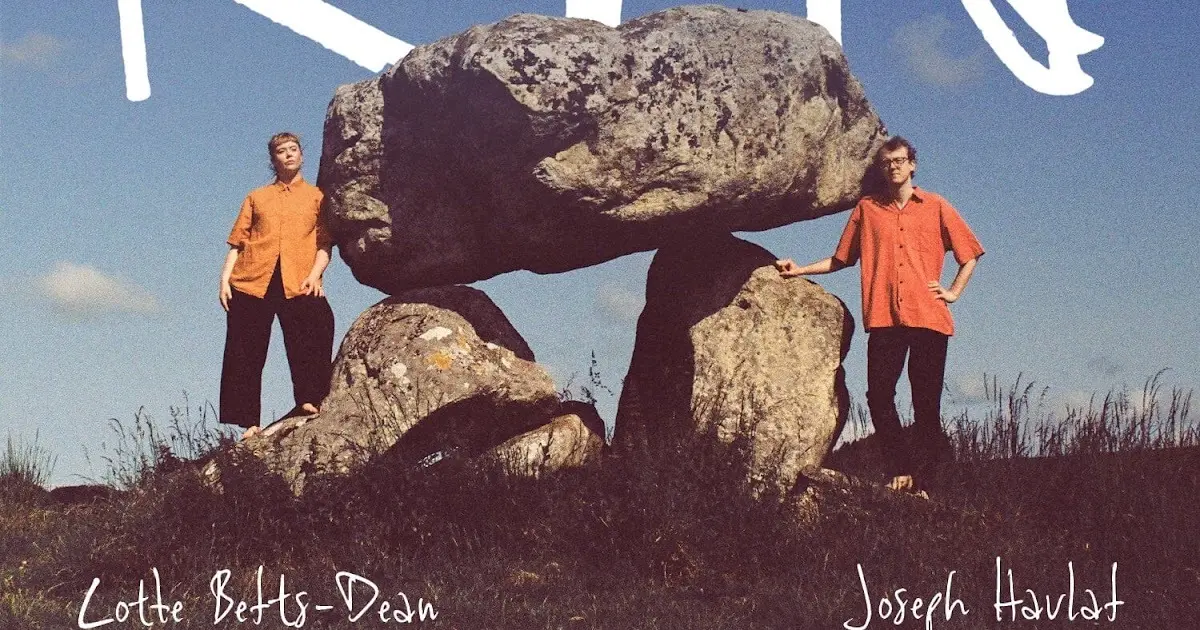
In the contemporary landscape of classical vocal music, few recordings manage to interrogate the mechanics of cultural inheritance with the precision, emotional weight, and musicological depth found on Kin. Released on Delphian Records (DCD34362), this thoughtfully curated 77-minute recital brings together two rising luminaries of the international concert stage: Australian-born mezzo-soprano Lotte Betts Dean and compatriot pianist Joseph Havlat. Recorded over two days in January 2025 at St Cuthbert’s Parish Church in Edinburgh, the album explores the intersections of folk traditions from across Europe and North America through the prism of Western classical art song arrangements.
At its core, Kin is an artistic meditation on diaspora, identity, and the perpetual search for a sense of belonging. Betts Dean and Havlat—both alumni of London’s prestigious Royal Academy of Music, possessing multifaceted heritage spanning the UK, Czechia, Germany, and Jewish Ashkenazi roots—approach these traditional melodies not merely as historical artifacts, but as living expressions of displacement. The album features arrangements and original compositions by a sweeping roster of historical and contemporary figures, including Ralph Vaughan Williams, Percy Grainger, Benjamin Britten, Béla Bartók, E.J. Moeran, and Joseph Canteloube, alongside new works by living composers such as Michael Finnissy, Josephine Stephenson, Louise Drewett, Isabella Gellis, and Ruth Wall.
This review-essay examines the architectural design of Kin, contextualizing its journey through the archives of folksong collection, the evolution of the art song accompaniment, and the contemporary responses that challenge traditional frameworks of cultural ownership.
Detailed Chronology and Repertoire Analysis
The intellectual spine of Kin rests on the historical movement of early-to-mid 20th-century folksong collection. Composers and ethnomusicologists of that era ventured into rural communities, peripheral regions, and colonial outposts with varying degrees of academic rigor and romantic idealism, seeking to capture dying oral traditions before industrial modernity erased them. Betts Dean and Havlat trace this trajectory across several distinct stops, highlighting how different arrangers imposed their own sonic personalities onto anonymous material.
The Transatlantic Bridge: Vaughan Williams and Doreen Senior
The recital opens with works firmly rooted in the British art-song paradigm pioneered by Ralph Vaughan Williams, who sought to elevate peasant melodies into sophisticated vehicles for the concert hall. In The Maiden’s Lament, Vaughan Williams works with a tune collected in Newfoundland by Maud Karpeles. Alongside her collaborator Cecil Sharp, Karpeles famously scoured regions like the Appalachian Mountains and Atlantic Canada, operating under the assumption that older English ballads had been preserved in these isolated environments in purer forms than in their homeland.
Vaughan Williams adopts a deliberately spare, translucent approach to the piano writing in The Maiden’s Lament. This ascetic foundation leaves Betts Dean exposed, allowing her expressively plangent tone and intimately conversational delivery to take center stage.
This spirit of directness also informs the inclusion of The Broken Ring, arranged by Doreen H. Senior. Senior collaborated with folklorist Helen Creighton on Traditional Songs from Nova Scotia before later serving as the Devon County Music Advisor. True to the Cecil Sharp tradition, Senior’s accompaniment remains largely subordinate to the vocal line, functioning as a discreet cushion that prioritizes the text and narrative clarity.
Idiosyncrasy and Ethnography: E.J. Moeran and Percy Grainger
Providing a distinct contrast to the straightforward settings of Vaughan Williams and Senior are E.J. Moeran’s Parson and Clark and The Shooting of his Dear. Moeran’s distinct harmonic language and modal twists inject the arrangements with eccentricities that test the boundaries of traditional folk pastiche.
The programme deepens with the inclusion of Percy Grainger, a figure whose relationship with folksong collection was uniquely complex. Born in Australia but primarily trained in the United Kingdom, Grainger was acutely aware of the power dynamics at play between elite urban collectors and the working-class rural singers they recorded. Unlike his contemporaries who relied exclusively on pen and paper—often looking down on modern technology—Grainger embraced the phonograph, aligning his methodology with contemporaries like Béla Bartók and Zoltán Kodály.
Grainger’s arrangements on Kin—including The British Waterside, The Pretty Maid Milkin’ her Cow, and Died for Love—display a fearless harmonic imagination. Rather than rendering the singers as quaint historical curiosities, Grainger uses rich, expressionistic textures to create psychological portraits of the original performers. The inclusion of The Twa Corbies and the dazzling piano solo Scotch Strathspey and Reel further demonstrates Grainger’s unique ability to blend authentic folk material with his own hyper-imaginative structural constructs.

Continental Intensities: Béla Bartók and Joseph Canteloube
Shifting the geographical focus eastward and southward, the recital incorporates Béla Bartók’s Eight Hungarian Folksongs. Drawing from field expeditions in the Csík district (historically part of Hungary, now in Romania) and Szekler military culture, these songs showcase Bartók’s synthesis of vernacular idiom and high-modernist composition. Betts Dean leans into the ferocious intensity of these texts, clearly relishing the linguistic contours. Bartók’s piano writing here is unabashedly romantic and structurally ambitious, treating the folk tune not as a museum piece to be preserved under glass, but as raw energy to be channeled into a distinct artistic creation.
Representing the French tradition, two selections from Joseph Canteloube’s famed Chants d’Auvergne—La délaissadô and Malurous qu’o uno fennô—offer a fascinating study in reduction. Stripped of Canteloube’s notoriously lush, opulent orchestral padding and reduced to a bare piano accompaniment, these melodies emerge with striking directness. Betts Dean navigates them without the operatic weight often forced upon the repertoire, revealing the raw emotional core beneath the pastoral sheen.
Supporting Context & Metrics
To fully appreciate the scope of Kin, it is necessary to examine the physical parameters of the recording, the venues involved, and the socio-historical framework underpinning the project.
+-----------------------------------------------------------------------------------+
|                               ALBUM METRICS & DATA                                |
+---------------------------+-------------------------------------------------------+
| Album Title               | Kin                                                   |
| Artists                   | Lotte Betts Dean (Mezzo-soprano), Joseph Havlat (Piano)|
| Label                     | Delphian Records                                      |
| Catalogue Number          | DCD34362                                              |
| Recording Dates           | January 21–22, 2025                                   |
| Recording Venue           | St Cuthbert’s Parish Church, Edinburgh                |
| Total Duration            | 77 minutes, 49 seconds (77:49)                        |
| Repertoire Scope          | Historical arrangements & contemporary commissions    |
+---------------------------+-------------------------------------------------------+
The Expat Paradigm and the Search for "Homeland"
The psychological engine of the album is articulated clearly in Betts Dean’s booklet notes:
"As two non-indigenous white Australians… we are perhaps always in search of a sense of homeland or belonging. We have also both left our ancestors’ adopted home of Australia and are still ‘expats’."
This condition of perpetual displacement directly informs the interpretive choices on the record. By exploring folk traditions that traveled across oceans—from England to Newfoundland, from Scotland and Ireland to Nova Scotia—the performers draw a parallel between the migratory nature of the songs and their own lived experiences as Australian musicians working within the European classical tradition.
Official Statements & Contemporary Commissions
While the historical arrangements form the foundation of Kin, the album’s second half looks toward contemporary composers who grapple with the ghosts of folk music through 21st-century lenses. These new commissions avoid pastiche, offering varied, often provocative responses to the concept of traditional song.
Bridging the Past and Present
- Josephine Stephenson (Rosemary Lane): Taking a traditional Somerset folksong, Stephenson crafts a sensitive, atmospheric setting that provides ample room for Betts Dean’s warm, resonant vocal phrasing.
- Louise Drewett (Lambs on the Hillside): Setting a Scottish/Irish tune, Drewett constructs an otherworldly sonic environment, surrounding the voice with spare, suspended piano chords that create deep acoustic resonance without crowding the melodic line.
- Isabella Gellis (Montreal Songs): British-Canadian composer Gellis addresses the fractured cultural identity of Montreal by weaving together three distinct linguistic threads: a French-Canadian tune, an English song collected by Maud Karpeles, and a Yiddish melody collected by Ruth Rubin. The triptych moves fluidly from delicate intimacy to a receding, spectral vocal line, mirroring the city’s complex demographic layers.
- Joseph Havlat (Interlude-Premonition & My Lagan Love): Aside from his sensitive collaborative pianism, Havlat contributes an abrasive, intentionally sketch-like deconstruction of a Czech folksong, pushing the boundaries of traditional art song accompaniment into avant-garde territory.
- Michael Finnissy (How dear to me): Finnissy’s piano solo utilizes a tune historically associated with Thomas Moore’s The Twisting of the Rope, offering a cerebral, highly compressed meditation on cultural memory.
Future Outlook
Kin arrives at a time when the classical music industry is increasingly forced to reckon with questions of cultural provenance, nationalism, and identity. Rather than retreating into sterile academicism or nationalist nostalgia, Lotte Betts Dean and Joseph Havlat use the medium of the song recital to map a transnational network of shared human experiences.
By pairing canonical arrangements by Vaughan Williams and Britten with edgy contemporary statements by Gellis, Stephenson, and Finnissy, the duo demonstrates that folk music is not a static monument, but a dynamic, malleable conversation across generations and borders. For listeners and scholars alike, Kin sets a high water mark for thematic programming and vocal-pianistic collaboration, suggesting that the future of the art song lies not in the preservation of an idealized past, but in the honest interrogation of our collective, shifting roots.