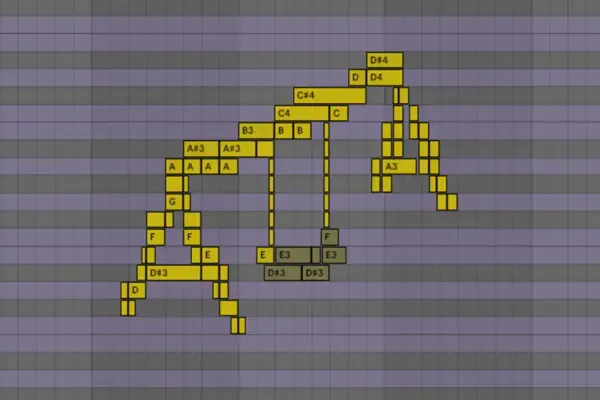
In the quiet corners of contemporary independent music, few artists cultivate intimacy quite like Clara Mann. On her Bandcamp profile, beneath the sparse details of her upcoming releases, sits a modest, self-effacing descriptor: “almost-folk music.” To the casual browser, it might seem like a throwaway piece of internet ephemera. Yet, spending even a brief moment immersed in Mann’s sonic universe reveals its profound significance. Her compositions exist in a state of perpetual motion—low-lit, structurally fluid, and emotionally restless. They capture the sensation of standing between destinations, tracking the physical shifts of train travel and departure alongside the psychological oscillations of love, desire, and anxiety.
Following her celebrated debut album, Rift, and a series of formative EPs and singles, Mann returns with her most accomplished and expansive work to date: Wishbone, slated for release on October 23rd via state51.
If her earlier material was characterized by a heavy, protective introspection born from the tension of emotional suspension, Wishbone marks a daring evolution. Here, Mann embraces the very uncertainties that once unsettled her, transforming tension into a wellspring of quiet joy and profound artistic maturity. Anchored by a newly fortified vocal confidence and an increasingly eclectic palette of arrangements, Wishbone positions Clara Mann not merely as a promising voice in modern chamber-folk, but as a master of musical chiaroscuro—expertly navigating the fragile, shifting boundary between darkness and light.
Detailed Chronology & Track-by-Track Evolution
To understand the artistic leap represented by Wishbone, one must trace Mann’s trajectory from her early, tentative steps to the self-assured, multifaceted storytelling found on her sophomore full-length project.
From Rift to Wishbone: A Shift in Perspective
Mann’s early work—encapsulated by Rift—was defined by a delicate, glass-like fragility. Her songs often felt as though they might shatter under the weight of their own introspection. This anxiety was intimately tied to a sense of geographic and emotional liminality; she was an artist caught between places, examining the world from behind a pane of frosted glass.
On Wishbone, that glass is shattered, and Mann steps directly into the elements. The anxieties of displacement and perpetual transit are no longer sources of fear, but catalysts for liberation. This newfound emotional fortitude is immediately evident in her vocal delivery. Her voice—still whispered, hushed, and dripping with sibilants reminiscent of a more restrained Laura Marling—now carries an authoritative core. She shapes her emotional delivery with surgical precision, allowing her lyrics to cut deeper while maintaining an ambient, dreamlike atmosphere.
Case Studies in Lyrical Range
The songwriting across the album’s tracklist demonstrates a remarkable broadening of thematic and sonic scopes:
- "The Izaak Walton Hotel": Accompanied by a gentle, cascading piano, this track recounts a genuinely haunting experience Mann had at a Peak District country house hotel. Rather than retreating into fear, she uses the memory to detail how the strange encounter paradoxically coaxed her out of a prolonged period of depersonalization and dissociation.
- "Connie’s Song": One of the album’s thematic centrepieces, this track investigates Mann’s complex desire to vanish, viewed through the lens of Connie Converse—the pioneering mid-century singer-songwriter who left a series of cryptic farewell notes to friends and family in 1974 and was never seen again. Singing, "Nobody can make me settle down," Mann simultaneously memorializes Converse’s tragic mystery while forging an empowering reclamation of her own rootlessness. It is a masterclass in quiet, devastating songwriting.
- "Oblivion": In stark contrast to the outward-looking explorations of travel and disappearance, "Oblivion" turns its gaze inward, staring directly into the terrifying void that can accompany falling in love. Set against a minimal, dark-hued backdrop of mournful viola and acoustic guitar, Mann navigates complex philosophical territory. She acknowledges the inherent darkness in human attachment, but unlike her earlier work, she does not shy away from it; she walks straight toward it, initiating a dialogue with the unknown.
- "News From Home" and "All My Devotion": Capturing moments of sudden emotional revelation, "News From Home" evokes the limpid, quiet quality of early morning light through a nostalgic melody and softly plucked strings. Meanwhile, "All My Devotion" navigates its terrain on a soft, brushed-percussion shuffle and a slow, wandering piano, emphasizing the healing power of platonic recovery and human connection.
- **
"I’m Everyone Who’s Ever Said I Love You" and "Song For Joy":* Displaying a sly, gentle irony, the former channels a hybrid of sophisticated Laurel Canyon country-folk and the naive pop sensibilities of Lesley Duncan. The latter, anchored by a stark acoustic guitar reminiscent of Leonard Cohen, flips traditional melancholia on its head. Its central thesis—"good things will find me wherever I am"*—reaches past sorrow into the warm, grounding light of genuine contentment.
Supporting Context & Metrics
The Aesthetic of "Almost-Folk" and Chamber-Folk Architecture
The musical architecture of Wishbone defies easy categorization, justifying Mann’s tongue-in-cheek "almost-folk" label. While traditional folk music relies on predictable verse-chorus structures and narrative linearity, Mann’s compositions are discursive, meandering, and exploratory. Structures frequently dissolve, yet they never feel aimless. Instead, they are held together by an internal, immutable logic—the logic of love, recovery, and psychological processing.
Musically, the album operates as a slowed-down take on contemporary chamber-folk. The instrumentation is sparse yet purposeful. Violas stretch notes into long, melancholic sighs; acoustic guitars offer rhythmic heartbeats rather than flashy fingerpicking; and pianos wander gently like thoughts drifting through a quiet room.
Comparative Analysis: Literary and Musical Lineages
- Kath Bloom: Mann shares Bloom’s rare, innate ear for the tactile language of physical nearness. Every touch, glance, and shared breath feels magnified in the mix.
- Leonard Cohen & Laurel Canyon Traditions: While channeling the stark poetic gravity of Cohen, Mann systematically sheds his world-weary cynicism, replacing it with an openness to joy. Her nods to the Laurel Canyon sound provide a warm, organic counterbalance to the cooler, more modern European cinematic textures of her arrangements.
- The Chiaroscuro Effect: Just as the Renaissance painters used chiaroscuro to define three-dimensional volume through stark contrasts between light and dark, Mann utilizes dynamic mixing, lyrical juxtaposition, and tonal shifts to create a listening environment where shadow and illumination are inextricably linked.
Official Statements & Production Notes
While Wishbone functions as an intensely personal diary, its creation represents a collaborative leap forward in production and arrangement. Released via the forward-thinking independent label state51, the album benefits from a meticulous attention to sonic detail that rewards active, engaged listening—a commodity rapidly disappearing in an era of passive, algorithmic streaming.
In promotional materials and visual accompaniments—such as the evocative visualiser released for the single "Oblivion"—Mann and her creative team emphasize a aesthetic of intentional deceleration. The visual language matches the audio: uncluttered, atmospheric frames that allow the listener to sit in stillness.
Label representatives and early press notes frame Wishbone not merely as a collection of songs, but as a deliberate journey through emotional maturation. The album asks listeners to slow down, lean in, and embrace the discomfort of transition.
Future Outlook
As the music industry increasingly prioritizes hyper-compressed, high-tempo content designed for immediate gratification, Clara Mann’s Wishbone stands as a defiant, beautiful counter-narrative. Scheduled for release on October 23rd, 2026, via state51, the album invites us into a space where nuance, hesitation, and quiet revelation are celebrated.
With Wishbone, Mann has built upon the promise of Rift and delivered an artistic statement of uncommon depth. For fans of intelligent, emotionally resonant chamber-folk—those willing to look past the surface noise and engage with music that breathes, hesitates, and heals—Clara Mann’s latest offering will be one of the defining releases of the year.
Wishbone will be available across digital download platforms, Compact Disc (CD), and Long Play (LP) vinyl formats via Bandcamp.