EXECUTIVE OVERVIEW
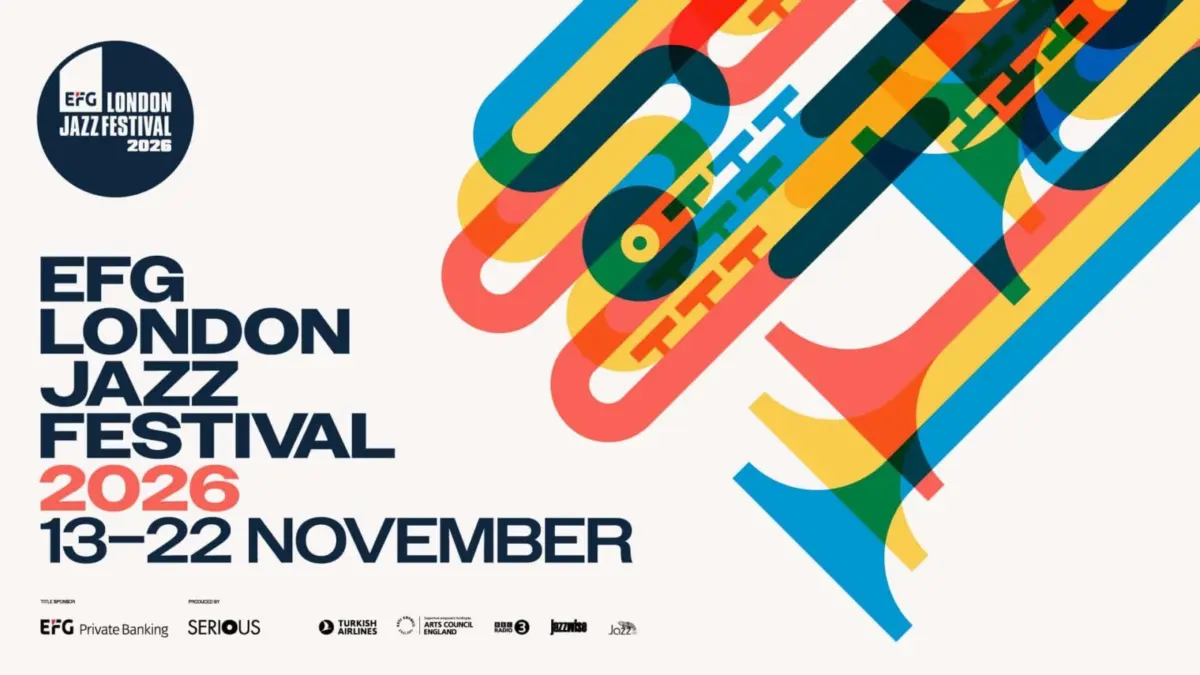
As London’s autumn chill settles, the capital transforms into a sprawling, borderless acoustic map. The 34th edition of the EFG London Jazz Festival, running from November 13 to November 22, arrives with a staggering programmatic footprint. Spearheaded by the live music promotion organization Serious, this year’s festival will unfurl across more than 70 distinct venues. From the cavernous, hallowed spaces of the Royal Albert Hall, the Barbican, and the Southbank Centre to intimate back rooms, canal-side barges, and pop-up venues, the ten-day marathon cements the festival’s reputation as Europe’s largest pan-city music event.
This year’s edition is anchored by a monumental historical milestone: the joint centenaries of jazz titans Miles Davis and John Coltrane, who were born four months apart a century ago. Tributes to these pillars of modern improvisation are etched deeply into the festival’s marquee programming. Yet, while the ghosts of 1960s modal jazz and 1970s electric fusion loom large, the beating heart of the 2026 festival is its restless, outward-looking global perspective.
The schedule reads like an atlas of contemporary diaspora and cross-cultural experimentation. Programmes traverse Mali, Lisbon, Havana, Tunisia, KwaZulu-Natal, Iran, and Palestine. They pair Persian setar masters with Senegalese griots, and map Ugandan club takeovers next to traditional Irish music revivals. With more than 300 shows projecting sound to an anticipated audience exceeding 100,000, the EFG London Jazz Festival continues to operate not merely as a celebration of a specific American art form, but as a vibrant, interconnected nexus of global folklores, electronic experimentation, and avant-garde composition.
DETAILED CHRONOLOGY: A TEN-DAY AUDIO VOYAGE
Week 1: Centenaries, Global Collaborations, and Opening Salvos
The festival’s operational hub, The Jazz Social, opens its doors early at City Point on Ropemaker Street starting Monday, November 9. Functioning as a pop-up social club, record store stocking Blue Note vinyl and Japanese imports, and live broadcasting space for Jazz FM and One Jazz, it serves as the ground zero for artist drop-ins and secret sessions ahead of the official launch.
Friday, November 13: The Dual Birthday Party
The festival’s opening night explodes into life with tributes to its dual centenaries. At the Barbican, Coltrane 100: Both Directions at Once—named after the legendary 1963 studio sessions unearthed in 2018—features a generational frontline of tenor saxophonists: Cleveland veteran Joe Lovano and Chilean virtuoso Melissa Aldana. They are backed by South African pianist Nduduzo Makhathini, bassist Linda May Han Oh, and powerhouse drummer Jeff “Tain” Watts.
Simultaneously, in Dalston, Mercury Prize-shortlisted producer and trumpeter Emma-Jean Thackray brings Dear Miles – A Love Letter to EartH, aggressively dragging Davis’s Bitches Brew era onto the modern dancefloor.
Globally minded programming kicks off early. At The Wilds in Barking Riverside, drummer and tabla player Sarathy Korwar weaves jazz, electronics, and Indian classical traditions. Meanwhile, the night sees the launch of Éire Eile (Another Ireland)—a collaborative strand with Dublin’s National Concert Hall—featuring Donegal blues guitarist Muireann Bradley at Stone Nest. Camden’s Jazz Cafe hosts a monumental late-night takeover courtesy of Ugandan collective Nyege Nyege, spearheaded by DJ Kampire, driving a high-octane line-up through Afro-house, gqom, kuduro, and Tanzanian singeli until 3:00 AM.
Saturday, November 14: Traditions Collide
Day two offers a dizzying array of free and ticketed events. The Southbank Centre’s Clore Ballroom hosts Tarana, a day-long exploration of South Asian and Arab music intersecting with jazz, featuring Nepali tabla player Anmol Mohara and a 30-piece community orchestra led by bassist Shri Sriram.
Over at the Barbican, cult icon Asha Puthli takes the main hall stage. Trained in Mumbai ragas and opera before singing on Ornette Coleman’s 1972 Science Fiction and pioneering cosmic disco with "Space Talk," Puthli performs with a full band, supported by sitarist Anoushka Shankar, trumpeter Yazz Ahmed, and Sarathy Korwar.
In Chelsea’s Cadogan Hall, Global Connections opens with L’Antidote—a cross-continental trio featuring Iranian percussionist Bijan Chemirani, Albanian cellist Redi Hasa, and Lebanese pianist Rami Khalifé. Over at the Royal Festival Hall, drum and bass pioneer Goldie presents Dare to Dream alongside a live band and full orchestra.
Sunday, November 15: Rivers, Griots, and Legends
Sunday delivers the festival’s densest concentration of global music. At Kings Place, Persian setar virtuoso Kiya Tabassian and Senegalese kora master Ablaye Cissoko present Estuary, mapping musical currents where rivers meet the sea.
The evening showcases three heavyweight headliners across the city:
- Fado superstar Mariza brings her upcoming album Amor to the Royal Festival Hall, drawing on her roots in Mozambique and Lisbon’s historic Mouraria district.
- Tunisian oud master Anouar Brahem anchors the Barbican with After the Last Sky, a hushed, contemplative chamber-jazz suite inspired by Palestinian poet Mahmoud Darwish, featuring cellist Anja Lechner and pianist Django Bates.
- At KOKO in Camden, Cuban pianist Alfredo Rodríguez and percussionist Pedrito Martinez merge conservatory precision with Afro-Cuban sacred folklore in an explosive display of virtuosity.
Week 2: Mid-Week Explorations and Global Vanguard
As the festival rolls into its second week, the focus shifts toward deeper cross-cultural dialogues, experimental vocal work, and intimate club settings.
Tuesday, November 17: Chamber Jazz and Baltic Folk
Cadogan Hall hosts an exquisite collaboration between Cuban piano luminary Roberto Fonseca and French cellist Vincent Segal, performing pieces from their Cubadisco-winning album Nuit parisienne à La Havane.
Concurrently, Milton Court presents Estonian violinist and singer Maarja Nuut. Blending pre-war village field recordings with electronics and classical training, Nuut unveils her new piece, Combing Hair into Sand, aided by the innovative British vocal collective Shards and Swiss percussionist Nicolas Stocker.
Wednesday, November 18: Mothers, Memory, and Modern Roots
At Camden’s Roundhouse, Malian powerhouse Fatoumata Diawara delivers tracks from her acclaimed album Massa. Co-produced with French pop icon -M-, the performance weaves Bambara folk-pop with fierce anti-establishment lyricism regarding women’s rights. The Thanda Choir, hailing from Khayelitsha, Cape Town, opens the night with transcendent South African gospel harmonies.
Across town at Union Chapel, Norwegian-Brazilian neo-soul artist Charlotte Dos Santos enchants audiences alongside Verve-signed Argentine trio TRÍADA.
Thursday, November 19: Modal Bridges and Queer Jazz
Union Chapel welcomes South African singer-songwriter Bongeziwe Mabandla, whose fragile isiXhosa folk-soul is shaped by producer Tiago Correia-Paulo.
At The Cockpit in Marylebone, Makam Salam pairs Palestinian vocalist Mira Awad and Turkish singer Olcay Bayır in an exploration of the shared makam modal system bridging Arabic and Turkish musical traditions. Late-night energy shifts to Brixton’s Hootananny, where Cuban-born pianist Eliane Correa brings her En El Aire project to a vibrant Queer Jazz showcase.
The Final Weekend: Tokyo Nights and Grand Finales
Saturday, November 21: The Peter Cat Legacy and Coltrane Ballads
The final Saturday evening at the Barbican Hall offers a unique cultural tribute: a three-part conceptual series honouring Peter Cat, the jazz club run by novelist Haruki Murakami in Tokyo between 1974 and 1981. Pianist Junko Onishi, saxophonist Sachi Hayasaka, and The Blend pay homage to the legendary literary-musical sanctuary.
Simultaneously, at Olympia, the Coltrane centenary celebrations reach an emotional crescendo. Saxophonist Branford Marsalis and vocalist Dianne Reeves recreate John Coltrane and Johnny Hartman’s legendary 1963 ballad sessions, breathing new life into timeless interpretations of "Lush Life" and "My One and Only Love."
Sunday, November 22: Closing Harmonies
The festival concludes with an embarrassment of riches. The Barbican hosts The Joy, an extraordinary five-piece vocal harmony group from Hammarsdale, South Africa, whose traditional Zulu mbube and isicathamiya styles require no instruments to captivate a room.
At the Southbank Centre, vocalists Cécile McLorin Salvant (performing with the BBC Concert Orchestra) and Samara Joy bring distinct generations of American and international jazz vocal mastery to Queen Elizabeth Hall and the Royal Festival Hall, respectively.
Finally, Islington Assembly Hall hosts the festival’s dancefloor finale: Kyoto Jazz Massive, helmed by brothers Shuya and Yoshihiro Okino, joined by the Paris-based Echoes of a New Dawn Orchestra, blending broken beat, jazz-funk, and soulful house into the early hours.
SUPPORTING CONTEXT & METRICS
- Longevity and Scale: Established by Serious in 1992 with its inaugural edition in May 1993 (featuring the Rebirth Brass Band and Abdullah Ibrahim), the festival has expanded from a localized North London event into Europe’s largest pan-city music festival.
- Audience Reach: The festival routinely draws over 100,000 attendees across more than 300 annual events.
- Venue Diversity: More than 70 venues are utilized, balancing prestigious historic auditoriums (Royal Albert Hall, Barbican, Southbank Centre) with grassroots spaces, floating pontoon stages on the River Lea (Grow), and intimate neighbourhood rooms (Green Note, Toulouse Lautrec, The Bull’s Head).
- Media Integration: Dedicated pop-up hub The Jazz Social anchors the festival’s broadcast output, facilitating live coverage and artist sessions in partnership with Jazz FM and One Jazz.
OFFICIAL STATEMENTS & ORGANIZATIONAL VISION
From its inception, the festival’s founders sought to defy narrow genre definitions. Co-founder John Cumming originally lobbied for the moniker North London Jazz Festival, before director David Jones insisted on the broader, more ambitious geographical designation.
Reflecting on the ethos of the 34th edition, festival programmers emphasize that jazz has never existed in a vacuum. By dedicating significant real estate to traditional folk forms, global diasporic beats—from Colombian bullerengue to South African isicathamiya—and modern electronic production, Serious has ensured that the festival remains an active participant in global musicology.
Aspedrted collaborations, such as the Éire Eile Irish exchange and extensive Middle Eastern and African showcases, reinforce the festival’s core message: jazz is not merely a historical artifact to be preserved behind glass, but a living, breathing language capable of translating any culture’s story.
FUTURE OUTLOOK
As the 34th EFG London Jazz Festival draws to a close, its trajectory points toward an increasingly decentralized and borderless future. The successful integration of alternative performance spaces—ranging from waterside containers in Hackney Wick to repurposed historic chapels and corporate pop-ups—demonstrates how live music can saturate an entire metropolis without losing its intimacy.
Looking ahead, the festival’s commitment to cross-genre commissioning and international artist development (such as the Take Five scheme) guarantees a healthy pipeline of boundary-pushing talent. By continuously interrogating its own history—honoring giants like Davis, Coltrane, and Reinhardt while giving equal platform to the avant-garde sounds of Dakar, Bogotá, and Tokyo—the EFG London Jazz Festival secures its status not only as a cornerstone of the British cultural calendar, but as an essential summit meeting for the global musical community.