Executive Overview
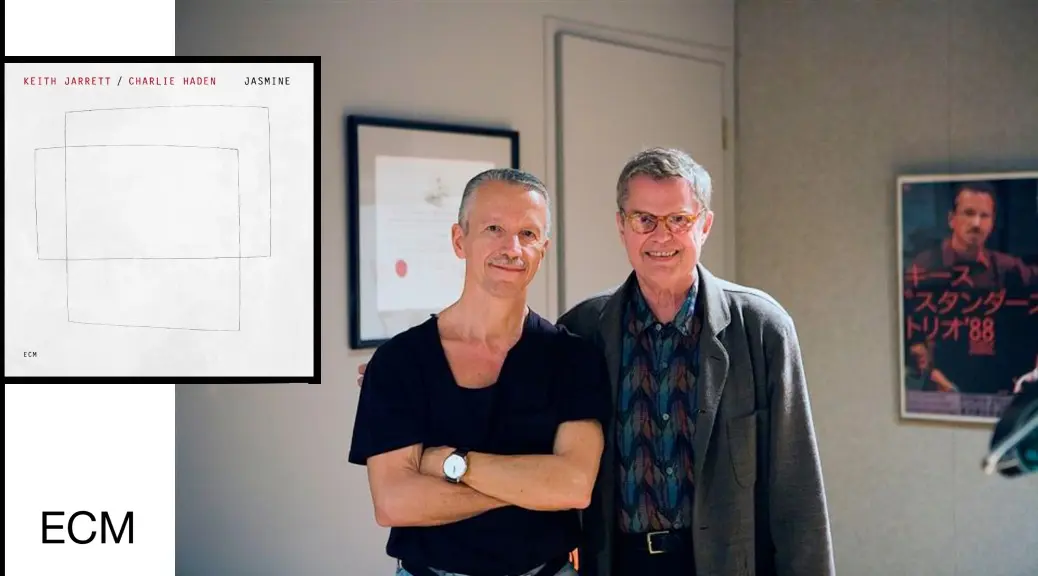
In the sprawling landscape of modern improvised music, few recordings achieve the quiet, transcendent gravity of Jasmine. Originally released on compact disc in 2010, this legendary collaboration between pianist Keith Jarrett and bassist Charlie Haden captured a rare lightning-in-a-bottle moment: two titans of twentieth-century jazz stepping away from high-concept avant-garde explorations and grand orchestration to strip their art down to its barest, most vulnerable essentials.
Now, ECM Records has breathed new life into this landmark recording through its esteemed Luminessence audiophile vinyl series. Marking the first time Jasmine has ever been pressed onto vinyl, this 2-LP release presents an opportunity to reevaluate a modern classic. Recorded over four days in March 2007 at Jarrett’s home studio in New Jersey, the album documents the first significant recorded meeting between the two musicians in decades. Their last extensive collaboration had occurred as the foundational engine of Jarrett’s celebrated American Quartet alongside saxophonist Dewey Redman and drummer Paul Motian.
Far from a nostalgic victory lap or a calculated reunion designed to cash in on past glories, Jasmine is a profound meditation on aging, memory, and musical telepathy. Comprising entirely of time-honored American popular standards, the album explores themes of love, longing, and bittersweet remembrance. With the new Luminessence edition—packaged in a luxurious tip-on gatefold sleeve and boasting a masterclass in acoustic transfer—the album commands our attention once more, proving that true musical communication requires nothing more than two master craftsmen listening intently to one another in an empty room.
Detailed Chronology: From the American Quartet to Cavelight Studio
To fully understand the emotional depth and historical weight of Jasmine, one must chart the parallel and diverging paths of Keith Jarrett and Charlie Haden across four decades of jazz history.
The Formative Years and the American Quartet
The roots of their musical partnership run deep into the fertile soil of the late 1960s and 1970s jazz underground. Though both men had carved out legendary individual identities—Haden anchoring Ornette Coleman’s revolutionary quartet and later leading the Liberation Music Orchestra, while Jarrett made waves with Art Blakey, Charles Lloyd, and his own genre-defying trio work—it was the formation of Keith Jarrett’s American Quartet that solidified their legendary partnership.
Alongside drummer Paul Motian and saxophonist Dewey Redman, Jarrett and Haden forged a telepathic, genre-blurring sound that synthesized modal jazz, free improvisation, Appalachian folk, and gospel. Albums from this era, such as The Survivors’ Suite (1977) and Eyes of the Heart (1979), remain monuments of collective interplay. However, as the 1980s dawned, Jarrett pivoted heavily toward his solo piano performances and his enduring Standards Trio with Gary Peacock and Jack DeJohnette. Haden, meanwhile, pursued numerous visionary projects, including his Quartet West. The two masters drifted along separate trajectories, their paths crossing only fleetingly over the next thirty years.
The Spark: Rambling Boy and the 2007 Sessions
The unexpected catalyst for their reunion arrived in the mid-2000s. Filmmaker Reto Caduff was deep in production on Rambling Boy, a documentary chronicling the extraordinary life, politics, and music of Charlie Haden. As part of the project, Jarrett was approached to contribute thoughts and musical moments celebrating his old friend and collaborator.
During the production process, Jarrett and Haden found themselves informally playing together. The results were immediate, visceral, and deeply rewarding. Recognizing that they had tapped into a rare creative vein, Jarrett extended an invitation to Haden: come to Cavelight Studio, Jarrett’s private home sanctuary in New Jersey, and simply play.
Over four days in March 2007, the duo locked themselves away from the pressures of the commercial music industry. There were no rehearsals, no pre-arranged charts, and no grand conceptual frameworks. Instead, they relied on a shared lexicon of classic American songbook standards. They played for hours, letting the tape roll, capturing the spontaneous combustion of two seasoned artists communicating without words.
The Patient Cultivation and 2010 Release
True to Jarrett’s meticulous artistic standards, the recordings were not rushed to the market. In a display of profound patience, the duo allowed the master tapes to rest for nearly three years. During this prolonged incubation period, Jarrett and Haden sat down to curate the material, thoughtfully editing down the hours of improvisation into a cohesive, perfectly paced album arc.
When Jasmine was finally unspooled to the public in 2010 via ECM, it caught the jazz world slightly off guard. Eschewing pyrotechnics, rapid tempos, or complex compositional structures, the record offered an oasis of tranquility. Critics and fans alike praised its radical intimacy, cementing the project as one of the defining late-career statements of both artists.
Supporting Context & Metrics: The Mechanics of Intimacy
The enduring power of Jasmine lies not just in the pedigree of its creators, but in the specific acoustic, structural, and philosophical choices that shaped its execution.

Repertoire and Emotional Resonance
The tracklist of Jasmine reads like a masterclass in song selection. Comprising entirely of standards—including "For All We Know," "Where Can I Go Without You," "No Moon at All," "Body and Soul," "I’m Gonna Laugh You Right Out of My Life," and "Don’t Ever Leave Me"—the album focuses heavily on the emotional terrain of the human heart.
- "For All We Know": Serving as the opening track, this standard immediately establishes the unhurried, conversational dynamic between piano and bass. There is no rush to state the theme; the notes hang in the air with deliberate, resonant weight.
- "Where Can I Go Without You": Infused with a palpable, haunting melancholy, this track highlights Haden’s extraordinary capacity to sing through his instrument, applying a sorrowful, bowed-like resonance to his plucked strings.
- "No Moon at All": Providing a vital injection of momentum, this swinging tune showcases the pair’s playful, light-footed rapport, proving that intimacy does not preclude joy or rhythmic bounce.
- "Body and Soul": One of the most frequently recorded standards in jazz history, Jarrett’s interpretation manages to sidestep cliché entirely. He strips away decades of performance baggage, finding startling new harmonic doorways within a familiar framework.
Acoustic Philosophy: The "Dry" Sound
In his original liner notes, Jarrett makes specific reference to the "dry" acoustic environment of Cavelight Studio. Eschewing the cavernous, cathedral-like reverb often associated with ECM’s signature European recordings, Jasmine presents an acoustic space that feels intensely domestic.
The piano is captured with absolute fidelity—every hammer strike, pedal depression, and wooden resonance rendered crystalline. Simultaneously, Haden’s double bass possesses a magnificent, woody, room-filling warmth. Every breath between the notes, every deliberate hesitation, and every shift in physical weight is audible. This sonic dryness acts as a magnifying glass, ensuring that the listener feels less like an audience member in a concert hall and more like an invited guest sitting quietly in the corner of Jarrett’s living room.
Official Statements & Artist Perspectives
The collaborative ethos of Jasmine is best understood through the reflections of the artists themselves, who viewed the sessions as a sacred act of preservation and dialogue.
In his accompanying liner notes for the original release, Keith Jarrett articulated the spontaneous, unvarnished nature of the project:
"This is spontaneous music, made without rehearsal… Two musicians attempting to preserve the message contained within these great love songs."
This sentiment cuts to the core of why Jasmine resonates so deeply. In an era dominated by technical perfectionism, digital editing, and over-production, Jarrett and Haden sought out emotional truth. They treated the great American songbook not as a museum exhibit to be technically mastered, but as a living, breathing emotional language capable of expressing the wisdom, regrets, and affections earned over decades of life experience.
Charlie Haden, known throughout his storied career for his deep social conscience and lyrical bass playing, viewed his musical collaborations as extensions of his soul. His philosophy of playing less to say more found its ultimate realization alongside Jarrett’s expansive yet disciplined harmonic vocabulary. Speaking on the nature of their lifelong musical kinship, Haden frequently emphasized that true jazz improvisation is an act of deep listening—a philosophy vividly brought to life in every bar of Jasmine.
Future Outlook: The Luminessence Legacy and Audiophile Resurgence
The arrival of Jasmine on vinyl via ECM’s Luminessence series signals a major milestone for both the label and audiophile collectors. As physical media experiences a sustained global renaissance, listeners are increasingly demanding releases that honor the artistic integrity of the original recordings while elevating the physical and acoustic presentation to modern reference-grade standards.
The Audiophile Treatment
The Luminessence LP edition of Jasmine features:
- First-Ever Vinyl Pressing: Translating a digital-era ECM master onto wax for the first time, giving analog enthusiasts a long-coveted holy grail.
- Tip-On Gatefold Sleeve: A heavy-duty, premium-grade jacket that faithfully preserves the original CD artwork, photography, and liner notes, turning the physical record into a tangible artifact of high art.
- Pristine Mastering: Optimized specifically for vinyl playback, allowing the natural warmth of Haden’s double bass and the crystalline articulation of Jarrett’s piano to bloom without compression fatigue.
A Timeless Standard
Looking ahead, Jasmine occupies a unique space in jazz history. Tragically, with the passing of Charlie Haden in 2014, sessions like these have been locked forever in the amber of the past. There will be no follow-up studio dates, no unexpected late-career tours.
Instead, Luminessence has preserved a historical artifact of rare grace. For jazz aficionados, audiophiles, and newcomers alike, this vinyl reissue ensures that the quiet, profound conversation between Keith Jarrett and Charlie Haden will continue to echo across turntables for generations to come. It stands not merely as a five-star record, but as a masterclass in listening—a reminder that in music, as in life, it is often the spaces between the notes that matter most.