To the modern mind, the ancient Greeks are often romanticized as master mariners—courageous seafarers comfortably charting the blue expanse of the Mediterranean. Yet, this historic familiarity with the ocean did not breed contempt for its hazards; rather, it fostered a profound, abiding dread. Danger and profound uncertainty loomed over every ancient voyage, anxieties that found immortal expression in the literature of the era.
At the center of this literary tradition stands Homer’s Odyssey, a foundational epic detailing a hero lost at sea for a decade. While the poem is globally celebrated for its menagerie of legendary beasts, modern literary scholarship offers a compelling, contemporary lens through which to view these horrors. Scholars increasingly categorize these encounters as early manifestations of "ecohorror"—literary expressions of deep-seated human terror regarding the untamable power of the natural world.
Far from being mere misinterpretations of real marine life or atmospheric phenomena, monsters in ancient epic poetry serve as creative "what ifs." They are imaginative extrapolations of background cultural anxieties, transforming raw environmental forces into sentient adversaries. Through a granular examination of the epic’s twin marine terrors—Charybdis and Scylla—this investigation explores how Homer weaponized the sea itself, turning the environment into an active, predatory antagonist and establishing a timeless blueprint for ecological dread.
Detailed Chronology: The Perils of the Strait
The terror of the unknown reaches a fever pitch when Odysseus and his beleaguered crew must navigate a treacherous, narrow strait guarded by two distinct yet equally terrifying entities. Chronologically within the narrative, this sequence represents the ultimate breakdown of human mastery over the sea, forcing sailors to choose between two catastrophic environmental hazards.
Charybdis: The Disembodied Abyss
The first of these perils is Charybdis, initially perceived as a creature responsible for a colossal, ship-destroying whirlpool. However, Homer’s verses hint at a far more unsettling reality. As Odysseus recounts their terrifying approach:
“We sailed out into the strait, lamenting, for Scylla was on this side, and on the other was Charybdis; dreadfully she sucked down the briny sea water. Whenever she vomited forth again, like a cauldron in a large fire, all boiled over and stirred up, foam fell from above onto the peaks of both cliffs. But when she sucked down the briny sea water, from within she was revealed all stirred up, and roared dreadfully all about the rock, and the ground appeared underneath with dark-blue sand, and pale-green fear took hold of us.”
Crucially, when the whirlpool’s violent suction pulls in enough water to briefly expose the sea floor, Odysseus does not see a monstrous physical entity. He sees only bare rock and dark-blue sand.
This eerie absence of a corporeal form—immediately followed by the paralyzing panic of the crew—highlights that Charybdis is an entirely disembodied figure. She is not a biological leviathan dwelling beneath the waves; she is an animate, ravenous stretch of the ocean itself. Ecohorror manifests here through the complete enmeshment of the monster with the environment, transforming a patch of water into a living, breathing predator.
Scylla: The Cliffside Predator and the Inversion of the Food Chain
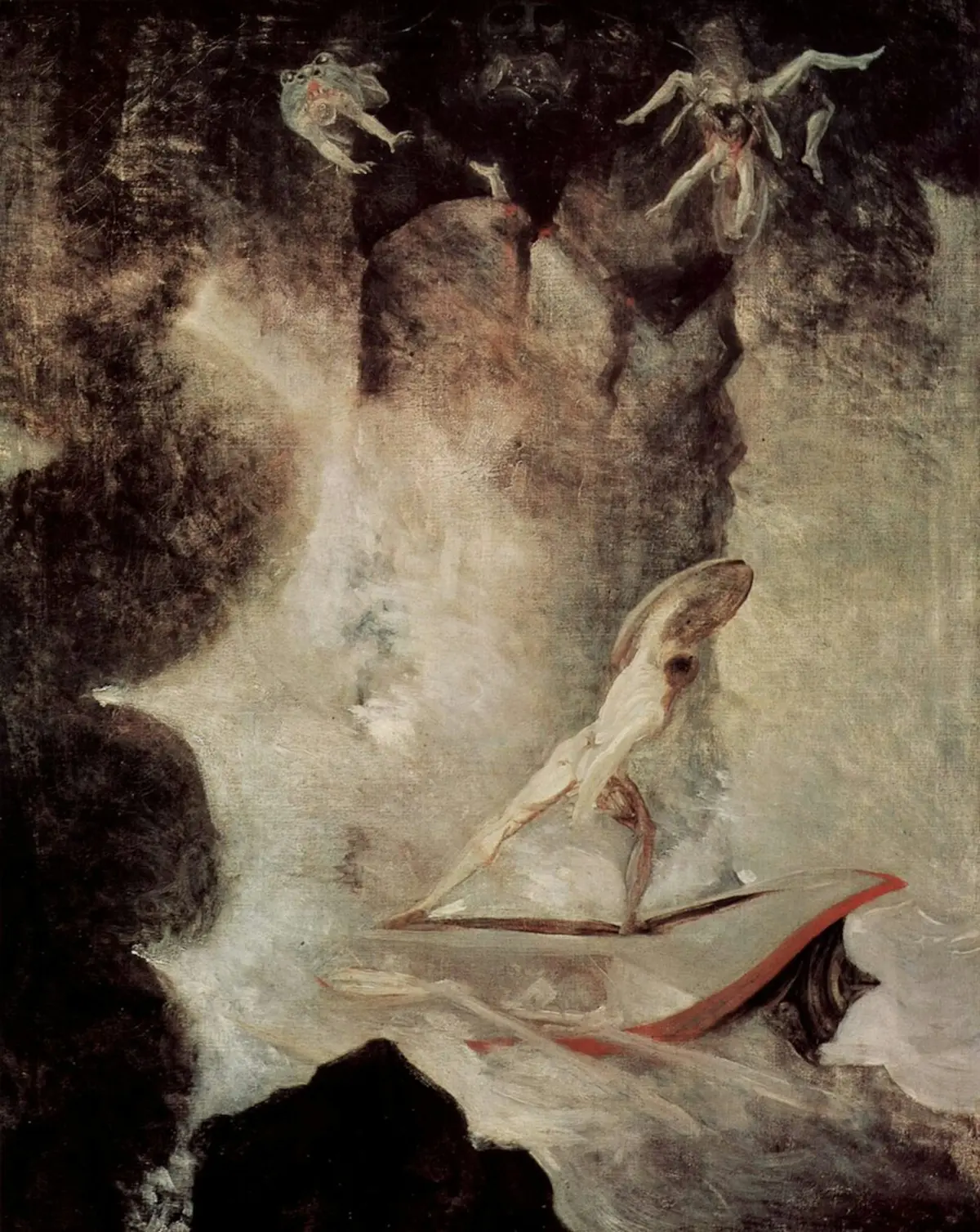
Directly across the strait from the formless void of Charybdis sits Scylla. Where Charybdis is amorphous, Scylla’s horror stems from a grotesque, hyper-physical body. Homer describes her as possessing 12 dangling feet, six extraordinarily long necks, and three rows of terrifying teeth in each of her mouths—a vivid description that eerily anticipates the cosmic, grotesque horrors found in modern weird fiction, such as the works of H.P. Lovecraft.
Yet, Scylla’s true ecohorror is realized not merely through her anatomy, but through her method of predation:
“We gazed at [Charybdis], fearing destruction, meanwhile Scylla snatched six of my comrades from the hollow of the ship, those who were the best with their hands and fighting. Looking back on the ship, I perceived only the hands and feet of my companions as they were pulled upwards… Scylla devoured them as they screamed and stretched out their hands to me in their horrid struggle.”
The speed with which the crew members are hoisted into the air creates an unforgettable, visceral scene of helplessness. The ecohorror here relies on a profound cosmic inversion: normally, human fishermen prey upon marine life, dropping lines and nets to haul creatures from the deep as commodities. Here, however, humans are reduced to mere forage. Trapped below Scylla’s cliff-side lair, the sailors become the prey, "fished up" and devoured by a superior apex predator of the marine ecosystem.
Supporting Context & Metrics: Cultural Anxieties of the Ancient Mediterranean
While no ancient Greek sailor ever encountered physical entities on the literal scale of Scylla or Charybdis, these exaggerated myths served a vital psychological function. They provided a vocabulary for the very real, statistical dangers of maritime trade and exploration in antiquity.
The Realities of Ancient Seafaring
Vessel Vulnerability: Ancient Greek ships (such as the penteconters and round merchant hulls) were primarily open-decked, single-mast vessels highly susceptible to sudden squalls, unmapped currents, and structural failure.
Navigation Limits: Lacking modern navigational instruments like the magnetic compass or sextant, sailors relied heavily on coastal landmarks, celestial observation, and seasonal weather windows (limiting major sailing primarily to the summer months).
Loss Rates: Historical and archaeological data from Mediterranean shipwrecks indicate that maritime trade, while economically essential, carried a notoriously high attrition rate. Cargo loss and shipwreck were constant economic and existential threats.
These real-world perils fertilized the cultural imagination. When sailors returned with tales of unnavigable narrows, erratic tides, and sudden storms, poets translated these environmental hazards into mythological entities. The monsters of the Odyssey thus function as cultural archives of maritime trauma, capturing the profound vulnerability of humans pitting frail wooden hulls against an indifferent, powerful sea.
Expert Insights and Literary Analysis
To better understand how these ancient motifs translate across millennia, contemporary literary critics point to the framework of ecohorror. Dr. Ryan Denson, scholar of classical reception and modern literature, emphasizes that horror genres frequently draw upon our immediate, localized anxieties about the natural world.
"Monsters in literature are rarely just about physical danger," notes academic commentary within the Rethinking the Classics series. "They are creative ‘what ifs’—imaginative extrapolations of background cultural fears. When the ancient Greeks looked at the sea, they didn’t just see a trade route; they saw a shifting, unpredictable abyss that could swallow civilization whole."
This thematic thread links the ancient Mediterranean directly to modern horror landscapes. Just as Homer transformed ocean currents into a hungry void, modern storytellers locate terror in everyday ecological phenomena. A prime contemporary parallel can be found in Silvia Moreno-Garcia’s acclaimed 2020 novel, Mexican Gothic.
In the novel, protagonist Noemí Taboada investigates a remote mansion where an aristocratic family has fallen under the psychological thrall of a sentient, parasitic fungus. While readers have never encountered a mind-controlling supernatural mold, the novel taps into a very real, visceral domestic dread: the sudden discovery of a patch of damp rot or black mold in one’s home, and the chilling realization that it is spreading unseen.
Both Homer’s Odyssey and Moreno-Garcia’s Mexican Gothic utilize ecohorror to explore the same fundamental anxiety: the horrifying realization that humanity is not the master of its environment, but rather vulnerable to an organic world that may be actively hostile, predatory, or indifferent to our survival.
Future Outlook: Re-Evaluating the Classical Canon Through an Environmental Lens
As literary studies increasingly embrace environmental humanities (including ecocriticism and blue humanities), our reading of ancient texts is undergoing a profound transformation. The classical canon—long viewed through the narrow prisms of heroism, political philosophy, and divine intervention—is now being re-evaluated through the lens of human-nature relationships.
Key Directions for Future Literary and Environmental Scholarship:
The Blue Humanities: Shifting focus from terrestrial empires to maritime spaces, scholars are examining how oceans, rivers, and weather systems act as active agents in classical literature rather than mere backdrops for human drama.
Climate and Catastrophe in Antiquity: Analyzing how ancient mythologies recorded real historical shifts in climate, seismic activity, and ecological collapse in the Mediterranean basin.
The Evolution of Ecohorror: Tracing the lineage of environmental dread from Homeric monsters and folklore straight through to contemporary cinema and speculative fiction addressing modern ecological crises.
Ultimately, revisiting works like the Odyssey reminds us that our fear of the natural world is deeply historical. Long before industrial climate change or modern ecological anxieties, ancient writers understood that the environment possesses a terrifying agency of its own. By framing the sea as a disembodied abyss and a predatory entity, Homer did more than entertain his audience—he articulated a primordial truth about the human condition: when we venture into the wild, we are always at the mercy of forces far greater than ourselves.