Executive Overview
Finding the holy grail of studio monitors—specifically, a set of three-way near-to-midfield speakers priced under £5,000—is an exercise in compromise. For decades, producers and mixing engineers have hunted for a unicorn pairing: low total harmonic distortion, extended yet disciplined bass response, expansive and uncolored midrange reproduction, and silky highs that avoid fatiguing the ears during grueling 12-hour mixing sessions. All of this must be packaged into a physical footprint that does not swallow a project studio whole. Furthermore, modern workflows demand robust room correction that is natively hosted on the speaker’s internal digital signal processing (DSP) for set-and-forget, zero-latency reliability.
Enter the Neumann KH 310 II. Priced at roughly £4,800 per pair (street) with an optional £279 investment for the MA 1 room measurement microphone kit, this updated iteration of Neumann’s legendary three-way design addresses the industry’s shifting demands. By retaining the acoustic brilliance of its predecessor while supercharging its digital architecture, onboard amplification, and workflow integration, the KH 310 II steps into the arena not merely as an update, but as a masterclass in acoustic engineering.
For engineers working across genres from intimate acoustic folk to dense K-pop and cinematic orchestrations, this monitor proves that high-end accuracy does not require an enormous footprint. However, it also raises questions about pricing models, software ecosystem lock-in, and the true cost of complete optimization.
Detailed Chronology & Evolution: What’s New in the Mark II?
To understand why the KH 310 II is generating such fervent industry buzz, one must trace its lineage. The original KH 310 established itself as an industry workhorse, celebrated for its sealed-cabinet design and astonishingly flat frequency response. Yet, as modern mixing environments migrated toward complex digital workflows and software-driven room correction, the original model began to show its structural age—specifically regarding its analog-only orientation and lack of onboard DSP.
The Hardware Re-Engineering
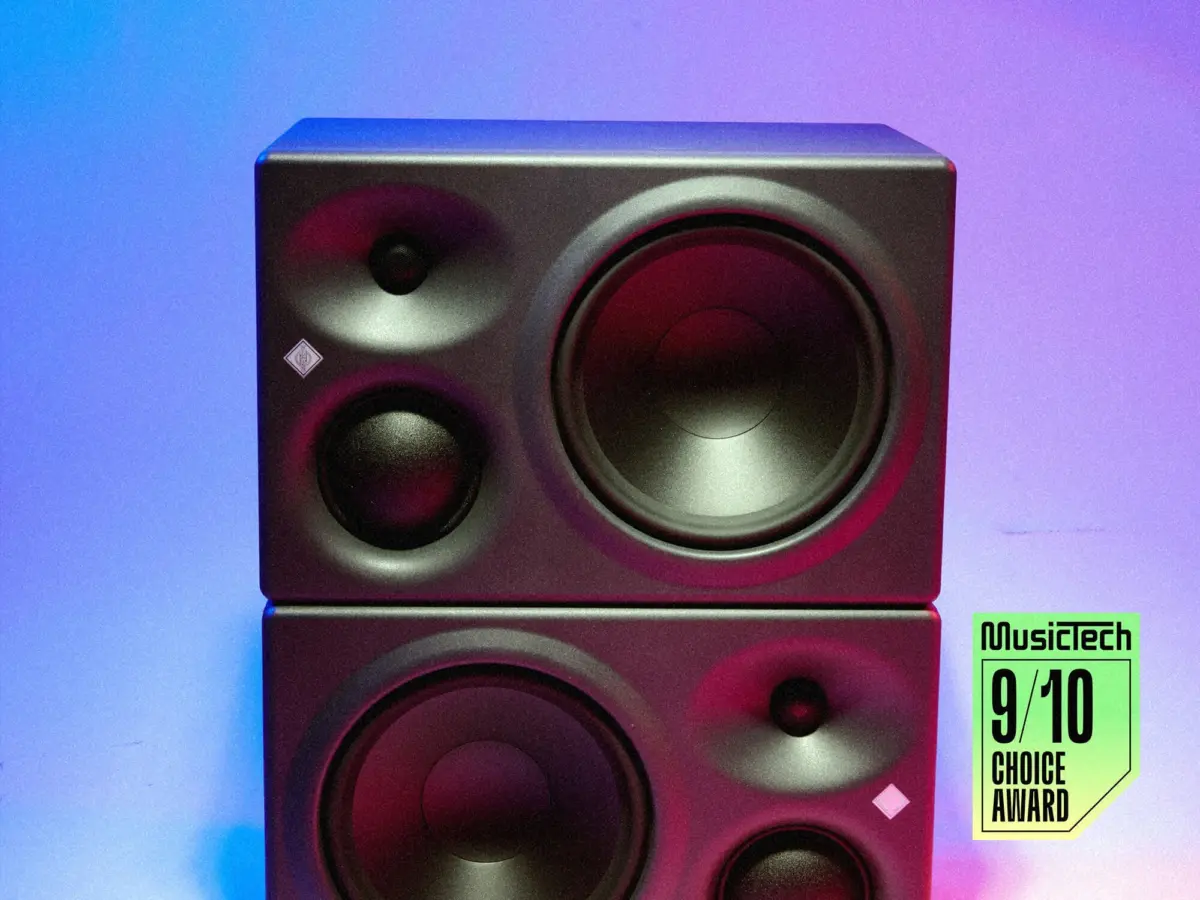
At first glance, the driver complement on the KH 310 II looks familiar. It relies on a dedicated 3-inch dome midrange driver and a 1-inch metal-dome tweeter. However, the woofer has been completely redesigned from the ground up, paired with substantially more powerful internal amplifiers.
This newfound headroom allows the speaker to push significantly higher SPLs (Sound Pressure Levels) before the onset of distortion or thermal compression. When tracking aggressive sources like live drums or brass sections, this extra headroom provides an invaluable sense of ease.
The DSP Revolution
The most transformative upgrade, however, lies beneath the hood in the digital domain. In the previous generation, KH 310 owners wishing to harness Neumann’s MA 1 alignment ecosystem were forced to route their signals through one of the brand’s high-end, DSP-equipped subwoofers.
The KH 310 II changes the game entirely by introducing onboard DSP directly into the monitors. Users can now control a pair of these speakers over a standard IP network, calculating correction filters and storing EQ profiles straight to the internal memory of the speakers.
Additionally, Neumann has incorporated a digital AES-3id input alongside the traditional balanced XLR analog inputs. This addition enables pristine, noise-free digital signal routing straight from an audio interface, complete with daisy-chaining capabilities over BNC cables to minimize studio cabling clutter.

Supporting Context & Metrics: Navigating the Sub-£5,000 Market
The sub-£5,000 three-way monitor market is fiercely competitive, populated by innovative designs that push the boundaries of price-to-performance. To truly contextualize the value proposition of the Neumann KH 310 II, it helps to examine how it stacks up against its primary market rivals.
| Monitor Model | Street Price (Per Pair) | Key Architectural Features | Room Correction & DSP Integration |
|---|---|---|---|
| Neumann KH 310 II | £4,800 | Sealed 3-way, redesigned woofer, new high-headamp amps, AES-3id + XLR | Native onboard DSP, MA 1 network integration |
| Adam Audio A8H | £2,500 | 8-inch woofer, X-ART ribbon tweeter, DSP | Integrated Sonarworks SoundID Reference |
| HEDD Audio Type 20 mk II | £3,400 | Air Motion Transformer, open/closed port options | Phase linearization DSP (no acoustic room correction) |
| Palmer Orbit 11 | £1,500 | Coaxial drivers, dual 8-inch woofers, cardioid response | Relies on third-party software (e.g., Sonarworks) |
The Competitive Landscape
- Adam Audio A8H: At nearly half the price of the Neumanns, the A8H models are aggressively priced and feature integrated Sonarworks calibration, offering immense value with their signature ribbon tweeters and punchy low end. Yet, they lack the surgical midfield imaging and tight transient snap of the Neumanns.
- HEDD Audio Type 20 mk II: Offering open and closed port options alongside phase-linearization DSP, the HEDD monitors deliver gorgeous, open soundscapes. However, they introduce noticeable processing latency and lack built-in room correction tools, requiring external workarounds.
- Palmer Orbit 11: As a budget-friendly contender featuring a cardioid response to mitigate low-frequency room build-up, the Orbit 11s are impressive. Nevertheless, their treble response can occasionally step into harsh territory, lacking the poised transparency required for critical mastering work.
Against this backdrop, the KH 310 II occupies a rarified tier. It does not chase gimmicks; instead, it refines the fundamental physics of transducer design and acoustic coupling.
Official Statements & Real-World Workflow: The MA 1 Alignment Process
While the KH 310 II can be run entirely in the analog domain with physical filter switches on the rear panel, doing so bypasses the technological leap that makes these monitors truly special. To experience their full potential, one must enter the digital ecosystem via Neumann’s MA 1 Automatic Alignment software.
Setting Up the Network
Setting up the system is surprisingly straightforward. By connecting the monitors and a host computer to a basic ethernet network switch, communication is established instantly. For users eager to maximize their audio interface’s analog I/O routing for external hardware gear, the digital AES-3id input is a godsend.
By connecting an S/PDIF output from an audio interface via a 75-Ohm RCA-to-BNC cable into the first monitor—and daisy-chaining to the second monitor with a secondary BNC cable—the entire stereo pair is fed a pristine digital stream. No advanced IT or networking knowledge is required; the hardware establishes handshake protocols seamlessly.
The Calibration Experience
While the MA 1 software provides basic utility functions out of the box (such as firmware updates, logo LED dimming, and auto-standby management), unlocking the room EQ engine requires purchasing the £279 MA 1 measurement microphone kit.
The calibration routine follows an intuitive, step-by-step guided process. The user positions the calibrated measurement microphone at various predefined coordinates and heights throughout the listening sweet spot. Once the sweep measurements are captured, the software generates a comprehensive acoustic map of the room’s anomalies.
Users can then customize their target curve—such as introducing a subtle warmth tilt with gently elevated low-end and slightly tamed high frequencies—before compiling and uploading the final corrective EQ profile directly into the monitor’s onboard DSP.
Once stored, the speakers retain this calibration independently of the host computer; the network cables can even be disconnected entirely.

Listening to the Correction
The sonic results of the MA 1 integration are nothing short of revelatory. Unlike competing systems that can overly flatten a room’s response by carving aggressively into phase and frequency domains, Neumann’s correction philosophy feels remarkably organic.
It tightens up the troublesome low-mid buildup and boundary loading native to small and medium-sized control rooms without making the sound feel brittle, thin, or anemic. The phase coherence between the hardware design and the internal DSP filter profiles creates a phantom center that feels carved out of solid granite.
Sonic Performance Analysis
To evaluate the true merit of the KH 310 II, one must subject them to a diverse gauntlet of demanding modern productions.
Pop & Multi-Layered Density: Rosé & Bruno Mars’ APT
K-pop and modern pop crossovers are notorious mixing stress-tests, packed with micro-dynamic shifts, razor-sharp transients, and dense layers of synthetic instrumentation. On APT, the KH 310 II renders the mono drum kit with striking acoustic depth, anchoring it firmly in the phantom center.
The acoustic guitars, hard-panned to opposite extremes, exhibit crystalline transient articulation without their high-mids sounding piercing or fatiguing. Because of the sealed cabinet design, the low-end elements remain punchy, agile, and devoid of port chuffing. While they will not rattle your ribcage the way an 18-inch subwoofer might, the bass translation is utterly honest, preventing muddy energy buildup in untreated corners.
Cinematic Nuance: Ólafur Arnalds’ In The Sound of Breathing
Shifting gears to cinematic neo-classical arrangements, Ólafur Arnalds’ Sages project highlights the monitors’ incredible transient speed and harmonic decay. The sonorous lead vocal placement is breathtakingly intimate.
As the low-pass filter on the underlying synth motifs gradually opens up against a backdrop of sweeping orchestral strings, the KH 310 II maintains absolute poise. The chaos of complex acoustic layers never collapses into congestion; every reverb tail and decay decay-curve breathes naturally within a vast, three-dimensional soundstage.
Retro Vibe & Complex Arrangements: Raye’s Joy
Raye’s dynamic vocal stylings paired with intricate brass arrangements and retro kick drums showcase the monitor’s masterclass midrange separation. Stacked vocal harmonies sit comfortably alongside aggressive brass swells without masking fundamental frequencies.
The low-end weight of the retro kick drum provides a realistic, "in-the-room" tactile sensation, while the micro-details of ambient delays and spatial effects are laid bare for surgical evaluation during mixing and mastering passes.

Future Outlook & Verdict
The Value Equation and Minor Grievances
Despite its near-flawless acoustic performance, the Neumann KH 310 II is not entirely immune to critique. Chief among user grievances is the financial and operational friction surrounding the MA 1 measurement kit.
At £4,800 a pair, pushing past the £5,000 threshold once the £279 microphone kit is added can be a hard pill to swallow for independent producers—especially when competing brands like IK Multimedia bundle their measurement microphones and room-correction software directly into the base price of their flagship systems.
Furthermore, the absence of a manual parametric EQ interface within the DSP limits users to the automated MA 1 target curve workflows, discouraging manual calibration tinkerers who prefer to dial in target curves by hand. Additionally, while the self-noise floor is completely imperceptible at normal working distances, an attentive ear pressed directly against the tweeter will detect a faint hiss.
Final Thoughts
Minor operational frustrations aside, the Neumann KH 310 II represents a monumental achievement in studio monitor design. They possess the muscle and SPL headroom required to impress tracking clients, alongside the surgical, uncolored transparency mandatory for precision mixing and mastering.
Contrary to conventional industry wisdom that suggests heavy-duty three-way monitors require massive acoustic spaces, the KH 310 II integrates magnificently into smaller control rooms, provided they are paired with the MA 1 alignment kit.
For engineers who have cycled through budget monitors, suffered through translation errors, and hit the performance ceilings of lesser hardware, the KH 310 II is the ultimate destination. It is the pair of monitors you will ultimately wish you had saved up for in the first place—easily claiming the crown as the premier sub-£5,000 three-way monitor on the market today.